Planning a long-term camp: the right place for weeks
If you stay in one place for weeks you need more than a sleeping spot for one night: water within reach but safely above floods, enough firewood, protection from wind and falling branches, ground that drains rain, and a toilet far from the water. First comes the landowner's permission – and the right order: a quick weather shelter first, then water and toilet, then fire and wood, and the solid hut last of all.
- 1–3 days of scouting and setting up, then ongoing
Explained simply
Imagine you are moving into the forest for a few weeks. Then you do not just pick any spot, but one where you can live well. You need water to drink, wood for the fire, a place where the wind does not blow you over, and ground on which you do not lie in water when it rains.
Just as important is what you do not want. A dead tree above your sleeping place can fall over. A stream can swell suddenly after a thunderstorm and wash your camp away. And if the toilet is too close to the water, the water gets dirty and everyone gets a tummy ache. So you look at the place carefully first, before you build anything.
Then you go step by step: first a quick roof against rain, then water point and toilet, then a safe fire site and wood – and the solid hut only at the very end. And one thing always applies: the forest belongs to someone. Ask for permission beforehand whenever you possibly can.
How it works
A long-term camp rests on four pillars: protected sleep, clean water, warmth from fire, and hygiene. For a single night you can cut corners on one of them, for weeks you cannot. Each pillar brings its own dangers, and almost all of them can be defused by choosing the site: height protects from floods, distance protects from contaminated water, sparks and falling branches.
The terrain works for or against you. At night cold air flows downhill like water and collects in hollows, so dips are colder and damper. Rain finds the lowest path; a gently sloping site with a ditch uphill stays dry. A forest edge or a bank on the weather side breaks the wind without you having to build anything.
The order of setting up follows the dangers. Cold and wet can become dangerous in a single night, thirst in a few days, hunger only after a longer time. So first comes weather protection, then water and hygiene, then fire and wood – and the solid hut only once survival until then is secured.
What really matters
Take time to scout. Walk the site, look up into the crowns, down at the ground and towards the water. You recognise flood marks by driftwood in bushes, mud lines on tree trunks and scoured banks. The camp goes well above the highest mark. If you can, watch the site for a day or two before putting a lot of work into it.
The distances are easy to remember: camp and toilet each at least about 60 metres from the water – that is around 70 big steps. The toilet is never uphill of the water point. For weeks a narrow pit works; after every use soil goes over it, and when it fills it is closed in good time and a new one dug. Water and soap for washing hands belong right next to it.
Do not underestimate firewood. A fire that burns for weeks for cooking, warmth and drying uses far more wood than you would think. A camp near enough fallen deadwood that you are allowed to take saves you long trips every day. Store a supply dry under cover before rain or snow arrive.
Safety: what to watch out for
Falling branches and toppling dead trees are among the serious dangers in the forest because they come without warning. Within at least one tree length of the sleeping place and fire nothing dead or leaning may stand. In a storm leave the forest if possible, or keep away from tall trees.
Water is the second big danger. Dry stream beds, gravel bars and valley floors can fill within minutes in heavy rain, even when the sun shines above you and it rains further up. The drinking water itself can contain germs even if it looks clear – it is always treated.
In a long-term camp the fire burns many hours a day. Keep the fire site away from the sleeping place and the wood store, clear the ground around it, keep water ready for putting it out and observe fire bans and wildfire warnings. A fire or stove inside a closed hut needs a real smoke exit, otherwise there is a risk of carbon monoxide poisoning.
When it makes sense – and when not
A well-planned long-term camp is worthwhile if you know for sure that you will stay in one place for a long time – for example on a planned stay on private land with permission, or in a situation where no help can be expected. For groups and families too, a clear order matters, because mistakes with hygiene and fire otherwise quickly affect everyone.
If you are lost or injured and people are searching for you, it is usually better to stay near the place where you are expected to be and build a simple shelter there. A big camp far away can make the search harder. In protected areas and places where camping is banned you do not camp – except in genuine danger to life.
Good to know
In Germany the Federal Forest Act allows everyone to enter the forest for recreation; anything beyond that – camping, fire, building – is regulated by the federal states, and usually the owner's permission is needed. In Austria the Forest Act explicitly states that camping and staying in the forest after dark are only permitted with the forest owner's consent. Other countries have other rules.
A simple sketch helps: draw water, sleeping place, fire, wood store, kitchen and toilet with arrows for wind and slope. That way you see at once whether smoke drifts to the sleeping place or whether the path to the toilet passes the water. And when breaking camp: fill in pits, put the fire out completely, take down structures if the owner wishes.
Step by step
Get permission
Find out who owns the land and ask permission for the camp, fire, wood and any building. Protected areas are out. In a genuine emergency build only what is necessary and make contact as soon as you can.
- 1
Get permission
Find out who owns the land and ask permission for the camp, fire, wood and any building. Protected areas are out. In a genuine emergency build only what is necessary and make contact as soon as you can.
- 2
Find water – at a distance
Choose a place from which you can reach water easily but at least about 60 metres (around 70 big steps) from the bank. Set one fixed collection point; nobody washes there. The water is always treated.
- 3
Stay above flood level
Look for flood marks: driftwood caught in bushes, mud lines on trunks, scoured banks. The camp goes well above the highest mark, not in hollows and not in dry stream beds.
- 4
Look up and around
Check every tree within one tree length: dead trees, broken hanging branches and leaning trunks rule a site out. Avoid rockfall and avalanche slopes, and ridges in thunderstorms. A forest edge or a bank on the weather side breaks the wind.
- 5
Check the wood supply
A camp for weeks uses a great deal of firewood. Check whether there is enough fallen deadwood within reach that you are allowed to take. Fetching wood costs energy – the shorter the way, the better.
- 6
Set up drainage
The site should slope gently, not lie flat in a hollow. Dig a shallow ditch uphill of the sleeping place that leads rain water around the side. Never sleep directly on the ground: insulation or a raised bed.
- 7
Toilet and hygiene
The toilet goes at least about 60 metres from water, path and camp and never uphill of the water point. For weeks a narrow pit works; cover with soil after every use and close it before it is full. Next to it: water and soap for washing hands.
- 8
Build in the right order
First a quick weather shelter (tarp or emergency shelter), then water point and toilet, then a safe fire site with water for putting it out, then a wood store under cover. Only when all that works do you start on the solid hut.
- 9
Observe and adjust
Walk through the camp after the first rain and the first storm: where does water collect? Where does the smoke go? Where does the wind come from? Better move something early than put weeks of work into a hut in the wrong place.
Common mistakes
- Camping right at the bank because the water is so close
- Building under dead trees or hanging branches
- Starting the big hut straight away and freezing on the first night
- Toilet too close to or uphill of the water point
- Building and cutting wood without permission
- Underestimating how much firewood is needed
Quick view
Materials
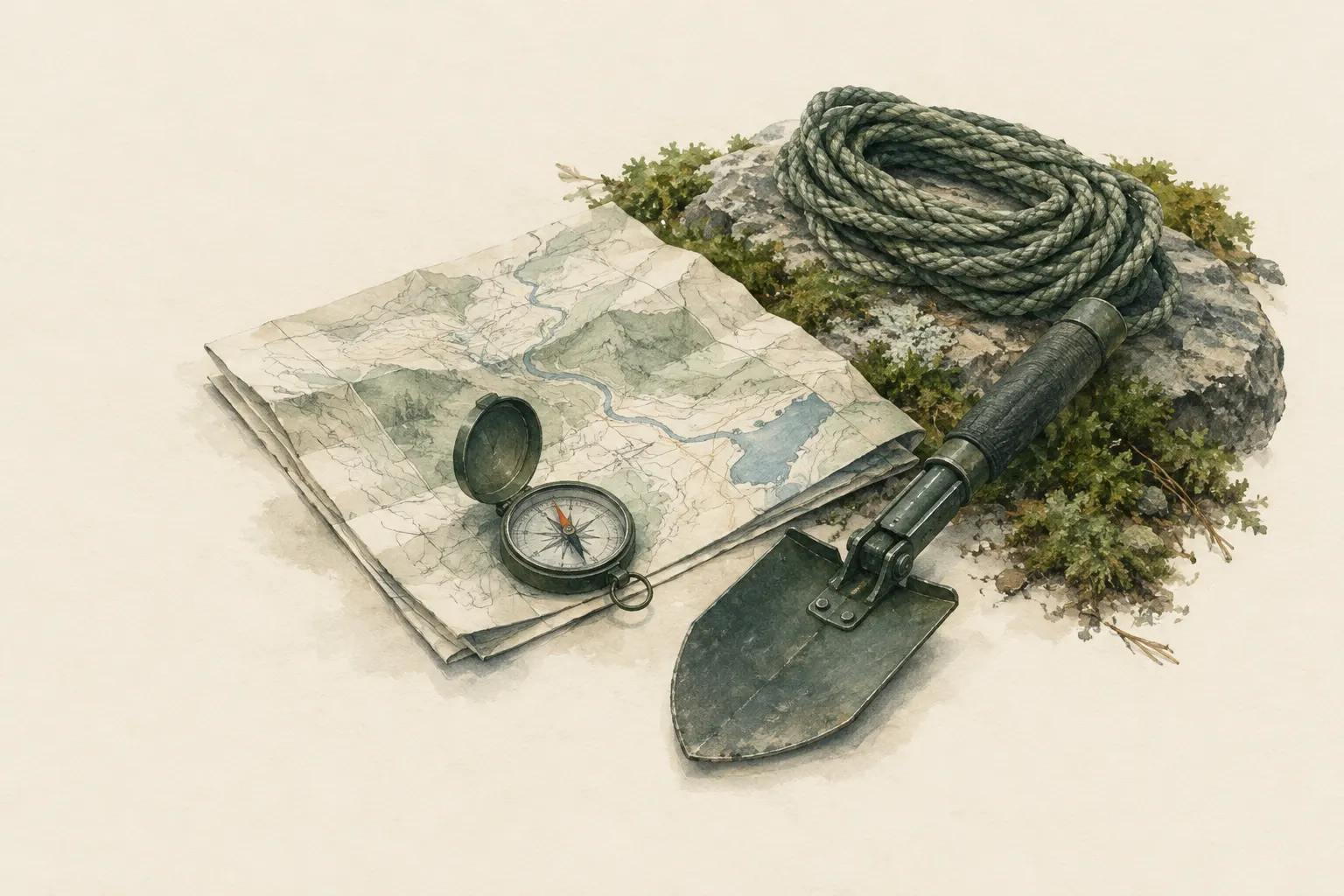
Tarp
For immediate weather protection
Small shovel / folding spade
For drainage ditch and toilet
Folding saw
Fold or cover the blade after use; saw teeth are very sharp.
Rope
Never use unknown or damaged rope for life-safety purposes.
Field notebook and pencil
Camp sketch, observations
Suitable for
- Stays of many days or weeks
- Groups and families
- Practice camps on private land with permission
Not suitable for
- A single night – normal site selection is enough then
- Protected areas and places where camping is banned
- Situations where rescuers should find you quickly and you are better off staying where the emergency happened
Prerequisites
- The landowner's permission or a genuine emergency
- Basic knowledge of shelter, fire and water treatment
- At least an emergency shelter for the first nights
Safety
- In Germany and Austria you may enter the forest, but camping, staying overnight, building and cutting wood generally need the owner's consent. In a genuine emergency your life comes first – make contact as soon as you can.
- A badly placed toilet can contaminate the drinking water and give the whole group diarrhoea. Put the toilet at least about 60 metres from water and camp and never above the water point; always treat drinking water.
How it works
A camp for weeks has to deliver four things at once: safe sleep, clean water, warmth and hygiene. Each of these pillars has its own dangers – falling branches, floods, sparks, germs. Distance and height defuse most of them, and a fixed order of setting up makes sure that what could kill you fastest – cold and wet – is dealt with first.
Advantages
- Prevents the most common serious mistakes: floods, falling branches, contaminated water
- Saves energy because routes are short and sensible
- Gives structure and safety for weeks
Disadvantages
- The ideal site rarely exists – you weigh things up
- Scouting costs time at the start
- Often not legal without permission
Deep knowledge
Background
Military survival manuals such as FM 3-05.70 repeatedly name the same points for choosing a camp: closeness to water and fuel, protection from wind and weather, and distance from hazards such as floods and dead trees. The distances of camp and toilet from water come from the Leave No Trace principles.
The order 'first shelter, then water, then fire, then food' is a well-proven rule of thumb. In the Alpine countries forestry and nature conservation laws set out what is permitted in the forest.
Variants
- Cold season
- Wood supply and wind protection come first. Avoid cold-air hollows, put the sleeping place slightly raised and get enough wood under cover early, before snow buries it.
- Hot and dry areas
- Shade and water matter more than wood. Fire only where permitted and safe – wildfire risk. Never camp in dry stream beds: flash floods.
- Group
- Share out tasks (water, wood, kitchen, hygiene), sketch a camp plan and agree fixed rules for toilet, hand washing and fire.
Common mistakes
- Camping right at the bank because the water is so close
- Building under dead trees or hanging branches
- Starting the big hut straight away and freezing on the first night
- Toilet too close to or uphill of the water point
- Building and cutting wood without permission
- Underestimating how much firewood is needed
Limits and risks
- Not legal advice – rules differ by country and region
- No figures for firewood quantities for given periods
- Does not replace water treatment
Material alternatives
Derived from material properties: a substitute must have all relevant properties. Observe the notes on the substitute.
- Tarp
- Plastic sheet / large bin bag (Tears easily; never pull over the head (suffocation risk).), Emergency blanket (Tears easily once punctured; short-term shelter only.), Document folder (waterproof) (Store securely – contains sensitive personal data.), Rain poncho (When used as a shelter, it no longer protects your body from rain.), Bivy bag (Never fully close off the face.), Tent (Do not cook or heat inside the tent (fire and carbon monoxide danger).), Heavy-duty bin bag (large) (Suffocation risk: never pull plastic bags over the head or face and keep them away from small children.), Group shelter bag (Airtight – ventilate regularly.)
- Rope
- Paracord (Not a climbing or safety rope.), Thin, soft wire (brass or galvanised steel) (Wire ends are sharp – protect eyes and fingers when bending), Tow rope or tow strap (Attach only to the towing eyes provided by the manufacturer; never stand next to it under load.)
Results come exclusively from structured entries. No improvised instructions are generated.
Sources
Headquarters, Department of the Army (USA) (2002): FM 3-05.70 Survival
Criteria for choosing a camp: water, fuel, protection, avoiding hazards
Leave No Trace Center for Outdoor Ethics: The Seven Principles of Leave No Trace (Principle 5: Minimize Campfire Impacts)
Camp and toilet about 60 m (200 feet) from water
Headquarters, Department of the Army (USA) (2000): FM 21-10 Field Hygiene and Sanitation
Latrines away from and downhill of water, cover daily, close in time, hand washing
Republik Österreich – Rechtsinformationssystem des Bundes (RIS) (1975): Forstgesetz 1975 (BGBl. Nr. 440/1975), § 33 Benützung des Waldes zu Erholungszwecken
Austria: camping and staying overnight in the forest only with the owner's consent
Bundesrepublik Deutschland – Bundesministerium der Justiz (1975): Gesetz zur Erhaltung des Waldes und zur Förderung der Forstwirtschaft (Bundeswaldgesetz), § 14 Betreten des Waldes
Germany: right to enter the forest for recreation; further rules set by the federal states