Lashing a carrying frame from poles
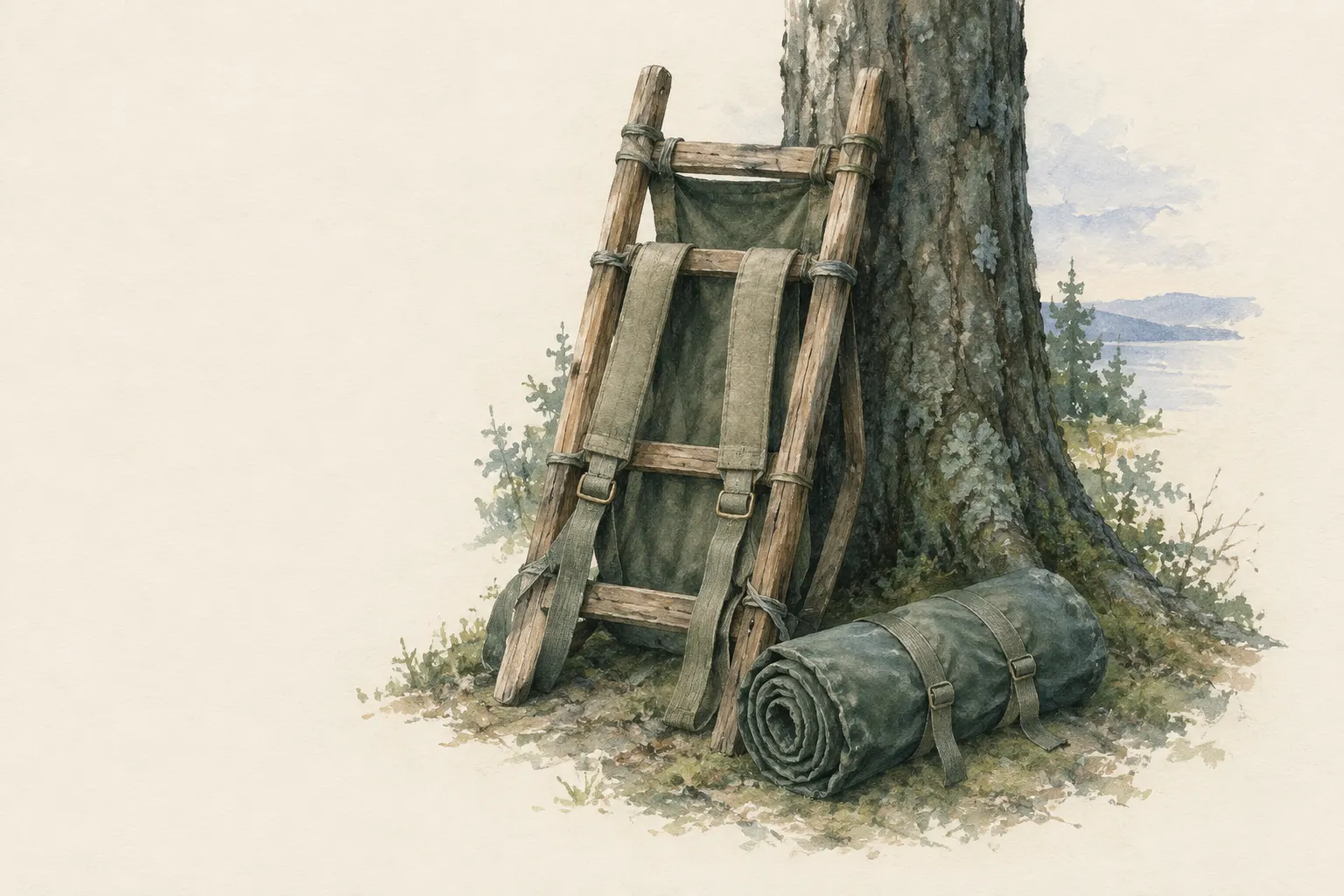
When your rucksack is broken or you have to carry something bulky – firewood, a water container, a rolled tarp – a carrying frame helps: two long poles, three cross bars, firmly lashed, plus wide shoulder straps. The load sits close to your back and is tied down with cord. It is built from deadwood or poles cut with permission.
- About 1 hour
Explained simply
Imagine you have to carry a big water container or a bundle of wood, but your rucksack is broken. In your arms it quickly gets heavy and awkward. A carrying frame helps: a frame of poles that you wear on your back like a rucksack.
You lash two long poles and three short cross bars together into a kind of ladder. A diagonal pole makes everything stable. Then come wide straps made of webbing, a belt or cloth. You tie the load firmly to the frame, close to your back.
It is important not to load too much and to put the heavy things in the middle. Thin cord as straps cuts into your shoulders – always use something wide. And you take poles only from deadwood or with permission.
How it works
A loose load swings back and forth as you walk. You have to balance every movement with muscle power, and that is tiring. A rigid frame keeps the load still and transfers its weight evenly to shoulders and back. You walk more upright and save energy.
The closer a load sits to the body, the less it pulls you backwards. That is why you pack heavy things directly against the frame and roughly in the middle, light things outside and on top. That keeps the centre of gravity close to your own.
A rectangle of four poles can rack into a diamond when the lashings give way. A diagonal pole divides the rectangle into two triangles – and triangles do not deform. That is why the diagonal is so important.
What really matters
The poles must be sound. Bend each one hard before you use it: if it cracks, is soft or full of splits, take another. The long poles are about as long as your back from neck to tailbone plus a hand's width, the cross bars about as wide as your shoulders.
The lashings hold through friction and tension. A square lashing consists of a clove hitch, three to four tight wraps and frapping turns between the poles that pull everything together. Without frapping turns, lashings quickly loosen under load.
The straps decide how comfortable it is. Wide webbing, a belt or a folded cloth spread the pressure. Pad them with clothing. The bottom cross bar should sit at hip height so the frame does not knock against your legs.
Safety: what to watch out for
A load that is too heavy is the biggest danger. It throws you off balance, especially downhill and on slippery ground, and strains back and knees. Better to make two trips than one overloaded one. When picking it up, stand up from the legs, do not lift with a rounded back and do not twist under load.
Test the finished frame empty first, then with a little weight, and only after that fully loaded. A pole that breaks on the way can make you fall. Check the lashings at every rest and tighten them.
Tingling or numb arms mean that the straps are pressing on nerves or blood vessels. Then take it off at once, add padding or make the straps wider. Carrying on with numb arms is not an option.
When it makes sense – and when not
A carrying frame is good for bulky things that fit in no rucksack: firewood, water containers, a rolled tarp, a box. A broken rucksack can also be tied onto it and kept in use. In a base camp it saves many trips.
It is unsuitable for climbing sections, rock and very steep terrain – it sticks out a long way and can catch. If you have a good, well-fitting rucksack, that is almost always more comfortable. The frame is a solution for special loads or broken equipment.
Good to know
In the Alps such frames are called a Kraxe. In the past people carried wood, hay, cheese and goods over the mountains on them. Some had a small board at the bottom on which the load stood.
The A-frame is a variant: two poles are tied together at the top and spread at the bottom, with a cross bar at hip height. It is very stable and good for long bundles.
When you dismantle it, you remove all the cord and scatter the poles in the forest again. Natural cord rots, paracord does not – none of it may be left behind.
Step by step
Choose the poles
Two straight, sound poles about one to two thumbs thick, as long as your back from neck to tailbone plus a hand's width. Also three cross bars about as long as your shoulder width and one diagonal pole. Only deadwood or wood cut with permission.
- 1
Choose the poles
Two straight, sound poles about one to two thumbs thick, as long as your back from neck to tailbone plus a hand's width. Also three cross bars about as long as your shoulder width and one diagonal pole. Only deadwood or wood cut with permission.
- 2
Lay out and fit
Lay the long poles parallel on the ground at shoulder width. Place cross bars at the top, middle and bottom. Hold the frame against your back: the bottom cross bar should sit at about hip height, the top one just below the neck.
- 3
Lash the corners
Join each crossing with a square lashing: clove hitch on the long pole, three to four wraps, then frapping turns between the poles, finished with a clove hitch.
- 4
Brace diagonally
Lash the diagonal pole from one top corner to the opposite bottom corner with diagonal lashings. Now the frame must no longer rack when you push it.
- 5
Fit wide straps
Fasten two wide straps – webbing, a belt or folded cloth – to the top cross bar, run them over the shoulders and tie them to the bottom corners. Pad them with clothing or moss inside a piece of cloth.
- 6
Pack the load correctly
Put heavy things close to the frame and roughly in the middle, light things outside and on top. Wrap the load in a tarp and lash it tightly to the frame with cord in a zigzag so nothing wobbles.
- 7
Test carry
First walk a few steps on level ground. If a pole presses, the load slips or your arms tingle, take it off and adjust. Tighten the lashings.
- 8
Carry safely and dismantle
Walk calmly, take frequent short rests and stand the frame against a tree instead of dropping it. At the destination remove all cord and scatter the wood, or burn it where fire is permitted.
Common mistakes
- Using rotten poles
- No diagonal brace – the frame racks
- Thin cord as shoulder straps
- Packing heavy things on top and far from the back
- Not tying the load down so it swings
Quick view
Materials
Sturdy sticks / poles
Two straight poles about back length, three shorter cross bars, all sound
Do not cut live wood where prohibited.
Paracord
For lashings and tying down
Not a climbing or safety rope.
Webbing (tubular webbing)
Or a belt, cloth or bag straps as wide straps
Inspect knotted webbing before every use.
UV light and abrasion age webbing; do not load damaged webbing.
Folding saw
Fold or cover the blade after use; saw teeth are very sharp.
Tarp
To wrap the load
Suitable for
- Bulky or heavy loads over short to medium distances
- A replacement for a broken rucksack
- Carrying wood and water in a base camp
Not suitable for
- Via ferratas, rock and very steep terrain
- Loads you cannot carry safely
- Long trips when a good rucksack is available
Prerequisites
- Able to tie square lashing, diagonal lashing and clove hitch reliably
- Deadwood or permission to cut poles
Safety
- A load that is too heavy or stacked too high throws you off balance and strains back and knees. Better to make two trips. Stand up from the legs with a straight back; to put it on, have someone help, or sit down in front of the frame leaning against a trunk.
- Rotten poles break suddenly under load. Bend and check every pole before lashing; test the finished frame empty first, then with gradually increasing load.
- Thin cord as straps cuts into the shoulders and presses on nerves. Always use wide straps or pad them; take the frame off if your arms tingle or go numb.
How it works
A rigid frame transfers the weight of the load evenly onto shoulders and back, instead of letting it swing around. The closer the load sits to your back and the more central it is, the less it pulls you backwards. A diagonal brace stops the rectangle of poles from racking into a diamond.
Advantages
- Carries bulky loads that fit in no rucksack
- Needs only poles and cord
- Hands stay free
Disadvantages
- Less comfortable than a good rucksack
- Lashings need retightening
- Needs suitable wood
Deep knowledge
Background
Wooden carrying frames – known in the Alps as a Kraxe – were long used to carry wood, hay and goods over mountains. The US Army manual FM 3-05.70 describes improvised packs, and scout handbooks the lashings they need.
If your rucksack is broken, you can often tie it onto such a frame and keep using it.
Variants
- A-frame
- Two poles tied together above the head and spread at the bottom, with a cross bar at hip height – this gives a very stable triangle on which long bundles are easy to tie. The straps run from the apex to the cross bar.
- Tumpline
- A wide strap across the forehead takes part of the load when leaning slightly forward. Use only briefly and with strong neck muscles.
Common mistakes
- Using rotten poles
- No diagonal brace – the frame racks
- Thin cord as shoulder straps
- Packing heavy things on top and far from the back
- Not tying the load down so it swings
Limits and risks
- No load or weight figures
- No medical advice on back problems
Material alternatives
Derived from material properties: a substitute must have all relevant properties. Observe the notes on the substitute.
- Paracord
- Rope (Never use unknown or damaged rope for life-safety purposes.), Thin, soft wire (brass or galvanised steel) (Wire ends are sharp – protect eyes and fingers when bending), Tow rope or tow strap (Attach only to the towing eyes provided by the manufacturer; never stand next to it under load.)
- Webbing (tubular webbing)
- Rope (Never use unknown or damaged rope for life-safety purposes.), Paracord (Not a climbing or safety rope.), Thin twine (Low breaking strength – light loads only.), Accessory cord (Use only certified cord after training for life-safety purposes.), Jute or sisal twine (bought) (Low strength, absorbs water and rots – light loads and practice only.), Tree straps (Load only within the manufacturer's limits.), Monofilament fishing line (Never leave scraps of line behind: birds and other animals get tangled in them and die slowly. Wind up scraps and take them with you.), Thin, soft wire (brass or galvanised steel) (Wire ends are sharp – protect eyes and fingers when bending), Tow rope or tow strap (Attach only to the towing eyes provided by the manufacturer; never stand next to it under load.)
- Tarp
- Plastic sheet / large bin bag (Tears easily; never pull over the head (suffocation risk).), Emergency blanket (Tears easily once punctured; short-term shelter only.), Document folder (waterproof) (Store securely – contains sensitive personal data.), Rain poncho (When used as a shelter, it no longer protects your body from rain.), Bivy bag (Never fully close off the face.), Tent (Do not cook or heat inside the tent (fire and carbon monoxide danger).), Heavy-duty bin bag (large) (Suffocation risk: never pull plastic bags over the head or face and keep them away from small children.), Group shelter bag (Airtight – ventilate regularly.)
Results come exclusively from structured entries. No improvised instructions are generated.
Sources
Headquarters, Department of the Army (USA) (2002): FM 3-05.70 Survival
Improvised packs and carrying frames
Boy Scouts of America: Scouts BSA Handbook
Square and diagonal lashings
Mors L. Kochanski – Lone Pine Publishing: Bushcraft: Outdoor Skills and Wilderness Survival
Carrying loads in the field
Leave No Trace Center for Outdoor Ethics: The Seven Principles of Leave No Trace (Principle 5: Minimize Campfire Impacts)
Leave what you find