A walking staff: choosing, sizing and using it safely
A good staff is an extra support: it takes strain off the knees downhill, gives grip on slippery ground and lets you probe mud, snow and puddles before stepping into them. In a stream crossing it forms a stable triangle with your legs. But it does not measure ice thickness and does not make a dangerous river safe.
- Choosing and sizing about 30 minutes
Explained simply
A walking staff is like a third leg. When you walk downhill, you lean on it, and your knees get less tired. On slippery ground it gives you grip. And you can use it to check whether the ground in front of you is firm before you step on it.
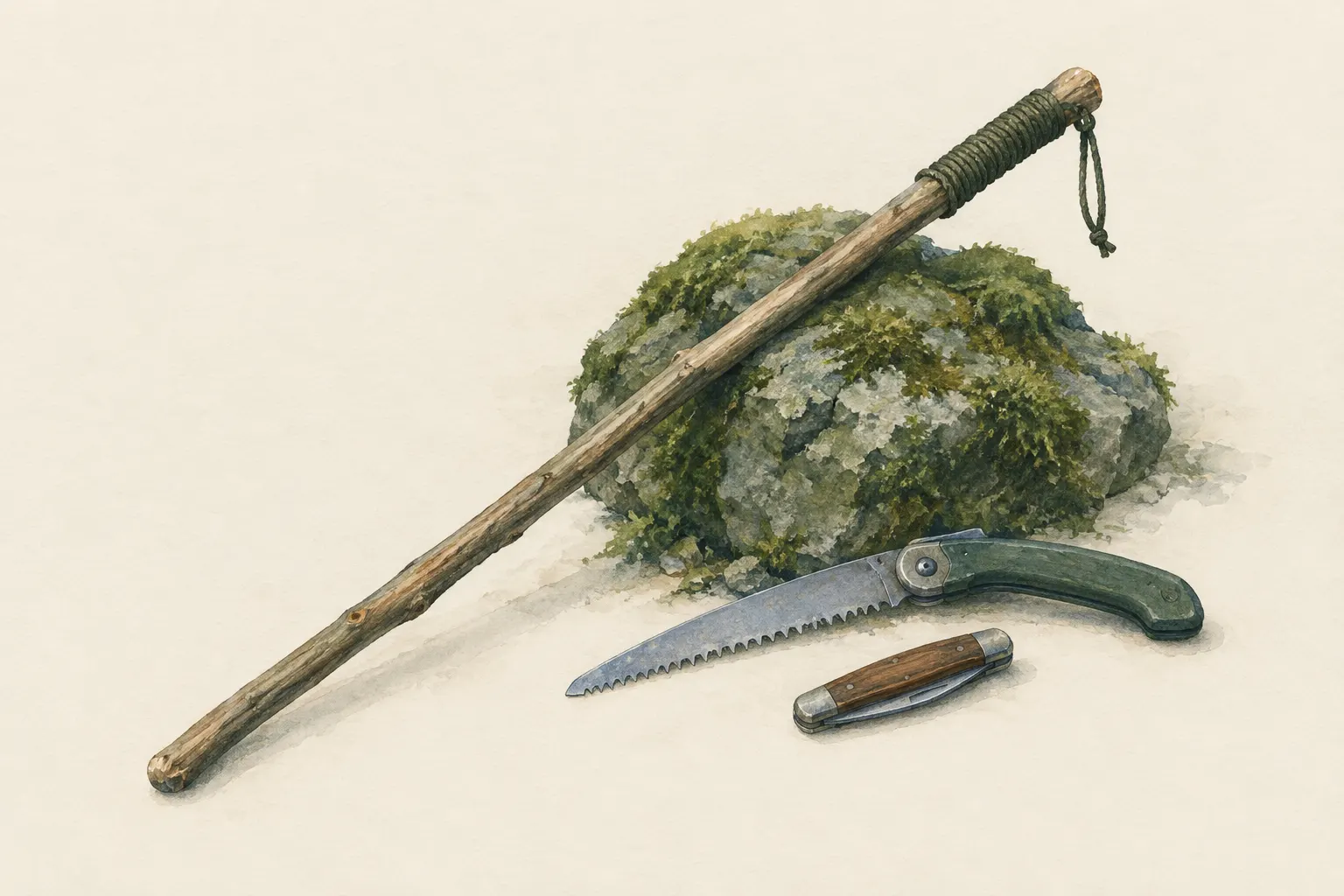
A good staff is straight, strong and reaches about up to your shoulder. You find it among deadwood, saw it to length and carve the stubs of branches smooth. In front of a muddy puddle or a snowfield you push it in first: if it sinks in deep, you go around.
But a staff cannot do everything. It does not tell you whether ice will hold – you only go on ice when it has been officially opened. And it does not make a fast, deep stream safe. Then the rule is: better to turn back.
How it works
When you stand on two legs, only two points touch the ground. Even a small push can knock you over. With a staff you have three points, and these form a triangle. A triangle is much more stable than a line – that is why a stool usually has three legs.
Downhill you have to brake your weight with every step, and that is carried mainly by the knees. If you plant the staff ahead of you and lean on it lightly, it takes over part of this braking work. Uphill you can push yourself up with it.
The staff also extends your arm. Through it you can feel whether the ground is hard, soft, hollow or slippery. That way you detect deep mud, holes under snow or leaves and deep spots at the edge of a puddle before you shift your weight onto them.
What really matters
The wood must be straight and sound. Hazel and ash often grow nicely straight and are tough. Bend the staff hard with both hands before taking it: it should spring back, not crack. Rotten, soft or cracked spots rule it out.
A length up to about the shoulder is versatile. You grip it lower uphill and higher downhill. This length is good for probing and stream crossings. The thickness should fit comfortably in your hand, about 3 cm.
Carve branch stubs smooth and lightly chamfer the bottom edge all round – that way the end splinters less. A cord wrap in the grip area improves your hold. Leave out a wrist loop, because in water or in a fall it can trap you.
Safety: what to watch out for
Flowing water is much stronger than it looks. Even knee-deep, fast current can knock an adult over. Cross only if it is really necessary and the water is slow, clear and at most knee deep. Not when the water is rising after rain, and not above waterfalls, weirs or fallen trees. Open the hip belt so you can throw off the rucksack.
Ice cannot be tested reliably with a staff. Its thickness changes from spot to spot, especially at banks, inflows and reeds. You only walk on natural ice when it has been opened by the authorities. If someone falls through, do not run over to them; call 112 and reach out the staff or a branch from the safe bank while lying flat.
A cracked staff breaks at exactly the moment you lean on it. Check it before every trip. A staff also sometimes gives a false sense of security – it replaces neither an avalanche probe nor safety equipment.
When it makes sense – and when not
A staff helps on uneven forest paths, in muddy spots, on snow, in easy stream crossings and when walking downhill. For children and older people it can give a lot of security. It costs nothing and is quickly made.
It does not help against dangers it cannot detect: ice thickness, avalanches, raging rivers. For long trips two trekking poles are often more comfortable, because they relieve both sides evenly.
Good to know
When fording, you stand diagonally facing the current, plant the staff upstream and move only one point at a time: first the staff, then one foot, then the other. That way you always have two firm points on the ground.
Groups can line up one behind the other and cross together. This is best learned in a course or under the guidance of experienced people.
Store your staff dry and check it regularly. A hazel staff can last many years if looked after well.
Step by step
Choose the wood
Look for a straight, sound staff without cracks and without soft, rotten spots – for example hazel or ash, from deadwood or cut with permission. Bend the staff hard with both hands: it should spring back, not crack.
- 1
Choose the wood
Look for a straight, sound staff without cracks and without soft, rotten spots – for example hazel or ash, from deadwood or cut with permission. Bend the staff hard with both hands: it should spring back, not crack.
- 2
Fit length and thickness
A staff about shoulder height is versatile: long enough for probing and stream crossings, and you can grip it higher or lower depending on the terrain. A thickness you can grip comfortably, about 3 cm, is good. Saw it to length.
- 3
Prepare it
Carve knots smooth so nothing presses into your hand. Lightly chamfer the bottom edge all round so the end splinters less. For a better grip you can wrap cord around the grip area – but without a wrist loop.
Carve away from your body.
- 4
Walk uphill and downhill
Uphill, grip the staff lower down and plant it beside you. Downhill, grip it higher, plant the staff ahead of you and lean on it lightly – this takes strain off the knees. On slippery ground, plant the staff first, then the foot.
- 5
Probe the ground
Before mud, snowfields, leaf piles and puddles, push the staff into the ground ahead of you. If it sinks in deep easily or meets nothing, do not go on but look for another way.
- 6
Ice: avoid it, don't test it
Ice cannot be tested reliably with a staff. Walk on natural ice only when it has been officially opened. If someone falls through, stay on the bank, call 112 and reach the staff across while lying down.
Never run onto the ice yourself to help.
- 7
Cross shallow streams
Cross only if it is necessary and the water is slow, clear and at most knee deep. Open the hip belt, keep your shoes on. Stand facing diagonally upstream, plant the staff upstream and move only one point at a time: staff, foot, foot.
If in doubt, do not cross.
- 8
Look after it and replace it
After every trip check for cracks and splinters and store it dry. Replace a cracked staff at once.
Common mistakes
- Wading with a wrist loop
- "Testing" ice with the staff and then walking on it
- Crossing when the water is rising or murky
- Using rotten wood
- Carrying the staff as a toy without using it
Quick view
Materials
Sturdy sticks / poles
One straight, sound staff about shoulder height
Do not cut live wood where prohibited.
Folding saw
Fold or cover the blade after use; saw teeth are very sharp.
Knife (fixed or locking blade)
Cut away from your body.
Rules on carrying knives differ by region – check local rules.
Trekking poles
A good alternative if available
Suitable for
- Walking on uneven, slippery or muddy ground
- Probing snow, mud and murky water at the edge
- Shallow, slow stream crossings when they are necessary
Not suitable for
- Testing ice thickness or walking onto ice
- Fast, deep or murky rivers
- A replacement for an avalanche probe or safety equipment
- Climbing or as a lever for heavy loads
Prerequisites
- Deadwood or permission to cut a pole
- Safe handling of saw and knife
Safety
- A cracked or rotten staff breaks exactly when you lean on it. Check it for cracks before each use and never shift your whole weight onto an old staff.
How it works
With the staff you have three points of support instead of two. Three points form a triangle, and a triangle tips over much less easily than a line. The staff also extends your arm: you can feel whether the ground in front of you is firm before you shift your weight onto it.
Advantages
- More balance and less strain on the knees
- Detects soft ground before stepping in
- Costs nothing
Disadvantages
- One hand is occupied
- Heavier than a trekking pole
- Can give a false sense of security
Deep knowledge
Background
The walking staff is one of humanity's oldest aids. Mountaineering textbooks such as "Mountaineering: The Freedom of the Hills" describe how a pole is planted upstream as a third point of support when fording.
The ice rules of the DLRG (German Life Saving Association) are clear: only walk on natural ice when it has been opened, and in case of a break-through help from the bank with a branch, pole or ladder.
Variants
- Trekking poles
- Two trekking poles give more even relief on long trips. When crossing water, take off the loops here too.
- Crossing in twos or threes
- Several people can line up one behind the other facing the current and cross together. This belongs in a training course or under the guidance of experienced people.
Common mistakes
- Wading with a wrist loop
- "Testing" ice with the staff and then walking on it
- Crossing when the water is rising or murky
- Using rotten wood
- Carrying the staff as a toy without using it
Limits and risks
- No training in fording rivers
- No ice rescue beyond reaching from the bank
- No avalanche knowledge
Material alternatives
Derived from material properties: a substitute must have all relevant properties. Observe the notes on the substitute.
- Trekking poles
- Sturdy sticks / poles (Do not cut live wood where prohibited.), Tent pole repair sleeve (Temporary only – have broken sections replaced at home.), Round logs (straight, sound) (Fell or take only with the forest owner's permission.)
Results come exclusively from structured entries. No improvised instructions are generated.
Sources
The Mountaineers Books (2017): Mountaineering: The Freedom of the Hills, 9th edition
Fording with a pole as third point of support, dangers of flowing water
Deutsche Lebens-Rettungs-Gesellschaft e. V. (DLRG): Eisregeln der DLRG
Walk on ice only when opened; rescue from the bank with aids
Wilderness & Environmental Medicine (Wilderness Medical Society) (2019): Wilderness Medical Society Clinical Practice Guidelines for the Treatment and Prevention of Drowning: 2019 Update
Drowning prevention, dangers of current
Headquarters, Department of the Army (USA) (2002): FM 3-05.70 Survival
Water crossings and aids