Which wood for what? Choosing native woods
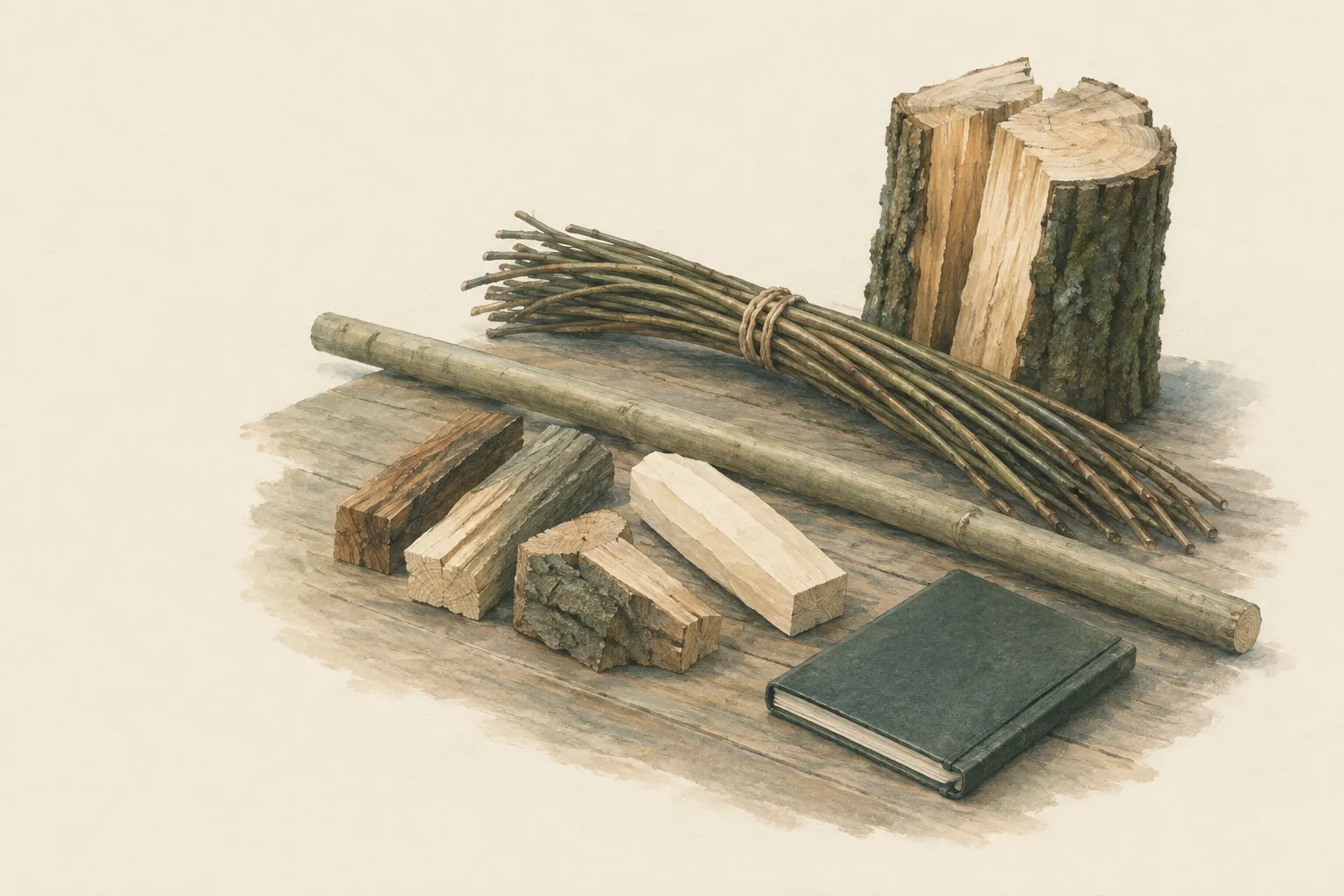
Every wood has its strengths: ash is tough and springy for handles, hazel grows in straight poles, willow bends for weaving, spruce and pine catch fire quickly, beech and oak give long-lasting embers, lime carves softly and cleanly. For anything that touches food, yew and laburnum are off limits, as is unknown or treated wood.
- Basic knowledge in a day, experience over many projects
Explained simply
Not all wood is the same. Some is soft and easy to carve, some is tough and does not break, some bends like rubber, and some bursts into flames at once. If you know which wood suits what, your projects succeed much more easily.
A little memory list: ash for handles, hazel for straight poles, willow for weaving, spruce and pine for lighting fires, beech and oak for long-lasting embers, lime for carving. With birch, alder and maple you can make good spoons and bowls.
Two trees you remember as hands-off: yew and laburnum. They are poisonous. You never make spoons, skewers or roasting sticks from their wood. And wood you do not know for sure, or that is painted, does not go near your food either.
How it works
Wood consists of long cells that run up the trunk like little tubes. How densely these tubes are packed determines how heavy and hard a wood is. Dense woods such as beech and oak contain a lot of mass in little space – they burn for a long time and give strong embers.
Softwoods such as spruce and pine contain resin. Resin burns very easily, so these woods catch fire quickly. At the same time small pockets of resin burst when heated – the wood crackles and throws sparks. That is great for lighting a fire, less so for calm cooking.
Whether a wood is tough or brittle depends on the length and direction of its fibres. Ash has long, tough fibres and springs back from blows – that is why it was the classic wood for axe handles. Lime has fine, even fibres without hard growth rings; the knife glides cleanly through it.
What really matters
It starts with the question: what do I want to make? For a fire you first need something that burns quickly, then something that lasts. For a spoon you need fine, non-toxic wood. For a handle, tough, straight-grown wood without knots in the grip. For weaving, flexible young rods.
Then you must identify the tree reliably. Always look at several features: bark, leaf or needle, fruit and growth form. A single feature can mislead – yew and fir, for example, both have flat needles. The entry "Recognising important trees" helps with this.
Check every piece before using it. Sound wood sounds bright when tapped, is firm and springs back when bent. Rotten wood sounds dull, is soft, spongy or has fungus. For fire the wood must be dry; for carving, fresh wood is often more pleasant.
Safety: what to watch out for
Yew and laburnum are highly poisonous. You recognise yew by flat, pointed needles without white stripes underneath, red seed cups and red-brown, flaking bark. Laburnum has long, hanging clusters of yellow flowers in early summer and later pods like peas. Nothing from either goes near food or into your mouth.
With unknown wood the rule is also: if in doubt, not for food vessels, skewers or roasting sticks. Painted, impregnated or glued wood – such as pallets, boards or fence posts – belongs neither near food nor in the campfire, because toxic substances can form when it burns. If you suspect poisoning, call 112, in Austria also 144, or a poison information centre.
Many ash trees have died from ash dieback. Dead ash trees quickly become brittle, drop branches or fall over completely. Never work or camp beneath dead trees. And with softwood on the fire: keep your distance, because sparks fly far.
When it makes sense – and when not
Knowing wood species pays off in every forest project: lighting fires, carving, building and weaving. It saves time because you search on purpose, and it makes your pieces last longer. In a group, everyone can collect the right wood for one task.
But it does not replace reliable tree identification, and it applies only to Central Europe. Other countries have other species, including other poisonous ones. And you may not take wood everywhere – deadwood only where permitted, fresh wood only with the owner's permission.
Good to know
In the past every craft had its favourite woods: wheelwrights built wheels and handles from ash, basket makers worked with willow, carvers and turners with lime. This old knowledge helps you in camp today.
Green, fresh wood is soft and flexible but shrinks and cracks as it dries. That is why spoons are often carved fresh and then dried slowly. Firewood, by contrast, must be dry, or it smokes heavily and gives little heat.
A small cheat sheet in your pocket helps with learning. Add what you observe yourself – how a wood smells, how it carves, how it burns.
Step by step
Clarify the task first
Ask yourself: do I want to carve, build, weave, make a handle or a fire? A different wood suits each task. Write down the task before you start collecting.
- 1
Clarify the task first
Ask yourself: do I want to carve, build, weave, make a handle or a fire? A different wood suits each task. Write down the task before you start collecting.
- 2
Identify the tree and check the rules
Identify the species reliably by several features – bark, leaf or needle, fruit, growth form. Collect deadwood only where permitted; cut fresh wood only with the owner's permission.
- 3
Wood for the fire
For lighting, use thin, dry spruce or pine and fatwood – it catches quickly but throws sparks. For long heat and cooking embers add dry beech, oak or birch. Good firewood is dry and breaks with a sharp crack.
- 4
Wood for carving and food vessels
Lime is soft and even – ideal for learning. Birch, alder, maple and hazel are good for spoons and bowls. Fresh wood carves more easily than dry; let the finished piece dry slowly.
- 5
Exclude poisonous woods
Never use yew (flat needles without white stripes, red seed cups, red-brown bark) or laburnum (hanging yellow flower clusters, pea-like pods) for food vessels, skewers or roasting sticks. Likewise no unknown, painted or treated wood.
If in doubt: keep it away from food.
- 6
Wood for handles and tools
Ash is tough and springy – the classic wood for axe and tool handles. For mallets and wedges, dense woods such as beech, hornbeam or oak are suitable. The wood must have grown straight and be free of knots in the grip area.
- 7
Wood for poles, rods and bindings
Hazel sends up straight poles – good for pegs, staffs and frames. Spruce poles are light and long. One-year willow rods bend for weaving, and lime bast provides fibre for cord.
- 8
Test the wood before use
Bend, tap and look at every piece: if it sounds dull, is soft, spongy or has fungus, it is rotten. For load-bearing parts, handles and staffs take only sound wood without cracks.
Common mistakes
- Cutting roasting sticks from unknown shrubs
- Mistaking yew for fir
- Cooking only with softwood – many sparks, few embers
- Using rotten wood for handles or load-bearing parts
- Cutting fresh wood from living trees without permission
Quick view
Materials
Knife (fixed or locking blade)
Cut away from your body.
Rules on carrying knives differ by region – check local rules.
Folding saw
Fold or cover the blade after use; saw teeth are very sharp.
Field notebook and pencil
To note how each wood behaves
Suitable for
- Planning carving, building and fire projects
- Central European forests and gardens
- Groups collecting wood for different tasks
Not suitable for
- Identifying trees by a single feature
- Other floral regions without a suitable field guide
- Wood from living trees without permission
Prerequisites
- Able to recognise the most important trees reliably
- Knowing where deadwood may be collected
Safety
- Many ash trees have died from ash dieback. Dead ash trees quickly become brittle and can fall or drop branches without warning – do not work or camp beneath them.
- Softwood such as spruce and pine crackles and throws sparks. Keep your distance from the fire, no synthetic clothing right next to it, and make fires only where they are permitted.
How it works
Wood differs in density, grain and the substances it contains. Dense woods such as beech and oak burn for a long time and give lots of embers; resinous softwoods ignite easily. Long, tough fibres as in ash withstand blows. Fine, even woods such as lime carve cleanly. Some species contain toxins – they are excluded for anything that touches the mouth or food.
Advantages
- Projects succeed more easily with the right wood
- Protects against poisonous woods
- Saves time when collecting
Disadvantages
- Requires reliable tree identification
- Applies only to Central Europe
- Availability differs by region
Deep knowledge
Background
The properties of native woods have been craft knowledge for centuries: wheelwrights used ash for handles and spokes, basket makers willow, turners and carvers lime. Bushcraft textbooks by Mears and Kochanski sum up this knowledge for camp.
There is good toxicological literature on the toxicity of yew and laburnum; the German Federal Institute for Risk Assessment counts both among the important poisonous plants in gardens.
Variants
- Green or dry?
- Green, fresh wood is softer to carve and more flexible but shrinks and cracks as it dries. Dry wood is firmer and burns better. For fire always use dry wood.
- Pocket cheat sheet
- A small card: ash = handle, hazel = pole, willow = weaving, spruce/pine = lighting, beech/oak = embers, lime = carving and bast, yew/laburnum = never near food.
Common mistakes
- Cutting roasting sticks from unknown shrubs
- Mistaking yew for fir
- Cooking only with softwood – many sparks, few embers
- Using rotten wood for handles or load-bearing parts
- Cutting fresh wood from living trees without permission
Limits and risks
- No complete list of poisonous woody plants
- No tree identification – see the separate entry
- No calorific value or strength tables
Sources
Ray Mears – Hodder & Stoughton (2002): Bushcraft
Properties and use of native woods in camp
Mors L. Kochanski – Lone Pine Publishing: Bushcraft: Outdoor Skills and Wilderness Survival
Choosing wood for tools, fire and camp building
Wissenschaftliche Verlagsgesellschaft Stuttgart (Dietrich Frohne, Hans Jürgen Pfänder): Giftpflanzen – Ein Handbuch für Apotheker, Ärzte, Toxikologen und Biologen
Toxicity of yew (Taxus baccata) and laburnum (Laburnum)
Bundesinstitut für Risikobewertung (BfR): Giftpflanzen: Wie kann man sich schützen und was ist bei einer Vergiftung zu tun? (Fragen und Antworten)
Yew and laburnum as poisonous plants; what to do in case of poisoning
HarperCollins (Owen Johnson, David More) (2004): Collins Tree Guide
Identification features of the tree species named