Lime bast: retting bark and twisting cord
Under the bark of the lime tree lies the bast: layers of long, strong fibres. You peel the bark from freshly cut or broken-off branches, put it in water for a few weeks until the layers separate, and then pull off thin strips of bast. Dried and dampened again, they can be twisted into cord. Bark only from branches that are already off the tree, or with the owner's permission – never from standing trees.
- Peeling about 1 hour, retting a few weeks, twisting 1–3 hours depending on length
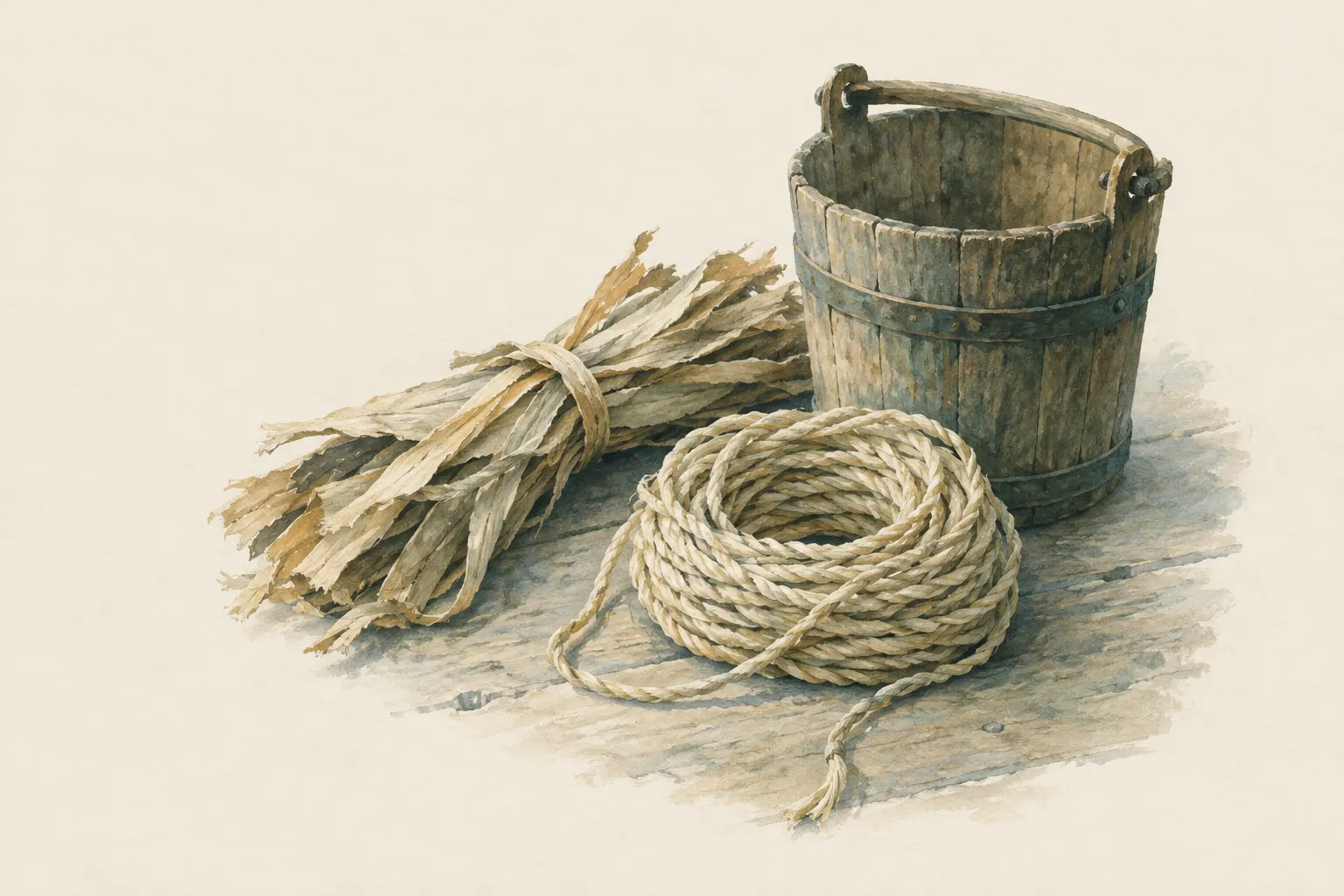
Explained simply
The lime tree is a large tree with heart-shaped leaves. Under its bark lies something special: the bast. These are many thin layers of long, strong fibres, almost like the pages of a book. In the past people made ropes, nets and mats from them.
For this you take branches that were cut off when the tree was pruned or broke off in a storm – and you ask the owner. You pull off the bark and put it in a bucket of water for a few weeks. There bacteria soften the glue between the layers. It smells pretty disgusting, but that is part of it.
After that the layers separate easily. You dry them, dampen them again and twist them into cord. Very important: you never pull bark off a living tree – the tree would die. And the cord is never meant for people or heavy loads.
How it works
A branch is built up from the outside in: on the outside the hard bark, beneath it the bast, then a thin growth layer and finally the wood. In a living tree the bast carries sugary sap down from the leaves. In lime it consists of many fine layers with long, tough fibres.
These layers are joined together by soft, juicy tissue. When you put the bark in water, bacteria start to break down exactly this soft tissue. The strong fibres remain. This is called retting – the same principle was once used for flax and hemp.
After retting the layers can be separated like the pages of a book. The thin inner layers are the finest and softest, the outer ones coarser. In two-ply twisting, two strips of bast are twisted against each other so they hold each other in place.
What really matters
The season decides whether the bark comes off easily. In spring and early summer, when the sap is rising, it almost slides off the wood on its own. In winter it sticks fast. The branch must also be fresh: if it lies around for weeks, the bark dries on and can hardly be peeled any more.
Retting takes patience. About once a week, check at one corner whether the layers are separating. In warm water it goes faster, in cold much slower – it usually takes a few weeks. If you take the bast out too early, the layers still stick together; left in the water too long, it becomes soft and weak.
After retting, rinse it thoroughly and dry it airily in the shade. Dry bast keeps for a long time. Before twisting, dampen it briefly so it becomes supple, and split it into strips of even width. Even strips make an even, stronger cord.
Safety: what to watch out for
The most important thing first: bark is never pulled off standing, living trees. The sap that feeds the tree flows under the bark. If a tree is peeled all the way round, it dies. This is prohibited without permission – in Germany § 39 of the Federal Nature Conservation Act protects plants from damage without good reason, and wood and bark always belong to the owner.
When scoring the bark the knife slips easily, because the bark is wet and smooth. Lay the branch on a firm support, cut away from your body and keep your free hand behind the blade. With heavy bleeding, press firmly on the wound and call 112, in Austria also 144.
Retting water rots and can contain germs. Never ret in streams, ponds or wells that anyone takes water from. Use your own container and later pour the water out far away from any water body. Afterwards wash your hands thoroughly.
When it makes sense – and when not
Lime bast is a project for people with time: peel in early summer, ret for weeks, twist in summer. It suits a base camp, a garden at home or a group that wants to learn old craft techniques. Many councils and gardeners prune lime trees regularly – the prunings are ideal.
The method is no good for quick emergencies, because retting takes weeks. If you need cord right away, use the cord you brought or twist something from nettles or grass. And for tents, loads or people, bought accessory cord is always the better and safer choice.
Good to know
Finds from the Stone Age show that people in Central Europe used lime bast for strings and nets very early on. For a long time bast was an important everyday material, for example for tying in gardening and wine growing.
It is best to practise twisting first with bought jute or sisal twine. Once the movement is second nature, bast is easy to work – it is smoother and more even than many other natural fibres.
Willow and elm also have usable bast. The same applies to all of them: only from branches that are already off, or with permission – never from the living trunk.
Step by step
Find permitted branches
Take lime branches that come from pruning or have broken off in a storm – only with the owner's permission. Bark peels best in spring and early summer while the sap is rising, and while the branches are fresh, that is within a few days of cutting.
- 1
Find permitted branches
Take lime branches that come from pruning or have broken off in a storm – only with the owner's permission. Bark peels best in spring and early summer while the sap is rising, and while the branches are fresh, that is within a few days of cutting.
- 2
Score and peel the bark
Lay the branch on a firm support and score the bark lengthwise with one cut down to the wood – away from your body. Lift the bark at the cut with your thumb or a wooden wedge and pull it off in long strips.
Free hand behind the blade.
- 3
Ret in water
Loosely roll or bundle the bark strips and lay them completely under water in your own container, weighted with a stone. Not in streams or ponds that anyone takes water from.
- 4
Check regularly
About once a week take out a strip and try at one corner whether the layers come apart. Depending on the water temperature this usually takes a few weeks – faster in warm water, much slower in cold. It smells rotten meanwhile; that is normal.
- 5
Separate the bast layers
Pull off the dark outer bark. Then carefully separate the pale bast layers from each other like pages in a book. Rinse in clean water until no slime is left on them.
- 6
Dry and store
Hang the bast strips loosely on a line in the shade until they are completely dry. Stored dry and airy they keep for a long time; folded up damp they go mouldy.
- 7
Dampen and twist
Dampen the bast briefly, split it into even strips a few millimetres wide and twist it two-ply as in the reverse wrap. Add new strips at staggered points, never in both strands at the same spot.
- 8
Test and use correctly
Test the finished cord slowly by pulling with your hands and look for thin spots. It is suitable for light lashings, nets and bags – never for people or for loads above people.
Common mistakes
- Peeling bark from standing trees
- Peeling branches weeks later, when the bark has dried on
- Taking it out of the water too early – the layers will not separate
- Retting in a stream or pond
- Storing damp bast folded up
Quick view
Materials
Lime bast (inner bark of lime/linden)
Bark from fresh lime branches, about thumb to arm thick
Only from cut or broken-off branches or with the owner's permission – never peel bark from standing trees.
Knife (fixed or locking blade)
Cut away from your body.
Rules on carrying knives differ by region – check local rules.
Sturdy sticks / poles
A wooden wedge to lift the bark
Do not cut live wood where prohibited.
Laundry tub or large lidded bucket
Or a large bucket for retting
Jute or sisal twine (bought)
For practising the twist
Low strength, absorbs water and rots – light loads and practice only.
Suitable for
- Tree pruning in spring or early summer, storm-felled wood with permission
- Longer projects in a base camp or at home
- Light lashings, nets, bags, handle wraps
Not suitable for
- Standing, living trees – never peel
- Quick emergency fixes – retting takes weeks
- Climbing, securing people or heavy loads
- Retting in drinking-water sources or protected waters
Prerequisites
- Able to recognise lime reliably
- The owner's permission, or branches that have already been cut or broken off
- Two-ply twisting (reverse wrap) practised with bought twine
Safety
- When scoring and lifting the bark the knife slips easily. Cut away from your body, keep your free hand behind the blade and brace the branch firmly on a support.
- Retting water rots and smells strongly. Do not ret in streams, ponds or wells that anyone takes water from, but in your own container. Later pour the water out far away from any water body.
- Home-twisted bast cord has no known strength and can suddenly break at thin spots. Never use it for climbing, belaying or for loads above people.
How it works
Between the outer bark and the wood lies the bast, which in a living tree carries sugary sap. In lime it consists of many thin layers of long fibres glued together by soft tissue. In water, bacteria slowly break down this soft tissue – this is called retting. Afterwards the fibre layers can be separated like the pages of a book and twisted into cord.
Advantages
- Long, strong natural fibre from material that is produced by pruning anyway
- Keeps for a long time when dry
- Rots if scraps are left in the woods
Disadvantages
- Retting takes weeks and smells
- Peels well only at certain times of year
- No reliable strength
Deep knowledge
Background
Lime bast was an important raw material for strings, ropes, mats and nets in Central Europe for thousands of years. Bushcraft textbooks such as Mears' describe retting lime bark as the classic method to obtain the fibre layers.
Because peeling living trees kills them, today you work with prunings: many lime trees in gardens and along roads are cut back regularly. If you ask politely, you are often given branches.
Variants
- Fresh bast without retting
- In early summer the inner bark of fresh branches can sometimes be pulled off directly in thick strips. It is usable for rough, short-lived lashings, but stiffer and less fine than retted bast.
- Other bast trees
- Willow and elm also provide bast. As with lime: only from branches that are already off, or with permission.
Common mistakes
- Peeling bark from standing trees
- Peeling branches weeks later, when the bark has dried on
- Taking it out of the water too early – the layers will not separate
- Retting in a stream or pond
- Storing damp bast folded up
Limits and risks
- No exact retting times – depends on temperature and bark
- No strength figures
- Not legal advice – clarify permission locally
Material alternatives
Derived from material properties: a substitute must have all relevant properties. Observe the notes on the substitute.
- Jute or sisal twine (bought)
- Rope (Never use unknown or damaged rope for life-safety purposes.), Paracord (Not a climbing or safety rope.), Thin twine (Low breaking strength – light loads only.), Accessory cord (Use only certified cord after training for life-safety purposes.), Webbing (tubular webbing) (Inspect knotted webbing before every use.), Tree straps (Load only within the manufacturer's limits.), Monofilament fishing line (Never leave scraps of line behind: birds and other animals get tangled in them and die slowly. Wind up scraps and take them with you.), Thin, soft wire (brass or galvanised steel) (Wire ends are sharp – protect eyes and fingers when bending), Tow rope or tow strap (Attach only to the towing eyes provided by the manufacturer; never stand next to it under load.)
Results come exclusively from structured entries. No improvised instructions are generated.
Sources
Ray Mears – Hodder & Stoughton (2002): Bushcraft
Obtaining lime bast by retting in water, twisting cord
Mors L. Kochanski – Lone Pine Publishing: Bushcraft: Outdoor Skills and Wilderness Survival
Natural fibres and making cordage
Bundesrepublik Deutschland (gesetze-im-internet.de) (2009): Gesetz über Naturschutz und Landschaftspflege (Bundesnaturschutzgesetz – BNatSchG), insbesondere § 39 und § 30
General protection of wild plants (§ 39)
Republik Österreich – Rechtsinformationssystem des Bundes (RIS) (1975): Forstgesetz 1975 (BGBl. Nr. 440/1975), § 33 Benützung des Waldes zu Erholungszwecken
Forest access in Austria; wood and bark belong to the forest owner
Bundesrepublik Deutschland – Bundesministerium der Justiz (1975): Gesetz zur Erhaltung des Waldes und zur Förderung der Forstwirtschaft (Bundeswaldgesetz), § 14 Betreten des Waldes
Forest access in Germany – no right to take wood