Daily routine, counting days and keeping a notebook while waiting for rescue
When you wait several days in one place for rescue, the days blur and apathy creeps in: you do less and less, although you ought to keep up warmth, water and signals. A fixed daily structure helps against this – marking the days, a morning round, blocks of tasks by daylight, fixed signal times, a notebook and a short evening review.
- A few minutes of planning daily, tasks spread over the day
Explained simply
When you wait several days in one place for help, one day looks like the next. Soon you no longer know: is today the third or the fourth day? And sometimes you no longer feel like doing anything – although you ought to look after the fire, the water and the signals.
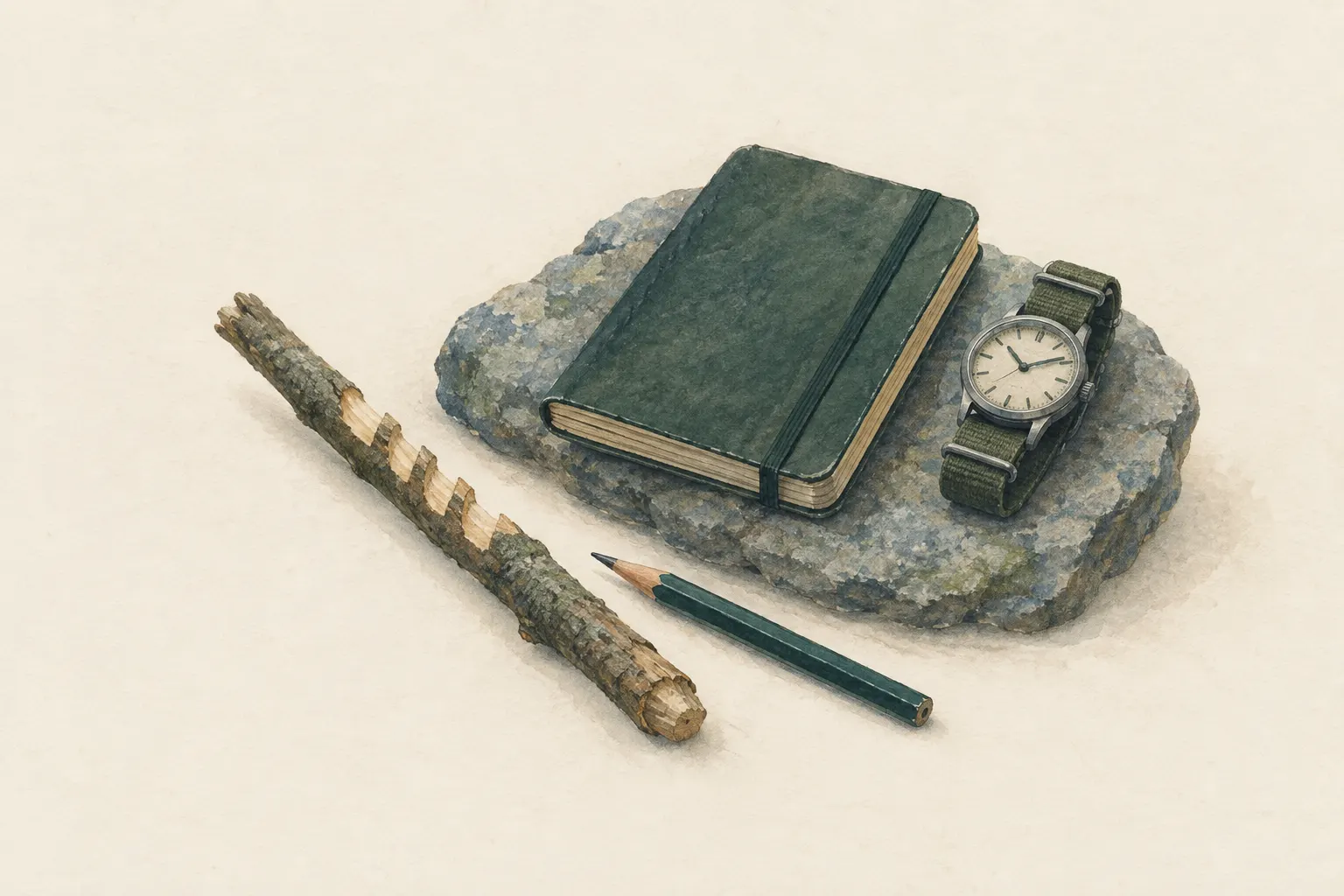
A fixed daily plan helps against this, a bit like at home or at school. Every morning you cut a notch in a stick or make a stroke in your notebook. Then comes your morning round: how am I? How much water do I have? What is the weather like? After that each part of the day has its task.
In your notebook you write what you did and how you feel. You also write a message for the rescuers. And in the evening you note three things that went well. That way you always know where you stand – and every day has a beginning and an end.
How it works
In everyday life clocks, appointments, meals and habits give us a fixed structure. In an emergency all of that disappears. Without these anchors you quickly lose your sense of time, especially after nights with little sleep and a lot of stress. At the same time uncertainty and inactivity increase low mood – up to apathy, in which you hardly do anything any more.
A daily structure replaces the missing anchors. Fixed times spare you constant decisions, and tasks fill the day with something meaningful. The notebook makes progress visible and records important information that is easily lost in your head: how much water is left? Since when has the foot been hurting? When was a helicopter last heard?
What really matters
Marking the day always comes first in the morning – that way it is not forgotten. Then the morning round, always in the same order: body (feet, hands, injuries, warmth), supplies (water, food, batteries), weather. Anything notable is noted immediately. Checking your feet daily lets you spot blisters, pressure points or cold injuries early.
The task blocks follow the daylight: in the morning fetch water and gather wood, at midday check signals and rest, in the afternoon wood and insulation for the night. An hour before sunset everything must be in place. Signals get fixed times – and in addition you signal immediately when you hear engines, voices or a helicopter.
The notebook holds time, weather, activities, food and drink, how you feel and your thoughts. A separate page is for the rescuers: who you are, since when you have been here, how you are. If you have to leave the spot, leave a clearly visible message there with direction and time.
Safety: what to watch out for
Keeping busy must never become a risk. Long explorations, climbing or heavy work cost strength and warmth you need to hold out. Many small tasks near camp are better than one big undertaking. Build rest times firmly into the plan and take breaks before you are exhausted.
Watch for warning signs in yourself: if you are hardly doing anything, no longer drinking or no longer care about anything, that can also be due to cold, dehydration or exhaustion. Then first warm up, drink, rest. Save phone battery for the emergency call and fixed check times – on 112 you reach help in the EU, in Austria also on 144 and in the mountains on 140.
When it makes sense – and when not
A fixed structure is worthwhile as soon as waiting lasts longer than a day: after getting lost, with an injury, in a snowed-in hut or when weather or flooding cuts off the way. It helps when alone just as in small groups, where tasks and signal watches are shared in turn.
For a few hours of waiting no elaborate plan is needed – then warmth, signals and a few notes are enough. And when immediate action is required, for example when danger approaches, action naturally takes priority over any routine.
Good to know
The US Army survival manual names boredom, loneliness and depression as typical reactions in long emergencies and advises keeping the mind busy. Guidelines on psychosocial support in crises also stress how important routines and meaningful activities are.
The notebook has another use after the rescue: doctors learn what you ate and drank and how symptoms developed. And many people later find it helpful to be able to read what they went through and achieved. Without paper, notches in a stick, pebbles in a row or charcoal on bark from dead wood also work.
Step by step
Mark the days
Every morning cut a notch in a stick or make a stroke in your notebook and add the date. After a few days of stress and little sleep it is easy to mix up the days – the strokes show reliably how long you have been waiting.
- 1
Mark the days
Every morning cut a notch in a stick or make a stroke in your notebook and add the date. After a few days of stress and little sleep it is easy to mix up the days – the strokes show reliably how long you have been waiting.
- 2
Morning round
After getting up always the same round: check your body (feet, hands, injuries, warmth), check supplies (water, food, batteries), assess the weather. Anything notable goes in the notebook. That way you spot problems early.
- 3
Divide the day into blocks
Plan by daylight: in the morning fetch water and gather wood, at midday check signals and rest (in the shade if it is hot), in the afternoon wood and insulation for the night, and an hour before sunset everything must be in place. Fixed blocks spare you constant brooding about what to do next.
- 4
Fixed signal times
Set times at which you signal and check: inspect the signal panel and ground signs every morning, blow three blasts at fixed times and listen, switch the phone on briefly only at fixed times to save battery. Signal immediately, outside the schedule, whenever you hear engines, voices or helicopters.
- 5
Keep a notebook
Several times a day note the time, the weather, what you did, what you ate and drank, how you feel physically and what you are thinking. Also write a message for rescuers: who you are, since when you have been here, how you are. If you have to leave the spot, leave a note there with direction and time.
- 6
Plan rest and energy
Rest times belong in the plan, not just work. Anyone who exhausts themselves in the first days has no strength left later. Take breaks before you are exhausted, and use the warmest time of day for a nap if the nights are cold.
- 7
Evening review
Before the night briefly write down: three things that went well today and the most important tasks for tomorrow. Then the same little bedtime routine every evening – tend the fire, lamp and whistle in their place, lie down. That way every day ends with a feeling of order.
Common mistakes
- Not marking the days and losing your sense of time
- Signalling only “when I feel like it”
- Exhausting yourself completely in the first days
- Switching the phone on constantly and draining the battery
- Leaving the spot without a message for rescuers
Quick view
Materials
Field notebook and pencil
Analogue wristwatch
Runs without a battery
Only a very rough direction aid – never a substitute for a compass in precise navigation.
Signal whistle
Carry within easy reach, not deep in the pack.
Do not blow right next to other people's ears.
Signal panel (fluorescent)
Weigh down or hold firmly in wind, especially near landing helicopters.
Suitable for
- Waiting several days after getting lost, injured or caught by bad weather
- A snowed-in hut, being cut off
- Alone or in small groups
Not suitable for
- Situations requiring immediate escape
- Short waits of a few hours – signals and warmth are enough then
Prerequisites
- Decision to stay in place and wait for rescue
- Basic shelter and water are set up
Safety
- Keeping busy must not lead to risky outings or too much exertion. Strength and warmth are scarce: better many small tasks near camp than one big exploration.
- If you notice you are hardly doing anything, no longer drinking or no longer care, that can also be due to cold, dehydration or exhaustion. Then first warm up, drink, rest – and use every opportunity for an emergency call.
How it works
Without a clock, appointments and daylight habits you quickly lose your sense of time. Uncertainty and inactivity increase stress and low mood. A structure of fixed times, small tasks and written notes gives you a hold, ensures that important things such as signals and water are not forgotten, and makes progress visible.
Advantages
- Keeps signals, water and warmth reliably in view
- Works against apathy and brooding
- Notes help rescuers and doctors
Disadvantages
- Requires discipline
- Does not change how long the rescue takes
Deep knowledge
Background
The US Army survival manual (FM 3-05.70) names boredom, loneliness and depression as typical reactions in long emergencies and advises keeping the mind busy and acting according to a plan. Guidelines on psychosocial support likewise stress that routines and meaningful activity support coping.
How to stay findable and use signals properly is described in the entries on signal whistles, signal panels and ground-to-air signs.
Variants
- Without a notebook
- Notches in a stick, pebbles laid in a row, or writing with charcoal on bark from dead wood. The structure matters more than the material.
- In a group
- Share tasks and signal watches in turn, keep the notebook together and do the evening review together – everyone names something that went well.
Common mistakes
- Not marking the days and losing your sense of time
- Signalling only “when I feel like it”
- Exhausting yourself completely in the first days
- Switching the phone on constantly and draining the battery
- Leaving the spot without a message for rescuers
Limits and risks
- Not a guide to signals or shelters – see the respective entries
- Not a treatment for depression
Sources
Headquarters, Department of the Army (USA) (2002): FM 3-05.70 Survival
Boredom, loneliness and depression as reactions; keeping the mind busy
Inter-Agency Standing Committee (IASC) (2007): IASC Guidelines on Mental Health and Psychosocial Support in Emergency Settings
Routines and meaningful activities in emergencies
World Health Organization (2020): Doing What Matters in Times of Stress: An Illustrated Guide
Meaningful activities under stress