Improvised cold protection in the city
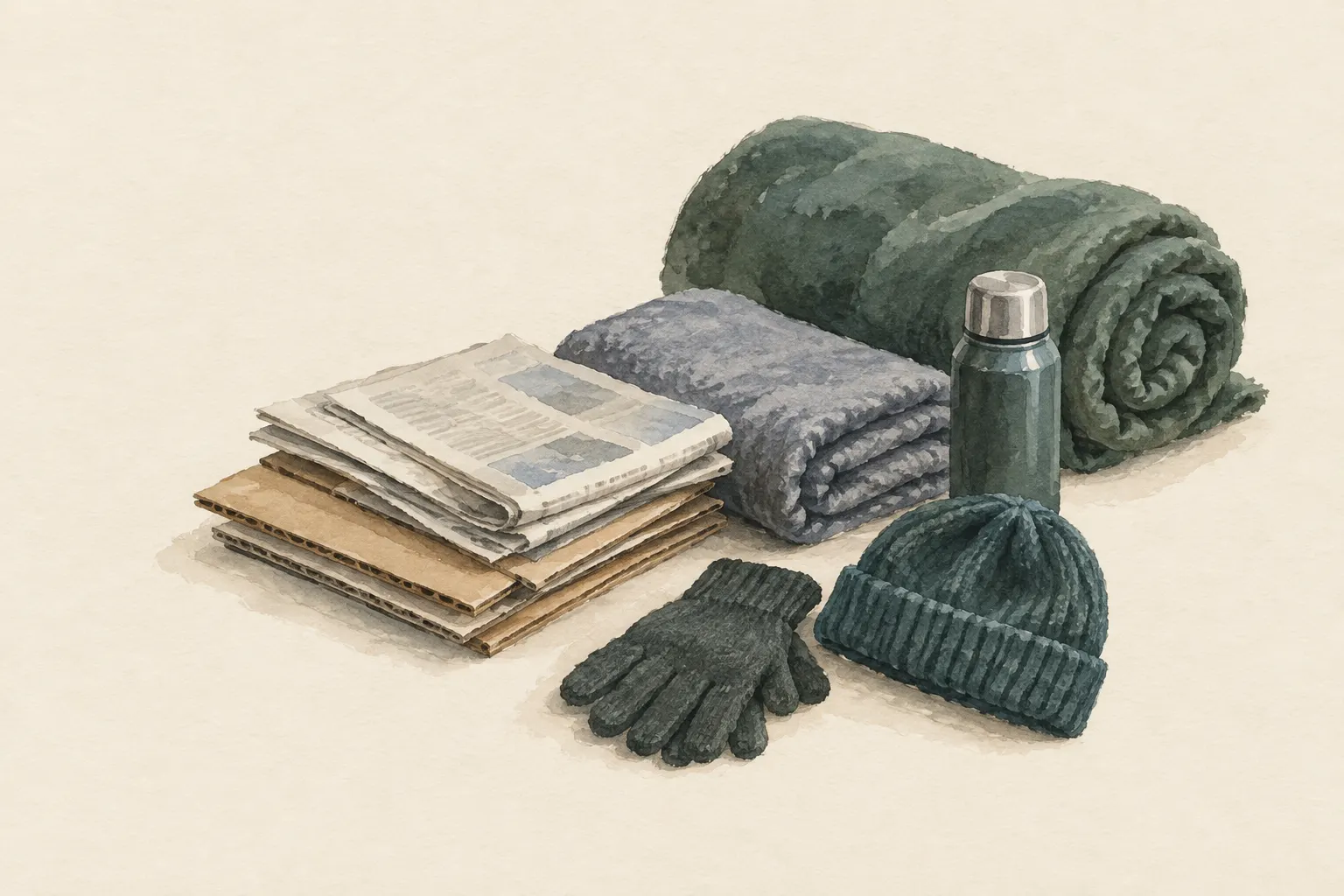
Anyone in a city left without a warm place to stay by an emergency – for example after building damage, during a power outage or while travelling – should first look for official emergency shelters and warming centres. To bridge the gap, cardboard and newspaper help as ground insulation, buildings break the wind and dry layers keep you warm. Damaged buildings and unsafe places are off-limits.
- Can be applied immediately
Explained simply
Imagine you are in a city and cannot get home because of an emergency – maybe the power is out, the building is damaged or you are stranded while travelling. There are buildings everywhere, but you need a place that is safe and warm. So the most important step is: ask for official help. Authorities and aid organisations often open emergency shelters or warming centres – heated rooms where people can warm up.
Until you get there, one simple trick helps: never sit directly on cold concrete or stone. The ground soaks the warmth out of your body like a sponge soaks up water. Several layers of cardboard or newspaper under you work like a thick blanket that the cold can hardly get through. A wall on the side away from the wind blocks the wind, and dry clothes keep you warm.
Very important for your safety: never go into damaged buildings, and never light a fire, barbecue or gas stove in rooms, tents or passageways. They can produce an invisible gas with no smell that is very dangerous. If someone shivers hard, seems confused or becomes very listless, call the local emergency number (112 in the EU).
How it works
Your body loses heat in several ways at once. The most underestimated is conduction: wherever you touch cold ground, heat flows straight from you into it. Concrete, paving and stone are heavy, dense materials that can absorb a lot of heat and pass it on quickly. That is why a stone bench feels much colder than a wooden one even though both are equally cold.
Cardboard and newspaper help because they trap many thin layers of air. Still air conducts heat very poorly – the same principle is at work in a down jacket or in double glazing. The more layers you stack, the more air cushions lie between you and the cold ground.
The second big heat thief is wind. It keeps blowing away the thin layer of warm air right next to your clothing, so your body has to heat new air all the time. A building wall, an alcove or a piece of cardboard set up on the windward side reduces this a lot. The third enemy is wet: wet clothing conducts heat away much faster than dry clothing.
What really matters
Finding a safe, warm place always comes first. You get information via radio, warning apps, the local council's website or hotline, emergency services on site and aid organisations. To bridge the gap, open public buildings such as stations, libraries or shopping centres can help – as far as they are accessible and you are allowed to stay there.
If you have to wait outdoors, the order is: insulate first, then block the wind, then keep out the wet. Lay the flattened boxes out in several layers, big enough for your bottom, back and feet. Sheeting over you protects against rain but must never be pulled over your head and face. A hat, scarf and gloves are valuable because heat is lost quickly from the head and hands.
Stay with other people if you can. Together it is easier to get information, look after the more vulnerable and fetch help if someone gets worse. Older people, small children and the sick often cool down faster and sometimes do not notice it themselves.
Safety: what to watch out for
Damaged buildings are off-limits after earthquakes, explosions, fires or floods, even if they look stable from outside. Parts can still collapse later, and gas or power lines may be damaged. Cordons and instructions from emergency services always apply. When flooding is possible, underpasses, underground car parks and basements are dangerous too, because water can rise very quickly there.
Never use barbecues, gas stoves, generators or open fires for heating in rooms, tents, garages or passageways. They produce carbon monoxide, a gas you can neither see nor smell that can poison even in small amounts. Headache, dizziness and nausea can be early signs. On top of that, cardboard and newspaper catch fire very easily – candles and cigarettes do not belong near them.
Hypothermia often creeps up slowly. Heavy shivering, confusion, slurred speech or sudden listlessness are warning signs. Then call the local emergency number (112 in the EU), protect the person from further heat loss and stay with them. Also respect other people's property and house rules; authorities and emergency services can tell you where you are allowed to stay.
When it makes sense – and when not
Improvised cold protection is a bridge: for the wait during an evacuation, for a few hours until an emergency shelter opens, or when you are suddenly stuck as a traveller. During that time it makes a real difference, because it stops you being chilled through before help arrives.
It is not enough for several nights outdoors in frost. Cardboard quickly gets wet and soft in rain or snow and then stops working. If it looks as though you would have to stay outside longer, it becomes all the more important to actively ask about official services or to stay with people you know.
For your own home when only the heating has failed, there is a separate entry ("one warm room"). This entry is meant for when the home cannot be used or reached.
Good to know
A mobile phone with a charged battery is often the most important tool in a city: for warning messages, emergency calls and letting relatives know where you are. Save battery by lowering the brightness and closing unnecessary apps. Cold makes batteries run down faster – carrying the phone in an inside pocket close to your body helps.
A cardboard bed can be improved by standing another box on its edge as a small wall at the head end. An emergency blanket or ordinary blanket over you holds in extra warmth. What still matters: keep your face free and watch out for sparks or flames nearby.
Step by step
Look for official help
Ask via radio, warning app, authorities, emergency services or aid organisations about emergency shelters, warming centres or assembly points.
- 1
Look for official help
Ask via radio, warning app, authorities, emergency services or aid organisations about emergency shelters, warming centres or assembly points.
- 2
Public warm places
To bridge the gap, use stations, shopping centres, libraries or other open public buildings as far as they are accessible and permitted.
- 3
Insulate from the ground
Put several layers of cardboard or newspaper under your body; never sit directly on concrete or stone.
- 4
Keep out wind and wet
Choose the sheltered side of buildings, cardboard as a windbreak, sheeting against rain – keep the face uncovered.
- 5
Layers and group
Put on dry layers, cover head and hands, stay with others and look after the more vulnerable.
Common mistakes
- Not looking for official emergency shelters
- Sitting directly on cold ground
- Seeking shelter in damaged buildings
- Heating indoors with a barbecue or gas stove
- Staying alone
Quick view
Materials
Newspaper and cardboard
As ground insulation and wind protection
Flammable – keep away from candles, stoves, heaters and embers.
Loses almost all insulation when wet.
Plastic sheet / large bin bag
Against wet, never over the head
Tears easily; never pull over the head (suffocation risk).
Do not use for drinking water unless food-grade.
Emergency blanket
Tears easily once punctured; short-term shelter only.
Conductive – keep away from power lines.
Wool blanket / duvet
Keep away from candles, stoves and heaters.
Mobile phone
The battery drains quickly in cold and with continuous screen and GPS use.
Do not plan on it as your only means of navigation or emergency calls.
Suitable for
- A short bridge until reaching an emergency shelter
- Stranded travellers
- Waiting outdoors during evacuations
Not suitable for
- Several nights outdoors in frost
- Damaged buildings or those at risk of collapse
- Underpasses and basements when flooding is possible
Prerequisites
- Information from the authorities (radio, warning app, local authority)
- Dry layers of clothing
Safety
- Respect private property and house rules; follow local rules and guidance from the authorities.
How it works
In a city there is rarely no roof at all, but there is often no safe, warm place. The most important step is therefore to find official help. Until then the same principles apply as outdoors: insulate from the cold ground, keep out wind, stay dry. Several layers of cardboard under the body interrupt heat conduction into concrete and paving.
Advantages
- Material can be found almost everywhere in a city
- Quick to apply
- No special equipment
Disadvantages
- Cardboard becomes useless when wet
- Flammable
- Only a stopgap
Deep knowledge
Background
Authorities such as the German BBK and Ready.gov recommend getting information through official channels in emergencies and going to heated public places or emergency shelters in extreme cold. Carbon monoxide poisoning from improvised heating with barbecues, generators or gas appliances is a known hazard during power outages.
For your own home when the heating fails there is a separate entry ("one warm room"); this entry covers situations in which the home cannot be used or reached.
Variants
- Cardboard bed
- Flattened boxes in several layers and one box as a windbreak at the head end make a simple sleeping surface.
Common mistakes
- Not looking for official emergency shelters
- Sitting directly on cold ground
- Seeking shelter in damaged buildings
- Heating indoors with a barbecue or gas stove
- Staying alone
Limits and risks
- No information on specific emergency shelters – varies by region
- No legal advice
Material alternatives
Derived from material properties: a substitute must have all relevant properties. Observe the notes on the substitute.
- Newspaper and cardboard
- Sleeping pad, Dry leaves, grass or conifer boughs (Collect only where allowed; no protected plants. Check for ticks and insects.), Backpack, Dry spare clothing (Carry it in waterproof packaging – wet clothing barely insulates.), Wool blanket / duvet (Keep away from candles, stoves and heaters.), Insulated cool box (Keeps cold only for a limited time; without ice packs or ice it is not a fridge.), Sleeping bag (Do not store compressed long-term; do not pack away damp.), Insulated cooking box (hay box, thermal cooker) (Never put open flame or embers inside – only the hot, closed pot.)
- Plastic sheet / large bin bag
- Tarp, Emergency blanket (Tears easily once punctured; short-term shelter only.), Document folder (waterproof) (Store securely – contains sensitive personal data.), Rain poncho (When used as a shelter, it no longer protects your body from rain.), Bivy bag (Never fully close off the face.), Tent (Do not cook or heat inside the tent (fire and carbon monoxide danger).), Heavy-duty bin bag (large) (Suffocation risk: never pull plastic bags over the head or face and keep them away from small children.), Group shelter bag (Airtight – ventilate regularly.)
- Wool blanket / duvet
- Sleeping pad, Dry leaves, grass or conifer boughs (Collect only where allowed; no protected plants. Check for ticks and insects.), Backpack, Dry spare clothing (Carry it in waterproof packaging – wet clothing barely insulates.), Insulated cool box (Keeps cold only for a limited time; without ice packs or ice it is not a fridge.), Sleeping bag (Do not store compressed long-term; do not pack away damp.), Newspaper and cardboard (Flammable – keep away from candles, stoves, heaters and embers.), Insulated cooking box (hay box, thermal cooker) (Never put open flame or embers inside – only the hot, closed pot.)
- Mobile phone
- Headlamp / flashlight, Battery lantern / LED light
Results come exclusively from structured entries. No improvised instructions are generated.
Sources
Bundesamt für Bevölkerungsschutz und Katastrophenhilfe (BBK), Deutschland: Ratgeber für Notfallvorsorge und richtiges Handeln in Notsituationen
Information through official channels and conduct in emergencies
Ready.gov – U.S. Federal Emergency Management Agency (FEMA): Power Outages
Going to warm public places in extreme cold; never running generators indoors
Centers for Disease Control and Prevention: Carbon Monoxide Poisoning – Prevention guidance
Carbon monoxide from improvised heating