Fox or dog? Telling paw prints and trails apart
Fox and dog tracks look the same at first glance: four toes with claws and one main pad. But the fox leaves a narrow, oval print with plenty of space between small pads and usually walks in a dead-straight line, one print in the next. The dog prints rounder and wider and runs all over the place. Looking at shape, size and trail pattern together usually gives the right answer – and droppings are never touched in the process.
- 10–20 minutes per trail; practice over several winters
Explained simply
Foxes and dogs are relatives. Both have four toes on each foot that show in the print, small claws in front and a large pad behind. That is why their tracks look almost the same at first glance. With a few tricks, though, you can still tell them apart.
The fox print is narrow like an egg, and there is a lot of space between the small pads. The dog print is rounder, and the pads are thicker. Even more important is how the trail runs: a fox walks as if on a string, paw in front of paw, always straight ahead. A dog runs back and forth, sniffs here and there and often runs next to its human's shoe prints.
One rule is really important: you never touch fox droppings and never sniff them. They can contain tiny eggs of a worm that can make people ill – the fox tapeworm. Just look, take a photo and wash your hands afterwards.
How it works
Canids walk on their toes. Four toes touch the ground; a fifth sits high up on the front foot and almost never prints. The claws cannot be retracted, so you usually see small dots or lines in front of the toes. Behind the toes lies the main pad. Fox, dog and wolf share this structure – and it separates them from cats, which retract their claws when walking and leave rounder prints.
The fox is lightly built and has small pads. Its two middle toes sit clearly ahead of the outer ones, and plenty of bare ground remains between the pads. In winter, hair grows between its pads, and then the prints look soft and blurred. Dogs vary greatly by breed but usually have stronger pads, and their toes sit closer together and more level. This makes the print round.
The trail pattern comes from the gait. A fox heading for a goal trots economically: the hind foot lands exactly in the front-foot print, and all prints lie almost on one line. Trackers call this a direct-register trot. A dog on a walk has no goal; it swings back and forth, jumps and turns back. The overall picture over many metres is therefore often more telling than a single print.
What really matters
Do not look for the first print you see but for the best one. At puddle edges, in damp mud or in thin fresh snow on firm ground, pads and claws are clearest. Lay a tape measure beside it and photograph straight from above, ideally in low light in the morning or evening. Measure several prints, because front and hind feet differ: the hind foot is slightly smaller and narrower.
As a guide value: an adult fox has front prints about 4.5 to 6 centimetres long and 3.5 to 4.5 centimetres wide. That overlaps with many small and medium-sized dogs. So size alone is not enough. Only when shape, size and trail pattern fit together is your guess well founded. Still note it as a guess, not a certainty.
Follow the trail for a while without stepping on it. If it runs dead straight over ten or twenty metres with prints in a row, that points to a fox. If it swings about, makes detours to every bush and runs next to shoe prints, that points to a dog. Also pay attention to the place: dog tracks gather on popular walking routes; fox tracks are also found away from them, at field edges and hedges.
Safety: what to watch out for
The biggest danger in tracking is invisible: pathogens in droppings. Fox droppings can contain fox tapeworm eggs, and dog droppings can transmit parasites too. So, without exception: do not touch, do not sniff, do not crumble. If you want to point at something, use a small stick and leave it there afterwards. After every tracking session wash your hands thoroughly with soap before eating.
A fox that shows no shyness, staggers, is emaciated or has bald patches in its fur may be ill, for example with mange or distemper – both can affect dogs too. Keep your distance, do not lure or feed it and keep your dog away. In settlements, report such animals to the municipality, the local hunting tenant or the police.
You never touch wild animals, not even injured or seemingly tame ones. After a bite or scratch, rinse the wound thoroughly with water and soap and see a doctor. For serious injuries call 112, in Austria also 144.
When it makes sense – and when not
Telling them apart is worthwhile on every walk after fresh snow or rain. It shows you that foxes live around you, even in the middle of town. For children it is a good start because the tracks are common and the differences become visible with a little practice.
You reach the limits with very small dogs that leave fox-like prints, and with tracks in leaves, grass or deep powder snow where no detail shows. Reliably telling a wolf trail from a large dog trail is often impossible even for experienced trackers – that is what experts and genetic analyses are for. If you see a strikingly large, dead-straight trail, report it instead of committing yourself.
Good to know
Foxes mark their territory with droppings and urine at conspicuous, raised spots such as stones, grass tussocks or molehills. In winter, during the mating season, such spots often smell strong. Fox droppings are usually twisted, pointed at one end and contain hair, bone splinters, feathers or fruit stones – depending on what the fox has eaten.
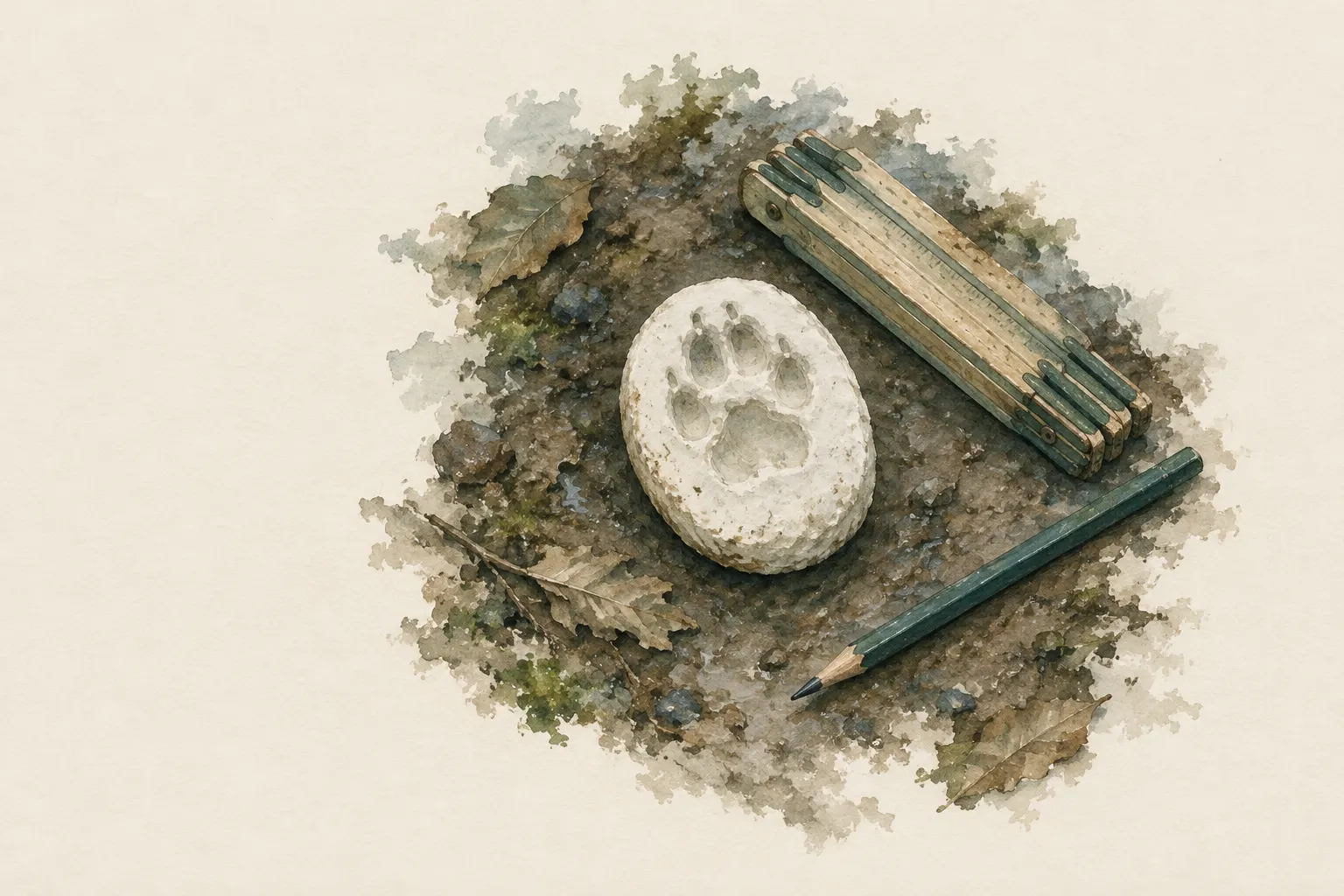
If you regularly record tracks in a tracking journal, after a few weeks you will recognise fixed runs: routes a fox uses again and again. This is exciting and possible without any disturbance. A plaster cast of a particularly nice print makes a lovely keepsake – as long as you stay on the path and touch no droppings.
Step by step
Find the trail without trampling it
Walk beside the trail, never on it. Look for the clearest print – often at puddle edges, in damp mud or in thin fresh snow. Lay the tape measure next to it without touching the print and photograph straight from above. Low light (morning, evening or a lamp held to the side) makes pads and claws easier to see.
- 1
Find the trail without trampling it
Walk beside the trail, never on it. Look for the clearest print – often at puddle edges, in damp mud or in thin fresh snow. Lay the tape measure next to it without touching the print and photograph straight from above. Low light (morning, evening or a lamp held to the side) makes pads and claws easier to see.
- 2
Count toes and claws
Four toe pads in front of one main pad and usually small claw tips in front of the toes: that fits the dog family (fox, dog, wolf). A round print with four toes and no claws suggests a cat, five toes a badger or marten.
- 3
Check the shape: oval or round
Fox: print clearly longer than wide, the two middle toes sit well ahead of the outer toes, the pads are small with plenty of bare ground between them. In winter, furry feet blur the outlines. Dog: print almost as wide as long, large pads, the toes sit closer together and more level, the claws are thicker and blunter.
- 4
Judge the size – carefully
An adult fox leaves front prints about 4.5 to 6 centimetres long and about 3.5 to 4.5 centimetres wide (guide values). Dogs range from clearly smaller to over 10 centimetres. Size alone therefore only rules out very large dogs. Measure several prints; thawing snow makes tracks larger.
- 5
Read the trail: straight line or all over
Look at at least ten to twenty metres of the trail. A trotting fox places its feet almost on one line, print in print, and keeps its direction for a long way. A dog trail swings back and forth, makes detours, jumps and circles and often runs next to shoe prints. Dogs sometimes trot straight too – what counts is the overall picture.
- 6
Only look at other signs
Foxes like to leave droppings on raised spots such as stones, grass tussocks or path junctions; they are usually twisted, pointed at one end and contain hair, bone splinters or seeds. In winter marking spots often smell strong. Only photograph droppings – never touch or sniff them.
Fox droppings can contain fox tapeworm eggs.
- 7
Record, wash hands, keep your distance
Note place, date, substrate, measurements and your guess. Then wash your hands with soap. If you see the fox itself: do not lure or feed it, put your dog on the lead. If a trail is strikingly large (around 10 centimetres) and runs dead straight over long distances, it may come from a wolf – then report it as described in the entry on large carnivores.
Common mistakes
- Looking at only a single print
- Deciding by size alone
- Confusing front and hind foot (the hind foot is slightly smaller and narrower)
- Taking thawed snow tracks for those of a larger animal
- Picking up droppings by hand or sniffing them
Quick view
Materials
Tape measure or folding rule
As a scale in photos
Mobile phone
Photos straight from above
The battery drains quickly in cold and with continuous screen and GPS use.
Do not plan on it as your only means of navigation or emergency calls.
Field notebook and pencil
Soap / detergent
Rinse drinking-water containers thoroughly after cleaning.
Suitable for
- Walks along woodland edges, farm tracks and in city parks
- Winter hikes after fresh snow
- Families and school classes
Not suitable for
- Reliably telling a wolf from a large dog – only experts can do that, often only with genetic analysis
- Tracks in leaves, grass or deep powder snow
Prerequisites
- Basic knowledge of gaits (walkers, trotters, bounders)
- A fresh trail in mud, damp sand or thin snow
Safety
- Never touch or sniff droppings (scat). Droppings of foxes, dogs and other wild animals can contain fox tapeworm eggs and other pathogens. Only photograph them, at most point with a small stick, then wash your hands thoroughly with soap.
- A fox that shows no shyness, staggers, has bald patches in its fur or behaves strangely may be ill (for example mange or distemper, which also affect dogs). Do not lure or feed it, keep your distance and keep dogs away. Report conspicuous animals in settlements to the municipality, the local hunting tenant or the police.
How it works
Foxes and dogs belong to the same animal family and have the same foot structure: four toes that touch the ground, non-retractable claws and one main pad. Differences come from build and lifestyle. The fox is light, has small, widely spaced pads and saves energy by placing the hind foot exactly into the front-foot print when trotting – the trail becomes a straight string of beads. Dogs are built very differently, have stronger pads and wander back and forth without a goal, often next to human shoe prints.
Advantages
- Possible almost everywhere and all year round
- Trains careful observation
- No contact with animals needed
Disadvantages
- Small dogs and foxes are often hard to separate
- Good prints are rare
Deep knowledge
Background
Field guides to European animal tracks such as those by Bang and Dahlström or Olsen describe the narrow, oval fox print and the straight-line trail as the key features separating it from a dog. Elbroch explains the same principles for North American canids.
Fox tapeworm occurs in large parts of Central Europe; the Robert Koch Institute describes transmission via eggs in the droppings of foxes and also dogs.
Variants
- Cat as a lookalike
- House cats leave round prints of about 3 centimetres, usually without claws because they retract them when walking. The main pad is large in proportion and three-lobed at the back.
- Foxes in town
- Urban foxes often run along paths, beside fences and through gardens. After rain you find tracks at puddle edges, or in snow on pavements.
Common mistakes
- Looking at only a single print
- Deciding by size alone
- Confusing front and hind foot (the hind foot is slightly smaller and narrower)
- Taking thawed snow tracks for those of a larger animal
- Picking up droppings by hand or sniffing them
Limits and risks
- No reliable wolf–dog distinction
- Sizes are guide values for adult animals
- No medical advice
Material alternatives
Derived from material properties: a substitute must have all relevant properties. Observe the notes on the substitute.
- Mobile phone
- Headlamp / flashlight, Battery lantern / LED light
Results come exclusively from structured entries. No improvised instructions are generated.
Sources
Preben Bang, Preben Dahlström – Oxford University Press (2001): Animal Tracks and Signs
Fox and dog prints, oval shape, straight-line trail
Lars-Henrik Olsen – Princeton University Press (2013): Tracks and Signs of the Animals and Birds of Britain and Europe
Tracks and droppings of the red fox in Europe
Mark Elbroch – Stackpole Books (2003): Mammal Tracks & Sign: A Guide to North American Species
Features of canid prints and trotting trails
Robert Koch-Institut: RKI-Ratgeber Echinokokkose
Transmission of fox tapeworm via eggs in fox and dog droppings