Separating water by use: drinking, hygiene and utility water
When water is scarce, it helps to divide it into tiers: safe drinking water for drinking, cooking, brushing teeth and baby food; treated or clean water for handwashing; utility water from a bathtub, rain barrel or pool only for flushing the toilet and cleaning. Clear labelling prevents mix-ups.
- Organise and label once, then keep to it daily
Explained simply
Not all water has to be equally clean. The water you drink, cook with and brush your teeth with must be completely safe. For flushing the toilet or mopping the floor, water from the bathtub or the rain barrel is enough. Keeping these apart means your safe drinking water lasts longer.
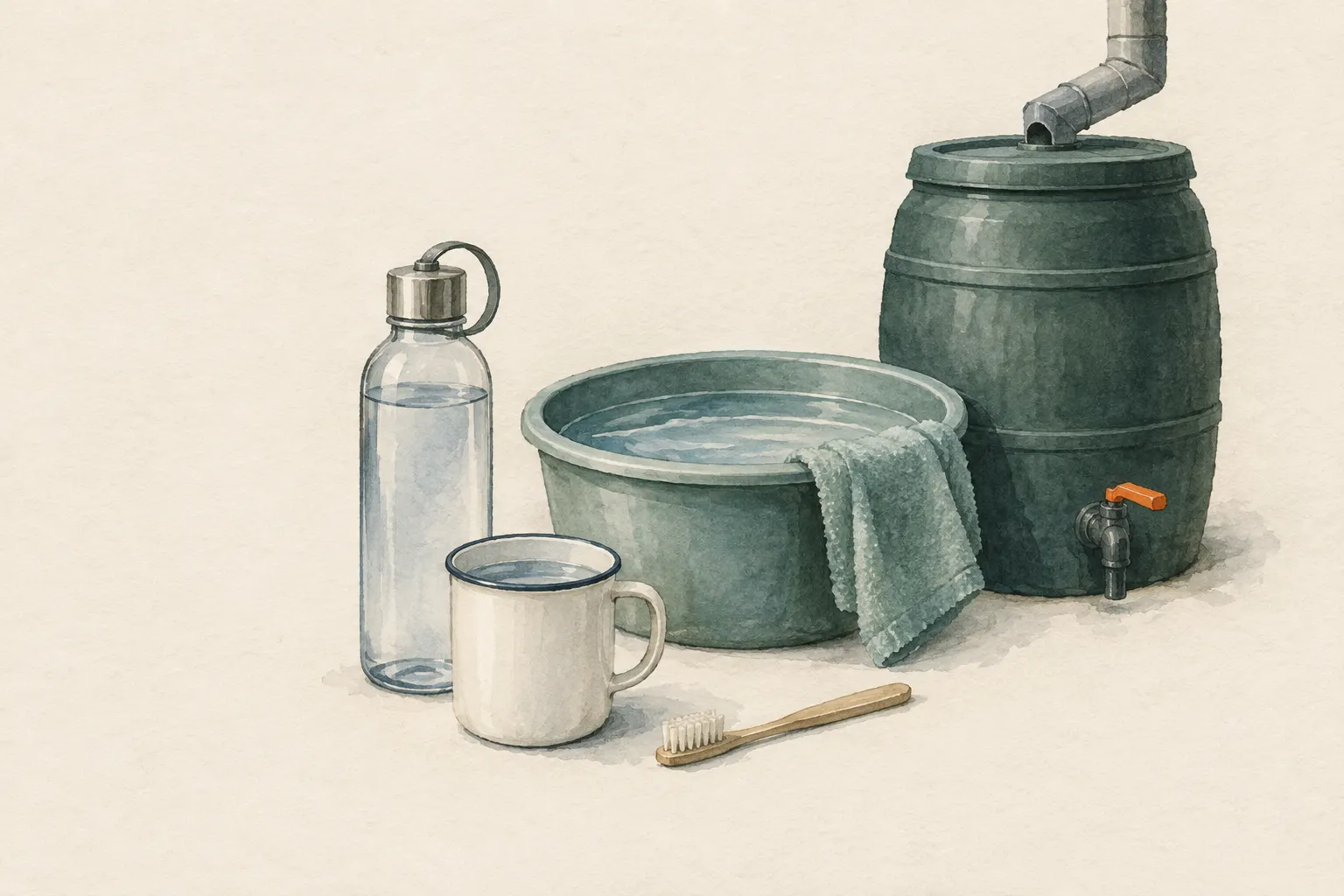
You can think of it as three boxes: box one is for everything that goes into the mouth. Box two is for handwashing and washing. Box three is for the toilet and cleaning. Each box gets its own containers with a clear label.
The most important thing: never mix them up. Utility-water containers get a clear ‘Not drinking water’ label and are kept somewhere other than the drinking water – especially if there are children in the house. Water from a pool, heating system, aquarium or toilet bowl is never drinking water.
How it works
In everyday life every tap delivers drinking-quality water – even for flushing the toilet. When the supply fails, safe water suddenly becomes precious. The idea of tiers is simple: the best quality goes only to whoever or whatever really needs it.
Tier 1 is safe drinking water: for drinking, cooking, brushing teeth, baby food and taking medication. Tier 2 is safe or treated water for handwashing and personal hygiene, because germs also get into the mouth via the hands. Tier 3 is utility water, for example from a bathtub, rain barrel or pool, used only for flushing the toilet and cleaning floors.
The gain is large: one toilet flush uses much more water than a whole day's drinking. Using utility water for it saves drinking water exactly where it counts most.
What really matters
The risk lies in mix-ups. That is why physical separation and clear labelling are the core of the method. Drinking water is kept cool, dark and clean in a fixed place, utility water somewhere else – for example in the bathroom next to the toilet. Different container colours or wide tape with large writing help as well.
To flush the toilet, pour a bucket of utility water quickly straight into the toilet bowl. That usually flushes well enough without using the cistern. In high-rises and in buildings with a sewage pump that stops during a power cut, however, waste water cannot drain away; then follow the building management's instructions, and an emergency toilet with bags is the alternative.
Everyone in the household must know the rules, guests included. A short explanation and a note on every container (‘drinking’, ‘handwashing’, ‘toilet only’) prevent mistakes, especially when people are tired or stressed.
Safety: what to watch out for
Water from pools, hot tubs, waterbeds, heating systems, toilet bowls and aquariums is not drinking water. It can contain chemicals, rust, additives or many germs and cannot be made safely drinkable at home. At most it is suitable for flushing the toilet.
For handwashing, brushing teeth and anything that touches food, use only safe or treated water. Under a boil-water notice this also covers brushing teeth and ice cubes. Water you suspect contains chemicals is not even used for hygiene.
Children must not be able to reach utility-water containers; a full bathtub is also a drowning risk for small children and needs supervision or a closed bathroom door.
Typical situations
If a water-supply outage is announced, a filled bathtub can provide many toilet flushes. Because of the tub itself, this water is meant as drinking water only in an emergency and after treatment; official advice takes precedence.
In a group camp with limited drinking water the principle works the same way: one jerrycan is only for drinking and cooking, a bowl of treated water is ready for handwashing, and stream water is used for rinsing out dirty pots, which are then boiled out hot.
Dividing water into tiers is not an official standard but a practical arrangement of the advice authorities give in their preparedness guides. It does not replace a sufficient drinking-water stock.
Step by step
Define the tiers
Tier 1: drinking, cooking, brushing teeth, baby food, medication. Tier 2: handwashing, personal hygiene. Tier 3: flushing the toilet, cleaning floors.
- 1
Define the tiers
Tier 1: drinking, cooking, brushing teeth, baby food, medication. Tier 2: handwashing, personal hygiene. Tier 3: flushing the toilet, cleaning floors.
- 2
Separate the containers
Give each tier its own containers, label them clearly and store them in different places – drinking water cool, dark and clean.
- 3
Use utility water
Use bathtub, rain or pool water for flushing by pouring it straight into the toilet bowl. During power cuts in high-rises or with sewage pumps, follow the building management's instructions.
- 4
Brief everyone
Explain to everyone in the household which water is for what. Children should not be able to reach utility-water containers.
Common mistakes
- Filling utility water into unlabelled bottles
- Assuming pool water is drinkable because it is chlorinated
- Brushing teeth with untreated water
- Using the same ladle for drinking and utility water
Quick view
Materials
Food-grade water container
Separate containers per tier
Only use containers that never held chemicals or fuel.
Labels and waterproof marker
Clear labelling
Galvanised bucket
For utility water for flushing
Do not heat: the zinc coating can release harmful fumes when heated.
Suitable for
- Longer water supply outages
- Households with children
- Group camps with limited drinking water
Not suitable for
- As a substitute for treating drinking water
- Water suspected of chemicals – not even for hygiene
Prerequisites
- Several containers
- A disinfection method for drinking water
- All household members know the rules
Safety
- Clearly label utility-water containers ‘Not drinking water’ and store them separately from drinking water – especially when there are children in the household.
- For handwashing, brushing teeth and food, use only safe or treated water. Under a boil-water notice this also applies to brushing teeth and ice cubes.
How it works
Not every use needs drinking-water quality. Reserving the scarce safe supply for the mouth and food, and using utility water for flushing and cleaning, makes the stock last longer. The risk lies in mix-ups – which is why physical separation and labelling are the core of the method.
Advantages
- Makes the drinking-water stock last longer
- Easy to implement
- Maintains hygiene and toilet use
Disadvantages
- Risk of mix-ups
- Needs several containers and space
- Requires everyone's discipline
Deep knowledge
Background
Preparedness guides from authorities distinguish between a drinking-water stock and water for hygiene. They explicitly warn against drinking water from radiators, waterbeds, pools or toilet bowls.
Dividing water into tiers is a practical arrangement of this advice, not an official standard.
Variants
- Fill the bathtub before an outage
- If an outage is announced, a filled bathtub can provide utility water for flushing. Because of the tub itself it is meant as drinking water only after treatment and in an emergency – follow official advice.
Common mistakes
- Filling utility water into unlabelled bottles
- Assuming pool water is drinkable because it is chlorinated
- Brushing teeth with untreated water
- Using the same ladle for drinking and utility water
Limits and risks
- Does not replace a sufficient drinking-water stock
- Utility water remains unsafe for mouth and food
- Flushing only works if the sewage system is intact
Material alternatives
Derived from material properties: a substitute must have all relevant properties. Observe the notes on the substitute.
- Food-grade water container
- Single-wall stainless steel bottle (Heat only single-wall bottles without paint/plastic; remove the lid before heating.), Double-wall insulated bottle (Never heat directly.), PET bottle (clear, max. 2 litres) (Do not heat or place in a fire.), Airtight food-grade storage container (Fill only when clean and completely dry; never use containers that previously held chemicals.), Collapsible water container or bag (Protect from sharp objects.), Food-grade water bag (Use only for drinking water, never for chemicals or fuel.), Fermentation jar or crock (Use only food-grade containers of glass, food-safe glazed stoneware or food-grade plastic – no metal containers for acidic food.), Resealable food bags (Use only bags intended for food; do not use with boiling water unless the manufacturer explicitly allows it.)
- Galvanised bucket
- Single-wall stainless steel bottle (Heat only single-wall bottles without paint/plastic; remove the lid before heating.), Double-wall insulated bottle (Never heat directly.), PET bottle (clear, max. 2 litres) (Do not heat or place in a fire.), Food-grade water container (Only use containers that never held chemicals or fuel.), Used chemical or fuel container (Never for drinking water or food – residues cannot be reliably removed.), Waterproof case or bag, Airtight food-grade storage container (Fill only when clean and completely dry; never use containers that previously held chemicals.), Wildlife-resistant food container (Where specific containers are required, use only approved models – check local rules.), Small metal tin with lid (Burn off coated or painted tins outdoors first.), Collapsible water container or bag (Protect from sharp objects.), Food-grade water bag (Use only for drinking water, never for chemicals or fuel.), Fermentation jar or crock (Use only food-grade containers of glass, food-safe glazed stoneware or food-grade plastic – no metal containers for acidic food.), Resealable food bags (Use only bags intended for food; do not use with boiling water unless the manufacturer explicitly allows it.)
Results come exclusively from structured entries. No improvised instructions are generated.
Sources
U.S. Federal Emergency Management Agency (FEMA): Are You Ready? An In-Depth Guide to Citizen Preparedness
No drinking water from radiators, waterbeds, pools or toilet bowls
Ready.gov – U.S. Federal Emergency Management Agency (FEMA): Water (emergency water supply guidance)
Building and safely storing a drinking-water stock
Bundesamt für Bevölkerungsschutz und Katastrophenhilfe (BBK), Deutschland: Ratgeber für Notfallvorsorge und richtiges Handeln in Notsituationen
Water stock for drinking and hygiene in the household