Using an emergency blanket: what it can and cannot do
An emergency blanket is a wafer-thin, metal-coated film. It keeps out wind and wet and reflects radiant heat – but it does not insulate: against the cold from below you need something to sit or lie on. Using it right means: insulate underneath, wrap up completely, cover your head, protect the film from tearing. Which side faces out hardly matters. A bivvy bag is the sturdier choice.
- A few minutes
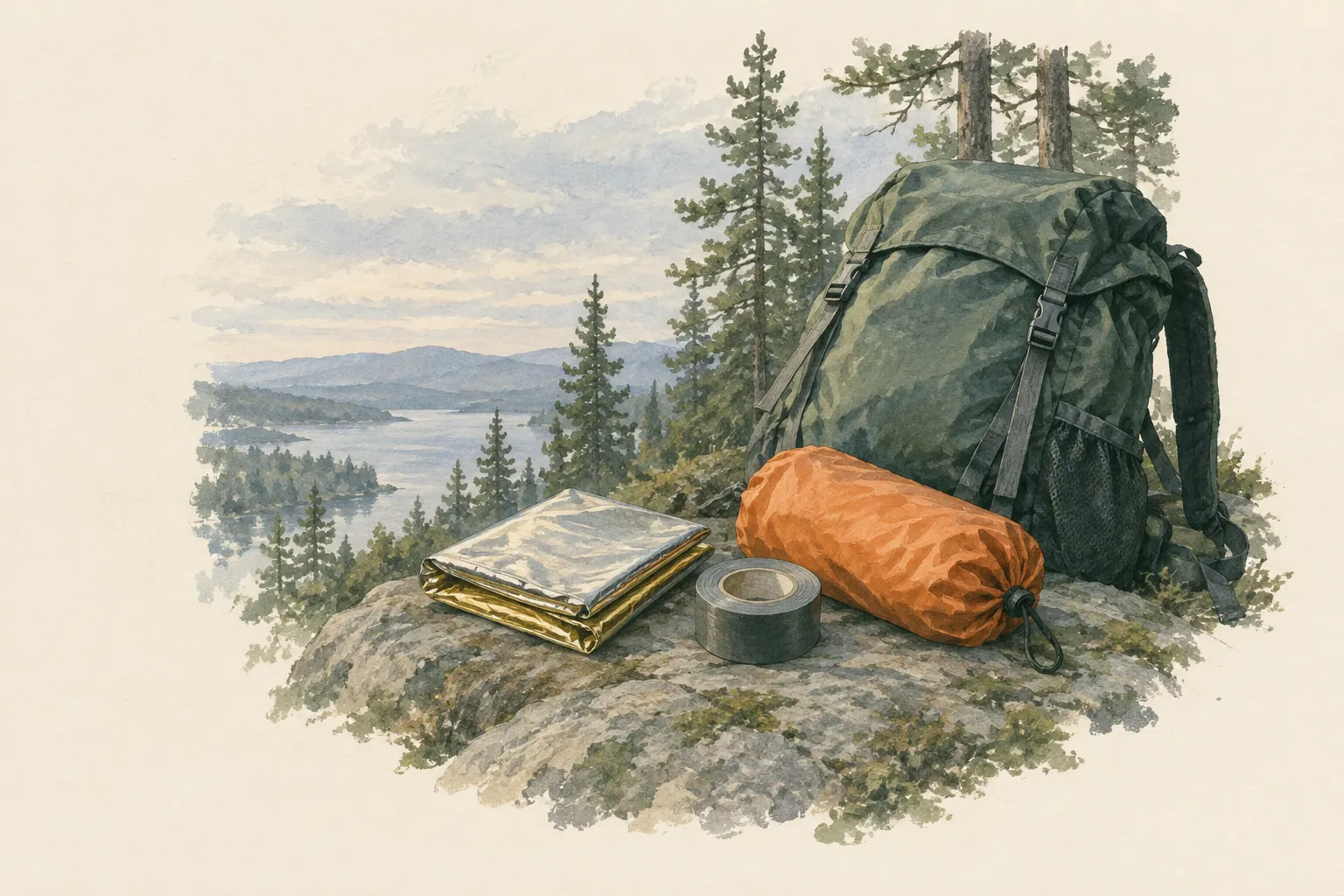
Explained simply
An emergency blanket looks like shiny gold or silver wrapping paper. It is very thin and fits folded in a trouser pocket. When you wrap it around yourself, it keeps out the wind and reflects part of the warmth your body gives off back to you.
But it has a weakness: it is so thin that it does not protect you from below. If you sit on cold stone or snow, the ground still pulls the warmth out of you. So you first sit on your backpack or a mat and then wrap up completely – including your head, only your face stays free.
Maybe you have heard that the gold side must always face out. For warmth, that hardly matters. What matters is that the blanket is closed and does not tear. And if a helicopter lands, you have to hold it tight so the wind does not tear it away.
How it works
Your body loses heat in several ways. It radiates heat like a warm stove, wind carries off the warm air around you, moisture evaporates and cools, and wherever you touch cold ground heat flows straight into it. The emergency blanket is a thin plastic film with an extremely thin metal layer. It lets no wind or water through and reflects a large part of the radiant heat.
What it cannot do is insulate. Insulating means trapping still air – like a down sleeping bag or a fleece jumper. The film is far too thin for that. If it lies directly on cold ground, it passes the cold on practically unhindered. That is why the base is just as important as the blanket itself.
The film also lets no moisture out. Over time sweat and condensation collect underneath. During a stop or while waiting that is acceptable, but while walking you get wet underneath – and wet clothing chills you badly later.
What really matters
The order decides: first a base (backpack, sleeping pad, rope, a thick layer of dry branches), then put on all warm layers and a hat, then wrap the blanket all around the body. Tuck the edges under you or tape them together. A jacket, poncho or bin bag over the film protects it from tearing and keeps it closed.
Whether the gold or the silver side faces out makes hardly any difference to warmth. On most blankets both sides are metal-coated; the gold colour is usually just a tinted protective layer. Much more important is that the wrap is sealed, sits close to the body and the head is covered.
The film tears easily once it has a hole or a nick. That is why you never pierce the corners for a roof. Instead, put a small pebble in the corner, gather the film around it and tie the cord behind the pebble. Tape small holes immediately. Ideally carry two blankets.
Safety: what to watch out for
Violent shivering, confusion, slurred speech, or someone stopping shivering despite the cold are signs of serious hypothermia. Then call 112 immediately, protect the person from further cold – base, dry layers, blanket, hat – and move them as little as possible. The blanket does not warm anyone up by itself; it only prevents further heat loss.
When a helicopter lands, the rotor creates a very strong downwash. Emergency blankets, tarps and loose clothing can be lifted and drawn into the rotor – which is dangerous for the crew. Hold everything down or weigh it down with stones before the helicopter is close.
The metal layer conducts electricity. Do not use the blanket near overhead lines, power lines or along railway tracks. And keep it away from fire: the film melts and can burn.
When it makes sense – and when not
The emergency blanket is ideal for short emergencies: waiting for help after an accident, a long stop in the wind, an injured person who must be protected from getting cold. It is so small and light that it fits in every pack and every first-aid kit. Spread out in open ground, it is also a highly visible signal for searchers from the air.
For a whole night outdoors or as the only source of warmth it is too weak. An emergency bivvy bag of sturdier material is closed, tears less easily and can be reused – it weighs only a little more. Anyone regularly in the mountains therefore prefers to carry a bivvy bag and keep the blanket as a spare.
Good to know
Metallised films became known through space travel, which is why the emergency blanket is often called a “space blanket”. Today it is in every car first-aid kit. After use it is usually crumpled and has small tears – then replace it instead of packing it again.
Try the blanket out once at home. Many people are surprised how loudly it rustles, how hard it is to control in the wind and how difficult it is to fold small again. Anyone who has practised once handles it more calmly in a real emergency.
Step by step
Know what it can do
The film is windproof and waterproof and reflects radiant heat. But it does not insulate and tears easily once it has a hole. It is a stopgap for hours, not a sleeping bag.
- 1
Know what it can do
The film is windproof and waterproof and reflects radiant heat. But it does not insulate and tears easily once it has a hole. It is a stopgap for hours, not a sleeping bag.
- 2
Insulate underneath first
Sit on your backpack, a sleeping pad, a rope or a thick layer of dry branches – never directly on stone, snow or wet ground. Otherwise the ground draws off more heat than the blanket can keep in.
- 3
Wrap up completely
First put on all warm layers and a hat. Then wrap the blanket around your whole body, also over shoulders and head – the face stays free. Tuck the edges under your body or close them with tape so no wind gets in.
- 4
Side does not matter – sealed does
On most blankets both sides are coated. Whether gold or silver faces out makes hardly any difference to warmth. What matters is that the wrap is closed and sits close to the body.
- 5
Protect it from tearing
Unfold carefully, do not drag it over branches or stones. A jacket, poncho or bin bag over it protects the film. Tape small holes immediately.
- 6
Rig it as weather protection
For a roof, do not pierce the corners: put a small pebble in the corner, gather the film around it and tie the cord behind the pebble. The corner then holds without tearing.
- 7
Use it as a signal
Spread out in open ground and weighed down with stones, the film shines in the sun and is easy to see from above. Moved by hand, it flashes.
When a helicopter approaches, hold everything down or weigh it down.
- 8
Better: a bivvy bag
An emergency bivvy bag is a closed sack made of sturdier material. You crawl inside, it tears less easily, and wind hardly gets in. It weighs only a little more and can be reused.
Common mistakes
- Sitting directly on cold ground with only the blanket around you
- Not covering the head
- Letting the blanket flap open
- Piercing the corners – they tear out
- Believing the gold side must face out
Quick view
Materials
Emergency blanket
Ideally two, one as a spare
Tears easily once punctured; short-term shelter only.
Conductive – keep away from power lines.
Sleeping pad
Or backpack, rope, dry branches as a base
Duct tape
For closing and reinforcing
Do not use on power cables, gas lines or as a wound dressing.
Adhesive can soften in heat and leave residue.
Bivy bag
The sturdier alternative
Never fully close off the face.
Condensation forms inside.
Paracord
Not a climbing or safety rope.
Suitable for
- Waiting for help after an accident
- Unplanned night or a stop in wind and rain
- First aid: protecting injured people from getting cold
- A signal in open ground
Not suitable for
- As the only insulation on cold ground or snow
- As permanent shelter
- Near power lines
- Near a fire – the film melts
Prerequisites
- Have unpacked and tried the blanket once at home
- Know the signs of hypothermia
Safety
- The coating conducts electricity. Do not use near overhead lines, power lines or along railway tracks.
How it works
A resting person loses heat in four ways: radiation, wind, evaporation and contact with cold ground. The film slows the first three: it reflects radiant heat, blocks the wind and keeps moisture out. It does not help against the fourth, because it is so thin that it traps no air. That is why something to sit or lie on always belongs with it.
Advantages
- Very light and small
- Windproof and waterproof
- Cheap, in every first-aid kit
Disadvantages
- Does not insulate
- Tears easily
- Noisy and hard to handle in wind
- Moisture collects underneath
Deep knowledge
Background
Emergency blankets are usually made of a thin polyester film with vapour-deposited aluminium. Such metallised films became known through space travel, hence the name “space blanket”. They have long been part of car first-aid kits and first-aid sets.
Hypothermia guidelines stress that protection from wind and wet and insulation from the ground belong together. The film is one layer among several, not the only one. The often-heard rule “gold out in heat, silver out in cold” has little relevance for keeping warm.
Variants
- In first aid
- For an injured person, first the emergency call and life-saving measures. Then slide insulation under the body, change wet clothing only under shelter, and wrap the blanket fully around the person, head covered with a hat.
- Between the layers
- Worn under a jacket, the film is not torn by the wind and still blocks it. Sweat can collect underneath though – do not wear it while walking, only during a stop.
Common mistakes
- Sitting directly on cold ground with only the blanket around you
- Not covering the head
- Letting the blanket flap open
- Piercing the corners – they tear out
- Believing the gold side must face out
Limits and risks
- No replacement for sleeping bag, pad and tent
- Does not treat hypothermia – only protects against further heat loss
- Usually crumpled and brittle after use – replace it
Material alternatives
Derived from material properties: a substitute must have all relevant properties. Observe the notes on the substitute.
- Sleeping pad
- Dry leaves, grass or conifer boughs (Collect only where allowed; no protected plants. Check for ticks and insects.), Backpack, Dry spare clothing (Carry it in waterproof packaging – wet clothing barely insulates.), Wool blanket / duvet (Keep away from candles, stoves and heaters.), Insulated cool box (Keeps cold only for a limited time; without ice packs or ice it is not a fridge.), Sleeping bag (Do not store compressed long-term; do not pack away damp.), Newspaper and cardboard (Flammable – keep away from candles, stoves, heaters and embers.), Insulated cooking box (hay box, thermal cooker) (Never put open flame or embers inside – only the hot, closed pot.), Long-stemmed thatch (reed, grass, rushes) (Extremely flammable – no open fire and no sparks nearby.)
- Bivy bag
- Tarp, Plastic sheet / large bin bag (Tears easily; never pull over the head (suffocation risk).), Emergency blanket (Tears easily once punctured; short-term shelter only.), Document folder (waterproof) (Store securely – contains sensitive personal data.), Rain poncho (When used as a shelter, it no longer protects your body from rain.), Tent (Do not cook or heat inside the tent (fire and carbon monoxide danger).), Heavy-duty bin bag (large) (Suffocation risk: never pull plastic bags over the head or face and keep them away from small children.), Group shelter bag (Airtight – ventilate regularly.)
- Paracord
- Rope (Never use unknown or damaged rope for life-safety purposes.), Thin, soft wire (brass or galvanised steel) (Wire ends are sharp – protect eyes and fingers when bending), Tow rope or tow strap (Attach only to the towing eyes provided by the manufacturer; never stand next to it under load.)
Results come exclusively from structured entries. No improvised instructions are generated.
Sources
Wilderness & Environmental Medicine (Wilderness Medical Society) (2019): Wilderness Medical Society Clinical Practice Guidelines for the Out-of-Hospital Evaluation and Treatment of Accidental Hypothermia: 2019 Update
Protection from wind, wet and ground cold as the core of hypothermia care
European Resuscitation Council – Resuscitation (journal) (2021): European Resuscitation Council Guidelines 2021: First Aid
First aid: protecting casualties from getting cold
Headquarters, Department of the Army (USA) (2002): FM 3-05.70 Survival
Space blanket as part of survival kit and for shelter and signalling