The ten essentials: what comes on every trip
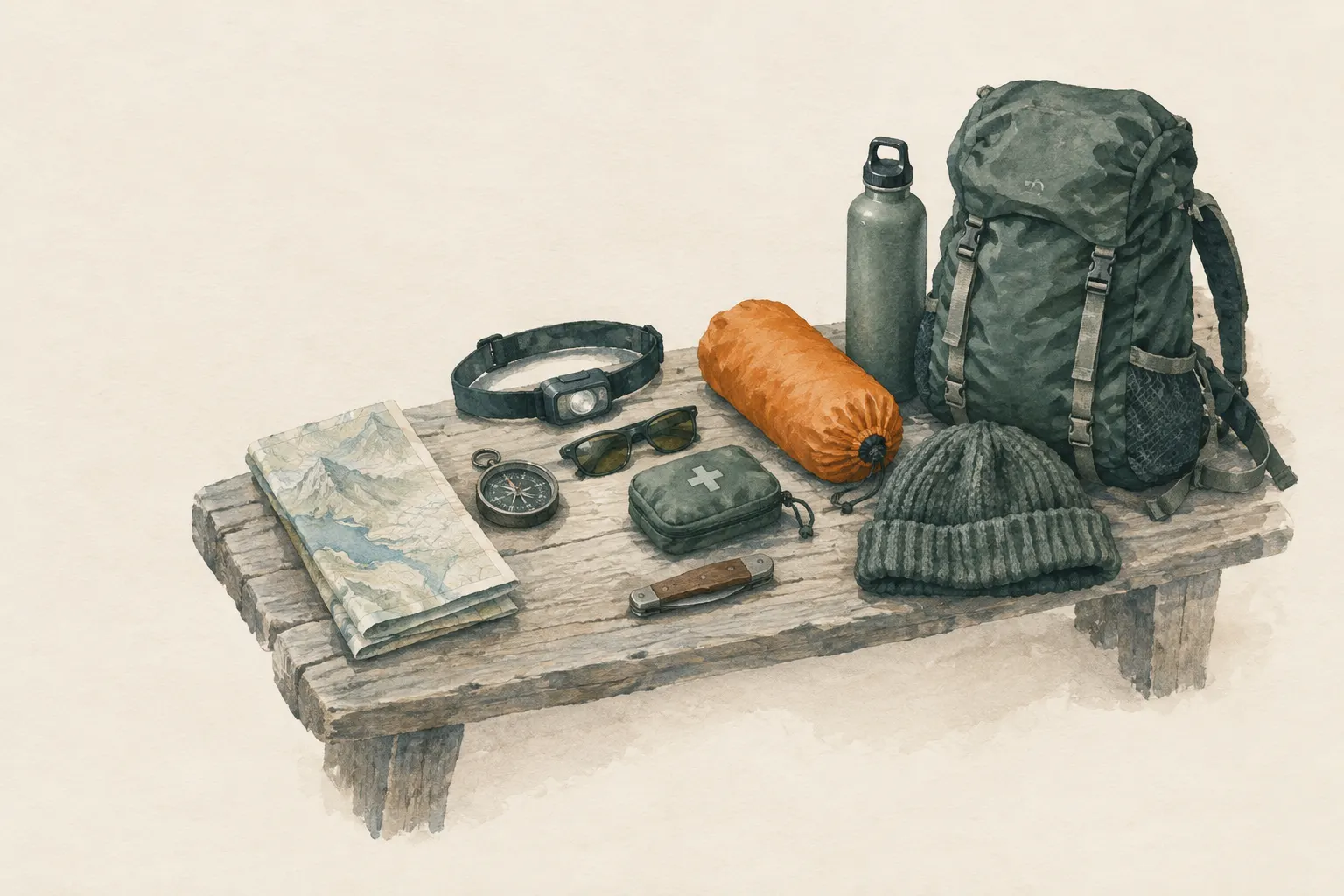
The “Ten Essentials” are a proven list of ten gear groups that come on every trip – even short ones: navigation, light, sun protection, first aid, knife and repair, fire, emergency shelter, extra food, extra water and extra clothing. They help when a trip takes longer than planned, the weather turns or someone is injured. Adapted here to Central Europe, with phone, emergency call and checklist.
- 10 minutes of packing before every trip
Explained simply
When you go on a trip, you pack things you need if everything goes well: a snack and something to drink. The “ten essentials” are a list for when something goes wrong – for example, when it gets dark before you are back, when it suddenly rains or when someone sprains an ankle.
The ten things are: something to find your way, light, sun protection, first aid, a pocket knife with some tape, something to make fire, emergency shelter such as a bivvy bag, and a bit more food, water and warm clothing than you actually need.
That sounds like a lot, but much of it is small and light. Before every trip you tick off the ten points on a list. And remember: the things only help if you know how to use them – practise with map and compass at home, for example.
How it works
The ten essentials are not a list of individual items but ten tasks. For “navigation” you might take map, compass and phone; for “emergency shelter” a bivvy bag or at least an emergency blanket. That way you can adapt the list to any trip without forgetting a task. You save weight by choosing light items within a group – not by leaving a group out altogether.
Many emergencies outdoors grow from small problems that build up: a trip takes longer, it gets dark, without a light you lose the way, you get wet and cold. Each of the ten groups breaks such a chain at one point. With a light you find the way in the dark, with a warm layer you can sit out a long stop, with first aid you treat a blister before it forces you to give up.
Groups 8 to 10 are expressly called “extra”: food, water and clothing beyond what the planned trip needs. This reserve makes the difference when an afternoon turns into a night or when you have to wait for help.
What really matters
For Central Europe, the phone with a downloaded offline map and a power bank belong to navigation – but it does not replace the paper map. Batteries weaken quickly in the cold, and valleys often lack reception. The phone torch is no headlamp: it drains exactly the battery you need for an emergency call. Note the emergency numbers: 112, in Austria also 144 for the ambulance and 140 for mountain rescue.
Sun protection is often underestimated, especially in spring on snow and at altitude. There UV radiation is stronger, and snow reflects additional light. Good sunglasses, sunscreen, lip balm and a hat therefore belong in the pack even on cool days.
The extra clothing is a warm layer (fleece or a light insulated jacket), hat and gloves and a rain jacket – even in high summer. In the mountains a thunderstorm or a sudden change in the weather can make the temperature drop sharply within a short time.
Safety: what to watch out for
Gear does not replace skill. If you have never used map and compass, you will not suddenly find the way with them in fog. Practise before the trip, refresh your first-aid knowledge and read your devices' instructions. And the most important safety gear is the decision to turn back in time.
The lighter is for emergencies – for example when someone is injured and warmth becomes vital. Open fire in the woods is mostly prohibited in Germany and Austria or allowed only at designated sites; during forest fire danger there is a strict ban.
In a group, everyone carries their own light, clothing, water and food. Shared items like the first-aid kit or the map are agreed on. If the group loses sight of each other, every individual must be able to cope.
When it makes sense – and when not
The ten essentials belong on every trip into nature, even short ones. Especially on “just a quick walk up the local hill” people like to leave everything behind – and that is where many accidents happen, because people feel safe. The list is quickly ticked off and the pack hardly gets heavier.
For glacier tours, climbing, ski touring or avalanche terrain the ten essentials are not enough. There, specialist gear such as harness, rope, avalanche transceiver, shovel and probe is added – and above all training, which gear cannot replace.
Good to know
The list goes back to the mountaineering club The Mountaineers in Seattle, who drew it up for their courses in the 1930s. It still appears in the textbook “Mountaineering: The Freedom of the Hills”. Originally it was ten individual items; today people speak of ten systems so that modern gear fits in.
A good habit is a fixed “base bag”: first aid, headlamp, emergency blanket, lighter, knife, tape and sunscreen always stay packed in a small bag. Before each trip only map, food, water and clothing are added – that way you forget nothing.
Step by step
1 Navigation
A paper map of the area and a compass, plus your phone with a downloaded offline map and a power bank. The phone does not replace the map: battery and reception can fail.
- 1
1 Navigation
A paper map of the area and a compass, plus your phone with a downloaded offline map and a power bank. The phone does not replace the map: battery and reception can fail.
- 2
2 Light
A headlamp with full batteries or a charged battery, plus spares. With a headlamp both hands stay free. The phone torch drains the battery you need for an emergency call.
- 3
3 Sun protection
Sunscreen, lip balm, sunglasses and a hat. On snow and at altitude the sun is especially strong – then wear well-protecting sunglasses, even when it is cloudy.
- 4
4 First aid
A small first-aid kit with disposable gloves, plasters, blister plasters, a bandage, a triangular bandage, your medicines and an emergency blanket. Note the emergency numbers: 112, in Austria also 144 and 140.
- 5
5 Knife and repair
A pocket knife or multitool, some tape, a few cable ties and cord. With these you can mend a strap, cut a bandage or secure a broken buckle.
- 6
6 Fire
A lighter and matches in a waterproof bag, possibly some tinder. Only for an emergency when warmth becomes vital – otherwise local fire bans apply.
Fire only in an emergency or where permitted.
- 7
7 Emergency shelter
An emergency bivvy bag or at least an emergency blanket, plus a small sit pad against the cold ground. This gets you through an unplanned night or a long wait for help.
- 8
8–10 Extra food, water, clothing
One meal or a few bars more than planned, enough water (or tablets or a filter to treat it) and an extra warm layer with hat, gloves and rain jacket.
- 9
Tick off and adapt
Tick off the ten points on the list before every trip. Then adapt: winter, altitude, length of the trip, children in the group. In a group agree who carries what – but everyone has their own light, clothing, water and food.
Common mistakes
- Leaving everything out on short trips “just this once”
- Relying only on the phone
- A headlamp with flat batteries
- No warm layer in summer
- All the group gear in one person's pack
Quick view
Materials
Topographic map
Check the publication date – paths and buildings may have changed.
Protect from wet (map case or bag).
Baseplate compass
Metal, magnets and electronics nearby deflect the needle.
Bubbles in the capsule or a sluggish needle indicate a defect.
Mobile phone
With an offline map
The battery drains quickly in cold and with continuous screen and GPS use.
Do not plan on it as your only means of navigation or emergency calls.
Power bank
Do not use damaged or swollen batteries; do not charge while covered.
Headlamp / flashlight
Spare batteries
Store cool and dry, observe the expiry date; keep button cells out of children's reach.
Sunscreen and sunglasses
Sunscreen has an expiry date; replace old tubes.
Wide-brimmed sun hat
Small first-aid kit for the trail
Check the expiry dates of plasters, medicines and sterile items regularly.
Multitool
Or a pocket knife
Rules on carrying blades differ by place – check local rules.
Lighter, matches or ferro rod
Observe local fire bans.
Bivy bag
Or at least an emergency blanket
Never fully close off the face.
Condensation forms inside.
Non-perishable food
Prefer food that can be eaten without cooking; consider allergies and dietary needs; do not forget a can opener.
Rain and wind shell
Dry spare clothing
Carry it in waterproof packaging – wet clothing barely insulates.
Suitable for
- Every hike, mountain walk, bike or paddling trip
- Day trips as well as multi-day trips
- Families and groups – coordinated per group
Not suitable for
- As a replacement for skill, planning and turning back in time
- Glacier tours, climbing, ski touring – they add specialist gear and training
Prerequisites
- Basic ability to read map and compass
- Know how to make an emergency call
Safety
- Gear only helps if you can use it. Practise map, compass and phone navigation before the trip and refresh your first aid. In an emergency call 112; in Austria mountain rescue is also reachable on 140.
- Even in summer the mountains can turn wet, windy and cold – even snowy. A warm layer, hat, gloves and rain jacket therefore always come along.
- The lighter is for emergencies. Open fire in the woods is mostly prohibited in Germany and Austria or allowed only at designated sites; during forest fire danger there is a strict ban.
How it works
The list does not ask “What do I need if everything goes well?” but “What do I need if it goes wrong?”: an unplanned night out, an injury, fog or a detour. Each group covers a basic task – finding the way, seeing, staying healthy, repairing, warming, protecting, supplying. You save weight by choosing within a group, not by leaving a group out.
Advantages
- Easy to remember and tick off
- Covers the most common emergencies
- Proven for decades
Disadvantages
- More weight than “just the bare minimum”
- Can create too much trust in gear instead of planning
Deep knowledge
Background
The “Ten Essentials” list goes back to The Mountaineers in Seattle in the 1930s and is described in the textbook “Mountaineering: The Freedom of the Hills”. Today it is phrased as a system of ten groups: navigation, headlamp, sun protection, first aid, knife, fire, emergency shelter, extra food, extra water and extra clothes.
For Central Europe this entry adds phone and power bank as part of navigation and emergency communication, plus the emergency numbers. The German Federal Office of Civil Protection (BBK) recommends similar basic ideas for emergency preparedness: light, water, first aid, weatherproof clothing.
Variants
- Winter and snow
- In addition: warmer clothing and spare gloves, a thermos flask, microspikes or snowshoes depending on terrain, a spare battery kept warm on your body. In avalanche terrain add transceiver, shovel and probe – only with training.
- With children
- Children carry their own small pack with whistle, jacket, drink, snack and hat. Adults carry first aid, navigation and reserves for everyone.
Common mistakes
- Leaving everything out on short trips “just this once”
- Relying only on the phone
- A headlamp with flat batteries
- No warm layer in summer
- All the group gear in one person's pack
Limits and risks
- Not a complete packing list for multi-day trips
- No gear for glacier tours, climbing or avalanche terrain
Material alternatives
Derived from material properties: a substitute must have all relevant properties. Observe the notes on the substitute.
- Mobile phone
- Headlamp / flashlight, Battery lantern / LED light
- Headlamp / flashlight
- Mobile phone (The battery drains quickly in cold and with continuous screen and GPS use.), Battery lantern / LED light
- Lighter, matches or ferro rod
- Ferro rod (Practise before you need it.), Fire striker and hard stone (Carbon steel, not stainless.), Bow drill set (bow, spindle, hearth board, bearing block) (Use only dry wood.), Burning lens / magnifier (Never leave lying in the sun – fire risk.), Fire piston (Maintain the seal.), Pump drill (spindle, flywheel, crossbar, cord) (Fix the flywheel firmly and centrally – a loose disc can fly off.)
- Bivy bag
- Tarp, Plastic sheet / large bin bag (Tears easily; never pull over the head (suffocation risk).), Emergency blanket (Tears easily once punctured; short-term shelter only.), Document folder (waterproof) (Store securely – contains sensitive personal data.), Rain poncho (When used as a shelter, it no longer protects your body from rain.), Tent (Do not cook or heat inside the tent (fire and carbon monoxide danger).), Heavy-duty bin bag (large) (Suffocation risk: never pull plastic bags over the head or face and keep them away from small children.), Group shelter bag (Airtight – ventilate regularly.)
- Rain and wind shell
- Cotton cloth / T-shirt (Removes coarse particles only – no disinfection.), Fine cloth or muslin net against flies (Keep clean and dry; do not hang it over the flames.)
- Dry spare clothing
- Sleeping pad, Dry leaves, grass or conifer boughs (Collect only where allowed; no protected plants. Check for ticks and insects.), Backpack, Wool blanket / duvet (Keep away from candles, stoves and heaters.), Insulated cool box (Keeps cold only for a limited time; without ice packs or ice it is not a fridge.), Sleeping bag (Do not store compressed long-term; do not pack away damp.), Newspaper and cardboard (Flammable – keep away from candles, stoves, heaters and embers.), Insulated cooking box (hay box, thermal cooker) (Never put open flame or embers inside – only the hot, closed pot.), Long-stemmed thatch (reed, grass, rushes) (Extremely flammable – no open fire and no sparks nearby.)
Results come exclusively from structured entries. No improvised instructions are generated.
Sources
The Mountaineers Books (2017): Mountaineering: The Freedom of the Hills, 9th edition
The Ten Essentials as a system of ten gear groups
Bundesamt für Bevölkerungsschutz und Katastrophenhilfe (BBK), Deutschland: Ratgeber für Notfallvorsorge und richtiges Handeln in Notsituationen
Basic emergency equipment: light, first aid, weatherproof clothing
Bundesministerium für Finanzen – Amtshelfer oesterreich.gv.at: Notrufnummern (oesterreich.gv.at)
Emergency numbers in Austria (112, 144, 140)
World Health Organization (with WMO, UNEP and ICNIRP) (2002): Global Solar UV Index: A Practical Guide
Stronger UV radiation at altitude and through reflection from snow