The pre-trip check: weather, plan, gear, phone
Most emergencies outdoors begin at home: with an overlooked thunderstorm, a flat battery or nobody knowing where you are. The pre-trip check takes a quarter of an hour: read the forecast and, in winter, the avalanche bulletin, plan route and turnaround time, tell someone your route and return time, check your gear, charge your phone and download offline maps. And agree beforehand what happens if you are overdue.
- 15–30 minutes the evening before, 5 minutes in the morning
Explained simply
Before a pilot takes off, they go through a checklist. You can do that before a hike too. You look at the weather forecast so that no thunderstorm surprises you. In winter in the mountains you also read the avalanche bulletin. And you plan when you will turn back at the latest, so you are back before dark.
Then you tell someone at home exactly where you are going and when you will be back. You agree on a time: if you have not been in touch by then, this person calls 112. That way mountain rescue knows straight away where to search.
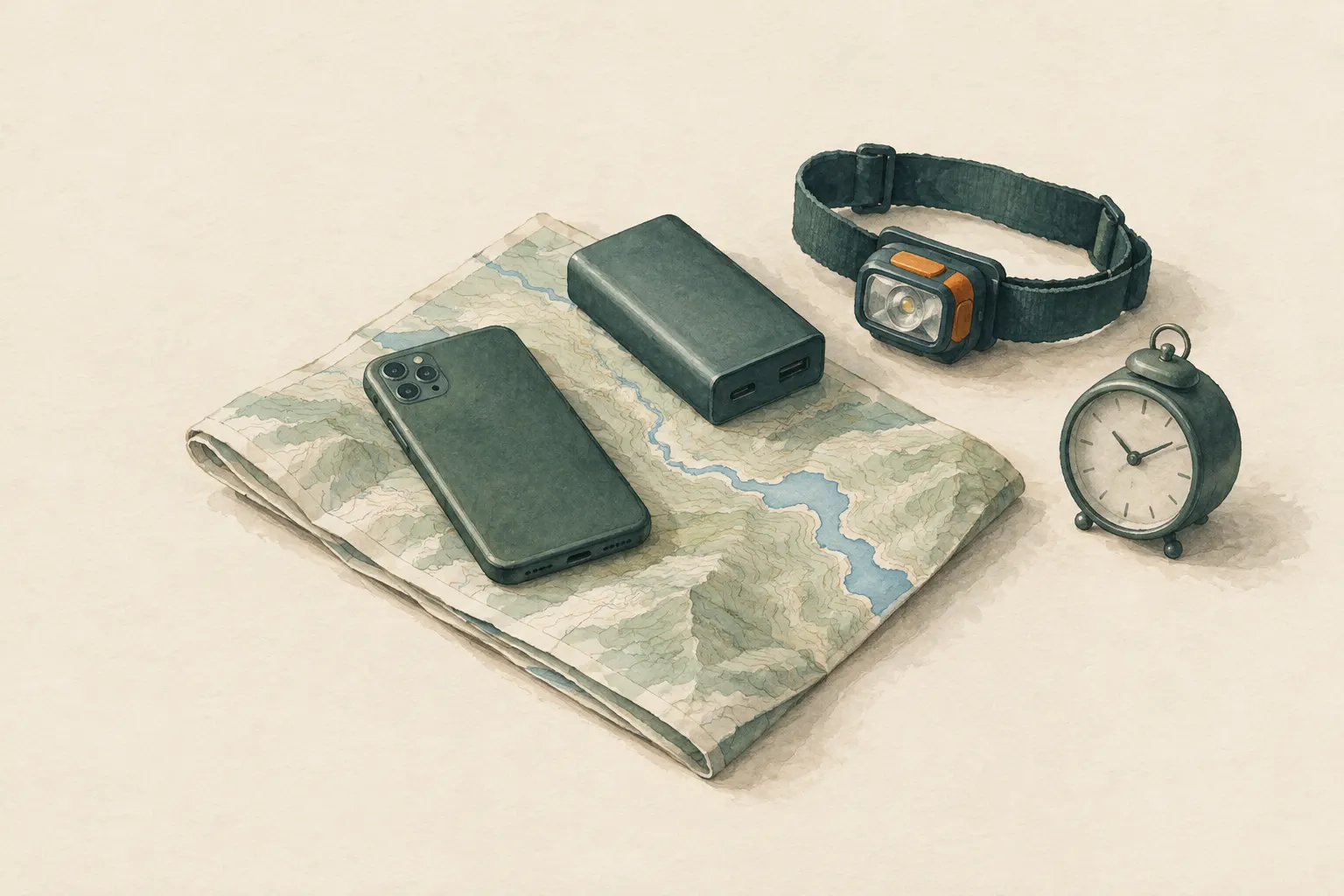
Finally you check your gear, charge your phone fully and download the map for the trip so it works without internet too. And after the trip you report in: I am back!
How it works
The pre-trip check builds several safeguards one after the other. The forecast stops you walking into a thunderstorm or gale. The turnaround time makes sure you are back before dark. The gear helps if something happens anyway. And the person at home is the last safeguard: they raise the alarm when you can no longer do it yourself.
This last safeguard is especially important. Anyone who has an accident alone without reception cannot rescue themselves. But if someone knows which route you are taking and when you meant to be back, the search starts early and in the right place. Search teams can then concentrate on a small area instead of a whole mountain range.
The fixed alarm time makes the plan reliable. “If I have not been in touch by 8 pm and cannot be reached, call 112” is a clear instruction. Without it the contact often waits too long because they do not know whether a delay is normal.
What really matters
Read the national weather service forecast the evening before and again in the morning, for example from the German Weather Service (DWD) or GeoSphere Austria. Do not just look at sun or rain but at thunderstorms, wind, temperature at altitude and warnings. In summer, thunderstorms in the mountains often form in the afternoon – setting off early helps.
Plan the route on the map and estimate the walking time generously. Set a turnaround time and check when the sun sets; in winter it is often dark by late afternoon. Think of a shorter alternative route in case the weather turns or someone gets tired.
Fully charge phone and power bank and download the map of the area for offline use. Test in airplane mode whether it really displays. Find out where you can read your coordinates in your app – in an emergency you may have to give them to the control centre.
Safety: what to watch out for
In the winter mountains the avalanche bulletin decides. The European avalanche warning services use a common scale from 1 (low) to 5 (very high) and describe on which slopes and at which altitudes there is danger. Without avalanche training, equipment and experience, stay on cleared, secured paths and pistes – regardless of the danger level.
A plan only helps if you stick to it. Thunderclouds, fog, exhaustion or reaching the turnaround time are reasons to turn back – even just short of the summit. Most serious mistakes happen because someone carries on “just a little further”.
If you will be late but are safe, report to your contact immediately. Otherwise a search starts for nothing, and rescuers may be missing elsewhere. Conversely, the contact really does call 112 at the agreed alarm time and passes on the trip plan – better once too early than too late.
When it makes sense – and when not
The check is worthwhile before every trip into nature – especially alone, in the mountains, in winter, on the water or in unfamiliar terrain. For a short loop in the town forest a short version is often enough: look at the weather, phone charged, tell someone you are out.
For glacier tours, ski tours and trips in avalanche terrain this check does not replace training. There you need knowledge of avalanche science, glacier or rope technique, which is learned in courses, for example with the Alpine clubs.
Good to know
If you realise you are overdue because you are lost or injured: stop, calm down, call 112 and stay at a safe, clearly visible place. Save your battery – screen dark, switch on only when needed – and signal with whistle or light. Anyone who stays in one place is found faster.
A trip plan can be very simple: a note or message with route, alternative route, participants, car and number plate, planned return and alarm time. On hut trips an entry in the hut book also helps. And after the trip do not forget: report briefly that everyone is back.
Step by step
Read the forecast
Read the national weather service forecast the evening before and in the morning, e.g. DWD or GeoSphere Austria. Watch for thunderstorms (in summer often in the afternoon), wind, temperature at altitude and warnings.
- 1
Read the forecast
Read the national weather service forecast the evening before and in the morning, e.g. DWD or GeoSphere Austria. Watch for thunderstorms (in summer often in the afternoon), wind, temperature at altitude and warnings.
- 2
In winter: avalanche bulletin
For trips in the winter mountains read the regional avalanche bulletin: danger level 1 to 5 and the described danger spots. Without training stay on secured paths only.
Avalanche terrain only with training and equipment.
- 3
Route and turnaround time
Plan the route on the map, estimate walking time generously and set a turnaround time. Check sunset – in winter it gets dark early. Think of a shorter alternative route.
- 4
Tell someone
Write down for a contact: route, alternative route, who is coming, car and number plate, planned return and a fixed alarm time. Agree: if no message has arrived by then, they call 112.
- 5
Check your gear
Tick off the ten essentials and adapt them to weather and season. Switch on the headlamp, check the first-aid kit, pack a warm layer and rain jacket.
- 6
Phone and offline map
Fully charge phone and power bank. Download the map of the area for offline use and test in airplane mode that it displays. Know where to read your coordinates in the app.
- 7
On the way: report changes
If you change the route or will be later, tell your contact immediately while you have reception. After the trip report: I am back.
- 8
If you are overdue
If you are lost or injured: stop, calm down, call 112, stay at a safe, visible place, save battery and signal. Your contact calls 112 at the alarm time and passes on the trip plan.
Common mistakes
- Only reading the previous day's forecast
- Telling nobody where you are going
- Agreeing no alarm time
- Offline map not tested
- Not reporting in after a delay – false alarm
- Ignoring the turnaround time
Quick view
Materials
Mobile phone
The battery drains quickly in cold and with continuous screen and GPS use.
Do not plan on it as your only means of navigation or emergency calls.
Power bank
Do not use damaged or swollen batteries; do not charge while covered.
Topographic map
Check the publication date – paths and buildings may have changed.
Protect from wet (map case or bag).
Field notebook and pencil
For the trip plan
Headlamp / flashlight
Suitable for
- Every trip into nature, alone or in a group
- Mountain walks, winter hikes, paddling trips
- Trips in unfamiliar terrain
Not suitable for
- As a replacement for training on glacier tours, ski tours and in avalanche terrain
Prerequisites
- A contact person who is reachable
- Basic map-reading knowledge
Safety
- Agree a fixed alarm time with your contact: if no message has arrived by then and you cannot be reached, they call 112. If you will be late but are safe, report in immediately – otherwise a search starts for nothing.
- A plan only helps if you stick to it. Turn back with thunderclouds, fog, exhaustion or when the turnaround time is reached – even just short of the goal.
How it works
An emergency is hard to solve when several things are missing at once: knowledge of the weather, light, battery, a person who raises the alarm. The pre-trip check makes sure that at least one safeguard always works. Most important is the person at home: they make sure the search starts early and in the right place.
Advantages
- Prevents many emergencies before they happen
- Speeds up the search if something does happen
- Takes only a few minutes
Disadvantages
- Needs a reliable contact person
- False alarm if you forget to report back
Deep knowledge
Background
Textbooks such as “Mountaineering: The Freedom of the Hills” stress trip planning, weather, turnaround times and leaving a trip plan as the basis of safe trips. The European avalanche warning services use a common five-level danger scale, so avalanche bulletins in the Alpine countries are comparable.
Mountain rescue services repeatedly report operations where nobody knew where the missing people had gone. A simple note with route and return time can shorten the search considerably.
Variants
- As a group
- One person is responsible for the check, but everyone checks their own gear. The contact receives the names of all participants and one phone number per person.
- Hut trips
- On hut trips in the Alps it helps to write in the hut book where you are heading next. Reservations also give a clue if someone does not arrive – but do not rely on that alone.
Common mistakes
- Only reading the previous day's forecast
- Telling nobody where you are going
- Agreeing no alarm time
- Offline map not tested
- Not reporting in after a delay – false alarm
- Ignoring the turnaround time
Limits and risks
- No introduction to avalanche science
- Forecasts can be wrong – keep watching on the way
Material alternatives
Derived from material properties: a substitute must have all relevant properties. Observe the notes on the substitute.
- Mobile phone
- Headlamp / flashlight, Battery lantern / LED light
- Headlamp / flashlight
- Mobile phone (The battery drains quickly in cold and with continuous screen and GPS use.), Battery lantern / LED light
Results come exclusively from structured entries. No improvised instructions are generated.
Sources
The Mountaineers Books (2017): Mountaineering: The Freedom of the Hills, 9th edition
Trip planning, weather, turnaround time and leaving a trip plan
European Avalanche Warning Services (EAWS): European Avalanche Danger Scale
European five-level avalanche danger scale
European Commission: 112 – the European emergency number
112 as the Europe-wide emergency number
Robert J. Koester – dbS Productions (2008): Lost Person Behavior: A Search and Rescue Guide on Where to Look – for Land, Air and Water
Importance of route and starting-point information for the search