A personal survival kit for your pocket
A small survival kit in a tin or waterproof pouch is carried on your body – even if the backpack gets lost. It holds only what counts in the first hours of an emergency: fire, signal, water, weather protection, light, first aid and a few repair items. A kit only helps if you know and have practised with every item and check the contents regularly.
- 1–2 hours to assemble, 15 minutes per check
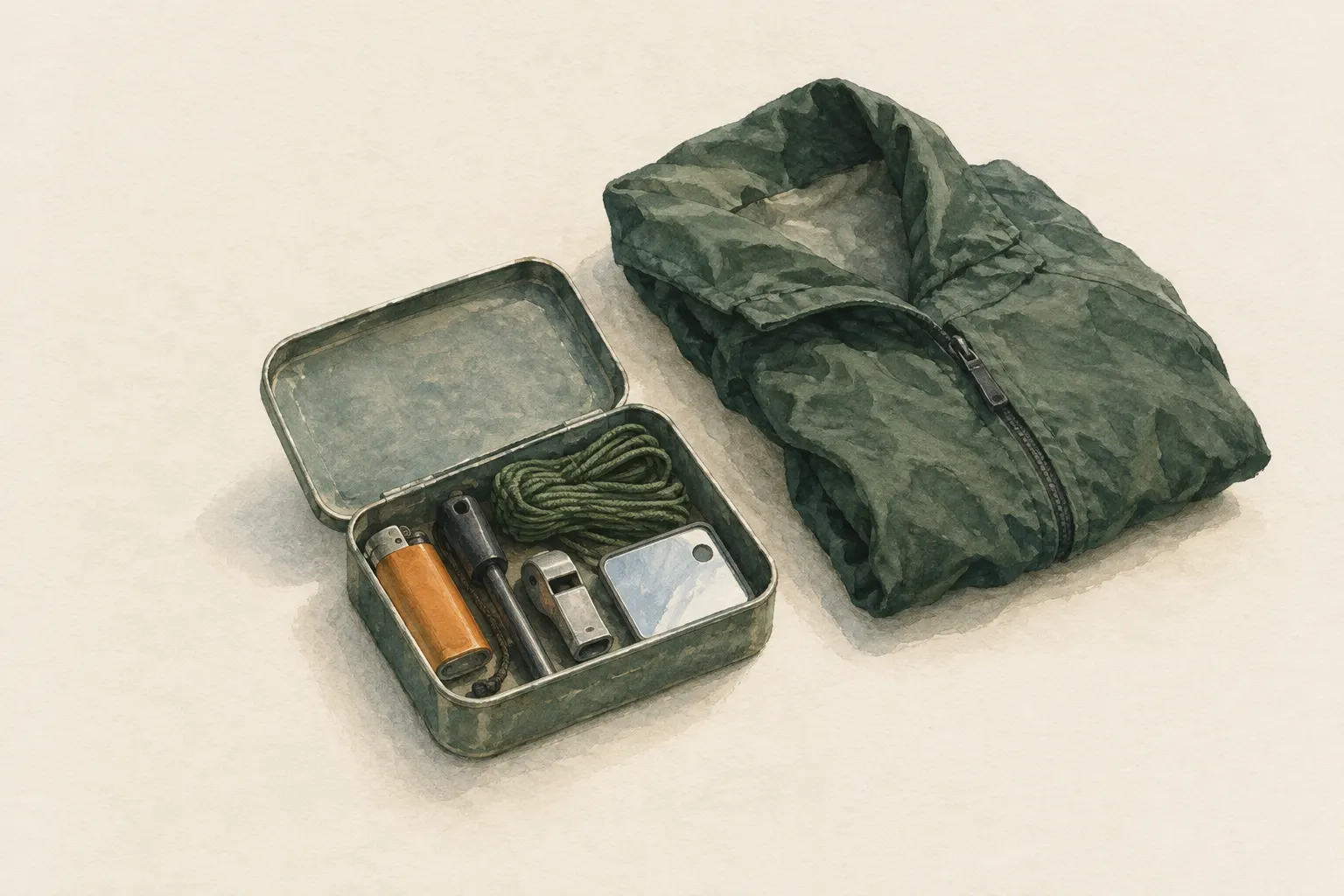
Explained simply
Imagine you are in the forest and your backpack tumbles down a slope. Everything in it is gone. What you still have is what is in your pockets. That is exactly what a small survival kit is for: a flat tin or a small pouch that always stays in your jacket pocket.
Only things that help in the first hours go into the tin: something to make fire, a whistle and a small mirror to be heard and seen, tablets that make water cleaner, a small light, plasters, tape and a piece of cord. Plus a note with phone numbers.
But the most important thing is not the tin – it is that you have used every item once already. A ferro rod you have never tried will not help you much in an emergency. And if you are lost, the rule is always: stay where you are, call 112, blow the whistle – and wait until help comes.
How it works
A survival kit follows a simple question: what do I need to get through the first hours and be found? The answer can be sorted into tasks – stay warm, give a signal, make water safe, treat small injuries, repair things, pass on information. Every item in the kit does at least one of these jobs, some even several: tape seals the tin and later patches a jacket.
Because the kit is carried on your body, it is not lost if you get separated from your pack – for example in a fall, when paddling or when you briefly walk away from camp without luggage. So it has to be small enough that you really always have it with you. A large kit left at home is useless.
The most important tasks are covered twice. For fire there is a lighter, matches and a small ferro rod; for signals a whistle and mirror. If one solution fails – the lighter is wet, the sun is not shining for the mirror – the other remains. You will find this principle of backup in almost every survival manual.
What really matters
Choose a container that fits in a zipped pocket: a flat metal tin or a small waterproof pouch. The tin protects fragile things better, the pouch is softer and holds an emergency blanket. Anything that should not rattle you pad with the tinder bag. A contents list in the lid helps you check it and reminds you under stress what you have.
Personal items must go in: emergency medication you need (for example for allergies or asthma) and a card with contact people and important health details. This can be crucial for helpers if you can no longer speak yourself. Some cash helps if you need a taxi or a phone call after an emergency.
Test every item at least once at home or in the garden: make sparks with the ferro rod onto cotton with petroleum jelly, blow the whistle hard, check whether the light is bright enough and read the instructions of the water tablets. Twice a year open the kit and check expiry dates, batteries and the lighter.
Safety: what to watch out for
A pocket kit is no replacement for clothing, map, headlamp and first-aid kit. It is meant to help you get through the first hours and get help. In danger, call 112 straight away – this number works all over Europe. In Austria you can also reach the ambulance on 144 and mountain rescue on 140.
Make fire only in a real emergency or where it is permitted. In many forests in Germany and Austria open fire is prohibited, and always during forest fire danger. Lighter, matches and blade belong with adults; children get their own pouch without these things.
Some lists from military manuals include fish hooks and wire for snares. Leave these out: fishing without a licence and trapping without hunting rights are illegal in Germany and Austria and only justifiable in genuine danger to life. Carrying knives is also regulated by law, for example by the Weapons Act in Germany – find out what is allowed.
When it makes sense – and when not
A survival kit is worth having wherever you might be separated from your luggage: hiking, cycling, paddling, skiing away from the hut, or on short detours without a pack. For children a small pouch with whistle, light, emergency blanket and phone numbers is a good start – together with the rule to stay put when lost.
It does not make sense to treat the kit as a kind of insurance that replaces planning. Anyone who sets off without a jacket, without a map and without telling anyone will get into trouble even with the best tin. The kit supplements the ten essentials; it does not replace them.
Good to know
Military manuals such as the US survival manual FM 3-05.70 have described small survival kits for a long time and organise the contents by task. Many ideas come from situations far from any settlement. In Central Europe it is almost always more sensible to call for help and be found than to obtain food – that is why the focus here is on signal, warmth and water.
The lid of a metal tin is not a good signal mirror, even though this is often claimed: it is usually too small, dented or painted. A real small signal mirror with a sighting hole is much more effective. And a whistle without a pea works reliably even when wet and in frost.
Step by step
Choose the container
A flat metal tin about the size of your palm, or a small waterproof pouch. It must fit in a zipped jacket or trouser pocket – the kit belongs on your body, not in the backpack.
- 1
Choose the container
A flat metal tin about the size of your palm, or a small waterproof pouch. It must fit in a zipped jacket or trouser pocket – the kit belongs on your body, not in the backpack.
- 2
Fire, twice over
A small lighter, a few matches in a sealed tube and a mini ferro rod. Add tinder, e.g. a few cotton balls with petroleum jelly in a small bag.
Fire only in an emergency or where permitted.
- 3
Signal: whistle and mirror
A loud whistle without a pea and a small signal mirror. Three blasts or three flashes mean: I need help. A whistle carries much further than your voice.
- 4
Water and weather protection
A few water disinfection tablets in their original packaging (note the expiry date) and a thin, strong plastic bag for collecting water. The pouch version also fits a folded emergency blanket.
- 5
Light, first aid, repair
A mini LED light, a few plasters and blister plasters, your personal emergency medication, safety pins, one metre of tape wound flat and three to five metres of cord.
- 6
Paper, pencil and emergency card
A short pencil, a piece of paper, a card with emergency contacts and important health details, and some cash. A contents list goes inside the lid.
- 7
Pack tightly and seal
Flat items at the bottom, fill gaps with the tinder bag so nothing rattles. Seal the lid with tape – the tape doubles as repair material. Put the kit in a zipped pocket.
- 8
Check and practise
Open it twice a year: does the lighter give a flame? Are tablets and medicines still in date? Does the light work? Do the plasters stick? Replace anything expired and use every item once before you need it.
Common mistakes
- Carrying the kit in the backpack instead of on your body
- Packing items you have never tried
- Expired tablets and medicines
- A single lighter as the only ignition source
- Treating the kit as a replacement for jacket, map and first-aid kit
Quick view
Materials
Small metal tin with lid
About palm-sized, sealed with tape – or a small waterproof pouch
Burn off coated or painted tins outdoors first.
Gets very hot in a fire.
Lighter, matches or ferro rod
Lighter and matches, plus a small ferro rod
Observe local fire bans.
Petroleum jelly cotton balls
As tinder in a small bag
Use only pure cotton.
Never substitute with fuel liquids.
Signal whistle
Carry within easy reach, not deep in the pack.
Do not blow right next to other people's ears.
Signal mirror
Do not flash into the eyes of people nearby or of drivers.
Glass mirrors can break – risk of cuts.
Emergency blanket
Usually fits only the pouch version
Tears easily once punctured; short-term shelter only.
Conductive – keep away from power lines.
Chlorine tablets (NaDCC) for drinking water
Label with the expiry date
Follow the manufacturer's dose and contact time.
Headlamp / flashlight
A mini LED light
Duct tape
One metre, wound flat
Do not use on power cables, gas lines or as a wound dressing.
Adhesive can soften in heat and leave residue.
Safety pins
Keep out of reach of small children.
Paracord
Three to five metres
Not a climbing or safety rope.
Emergency card (contacts and health details)
Note only necessary data; for children do not display the address visibly on clothing but carry the card in a pocket.
Suitable for
- Day hikes, bike trips, paddling
- As a supplement to normal gear
- Situations where you may be separated from your pack
Not suitable for
- As a replacement for proper gear (clothing, map, first-aid kit)
- Long emergencies without outside help
- Unsupervised children – lighter and blade belong with adults
Prerequisites
- Every item tried out once at home
- Have practised lighting a fire with lighter and ferro rod
- Know the emergency number 112
Safety
- A pocket kit keeps nobody warm and fed for long. It is meant to help you get through the first hours, attract attention and be found – nothing more. In danger, call 112 straight away.
- Fish hooks and snare wire, as listed in military manuals, do not belong in this kit: fishing without a licence and trapping without hunting rights are illegal in Germany and Austria and only justifiable in genuine danger to life. Carrying knives is regulated by law (e.g. the Weapons Act in Germany) – check beforehand.
- Make fire only in a real emergency or where permitted – during forest fire danger open fire in the woods is prohibited. Keep lighter and matches out of reach of small children.
How it works
In an emergency the first hours decide: stay warm and dry, call for help, be visible and audible, make water safe. A kit on your body does not get lost with the backpack. Every item should do at least one of these jobs, and the most important ones (fire, signal) are doubled – if one fails, the other remains.
Advantages
- Always with you, even without a pack
- Small, light and cheap
- Makes you think about emergencies
Disadvantages
- Very limited contents
- Can create false confidence
- Contents age and need maintaining
Deep knowledge
Background
Military survival manuals such as FM 3-05.70 recommend small survival kits carried on the body and organise the contents by task: fire, water, shelter, signal, first aid. Many military and bushcraft lists also include fishing gear and snare wire – that suits remote operations, not hiking in Central Europe.
In densely populated regions it is almost always more sensible to call for help and be found than to obtain food. That is why this kit focuses on signal, warmth and water.
Variants
- Pouch version
- A small waterproof pouch is softer and holds an emergency blanket and more cord. It fits the pocket better but protects fragile items less well than a tin.
- For children
- Children get their own small pouch with whistle, mini light, emergency blanket, a snack bar and a card with phone numbers – without fire or blade. Add the rule: if you are lost, stay where you are and blow the whistle three times.
Common mistakes
- Carrying the kit in the backpack instead of on your body
- Packing items you have never tried
- Expired tablets and medicines
- A single lighter as the only ignition source
- Treating the kit as a replacement for jacket, map and first-aid kit
Limits and risks
- Does not replace clothing, map, headlamp or first-aid gear
- Not a guide to obtaining food
- Contents must be adapted to the person and their health
Material alternatives
Derived from material properties: a substitute must have all relevant properties. Observe the notes on the substitute.
- Small metal tin with lid
- Single-wall stainless steel bottle (Heat only single-wall bottles without paint/plastic; remove the lid before heating.)
- Lighter, matches or ferro rod
- Ferro rod (Practise before you need it.), Fire striker and hard stone (Carbon steel, not stainless.), Bow drill set (bow, spindle, hearth board, bearing block) (Use only dry wood.), Burning lens / magnifier (Never leave lying in the sun – fire risk.), Fire piston (Maintain the seal.), Pump drill (spindle, flywheel, crossbar, cord) (Fix the flywheel firmly and centrally – a loose disc can fly off.)
- Petroleum jelly cotton balls
- Dry firewood (Collect only where permitted.), Tinder (Carry in waterproof packaging.), Char cloth (charred cotton) (Store dry in a tin.), Finest-grade steel wool (Store separately from batteries – fire risk.), Fatwood (resin-rich wood) (Collect only dead wood where permitted.), Stove fuel (canister, liquid fuel, alcohol) (Store fuels apart from food and in original containers or bottles intended for them.), Cooking oil or cooking fat (tallow, lard) (Never put out burning fat with water – cover it with a lid to smother it.), Tree resin (spruce, pine) (Resin is flammable and sticks to the skin when hot – melt it only slowly over low heat.), Birch bark (from dead, fallen wood) (Never peel from living trees.)
- Signal mirror
- Emergency blanket (Tears easily once punctured; short-term shelter only.), High-visibility vest (Keep within reach inside the cabin, not in the boot/trunk.), Warning triangle (Whether warning triangles are mandatory, or should be placed at all on certain roads (e.g. motorways), differs between countries – check local rules.), Aluminium foil (heavy-duty) (Edges can be sharp; conducts heat and electricity.)
- Chlorine tablets (NaDCC) for drinking water
- Chlorine dioxide tablets or drops (Only approved drinking-water products; follow manufacturer instructions.), Unscented household bleach (sodium hypochlorite) (Only unscented, without additives, with known concentration.), Iodine water purification tablets (Not in pregnancy, thyroid disease or iodine allergy without medical advice.)
- Headlamp / flashlight
- Mobile phone (The battery drains quickly in cold and with continuous screen and GPS use.), Battery lantern / LED light
- Paracord
- Rope (Never use unknown or damaged rope for life-safety purposes.), Thin, soft wire (brass or galvanised steel) (Wire ends are sharp – protect eyes and fingers when bending), Tow rope or tow strap (Attach only to the towing eyes provided by the manufacturer; never stand next to it under load.)
Results come exclusively from structured entries. No improvised instructions are generated.
Sources
Headquarters, Department of the Army (USA) (2002): FM 3-05.70 Survival
Small survival kits carried on the body, contents organised by task
Ray Mears – Hodder & Stoughton (2002): Bushcraft
Personal emergency kit always carried on the person
Bundesrepublik Deutschland – Bundesministerium der Justiz (gesetze-im-internet.de): Strafgesetzbuch (StGB) – § 292 Jagdwilderei
Poaching is a criminal offence in Germany (§ 292 StGB)
Republik Österreich – Rechtsinformationssystem des Bundes (RIS) (1974): Strafgesetzbuch (StGB), BGBl. Nr. 60/1974 – §§ 137, 138 (Eingriff in fremdes Jagd- oder Fischereirecht) und § 222 (Tierquälerei)
Interference with another's hunting or fishing rights in Austria
European Commission: 112 – the European emergency number
112 as the Europe-wide emergency number