Paracord and utility cord: strength, uses, securing the ends
A few metres of strong cord solve many problems outdoors: a ridgeline for the tarp, a spare bootlace, lashings, repairs, securing a splint. Paracord to military spec (Type III, “550 cord”) has a sheath and several inner strands. The limits matter: knots weaken any cord considerably, cheap cord often holds less than stated – and paracord is never a climbing or rescue rope.
- Minutes per use
Explained simply
Paracord is a thin but very strong cord. It was originally made for parachutes. If you cut open a piece, you see that it is hollow inside and contains several thin threads – like a drinking straw with spaghetti inside.
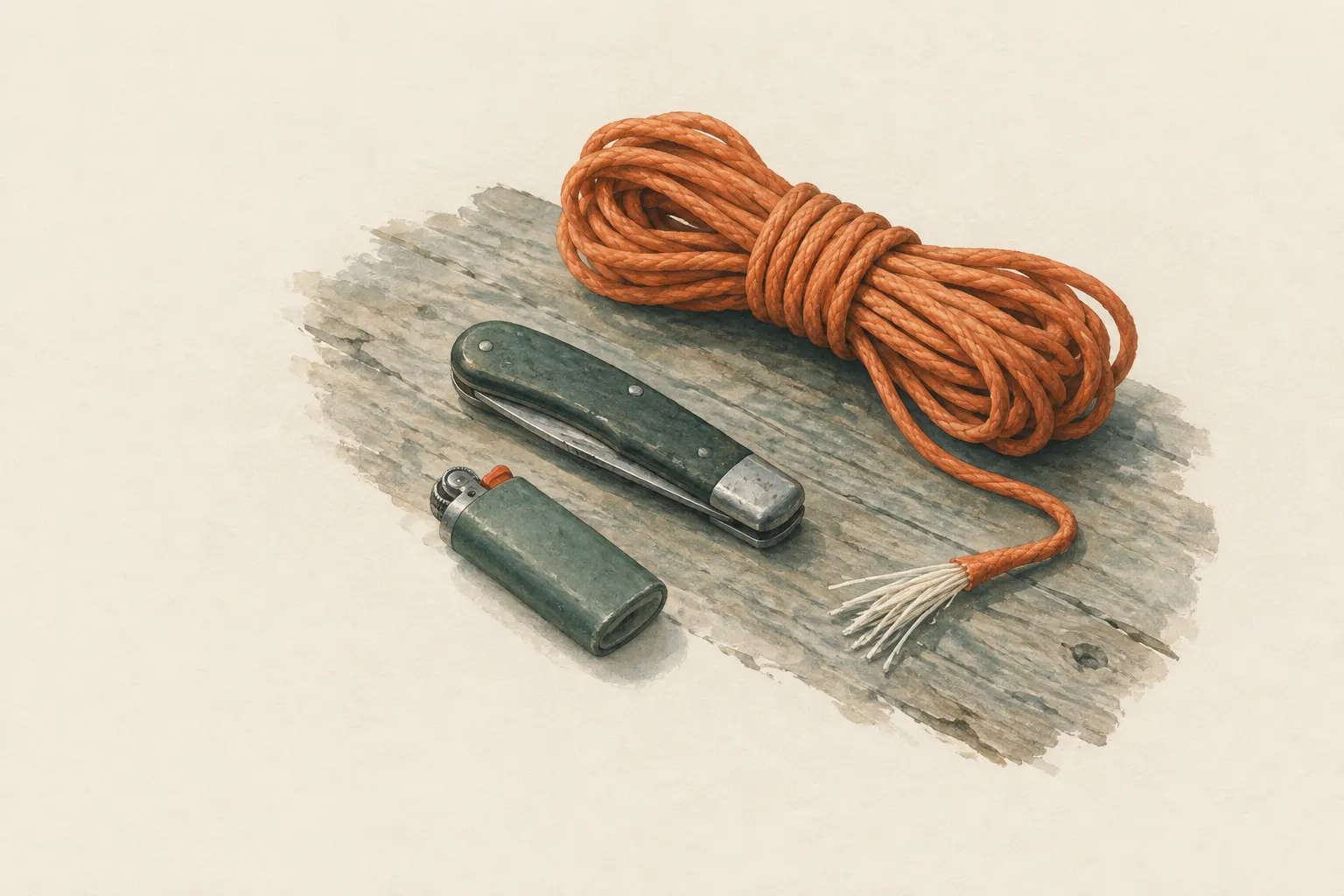
With a few metres of cord you can do a lot outdoors: string a line for a rain roof, replace a broken bootlace, tie sticks together or fasten things to your pack. You melt the ends together with a lighter so they do not fray – but careful, the melted end is very hot!
One thing you must never do: use paracord for climbing, abseiling or swings for people. It is not made for that. If it breaks under a person, they can be badly hurt. For people there are only real, tested climbing ropes.
How it works
Paracord is a so-called kernmantle cord. Outside lies a braided nylon sheath; inside run several core strands, the inner strands. The inner strands carry most of the load, the sheath protects them from abrasion and dirt. Nylon is tough, stretchy and does not rot – but it melts when it gets hot.
The US military specification MIL-C-5040H describes several types. Type III is designed for a minimum breaking strength of 550 pounds, about 250 kilograms, and has seven to nine inner strands. That is where the name “550 cord” comes from. Many cords sold in shops are called paracord but are not tested to this spec and hold less.
The breaking strength applies to a straight cord loaded slowly. Every knot, every sharp edge, every jerk, sunlight and age lower the real strength considerably. That is why, for a load you put on the cord, you plan with only a fraction of the stated breaking strength.
What really matters
Cut cord on a firm surface, not in the air. Then hold the end briefly in a flame until sheath and core fuse. Let it cool before touching it. If you do not want to or may not make a flame, wrap the end tightly with tape. That way the cord does not fray and the inner strands do not slip out.
For a ridgeline between two trees, use tree straps or put some cloth underneath so the cord does not cut into the bark. Fix one end with a bowline, the other with a taut-line hitch so you can retension it. For lashings, many tight turns hold better than one big knot.
The inner strands are thin and strong. You pull them out by pushing back the sheath at one end. They are suitable for sewing, fine repairs or tying down light things. The empty sheath then becomes a flat, soft tape.
Safety: what to watch out for
Paracord and utility cord from the outdoor shop are not climbing, belay or rescue ropes. Never hang people on them, abseil, belay or let children swing on them. For anything people hang on there are certified ropes – and training in how to use them.
Nylon stretches under load like a rubber band. If it breaks or a knot slips, the cord snaps back. So when tensioning you never stand in the line of pull and keep face and eyes out of the direction the cord could fly.
In first aid, cord only holds padding and splint in place. It must never be tied tightly around an injury or used as a tourniquet – thin cord cuts in and can cut off circulation. Check fingers or toes afterwards: they must stay warm, pink and with feeling. And call 112.
When it makes sense – and when not
Ten to fifteen metres of paracord or utility cord are useful on almost every trip: for tarp and washing line, for repairs and as a replacement for bootlaces or guylines. For camp lashings that you take down later, natural twine such as jute is a good alternative, because it rots if a scrap does get left behind.
For heavy loads such as a car, a log or a rope bridge, paracord is the wrong choice. And a braided bracelet looks handy, but it takes a long time to unpick – a loose hank in the pack is ready faster.
Good to know
Paracord comes from the suspension lines of military parachutes. Soldiers used leftover lines for all kinds of purposes early on, and so the cord became popular with outdoor fans. Today it comes in many colours; a bright colour helps you find the cord again at night and in leaves and makes trip hazards visible.
Store cord laid in loops into a hank and tied off; then it does not tangle. Run it through your hand once before each use. Abraded, hard or faded spots are a sign that the cord has become weaker – then retire it or use it only for light things.
Step by step
Choose the right cord
Type III paracord (“550 cord”) is designed to a US military spec for a minimum breaking strength of 550 pounds, about 250 kg, with seven to nine inner strands. Many cheap cords only carry the name and hold less. Utility cord from mountaineering (3–5 mm) stretches less.
- 1
Choose the right cord
Type III paracord (“550 cord”) is designed to a US military spec for a minimum breaking strength of 550 pounds, about 250 kg, with seven to nine inner strands. Many cheap cords only carry the name and hold less. Utility cord from mountaineering (3–5 mm) stretches less.
- 2
Cut and secure the ends
Cut with the knife on a firm surface. Hold the end briefly in the flame until sheath and core fuse, then let it cool. Alternatively wrap it with tape.
Hot nylon drips – away from your face, do not touch.
- 3
Rig a ridgeline
String it between two trees at chest height, with tree straps or padding so the bark is not damaged. One end fixed with a bowline, the other adjustable with a taut-line hitch.
- 4
Lashings and bundles
Join two poles with a square lashing, strap firewood or a sleeping pad to the pack. Many tight turns hold better than one big knot.
- 5
Repair
A broken bootlace, a snapped zip pull, a lost tent guyline: replace with cord and melt the ends. For a boot, a single inner strand is often too thin – better use the whole cord.
- 6
Secure a splint
In first aid, cord only holds padding and splint in place. Pad widely, do not knot over the injury, do not constrict. Check fingers or toes afterwards: warm, pink, with feeling. Call 112.
Never use as a tourniquet.
- 7
Use the inner strands
Push back a piece of sheath and pull out the inner strands. They are thin and strong enough for sewing, small repairs or tying light things. Use the empty sheath as a flat tape.
- 8
Store and check
Lay the cord in loops into a hank and tie it off so nothing tangles. Run it through your hand before use: abrasion, hard spots, a faded sheath – then retire it.
Common mistakes
- Using paracord for climbing or abseiling
- Trusting the label on cheap cord
- Standing in the line of pull when tensioning
- Shaping hot ends with your fingers
- Tying cord tightly around an injury
Quick view
Materials
Paracord
10–15 m on trips
Not a climbing or safety rope.
Accessory cord
3–5 mm utility cord as an alternative
Use only certified cord after training for life-safety purposes.
The diameter must suit the main rope or friction hitches will not grip.
Lighter, matches or ferro rod
For melting the ends
Observe local fire bans.
Knife (fixed or locking blade)
Cut away from your body.
Rules on carrying knives differ by region – check local rules.
Tree straps
Protect the bark with ridgelines
Load only within the manufacturer's limits.
Check for wear before each use.
Suitable for
- Tarp and washing lines
- Gear repairs
- Lashings in camp
- Securing padding and splint in first aid
Not suitable for
- Climbing, abseiling, belaying people
- Lifting or pulling heavy loads (car, log)
- Swings or rope bridges for children
- As a tourniquet for bleeding
Prerequisites
- A few basic knots: bowline, taut-line hitch, clove hitch
- Safe handling of knife and lighter
Safety
- Nylon stretches under load and snaps back when it breaks. When tensioning, do not stand in line with the pull and keep face and eyes out of the line.
- Molten nylon is very hot, drips and sticks to skin. Melt ends outdoors, away from your face, and do not shape them with your fingers before they have cooled.
How it works
Paracord is a kernmantle cord: a braided nylon sheath protects several inner strands that carry most of the load. Nylon is tough and stretchy but melts with heat. The breaking strength on the package applies to straight cord loaded slowly – knots, edges, shock loads and ageing lower it considerably. That is why you plan the working load with only a fraction of it.
Advantages
- Light, strong and versatile
- Inner strands as fine thread
- Ends are easy to melt
Disadvantages
- Stretches under load
- Melts with heat
- Quality in shops varies widely
- Not a safety rope
Deep knowledge
Background
Paracord comes from the suspension lines of military parachutes. The US military specification MIL-C-5040H describes several types; Type III, with a minimum breaking strength of 550 pounds, gave the cord the name “550 cord”. Parachutists and soldiers soon used leftover lines for all kinds of things.
Today much is sold as “paracord” without being tested to that spec. If you must rely on a certain strength, buy tested cord – and for people, only certified climbing and rescue ropes anyway.
Variants
- Bracelet
- Braided paracord bracelets contain only a few metres of cord and must first be laboriously unpicked. A loose hank in the pack is ready faster.
- Natural fibre
- Jute or sisal twine is weaker but rots if a scrap is left in the woods. Good for camp lashings that are taken down when breaking camp.
Common mistakes
- Using paracord for climbing or abseiling
- Trusting the label on cheap cord
- Standing in the line of pull when tensioning
- Shaping hot ends with your fingers
- Tying cord tightly around an injury
Limits and risks
- No load ratings for your own constructions
- No guidance on rope work with people
- First aid at lay level only
Material alternatives
Derived from material properties: a substitute must have all relevant properties. Observe the notes on the substitute.
- Paracord
- Rope (Never use unknown or damaged rope for life-safety purposes.), Thin, soft wire (brass or galvanised steel) (Wire ends are sharp – protect eyes and fingers when bending), Tow rope or tow strap (Attach only to the towing eyes provided by the manufacturer; never stand next to it under load.)
- Accessory cord
- Rope (Never use unknown or damaged rope for life-safety purposes.), Paracord (Not a climbing or safety rope.), Thin twine (Low breaking strength – light loads only.), Webbing (tubular webbing) (Inspect knotted webbing before every use.), Jute or sisal twine (bought) (Low strength, absorbs water and rots – light loads and practice only.), Tree straps (Load only within the manufacturer's limits.), Monofilament fishing line (Never leave scraps of line behind: birds and other animals get tangled in them and die slowly. Wind up scraps and take them with you.), Thin, soft wire (brass or galvanised steel) (Wire ends are sharp – protect eyes and fingers when bending), Tow rope or tow strap (Attach only to the towing eyes provided by the manufacturer; never stand next to it under load.)
- Lighter, matches or ferro rod
- Ferro rod (Practise before you need it.), Fire striker and hard stone (Carbon steel, not stainless.), Bow drill set (bow, spindle, hearth board, bearing block) (Use only dry wood.), Burning lens / magnifier (Never leave lying in the sun – fire risk.), Fire piston (Maintain the seal.), Pump drill (spindle, flywheel, crossbar, cord) (Fix the flywheel firmly and centrally – a loose disc can fly off.)
- Tree straps
- Rope (Never use unknown or damaged rope for life-safety purposes.), Paracord (Not a climbing or safety rope.), Thin twine (Low breaking strength – light loads only.), Accessory cord (Use only certified cord after training for life-safety purposes.), Webbing (tubular webbing) (Inspect knotted webbing before every use.), Jute or sisal twine (bought) (Low strength, absorbs water and rots – light loads and practice only.), Monofilament fishing line (Never leave scraps of line behind: birds and other animals get tangled in them and die slowly. Wind up scraps and take them with you.), Thin, soft wire (brass or galvanised steel) (Wire ends are sharp – protect eyes and fingers when bending), Tow rope or tow strap (Attach only to the towing eyes provided by the manufacturer; never stand next to it under load.)
Results come exclusively from structured entries. No improvised instructions are generated.
Sources
U.S. Department of Defense: MIL-C-5040H – Cord, Fibrous: Nylon (military specification for parachute cord, Types I–IV)
Types of paracord, Type III with 550 lb minimum breaking strength and inner strands
Clifford W. Ashley – Doubleday, Doran & Co. (1944): The Ashley Book of Knots
Knots and lashings for lines and loads
The Mountaineers Books (2017): Mountaineering: The Freedom of the Hills, 9th edition
Accessory cord and ropes: strength loss from knots, no belaying with accessory cords
European Resuscitation Council – Resuscitation (journal) (2021): European Resuscitation Council Guidelines 2021: First Aid
Lay first aid for fractures