Improvising a backpack: blanket roll, bundle pack, jacket pack
If your backpack is lost or broken, you can still carry things with a tarp, blanket or jacket and some cord. The blanket roll (horseshoe pack) lies diagonally over the shoulder, the bundle pack has two cord straps, and a jacket or trousers become a simple bag with straps. What matters are wide, padded straps, tight tying and a light load – and frequent checks for pressure points.
- 10–20 minutes
Explained simply
What do you do if your backpack breaks or gets lost but you still have to carry things? You can build a simple pack from a blanket, a tarp or even a jacket. All you need besides is a piece of cord.
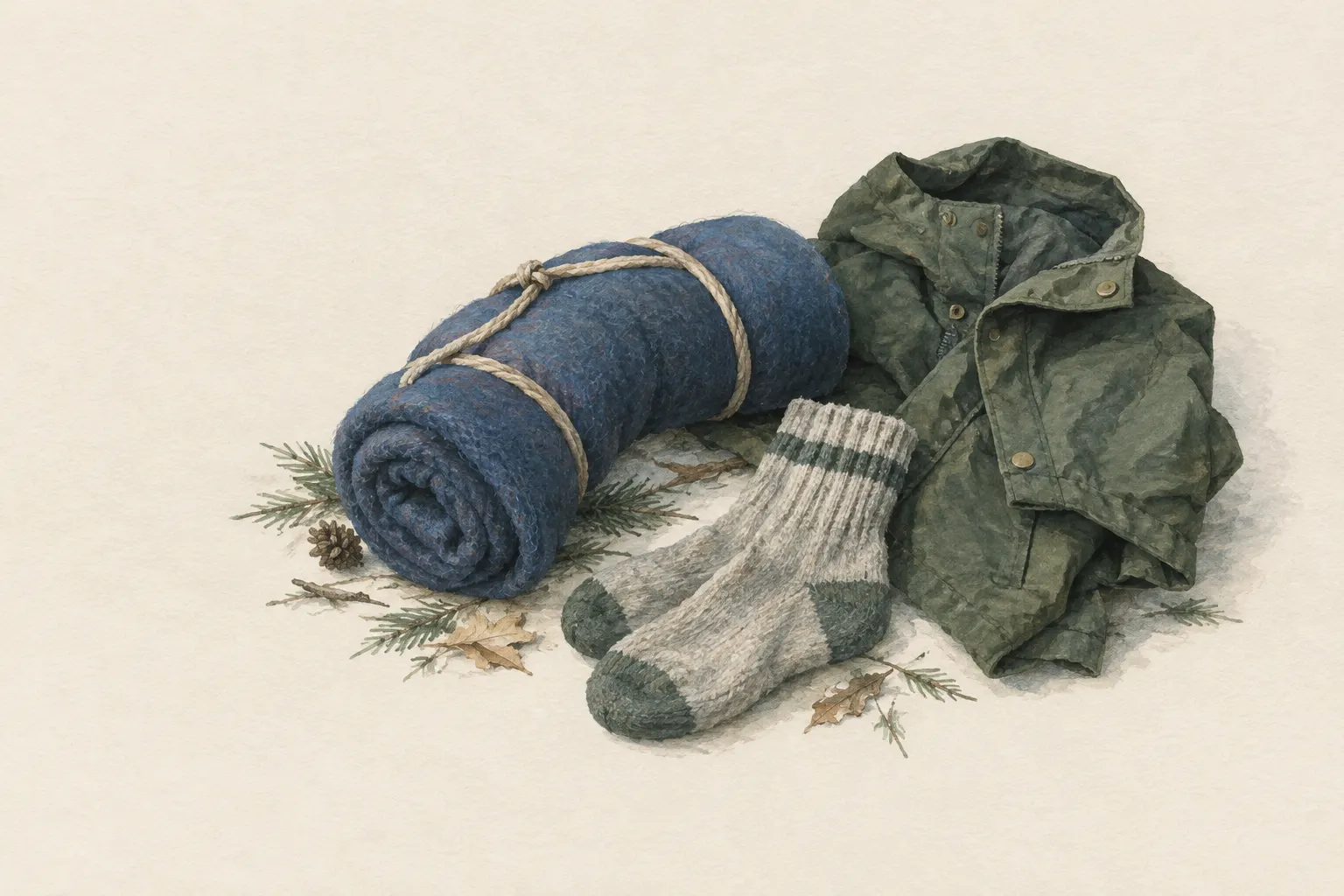
The simplest form is the blanket roll: you lay your things in a row on the blanket, roll it up tightly like a sleeping bag, tie the ends and bend the roll into a horseshoe. Then you carry it diagonally over your shoulder. Or you make a parcel with two cord loops as straps.
Cord on the shoulder soon hurts. So you put socks or gloves underneath. And importantly: when it is cold, never turn your only warm jacket into a pack – staying warm is more important than luggage.
How it works
A backpack does three things: it holds things together, it keeps them close to the body, and it spreads the weight over wide straps. An improvised pack imitates this. The cover – blanket, tarp, jacket – holds everything together. The tying stops anything shifting or falling out. And the straps should be as wide as possible so they spread the pressure over a large area.
The horseshoe roll lies diagonally over one shoulder and against the back. Because the weight is spread on both sides of the roll, it does not pull you to the side as much as a simple bag. The bundle pack with two shoulder loops sits centrally on the back, similar to a real backpack, but needs good padding.
A jacket or trousers become a bag when you tie the openings shut. With the jacket the bottom hem is tied shut and the sleeves become straps; with trousers the leg ends are tied off and the legs are put over the shoulders. This is quick to do but only holds light loads.
What really matters
The most important step is the first: sort out. The less you carry, the better any improvised pack holds and the less it hurts. Important things like phone, survival kit, map and first-aid material go in your jacket pockets so you still have them if you need to put the load down or leave it behind.
In the blanket roll, soft things go on the outside and hard, angular things in the middle. That way nothing presses into your back. The roll must be wound tightly and tied firmly at both ends and two or three times in between, otherwise it falls apart while you walk.
The straps are the weak point. Thin cord cuts in and presses on nerves and blood vessels at the shoulder. Put socks, gloves or a folded cloth underneath, or use wide tape or strips of cloth as straps. After ten to fifteen minutes stop and check whether everything sits well and nothing presses.
Safety: what to watch out for
In the cold, warmth always comes before luggage. Anyone who turns their only warm jacket into a pack risks hypothermia. Then rather take less and keep the jacket on. A blanket or tarp you use for carrying can serve as warmth and weather protection again in the evening.
Improvised packs swing and shift more easily than a real backpack. In steep, slippery or exposed terrain walk slowly and keep your hands free. If the load throws you off balance, put it down – if in doubt, leave it behind.
Tingling or numbness in the arms and hands is a warning sign: a strap is pressing on nerves or blood vessels. Put it down immediately, pad the straps more widely and shift the load to the other shoulder or onto two straps.
When it makes sense – and when not
An improvised pack helps when a backpack tears on the trail, when belongings have to be carried after an evacuation or when there is extra load for a short distance. But often your own pack can be saved: a torn strap is replaced with tape or cord, a broken buckle bridged with a cable tie or a knot. That is almost always more comfortable than any improvised pack.
Improvised packs are no good for heavy loads over long distances. They press, shift and tire you quickly. Then it is better to leave luggage behind, share it out or get help.
Good to know
The blanket roll over the shoulder was long the typical luggage of soldiers, itinerant workers and travellers. Military survival manuals such as FM 3-05.70 describe the horseshoe pack and the square pack as stopgaps.
A strong bin bag is also a good cover: waterproof and light. Tie a small pebble into each bottom corner and attach the cord straps to it – that way the bag does not tear out at the knots. It is, however, sensitive to thorns and sharp edges.
Step by step
Sort and lighten
Spread everything out. Important things like phone, survival kit, map and first aid go in your jacket pockets. What you do not need stays behind – the lighter the load, the better any improvised pack holds.
- 1
Sort and lighten
Spread everything out. Important things like phone, survival kit, map and first aid go in your jacket pockets. What you do not need stays behind – the lighter the load, the better any improvised pack holds.
- 2
Lay out the cover
Spread the tarp or blanket flat. For the blanket roll lay the items in a row along one edge: soft things outside, hard and angular things in the middle.
- 3
Roll it tightly
Roll tightly from the loaded edge. Tie both ends of the roll closed, then put two or three more ties around the roll so nothing slips out.
- 4
Bend into a horseshoe
Bend the roll into a horseshoe and tie the two ends together. Wear it diagonally over one shoulder with the ends at the opposite hip. Switch shoulders regularly.
- 5
Or: a bundle pack
Put the items in the middle of a square of tarp, fold the sides over like a parcel and tie it crosswise tightly. Attach two cord loops at top and bottom – these are the shoulder straps.
- 6
Or: jacket or trousers
Close the jacket, tie the bottom hem tightly shut and fill it from the top. Put the sleeves over your shoulders and knot them to the bottom corners. With trousers, tie off the leg ends and use the legs as straps.
- 7
Pad the straps
Where cord lies on the shoulder, put socks, gloves or a piece of cloth underneath. Wide straps of tape or strips of cloth are better than thin cord.
- 8
Check after 10–15 minutes
Stop briefly: is everything secure? Is anything pressing? Do your arms tingle? Retighten knots, move padding, redistribute the load. Then repeat about every hour.
Common mistakes
- Taking too much
- Hard objects on the outside of the roll
- Thin cord as straps without padding
- Loose tying – the roll falls apart
- Turning your only warm jacket into a pack
Quick view
Materials
Tarp
Or blanket, poncho, large bin bag
Wool blanket / duvet
Keep away from candles, stoves and heaters.
Paracord
About 5–8 m
Not a climbing or safety rope.
Rain and wind shell
Jacket or trousers for the jacket pack
Webbing (tubular webbing)
Wide tape for straps, if available
Inspect knotted webbing before every use.
UV light and abrasion age webbing; do not load damaged webbing.
Suitable for
- A torn backpack on the trail
- Carrying belongings after an evacuation
- Extra load over short distances
Not suitable for
- Heavy loads over long distances
- Climbing or fall terrain where you need both hands and balance
- When the only warm jacket would have to come off for it
Prerequisites
- A few secure knots (e.g. reef knot, clove hitch)
- A tarp, blanket or jacket you can spare
Safety
- In cold weather never turn your only warm jacket into a pack. Warmth comes before luggage – carry less instead.
- Improvised packs swing and shift. In steep, slippery or exposed terrain walk slowly, keep your hands free and leave the load behind if necessary.
- Thin cord cuts into the shoulders and can press on nerves and blood vessels. If your arms tingle or go numb: put it down at once and pad the straps more widely.
How it works
A backpack spreads weight over wide straps onto shoulders and hips and keeps the load close to the body. An improvised pack imitates this: the cover holds everything together, the tying stops shifting, wide straps spread the pressure. The more compact and the closer to the body, the less the load pulls you backwards.
Advantages
- Possible with everyday materials
- Hands stay free
- The cover serves as a blanket or tarp again at the destination
Disadvantages
- Uncomfortable with heavy loads
- Shifts and swings
- Costs time and cord
Deep knowledge
Background
The blanket roll over the shoulder was long the luggage of soldiers, itinerant workers and travellers. Military survival manuals such as FM 3-05.70 describe the “horseshoe pack” and the “square pack” among field-expedient equipment as stopgaps when no rucksack is at hand.
Today the most likely case is a torn strap or a broken buckle. Then repairing is usually the best solution; the improvised pack is plan B.
Variants
- Bin-bag pack
- A strong bin bag knotted at the top, with a small pebble tied into each bottom corner: attach the cord straps there. Waterproof, but sensitive to thorns.
- Patch the broken pack
- Often your own pack can be saved: replace a torn strap with tape or cord, bridge a broken buckle with a cable tie or a knot. That is usually better than any improvised pack.
Common mistakes
- Taking too much
- Hard objects on the outside of the roll
- Thin cord as straps without padding
- Loose tying – the roll falls apart
- Turning your only warm jacket into a pack
Limits and risks
- Only for light to medium loads
- No substitute for a well-fitting pack on long trips
Material alternatives
Derived from material properties: a substitute must have all relevant properties. Observe the notes on the substitute.
- Tarp
- Plastic sheet / large bin bag (Tears easily; never pull over the head (suffocation risk).), Emergency blanket (Tears easily once punctured; short-term shelter only.), Document folder (waterproof) (Store securely – contains sensitive personal data.), Rain poncho (When used as a shelter, it no longer protects your body from rain.), Bivy bag (Never fully close off the face.), Tent (Do not cook or heat inside the tent (fire and carbon monoxide danger).), Heavy-duty bin bag (large) (Suffocation risk: never pull plastic bags over the head or face and keep them away from small children.), Group shelter bag (Airtight – ventilate regularly.)
- Wool blanket / duvet
- Sleeping pad, Dry leaves, grass or conifer boughs (Collect only where allowed; no protected plants. Check for ticks and insects.), Backpack, Dry spare clothing (Carry it in waterproof packaging – wet clothing barely insulates.), Insulated cool box (Keeps cold only for a limited time; without ice packs or ice it is not a fridge.), Sleeping bag (Do not store compressed long-term; do not pack away damp.), Newspaper and cardboard (Flammable – keep away from candles, stoves, heaters and embers.), Insulated cooking box (hay box, thermal cooker) (Never put open flame or embers inside – only the hot, closed pot.), Long-stemmed thatch (reed, grass, rushes) (Extremely flammable – no open fire and no sparks nearby.)
- Paracord
- Rope (Never use unknown or damaged rope for life-safety purposes.), Thin, soft wire (brass or galvanised steel) (Wire ends are sharp – protect eyes and fingers when bending), Tow rope or tow strap (Attach only to the towing eyes provided by the manufacturer; never stand next to it under load.)
- Rain and wind shell
- Cotton cloth / T-shirt (Removes coarse particles only – no disinfection.), Fine cloth or muslin net against flies (Keep clean and dry; do not hang it over the flames.)
- Webbing (tubular webbing)
- Rope (Never use unknown or damaged rope for life-safety purposes.), Paracord (Not a climbing or safety rope.), Thin twine (Low breaking strength – light loads only.), Accessory cord (Use only certified cord after training for life-safety purposes.), Jute or sisal twine (bought) (Low strength, absorbs water and rots – light loads and practice only.), Tree straps (Load only within the manufacturer's limits.), Monofilament fishing line (Never leave scraps of line behind: birds and other animals get tangled in them and die slowly. Wind up scraps and take them with you.), Thin, soft wire (brass or galvanised steel) (Wire ends are sharp – protect eyes and fingers when bending), Tow rope or tow strap (Attach only to the towing eyes provided by the manufacturer; never stand next to it under load.)
Results come exclusively from structured entries. No improvised instructions are generated.
Sources
Headquarters, Department of the Army (USA) (2002): FM 3-05.70 Survival
Field-expedient packs: horseshoe pack and square pack
Mors L. Kochanski – Lone Pine Publishing: Bushcraft: Outdoor Skills and Wilderness Survival
Carrying and lashing loads by improvisation