The first minutes after getting lost: stopping panic, regaining control
The moment you realise you are lost is dangerous – not because of the forest, but because of panic. Many people then start walking faster or even running and tell themselves the map still fits. That makes everything worse. This guide shows step by step how to stop, sit down, drink, check honestly, write everything down and then make a calm decision.
- 10–20 minutes for the first steps
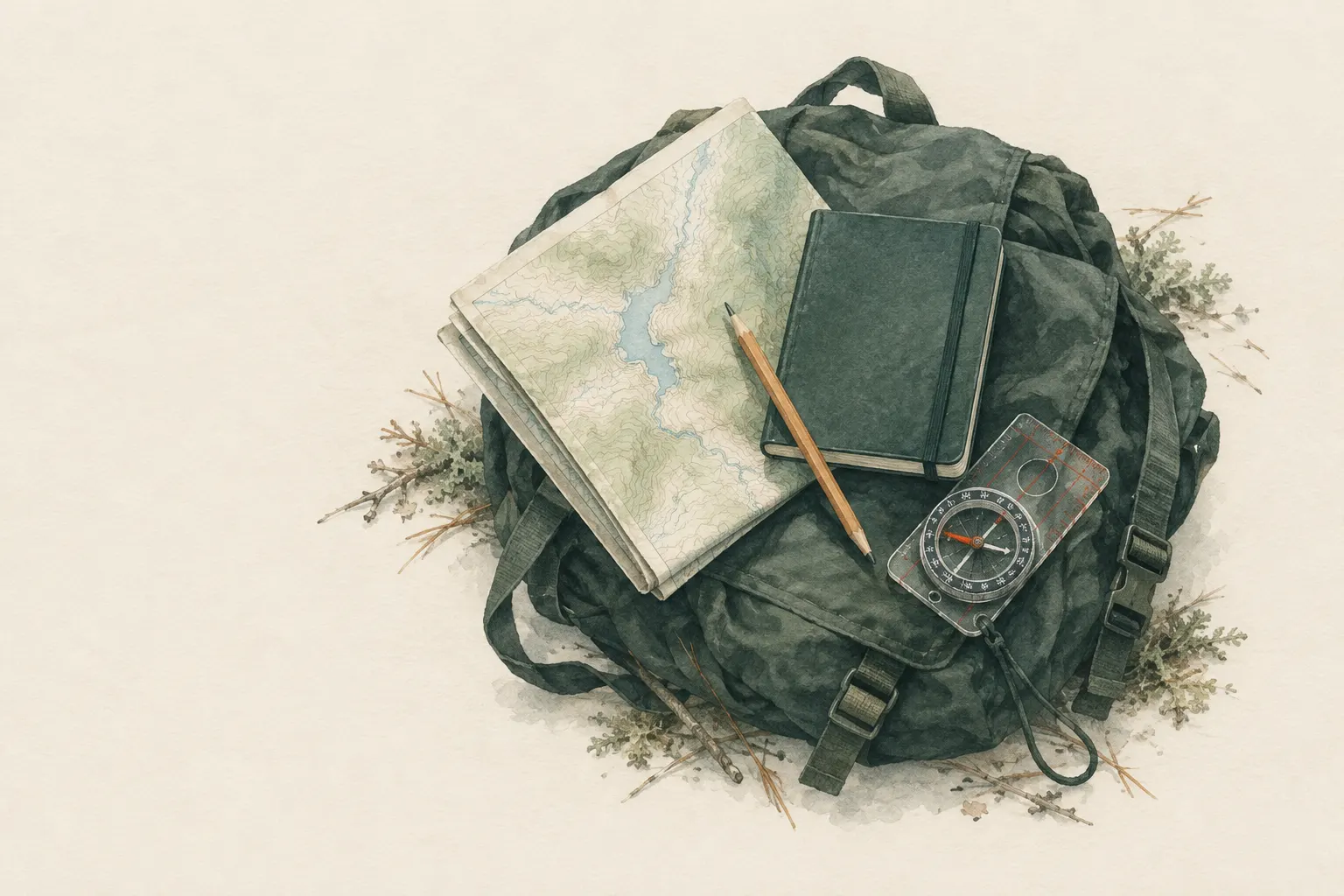
Explained simply
Imagine you are walking through the forest and suddenly realise: I have never been here before. The path is gone, everything looks the same. Your heart pounds and you want to hurry on to find the path again. But that is exactly the most dangerous moment. Anyone who starts running now usually gets even more lost and may fall.
That is why there is a simple order: stop. Sit down, ideally on your backpack. Breathe slowly. Drink a few sips and eat something. Then think honestly: where was I last completely sure? And write down everything you know – with the time. Writing helps your mind to think in an orderly way again.
After that you decide calmly. If you have phone reception, call 112 and stay where you are. Without reception staying is usually right, especially if someone knows where you wanted to hike. With three whistle blasts and bright clothing you make yourself findable. That puts you back in control – even if you do not yet know where you are.
How it works
Realising you are lost triggers a strong stress reaction. Search services speak of “woods shock”: pulse and breathing race, thinking narrows, and the urge to do something – above all to walk on quickly – becomes overwhelming. In this state people rarely make good decisions. The body is set for flight, not for thinking.
A second well-known phenomenon is “bending the map”. You want so much to believe you are right that you argue away contradictions: the stream flows the wrong way? Then it must be a different stream. The slope rises although it should fall? The map must be inaccurate. So you keep going further in the wrong direction.
Sitting down, breathing, drinking and writing slow both down. They take the body out of flight mode and force thinking into an order: what do I know for sure, what am I only guessing? Only then is a decision made – with an eye on what rescuers need to find you.
What really matters
The most important step is the first: stop immediately when doubts arise. Not “just as far as the next bend”. Mark the spot with something conspicuous, such as a bright cloth on a branch. Then sit down, ideally on your pack, and put on a layer – after walking you quickly chill when sitting.
When checking honestly, the question of the last certain point helps: a hut, a path junction, a summit cross where you were completely sure. From there you think about how long and roughly in which direction you have walked since. If things around you do not fit the map, say it out loud: “I do not know where I am.” That is not failure but the beginning of a good decision.
Write down: time, last certain point, route since then, what you see and hear, supplies, battery level, weather, remaining daylight. With these notes you can calmly give all the important details during the emergency call. With reception: call 112, follow the instructions, stay put and keep the phone switched on sparingly for callbacks.
Safety: what to watch out for
Panicked walking or running is dangerous: falls, injuries, sweat-soaked clothing that chills you later, and an ever larger search area. Following a stream downhill also sounds sensible but often leads into gorges, to waterfalls and into dense, wet terrain. Scout at most briefly within sight of the marked spot and with a fixed way back.
If it will be dark in less than about two hours, preparing for the night takes priority: insulation, warmth, protection from wind and wet. Without reception the distress signal of three blasts, pause, repeat helps; bright clothing or a signal panel makes you visible from above. In Austria you can also reach mountain rescue on 140 in the mountains; 112 works everywhere in the EU, even without credit.
When it makes sense – and when not
These steps suit anyone who loses their bearings outdoors: hikers, runners, foragers, hunters, families. Groups who disagree about where they are also benefit – then one person writes and everyone says what they remember. They are especially important when someone knows your route plan, because rescuers then search first along the planned route.
They are not suitable when there is acute danger at your location, such as rockfall, rising water or fire. Then you first move to a nearby safe place and start the steps there. With life-threatening injuries the emergency call has absolute priority.
Good to know
Search-service literature such as Robert Koester's handbook “Lost Person Behavior” describes how differently lost people behave and helps rescuers search in a targeted way. A recurring idea in it: anyone who stays in one place and makes themselves visible makes rescuers' work considerably easier.
The feeling of “just sitting around stupidly” is normal. But in this situation sitting is an active decision: you save energy, stay warm, get found and make no rash mistakes. How to find your own position systematically afterwards is explained in the navigation entries on the STOP rule and on relocation.
Step by step
Stop immediately
As soon as doubts arise, stop – right there. Not “just as far as the next rise”. Every step without a plan can take you further away from your route and from searchers. If possible, mark the spot with a conspicuous object.
- 1
Stop immediately
As soon as doubts arise, stop – right there. Not “just as far as the next rise”. Every step without a plan can take you further away from your route and from searchers. If possible, mark the spot with a conspicuous object.
- 2
Sit down and breathe
Take off your pack and sit on it so you are not on cold ground. Breathe slowly for a few minutes, out longer than in. Say aloud: “I am lost. It happens. I have time.” Panic subsides when the body calms down.
- 3
Drink and eat something
Drink a few sips and eat a little. That gives your hands a calm task, and thirst and low blood sugar worsen thinking. Put on a layer before you get cold – after sweating you quickly chill when sitting.
- 4
Check honestly, do not bend the map
Ask yourself: where was I last completely sure? What has happened since then? What do I really see now? If stream, path or slope do not fit the map, admit: “I do not know where I am.” Do not explain differences away – that is exactly what bending the map means.
- 5
Write everything down
Note the time, the last certain point, the rough route since then, what you see and hear, water, food, battery level, weather and how long it will stay light. Writing forces slow, orderly thinking – and the notes later help you and the rescuers.
- 6
Call for help and decide calmly
With reception: call 112, give your situation and notes, then stay. Without reception the rule is usually: stay, especially if someone knows your route plan, you are injured or it will soon be dark. Only move if the target is safe and certain – for example back along your own clearly visible track to the last certain point.
Short scouting trips only within sight of the marked spot and with a fixed way back.
- 7
Make yourself findable
Three strong blasts, pause, repeat – the well-known distress signal. Make bright clothing or a signal panel openly visible. If you stay: start early on insulation, warmth and a place for the night. That puts you back in control even if you do not yet know where you are.
Common mistakes
- Walking faster to “make up time”
- Bending the map instead of admitting you are lost
- Scouting without a marker and losing the starting point
- Draining the battery searching in apps before the emergency call is made
- Following a stream downhill without knowing the dangers
Quick view
Materials
Field notebook and pencil
A pencil writes even when wet and cold
Signal whistle
Carry within easy reach, not deep in the pack.
Do not blow right next to other people's ears.
Mobile phone
The battery drains quickly in cold and with continuous screen and GPS use.
Do not plan on it as your only means of navigation or emergency calls.
Topographic map
Check the publication date – paths and buildings may have changed.
Protect from wet (map case or bag).
Baseplate compass
Metal, magnets and electronics nearby deflect the needle.
Bubbles in the capsule or a sluggish needle indicate a defect.
Suitable for
- Hikers, foragers, hunters, runners who have lost their bearings
- Anyone who realises: “I have never been here before”
- Groups who disagree about where they are
Not suitable for
- Acute danger at your location (rockfall, flooding, fire) – first move to a nearby safe place
- Life-threatening injuries – call 112 immediately
Prerequisites
- Some water and, if possible, a little food
- Ideally a route plan left with someone
Safety
- If it will be dark in less than about two hours, preparing for the night is usually more important than any attempt to find the way.
How it works
People who realise they are lost often feel a shock that search services describe as “woods shock”: pulse and breathing race, thinking narrows, the urge to rush off is strong. On top of that comes “bending the map”: explaining away differences between map and terrain because you want to believe you are right. Sitting down, drinking and writing things down slow the body and force thinking into a calm order.
Advantages
- Prevents the most common follow-on mistakes after getting lost
- Needs only paper and pencil
- Gives rescuers useful information
Disadvantages
- Feels like a waste of time at first
- Does not replace navigation skills
Deep knowledge
Background
The literature of search services, such as Robert Koester's handbook “Lost Person Behavior”, describes how differently lost people behave and why many keep walking instead of stopping. Terms such as “woods shock” and “bending the map” come from this tradition. The US Army survival manual (FM 3-05.70) advises first sizing up the situation, avoiding haste and consciously confronting fear and panic.
How to then find your position systematically is explained in the navigation entries on the STOP rule and on relocation.
Variants
- In a group
- Everyone stays together, one person writes notes, everyone says what they remember. Disagreement is normal – what matters is that nobody sets off alone.
- With a phone map
- Check your position in offline map mode and write down the coordinates, then switch off the screen. Give the coordinates during the emergency call.
Common mistakes
- Walking faster to “make up time”
- Bending the map instead of admitting you are lost
- Scouting without a marker and losing the starting point
- Draining the battery searching in apps before the emergency call is made
- Following a stream downhill without knowing the dangers
Limits and risks
- Not a navigation guide – see the navigation entries
- Whether staying or moving is right depends on the situation; when in doubt, stay
Material alternatives
Derived from material properties: a substitute must have all relevant properties. Observe the notes on the substitute.
- Mobile phone
- Headlamp / flashlight, Battery lantern / LED light
Results come exclusively from structured entries. No improvised instructions are generated.
Sources
Robert J. Koester – dbS Productions (2008): Lost Person Behavior: A Search and Rescue Guide on Where to Look – for Land, Air and Water
Behaviour of lost persons and typical reactions after getting lost
Headquarters, Department of the Army (USA) (2002): FM 3-05.70 Survival
Size up the situation, avoid haste, confront fear and panic
European Commission: 112 – the European emergency number
European emergency number 112
Bundesministerium für Finanzen – Amtshelfer oesterreich.gv.at: Notrufnummern (oesterreich.gv.at)
Emergency numbers in Austria, including 140 alpine emergency