The figure-4 deadfall
In the figure-4 deadfall three notched sticks – upright, diagonal and bait stick – hold a heavy flat stone at an angle in the air. When an animal tugs at the bait, the frame slips apart and the stone falls. It must be heavy enough to kill instantly. Setting it is precision work and dangerous for your own fingers: your hand is never under the weight.
- 30–60 minutes per trap, practice needed beforehand
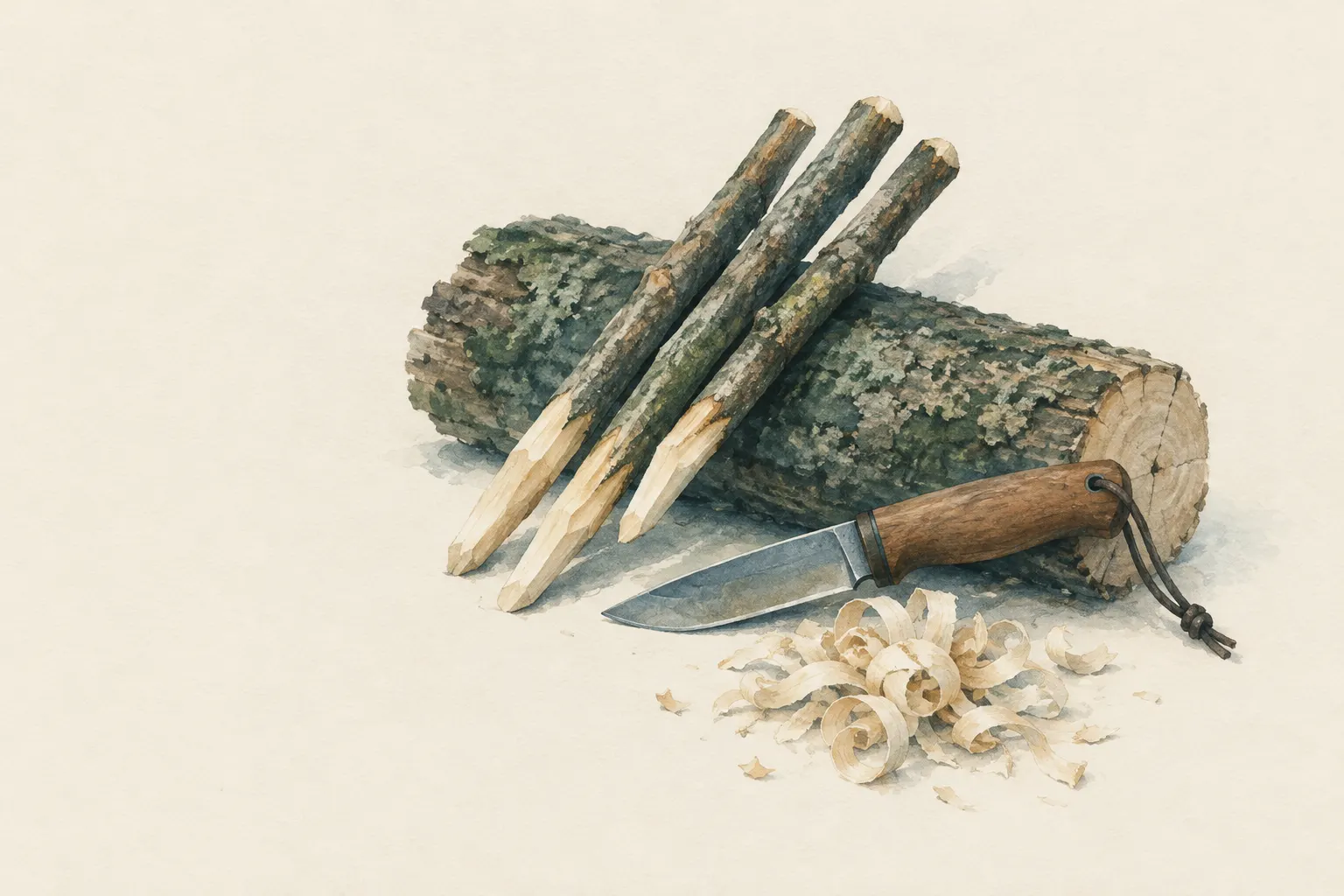
Explained simply
In the figure-4 trap a small frame of three sticks holds a heavy, flat stone at an angle in the air. From the side, the three sticks look like the number 4 – that is where the name comes from. Under the stone lies some bait.
When a small animal tugs at the bait, one stick slips away, the whole frame collapses and the stone falls down. It must be so heavy that the animal is dead at once and does not suffer. This only works if the notches in the sticks are carved very precisely.
The trap is dangerous for you too: a falling stone can break fingers. So you never put your hand under the stone, children stay well away, and it is only set in genuine danger to life – otherwise it is forbidden.
How it works
The trap consists of three parts. The upright stands vertically, with a flat wedge tip at the top and a square notch in the middle. The diagonal stick rests with a notch on the upright's tip like a seesaw. The bait stick lies horizontally, is hooked onto the upright by its square notch and holds the lower end of the diagonal with its rear notch.
The weight presses on the upper end of the diagonal. Because it pivots on the upright's tip, its lower end pushes hard against the bait stick, and the bait stick is pressed into the upright's notch. The three sticks thus hold each other under tension – the heavier the weight, the tighter.
When an animal tugs at the bait, the bait stick shifts a little. Its notch slips off the upright, the diagonal flies away and the weight falls onto the animal. The same principle – stored potential energy released by a small trigger – can be shown safely with dominoes in the mechanics entry.
What really matters
Precision in the notches is everything. The square notches of the upright and the bait stick must be right-angled and clean so they lock together but release easily when moved. That is why you practise the trap without a weight first and re-carve until it holds under light pressure and reliably collapses when tapped. FM 3-05.70 explicitly stresses that you should practise it beforehand.
The weight must be much heavier than the animal, rest flat and fall onto a hard base – ideally a flat stone in the ground. On soft ground the animal is only pressed into the soil and suffers. A weight that is too light is worse than no trap at all.
The wood should be dry, straight and sound. Rotten wood breaks; very fresh, bendy wood deforms under the weight, and then the notches no longer engage properly.
Safety: what to watch out for
The greatest danger when setting are your own hands. The golden rule is: the hand is never under the weight. So you put the bait on before the weight is resting on the frame, kneel to the side and hold the weight from above at the outer edge. If it falls while you set it, let go and pull your hand back – never grab after it.
When checking and dismantling, your hand stays away too: you set the trap off from the side with a long stick. Children keep several metres away, never build a trap themselves and are told where traps are.
Legally the same applies as for all traps: without hunting rights it is poaching, traps that do not kill instantly are banned, and unnecessary suffering is an offence under animal-welfare law. The trap is only meant for genuine danger to life when no rescue can be reached.
When it makes sense – and when not
The figure 4 is suitable for small game and rodents at feeding places and runs when there are flat stones or heavy pieces of log nearby. It needs only wood and a knife and, with the right weight, kills instantly – an advantage over the snare from an animal-welfare point of view.
It is unsuitable on soft ground without a hard base, in strong wind or rain that can set it off, and anywhere children, pets or other people can get to. Anyone who is inexperienced and cannot carve cleanly should choose the Paiute trap first, or no trap at all.
Good to know
You can learn the mechanism safely at home: three pencils or lolly sticks with notches, a light book as the weight, no bait. That way you practise angles and notches without ever endangering an animal – and when you notice how much finesse is needed, you understand why experts say you should practise the trap beforehand.
When carving, always: away from your body, legs out of the cutting line, safe grips. A cut in the hand is a serious injury in the wild. The carving grips are explained in the entry on safe knife handling.
Deadfalls also go off from wind, rain, birds or falling twigs. A sprung trap without a catch is normal – you reset it using the same safety rules or dismantle it.
Step by step
Choose site, weight and base
Look for a feeding place or run used by small animals, far from paths and camp. You need a flat, heavy stone or a heavy piece of log, much heavier than the animal, and a hard, level base – ideally a flat stone in the ground. On soft ground the animal is only pressed into the soil instead of being killed instantly.
- 1
Choose site, weight and base
Look for a feeding place or run used by small animals, far from paths and camp. You need a flat, heavy stone or a heavy piece of log, much heavier than the animal, and a hard, level base – ideally a flat stone in the ground. On soft ground the animal is only pressed into the soil instead of being killed instantly.
- 2
Prepare three sticks
Cut three straight, dry and sound sticks, about thumb-thick and, for small game, about forearm-long: the upright, the diagonal and the slightly longer bait stick. Rotten or very bendy wood will not hold the notches.
- 3
Carve the upright
Carve the top end of the upright into a flat wedge tip like a screwdriver. About halfway down, cut a square notch into one side with exactly right-angled edges. Always carve away from your body.
- 4
Carve the diagonal stick
A short distance from one end, cut a notch that fits exactly onto the wedge tip of the upright. Carve the other end of the diagonal stick into a flat wedge tip as well.
- 5
Carve the bait stick
Near the rear end goes a small notch in which the wedge tip of the diagonal sits. Where the bait stick crosses the upright, cut a square notch that locks into the upright's notch. Sharpen the front end for the bait.
- 6
Practise without the weight
Stand the upright vertically on the base, hook the bait stick's notch into the upright's notch, set the diagonal's notch on the upright's tip and its lower end in the bait stick's notch. Press lightly on the upper end with one finger: the frame must hold and collapse when the bait stick is tapped lightly. Re-carve the notches until it works reliably.
- 7
Fix the bait, lower the weight from the side
First push the bait onto the bait stick. Rest one edge of the weight on the ground and hold it with one hand from above at the rear edge. With the other hand assemble the frame and slowly lower the weight onto the upper end of the diagonal. Kneel to the side; your hand stays at the outer edge of the weight.
If the weight falls while you set it, do not grab after it – let go and pull back.
- 8
Check, mark, keep away
Check from a distance at the side that the weight rests securely and sits above the bait and the base. Mark the spot, enter it in the list and check at least daily. When checking and dismantling, set the trap off from the side with a long stick.
Common mistakes
- Weight too light or base too soft
- Inaccurate notches – the trap falls at once or not at all
- Fixing bait when the weight is already resting on the frame
- Hand under the weight while setting
- Not practising the trap without a weight first
- Setting the trap off by hand instead of with a stick
Quick view
Materials
Sturdy sticks / poles
Three straight, dry, sound sticks, about thumb-thick
Do not cut live wood where prohibited.
Knife (fixed or locking blade)
For carving the notches
Cut away from your body.
Rules on carrying knives differ by region – check local rules.
Sturdy work gloves
When handling flood mud or chemicals, also wear waterproof gloves.
Brightly coloured flagging tape
Remove every piece again when dismantling
Suitable for
- Small game and rodents at feeding places and runs
- Terrain with flat stones or heavy pieces of log
Not suitable for
- Children nearby – a falling weight causes serious injury
- Soft ground without a hard base
- Any place that pets or people can reach
Prerequisites
- Genuine danger to life, no rescue within reach
- Able to carve safely with a knife
- Basic rules from “Traps in a genuine emergency” read
Safety
- A weight that is too light only injures the animal and makes it suffer. The weight must be much heavier than the animal and come down onto a hard base.
How it works
The weight presses on the upper end of the diagonal stick. It rests like a seesaw on the tip of the upright, so its lower end pushes against the end of the bait stick. The bait stick in turn is hooked onto the upright by a notch. In this way the three sticks hold each other under tension. If the animal moves the bait stick only slightly, its notch slips off the upright, the triangle collapses and the weight falls.
Advantages
- Kills instantly with the right weight
- Only wood and a knife needed
- Only goes off when the bait is pulled
Disadvantages
- Carving the notches takes practice and time
- Danger to fingers and hands when setting
- Also goes off from wind, rain or birds
- Illegal without hunting rights
Deep knowledge
Background
The name comes from the shape: seen from the side, the upright, bait stick and diagonal form a figure 4. FM 3-05.70 describes the figure 4 as a trigger that drops a weight and stresses that the weight must kill or incapacitate immediately and that the build should be practised beforehand because it needs precise angles.
How levers and stored energy work together here can be tried out safely with the tabletop experiments in the mechanics entry.
Variants
- Log instead of stone
- A heavy, short piece of log works like a stone. It must rest flat enough not to roll away sideways.
- Practise only as a model
- If you want to learn the mechanism in advance, build the three sticks at home in miniature with a light book as the weight – without bait and without ever catching anything.
Common mistakes
- Weight too light or base too soft
- Inaccurate notches – the trap falls at once or not at all
- Fixing bait when the weight is already resting on the frame
- Hand under the weight while setting
- Not practising the trap without a weight first
- Setting the trap off by hand instead of with a stick
Limits and risks
- No weight figures – only “much heavier than the animal”
- Small game only; no deadfalls for larger animals
Sources
Headquarters, Department of the Army (USA) (2002): FM 3-05.70 Survival
Figure-4 trigger of three notched sticks; weight must kill immediately; practise beforehand because precise angles are needed
Bundesrepublik Deutschland – Bundesministerium der Justiz (gesetze-im-internet.de) (1976): Bundesjagdgesetz (BJagdG) in der Fassung der Bekanntmachung vom 29. September 1976
§ 19: ban on snares of any kind and on traps that neither catch unharmed nor kill instantly
Bundesrepublik Deutschland – Bundesministerium der Justiz (gesetze-im-internet.de): Strafgesetzbuch (StGB) – § 292 Jagdwilderei
§ 292: poaching; using snares counts as a particularly serious case
Republik Österreich – Rechtsinformationssystem des Bundes (RIS) (1974): Strafgesetzbuch (StGB), BGBl. Nr. 60/1974 – §§ 137, 138 (Eingriff in fremdes Jagd- oder Fischereirecht) und § 222 (Tierquälerei)
§§ 137, 138: interference with another person's hunting rights; § 222: cruelty to animals
Bundesrepublik Deutschland – Bundesministerium der Justiz (gesetze-im-internet.de) (2006): Tierschutzgesetz (TierSchG) in der Fassung der Bekanntmachung vom 18. Mai 2006
§ 17: offence of killing without good reason or causing considerable suffering; § 4: killing only with the necessary knowledge and avoiding pain as far as possible
Republik Österreich – Rechtsinformationssystem des Bundes (RIS) (2004): Bundesgesetz über den Schutz der Tiere (Tierschutzgesetz – TSchG), BGBl. I Nr. 118/2004
Ban on cruelty and on killing animals without good reason
European Community, Canada, Russian Federation: Agreement on International Humane Trapping Standards between the European Community, Canada and the Russian Federation
International humane trapping standards: traps must kill quickly or restrain without injury