Traps in a genuine emergency: law, ethics and realistic chances of success
Traps are the last resort when someone is stuck in the wild for days without rescue. Without hunting rights they are illegal, they need a lot of knowledge and they often catch nothing. Anyone who sets them in a genuine emergency first looks for animal runs and bottlenecks, sets only as many traps as they can check every day, counts and marks every single one, and dismantles everything at the end.
- 1 hour of planning, then daily checking rounds
Explained simply
Imagine someone is lost in a huge, empty area, and for days nobody comes. At some point it can become important to find something to eat. One possibility is a trap for small animals such as rabbits. But traps are only meant for a genuine emergency like this – otherwise they are forbidden here, because they can hurt animals and because the animals in the forest belong to someone who holds the hunting rights.
Other things come first: calling for help, finding water, building a warm shelter. A person can last much longer without food than without water or warmth. A trap also takes a lot of strength and often catches nothing at all. That is why it is only an extra when you are really stuck for a long time.
If you do set traps in an emergency, there are firm rules: only where no person and no dog can get to them. Every trap is counted and marked. You check every day so that no animal has to suffer for long. And when rescue comes, you take everything down again.
How it works
Small animals such as hares, rabbits or squirrels do not move at random. They use the same paths again and again between their hiding place, their feeding spots and water. These paths are called runs. In grass you see them as a narrow, flattened trail, in mud as a line of tracks, and in snow especially clearly.
A trap only catches if an animal passes right by it. That is why reading signs matters more than building the trap itself. Best are bottlenecks where the run passes between bushes, rocks or under a trunk: there the animal almost has to step in the same spot.
Animals are cautious. If it smells of people or freshly cut wood, or the path has suddenly changed, they avoid it. So you work with little disturbance, with material that is already lying there, and with gloves or soil-rubbed hands.
What really matters
The most important decision is made before the first trap: is this really an emergency in which life is at stake and no rescue is coming? Someone who is hungry after a day without food is not in danger of their life. As long as the emergency call, signals, water, shelter and warmth are not secured, every minute spent on traps is badly invested.
The second question is the energy balance. Building, searching and checking cost strength and body heat. A rare catch of a lean small animal often brings in less than you used. Foraging plants you know for certain or fishing in a stream or lake is often more productive. Traps make sense when they stand close to camp and work in the background while you save your strength.
The third rule is order: few traps, each with a number, each marked, each in a list with a sketch. Only then will you find all of them again, check them reliably and dismantle them completely at the end.
Safety: what to watch out for
Traps do not distinguish who walks into them. A snare also catches cats and dogs, a deadfall can break a child's fingers. That is why traps never belong by paths, camps, huts, pastures or places where people move about. Children do not build traps and are told exactly which areas are off-limits.
Legally the situation is clear: in Germany and Austria trapping without hunting rights is poaching and therefore a criminal offence. In Germany the Federal Hunting Act bans snares even for hunters; in Austria the state hunting laws are similarly strict. Whether a genuine emergency existed in a particular case is examined afterwards by the authorities and courts – when in doubt the ban applies.
Then there is animal welfare: anyone who causes an animal unnecessarily long suffering commits an offence. Anyone who sets traps must check them at least daily, kill caught animals at once and safely, and release non-target animals. Traps for larger animals, leghold traps, spear and spring traps, poison or explosives are off-limits – they have no place in any emergency either.
When it makes sense – and when not
Traps can only make sense in a long emergency far from any help, when basic needs are covered, clear small-game signs can be seen near the camp and you can check every day. Then they supplement foraging and fishing.
They make no sense in short emergencies, which in Central Europe almost always end with rescue after hours or a few days. Anyone who is weak, chilled or injured should also save their strength for warmth, water and signals. And traps for practice or as a hobby are not an option – practice is only possible with harmless models without bait at home.
Good to know
Small game such as rabbits is very lean. Anyone who lives almost only on lean meat for a long time does not feel properly full and can become ill, because fat and carbohydrates are missing. Trapping alone is therefore not a way to live.
Knowledge of runs, tracks and animal behaviour is valuable even without traps: it shows you water points, helps you find your way and makes you a more attentive observer. The entries on track patterns, feeding signs and habitats go deeper into this.
Military survival manuals such as the US Army's FM 3-05.70 cover traps in detail – but always as a means for emergencies. They also say that many traps in good places, checked regularly, are the precondition for success, and that success is still never guaranteed.
Step by step
Check honestly: is this a genuine emergency?
A healthy person survives several weeks without food, but only a few days without water and, in the cold, often only hours without shelter. So first: emergency call and signals (whistle, fire, signal panel), water, shelter, warmth. Traps only come into question once it is clear that nobody will come for a long time and life is in danger.
Caution: Hunger on a weekend trip is not an emergency. Without genuine danger to life, trapping remains poaching.
- 1
Check honestly: is this a genuine emergency?
A healthy person survives several weeks without food, but only a few days without water and, in the cold, often only hours without shelter. So first: emergency call and signals (whistle, fire, signal panel), water, shelter, warmth. Traps only come into question once it is clear that nobody will come for a long time and life is in danger.
Hunger on a weekend trip is not an emergency. Without genuine danger to life, trapping remains poaching.
- 2
Work out the energy balance
Think about what costs you the least strength: foraging plants you know for certain, fishing in a stream or lake, or traps. Traps often catch nothing for days, and lean small game alone does not cover your needs – without fat it does not fill you up. Traps are therefore a supplement that works in the background while you save your strength.
- 3
Read animal runs and bottlenecks
Look for fresh signs: narrow trails through grass, tracks in mud, droppings, feeding signs on bark or shoots, burrows. The best spots are bottlenecks where the trail passes between bushes, rocks or fallen trunks, and paths to water and food. In the middle of open ground a trap almost never catches anything.
- 4
Choose safe places
Only use spots that no people, children, dogs, cats or grazing animals can reach: far from paths, huts, pastures and the trail around your own camp. Watch for signs of protected species (for example otter, wildcat, beaver) and set nothing there. Only on small-game runs, never on deer or wild boar trails.
- 5
Keep scent and disturbance low
Animals smell people and freshly cut wood. Handle material with gloves or rub your hands with soil, hold wood briefly in smoke, rub fresh cuts with soil. Use material that is already lying there, trample as little as possible and leave the trail looking as it did before.
- 6
Few traps, all counted and marked
Set only as many traps as you can safely check every day – better a few good ones than many forgotten ones. Give each trap a number, mark the spot with tape at eye level a few steps beside it and enter it in a list with a sketch: number, type of trap, location.
- 7
Check at least daily
Walk the round at least once a day, better twice – early morning and evening, because many small animals are active at dusk and dawn. A caught animal must not suffer for hours or days. How to go about it is described in the entry “Checking traps, killing animals quickly and dismantling traps”.
If you can no longer manage a round (illness, weather, moving on), dismantle the traps or set them off beforehand.
- 8
Dismantle everything after the emergency
As soon as rescue comes or you move on, dismantle every trap using your list: take wire and cord with you, scatter sticks and stones, remove the tape. Count again – the number of dismantled traps must match the number set. If you could not dismantle everything, tell the rescuers or the police exactly where traps are still standing.
Common mistakes
- Setting traps before water, warmth and signals are secured
- Placing traps in open ground instead of on runs
- Setting more traps than you can check
- Not counting or marking traps
- Traps close to paths, camps or pastures
- Leaving traps behind when moving on
Quick view
Materials
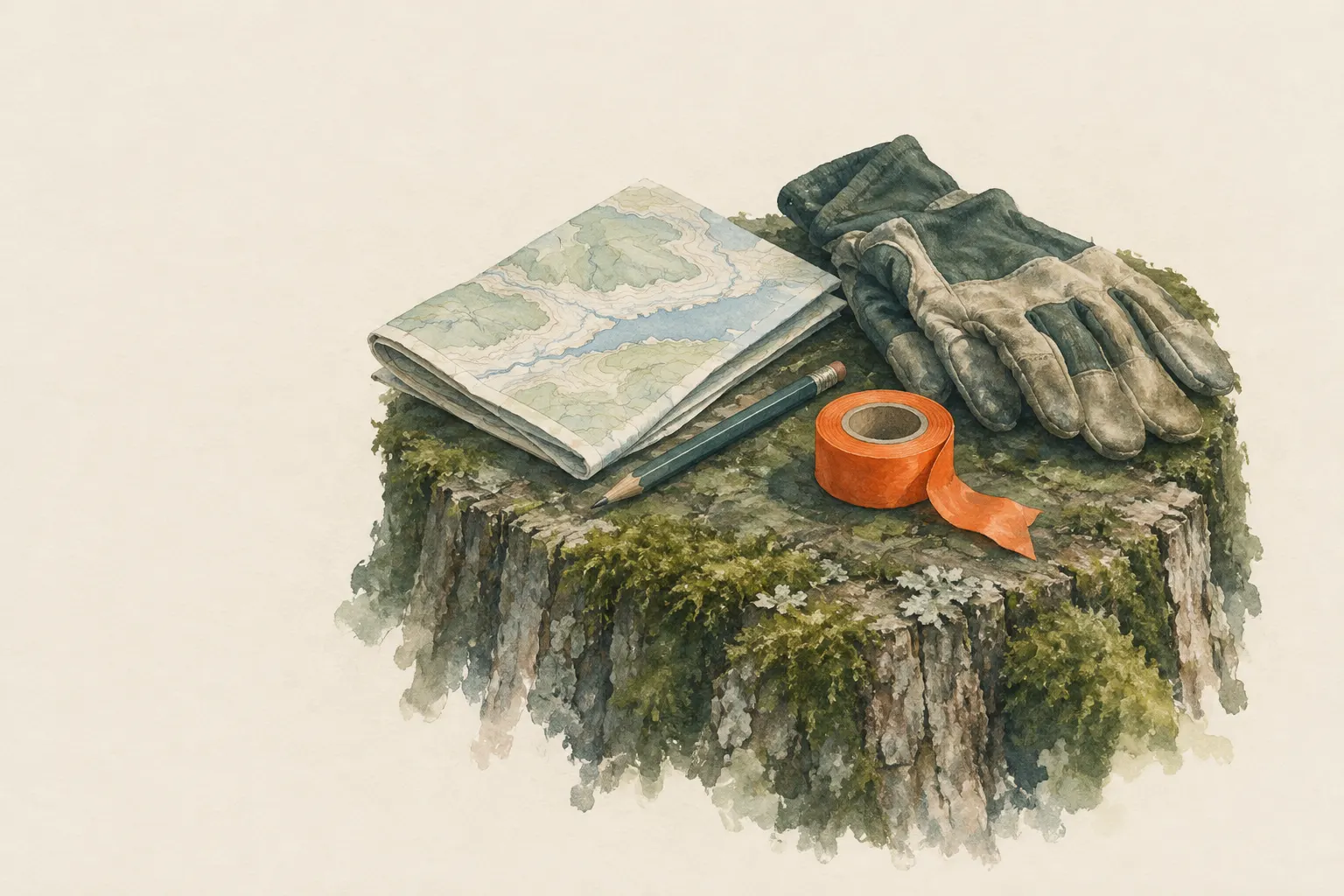
Brightly coloured flagging tape
To mark every trap site
Remove every piece again when dismantling
Labels and waterproof marker
For a list and sketch of all traps
Knife (fixed or locking blade)
Cut away from your body.
Rules on carrying knives differ by region – check local rules.
Sturdy work gloves
Against scent and germs
When handling flood mud or chemicals, also wear waterproof gloves.
Suitable for
- Long emergencies in which nobody comes
- Areas with clear small-game signs
- As a supplement to foraging and fishing
Not suitable for
- Short emergencies of a few days – you can manage without food
- Practice, hobby or “survival training”
- Areas with hikers, dogs, grazing animals or children
Prerequisites
- Genuine danger to life, rescue cannot be reached
- Water, shelter, warmth and signals are already taken care of
- Able to read tracks and animal runs
Safety
- Trapping costs strength, calories and time. If you are weak, building and checking often uses more energy than a rare catch brings in. Rest, warmth and water come first.
How it works
Small animals use the same paths again and again between cover, food and water. A trap only works if it sits exactly on such a run or at a natural bottleneck and the animal smells nothing unusual. Because even then only a small share of traps catches anything, the energy balance decides: traps are worth it at most in longer emergencies and only in addition to foraging and fishing.
Advantages
- Traps work while you rest
- Possible with very little equipment
- Tracking knowledge also helps with foraging and finding your way
Disadvantages
- A criminal offence without hunting rights
- Often no catch for days
- Danger to pets, protected species and people
- Animal suffering if not checked often enough
Deep knowledge
Background
Military survival manuals such as the US Army manual FM 3-05.70 explicitly describe traps as a means for emergencies and stress that you must recognise runs, feeding places and water points, avoid scent and check many sites regularly.
In Central Europe game belongs to the holder of the hunting rights, not to whoever catches it. That is why trapping without hunting rights is poaching, and even hunters may only use approved traps that kill instantly or catch unharmed. Whether a genuine emergency existed in a particular case is judged afterwards by the authorities and the courts.
Variants
- In a group
- One person is responsible for all traps and keeps the list. Children are not involved and are told where they must not go.
- In winter
- In snow, runs are very easy to see, but checking rounds cost far more warmth and strength. Set traps only very close to camp or do without them altogether.
Common mistakes
- Setting traps before water, warmth and signals are secured
- Placing traps in open ground instead of on runs
- Setting more traps than you can check
- Not counting or marking traps
- Traps close to paths, camps or pastures
- Leaving traps behind when moving on
Limits and risks
- Not legal advice – when in doubt the ban applies
- No traps for larger animals, no leghold traps, no spear or spring traps
- No figures on catch rates – success varies greatly
Sources
Headquarters, Department of the Army (USA) (2002): FM 3-05.70 Survival
Traps as an emergency means; recognising runs, feeding and water places; avoiding scent; checking regularly
Bundesrepublik Deutschland – Bundesministerium der Justiz (gesetze-im-internet.de) (1976): Bundesjagdgesetz (BJagdG) in der Fassung der Bekanntmachung vom 29. September 1976
§ 19: ban on snares of any kind and on traps that neither catch unharmed nor kill instantly
Bundesrepublik Deutschland – Bundesministerium der Justiz (gesetze-im-internet.de): Strafgesetzbuch (StGB) – § 292 Jagdwilderei
§ 292: poaching; using snares counts as a particularly serious case
Republik Österreich – Rechtsinformationssystem des Bundes (RIS) (1974): Strafgesetzbuch (StGB), BGBl. Nr. 60/1974 – §§ 137, 138 (Eingriff in fremdes Jagd- oder Fischereirecht) und § 222 (Tierquälerei)
§§ 137, 138: interference with another person's hunting rights; § 222: cruelty to animals
Bundesrepublik Deutschland – Bundesministerium der Justiz (gesetze-im-internet.de) (2006): Tierschutzgesetz (TierSchG) in der Fassung der Bekanntmachung vom 18. Mai 2006
§ 17: offence of killing without good reason or causing considerable suffering; § 4: killing only with the necessary knowledge and avoiding pain as far as possible
Republik Österreich – Rechtsinformationssystem des Bundes (RIS) (2004): Bundesgesetz über den Schutz der Tiere (Tierschutzgesetz – TSchG), BGBl. I Nr. 118/2004
Ban on cruelty and on killing animals without good reason
European Community, Canada, Russian Federation: Agreement on International Humane Trapping Standards between the European Community, Canada and the Russian Federation
International humane trapping standards: traps must kill quickly or restrain without injury
Council of the European Communities (1991): Council Regulation (EEC) No 3254/91 prohibiting the use of leghold traps in the Community
Leghold traps are banned in the EU – this trap type is deliberately not shown here