The simple wire snare for small game
The simple snare is a loop of wire with a running eye that hangs across a small-game run and is tied to a firm anchor. When a hare or rabbit runs through, it tightens. It is easy to make but problematic: it often does not kill instantly and catches other animals too. That is why it is banned even for hunters in Germany – it appears here only as knowledge for genuine danger to life.
- 10–20 minutes per snare, daily checks
Explained simply
A snare is a small loop of wire that hangs over a path that a rabbit uses every day. When the rabbit runs through, the loop tightens and holds it. That sounds simple – and that is exactly why it is also dangerous.
A snare does not know who runs into it. It also catches cats, dogs or rare, protected animals. And often the animal is not dead at once but is held for a long time and is frightened and in pain. That is why the snare is banned in Germany even for hunters, and in Austria you are not allowed to simply set one either.
This entry explains how it works – but only for the case where someone is in genuine danger to life and nobody comes. Then: a small loop, a firm anchor, only on a rabbit path far from people, mark every snare, check every day and take everything with you at the end.
How it works
The heart of the snare is the running eye: a tiny ring of wire at one end. The other end of the wire is passed through it, creating a loop that gets smaller when the wire is pulled. When an animal runs into it head first and keeps going forward, it tightens the loop itself.
Soft wire has a big advantage over cord: as it tightens, it kinks and stays closed. Cord can loosen again so that the animal escapes injured. That is why survival manuals such as FM 3-05.70 recommend wire when it is available.
For the snare to work, it must be firmly anchored, hang across the run and sit exactly where the animal's head is as it runs. For hares and rabbits the rule of thumb is: loop about the size of a fist, bottom edge about a hand's width above the ground. Larger loops endanger larger animals and pets.
What really matters
The location decides almost everything. A snare belongs on a freshly used small-game run, ideally at a narrow spot between bushes or under a branch. With rabbits and hares you can often see landing spots – small flattened patches where the animal touches down. The snare goes between two landing spots, because that is where the head is forward and up.
The anchor must be rock solid. A peg driven deep and at an angle, a strong root or a sapling will hold. If an animal tears itself free with the wire, it suffers for a long time and may die miserably. Pull hard on the anchor before setting.
Order is animal welfare: every snare gets a number, a piece of tape at eye level nearby and an entry in the list. It is checked at least daily, better morning and evening. Anyone who cannot manage that does not set snares.
Safety: what to watch out for
The snare is the most controversial trapping method of all. It often does not kill but holds, and it catches indiscriminately. That is why in Germany § 19 of the Federal Hunting Act bans it even for hunters; anyone who sets snares without hunting rights also commits poaching, and snares even count as a particularly serious case. In Austria snares are likewise strictly banned under the state hunting laws.
Never by paths, camps, houses or pastures and never in sizes for deer, foxes or dogs. A large snare on a game trail can also seriously injure a dog. Protect your eyes when bending the wire – wire under tension springs back.
If you find a live animal when checking, follow the entry on checking and killing: free non-target animals carefully, kill small game quickly and safely. The risk of bites is high; gloves and a jacket help.
When it makes sense – and when not
A snare only comes into question in a genuine, long emergency, when there are clear rabbit or hare runs and you can check every day. Its advantage is that it weighs almost nothing, is quick to make and works without bait.
When a deadfall is possible, it is often the better choice from an animal-welfare point of view, because with the right weight it kills instantly. If you cannot check daily, people or pets are nearby or there is no emergency, you do not set a snare.
Good to know
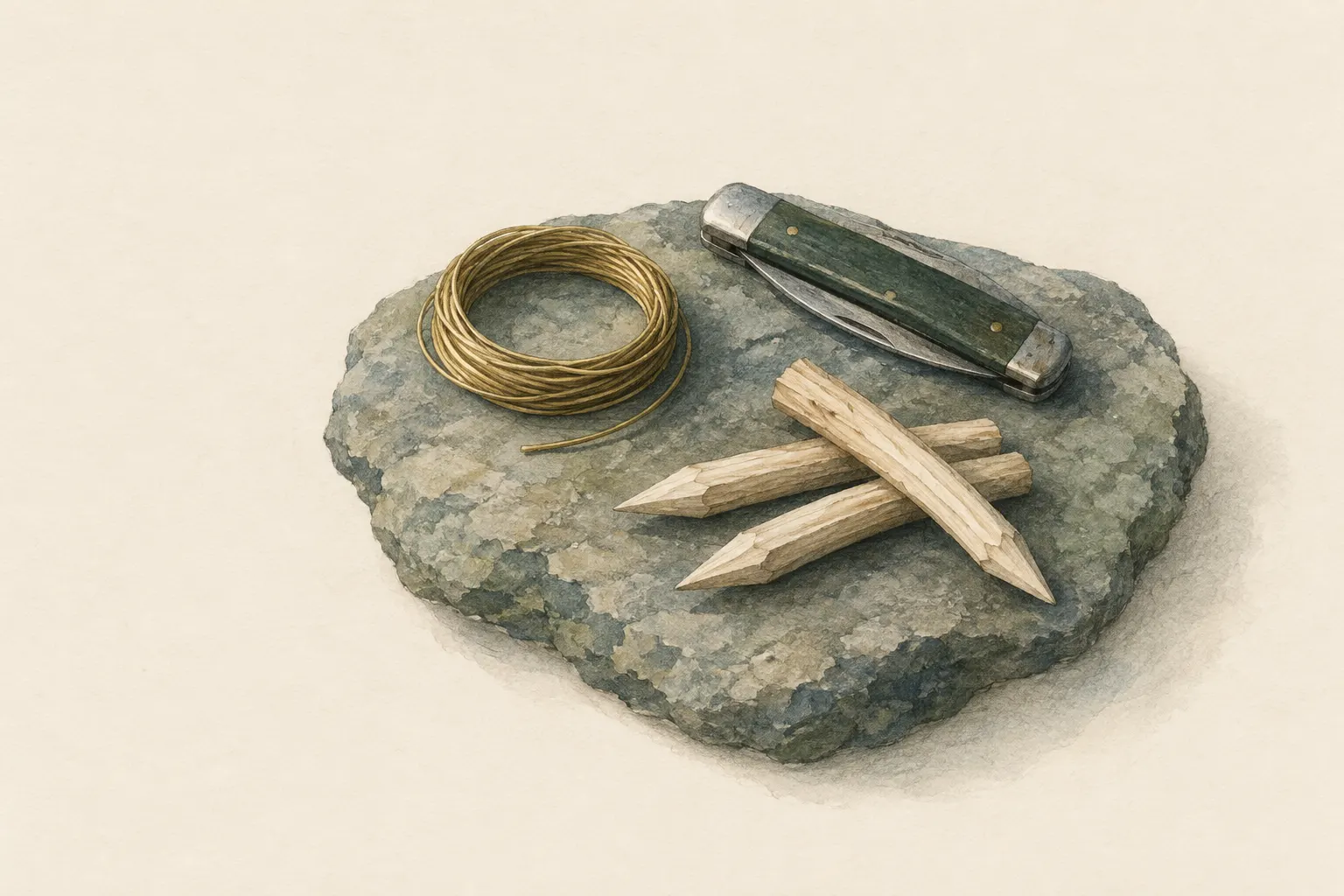
Brass wire is soft and bends easily; galvanised steel wire is stronger. Many emergency kits contain a piece of wire because it is also useful for repairs, hanging a pot or binding – which is often the more common use.
The measurements in this entry are rules of thumb from survival manuals, not tested values. Every run is different, and it is better to set a snare too small than too large.
Anyone who finds a snare in everyday life does not touch it, notes the spot and reports it to the police. Illegal snares are a real problem for wildlife and pets.
Step by step
Check the emergency and the place
Snares only in genuine danger to life and only following the basic rules: far from paths, camps, pastures and houses, only on a small-game run. Decide how many snares you can check daily and enter each one in your list.
- 1
Check the emergency and the place
Snares only in genuine danger to life and only following the basic rules: far from paths, camps, pastures and houses, only on a small-game run. Decide how many snares you can check daily and enter each one in your list.
- 2
Bend the running eye
About two fingers' width from the end of the wire, bend a small eye: lay the wire around a thin peg or nail, wrap the end tightly around the wire itself two or three times and pull the peg out. Bend the end flat so nothing sticks out.
- 3
Form and test the loop
Pass the long end of the wire through the eye – this makes a running noose. Open and close it a few times: the wire must slide easily and without catching. Smooth out kinks in the wire first, otherwise the loop sticks.
- 4
Find the right spot on the run
Choose a spot where the run is narrow, for example between two bushes or under a branch. With rabbits and hares you often see landing spots – small flattened patches where the animal touches down. The snare goes between two landing spots, not on one.
- 5
Make the anchor firm
Tie the free end of the wire firmly to a strong peg driven deep and at an angle into the ground, or to a strong root or sapling beside the run. Pull hard on it: an anchor that gives way lets the animal run off with the wire – that prolongs its suffering.
- 6
Set the snare
The loop hangs upright and across the run. As a rule of thumb from survival manuals for hares and rabbits: loop about the size of a fist, bottom edge about a hand's width above the ground. Hold it in position with a split stick pushed into the ground beside the run.
Never set larger loops – they catch deer, dogs and foxes and cause severe suffering.
- 7
Place guide twigs
Push thin twigs in on the left and right or arrange dry material so that the natural path leads through the loop. Do not block the whole run – the animal should notice nothing unusual. Then leave the spot as you found it.
- 8
Mark, check, dismantle
Tie tape at eye level a few steps beside the snare and write its number and location in the list. Check at least daily, renew or remove bent or sprung snares. When leaving, dismantle every snare and take the wire with you.
Common mistakes
- Snare too large or too low – wrong animals and paw catches
- Snare beside the run instead of on it
- Anchor gives way
- Cord instead of wire – the animal frees itself injured
- Too many snares, rare checks
- Forgetting snares when leaving
Quick view
Materials
Thin, soft wire (brass or galvanised steel)
About an arm's length; thin, soft wire works best
Wire ends are sharp – protect eyes and fingers when bending
Collect and carry out every piece that was set as a snare
Setting snares is illegal without hunting rights in Germany and Austria – only in genuine danger to life
Thin twine
Only as a stopgap – cord loosens
Low breaking strength – light loads only.
Sturdy sticks / poles
Anchor peg, support stick and guide twigs
Do not cut live wood where prohibited.
Knife (fixed or locking blade)
Cut away from your body.
Rules on carrying knives differ by region – check local rules.
Brightly coloured flagging tape
Remove every piece again when dismantling
Suitable for
- Hares and rabbits on clearly visible runs
- Longer emergencies with the chance to check daily
Not suitable for
- Paths used by people, dogs, cats or grazing animals
- Larger animals – large snares are especially cruel and dangerous
- Situations in which you cannot check daily
Prerequisites
- Genuine danger to life, no rescue within reach
- Basic rules from “Traps in a genuine emergency” read
- A fresh small-game run found
Safety
- Wire under tension can spring back when bent. Protect your eyes, bend the ends over cleanly and never wrap the wire around your fingers.
How it works
A running eye is a small ring of wire through which the other end of the wire slides freely. When the animal runs into the loop head first and keeps going, the wire slides through the eye and the loop gets smaller. Soft wire kinks as it does so and keeps the loop closed – cord, by contrast, loosens again. Without a firm anchor and a run, the snare does not work.
Advantages
- Very light and small to carry
- Quick to make
- Works without bait
Disadvantages
- Often does not kill instantly
- Catches pets and protected species indiscriminately
- Banned outright in Germany, equally strictly regulated in Austria
- Only works on a real run
Deep knowledge
Background
The wire snare is one of the oldest trapping methods and appears in almost every survival manual. FM 3-05.70 explains that wire is better than cord because cord can loosen, and that the simple snare usually does not kill the animal.
That is exactly why it is banned in many countries today: it does not distinguish between species and often causes long suffering. The international humane trapping standards require traps that kill quickly or hold without injury – a simple snare does not meet this.
Variants
- With a cross bar
- FM 3-05.70 also describes a snare hung from a cross bar resting on two forked sticks. The principle is the same; the height is again set by the small animal's head, never so low that it steps in with a leg.
- Cord as a stopgap
- Without wire, strong, smooth cord can be used. It tightens less reliably and can loosen again – so check even more often.
Common mistakes
- Snare too large or too low – wrong animals and paw catches
- Snare beside the run instead of on it
- Anchor gives way
- Cord instead of wire – the animal frees itself injured
- Too many snares, rare checks
- Forgetting snares when leaving
Limits and risks
- Measurements are rules of thumb for hares and rabbits, not tested values
- No snares for larger animals
- No instructions for spring-pole or lifting snares
Material alternatives
Derived from material properties: a substitute must have all relevant properties. Observe the notes on the substitute.
- Thin, soft wire (brass or galvanised steel)
- Rope (Never use unknown or damaged rope for life-safety purposes.), Paracord (Not a climbing or safety rope.), Tow rope or tow strap (Attach only to the towing eyes provided by the manufacturer; never stand next to it under load.)
- Thin twine
- Rope (Never use unknown or damaged rope for life-safety purposes.), Paracord (Not a climbing or safety rope.), Accessory cord (Use only certified cord after training for life-safety purposes.), Webbing (tubular webbing) (Inspect knotted webbing before every use.), Jute or sisal twine (bought) (Low strength, absorbs water and rots – light loads and practice only.), Tree straps (Load only within the manufacturer's limits.), Monofilament fishing line (Never leave scraps of line behind: birds and other animals get tangled in them and die slowly. Wind up scraps and take them with you.), Thin, soft wire (brass or galvanised steel) (Wire ends are sharp – protect eyes and fingers when bending), Tow rope or tow strap (Attach only to the towing eyes provided by the manufacturer; never stand next to it under load.)
Results come exclusively from structured entries. No improvised instructions are generated.
Sources
Headquarters, Department of the Army (USA) (2002): FM 3-05.70 Survival
Simple snare over a run or den, tied to a firm stake; wire better than cord; usually does not kill; height set by the animal's head
Bundesrepublik Deutschland – Bundesministerium der Justiz (gesetze-im-internet.de) (1976): Bundesjagdgesetz (BJagdG) in der Fassung der Bekanntmachung vom 29. September 1976
§ 19: ban on snares of any kind and on traps that neither catch unharmed nor kill instantly
Bundesrepublik Deutschland – Bundesministerium der Justiz (gesetze-im-internet.de): Strafgesetzbuch (StGB) – § 292 Jagdwilderei
§ 292: poaching; using snares counts as a particularly serious case
Republik Österreich – Rechtsinformationssystem des Bundes (RIS) (1974): Strafgesetzbuch (StGB), BGBl. Nr. 60/1974 – §§ 137, 138 (Eingriff in fremdes Jagd- oder Fischereirecht) und § 222 (Tierquälerei)
§§ 137, 138: interference with another person's hunting rights; § 222: cruelty to animals
Bundesrepublik Deutschland – Bundesministerium der Justiz (gesetze-im-internet.de) (2006): Tierschutzgesetz (TierSchG) in der Fassung der Bekanntmachung vom 18. Mai 2006
§ 17: offence of killing without good reason or causing considerable suffering; § 4: killing only with the necessary knowledge and avoiding pain as far as possible
Republik Österreich – Rechtsinformationssystem des Bundes (RIS) (2004): Bundesgesetz über den Schutz der Tiere (Tierschutzgesetz – TSchG), BGBl. I Nr. 118/2004
Ban on cruelty and on killing animals without good reason
European Community, Canada, Russian Federation: Agreement on International Humane Trapping Standards between the European Community, Canada and the Russian Federation
International humane trapping standards: traps must kill quickly or restrain without injury