Roe deer, red deer, chamois: recognising hoof prints
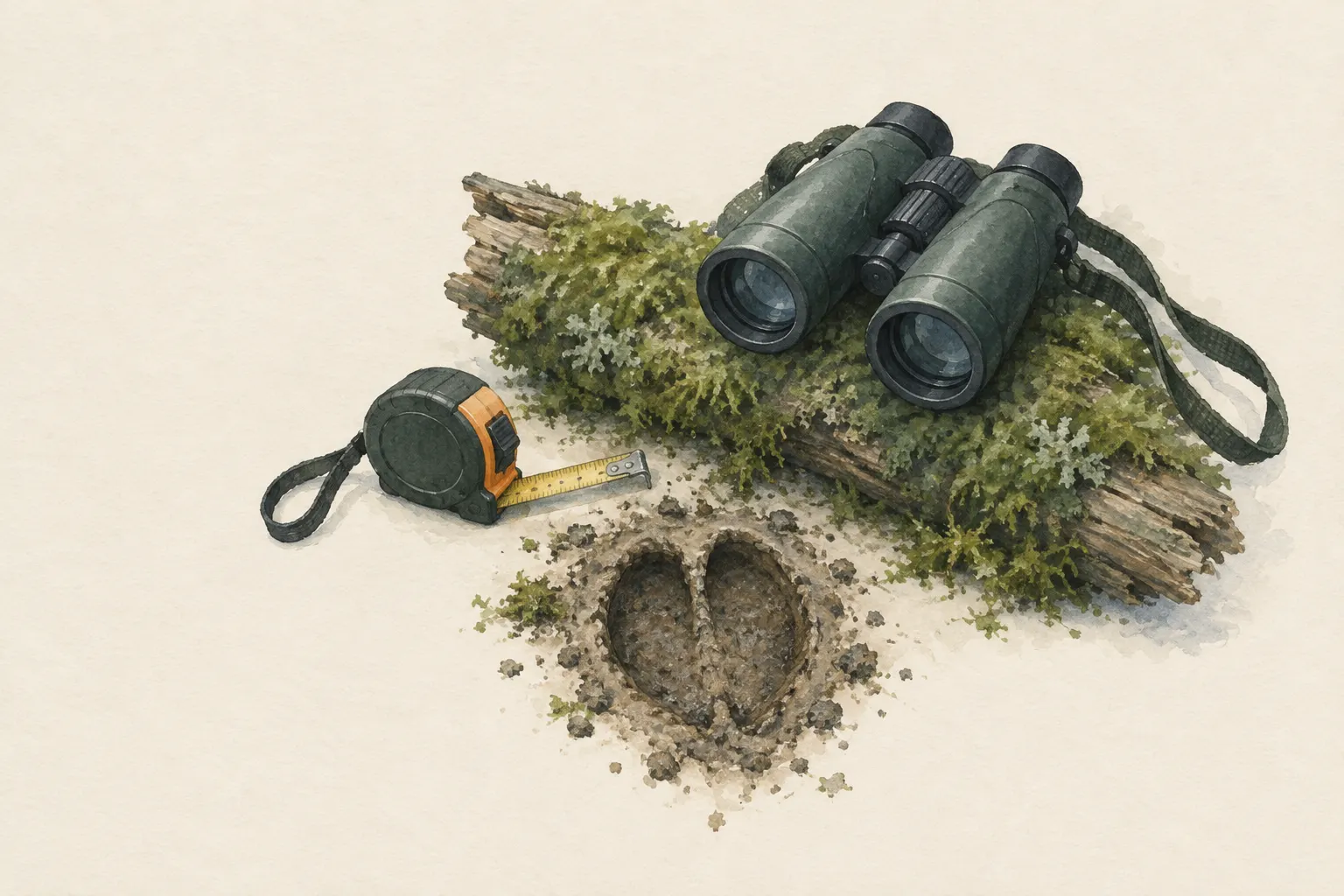
Roe deer, red deer, chamois and ibex walk on two toe tips, the cleaves. Their print looks like a heart or a drop with its tip pointing in the direction of travel. The roe deer leaves small, pointed prints, the red deer large and broader ones, and in the mountains chamois and ibex leave theirs. The position of the dewclaws separates deer from wild boar. When watching: keep your distance, never touch fawns, avoid stags in the rut.
- 10–20 minutes per trail
Explained simply
Roe deer and red deer walk on tiptoe – on two hard toes called cleaves. Their print looks like a small heart standing on its head. The tip of the heart always points where the animal went. So you know straight away which direction it was travelling.
A roe deer leaves small, pointed hearts, about as long as your thumb. A red deer is much bigger and heavier; its print is almost twice as long and rounder at the front. High in the mountains, between rocks, you find prints of chamois and ibex. On alpine pastures, though, goats and sheep look very similar.
If you find a roe deer fawn alone in the grass, it is not abandoned. The mother hides it there and comes back to suckle it. Never touch it and walk on quietly. And stags that bellow loudly in autumn are only watched from a great distance.
How it works
Deer, chamois and ibex are even-toed ungulates. Only two of their toes carry the weight; they are covered by hard horny shoes, the cleaves. Behind them sit two small, reduced toes, the dewclaws. On firm ground they do not touch it. Only in soft ground, in deep snow or when the animal runs fast and the cleaves sink deeper do they print as two small dots behind the cleaves.
Because the cleaves come together at the front, every print is an arrow pointing in the direction of travel. When walking slowly, the animals put the hind hoof in or beside the print of the front hoof, and the trail forms a narrow line. When fleeing, the cleaves splay, the dewclaws print too, soil flies backwards, and the prints lie in groups of four with large gaps.
The species differ mainly in size and shape. The roe deer has small, pointed, sharp-edged cleaves. The red deer has large, broader cleaves with rounder tips. Chamois and ibex have hard rims and a softer, rubbery sole that grips on rock; their cleaves splay on steep slopes. Together with the habitat this usually gives a clear picture.
What really matters
Measure the length of the print from the tip to the rear edge of the cleaves, without the dewclaws. As guide values, about 4 to 5 centimetres for an adult roe deer and 7 to 9 centimetres for an adult red deer. Fallow deer, which only occur in some areas, lie in between. Young animals of larger species can be as small as a roe deer – so take several prints and the habitat into account.
The most important comparison is with wild boar. In wild boar the dewclaws are almost always visible and sit clearly further out, wider than the cleaves. The whole print looks roundish, almost as wide as long. In roe and red deer the dewclaws, if you see them at all, sit closer together and more directly behind the cleaves.
In the mountains the place helps: prints in rocky terrain above the tree line are more likely to come from chamois or ibex. On alpine pastures with grazing animals, goats and sheep can hardly be distinguished. Then other signs become more important, such as hair on fences, droppings or sightings through binoculars. Stay honest with your identification and add 'probably' when you are unsure.
Safety: what to watch out for
In May and June roe deer fawns often lie alone and motionless in tall grass. That is their protection: they hardly smell and stay still while the mother grazes nearby. Touching a fawn can cause the mother to reject it. So you walk on quietly at once and put dogs on the lead. More on this in the entry on injured or seemingly abandoned wild animals.
During the rut, for red deer roughly from September to October, stags are agitated and can react unpredictably. Watch bellowing animals only from a great distance with binoculars, never closer for a photo. On roads and at forest edges, also expect deer crossing at dusk.
In winter wild animals have little food and save energy. Every escape through deep snow can weaken them badly. Stay on paths, respect wildlife rest areas and signs, and do not follow a trail into resting areas. In the mountains also mind your own safety: you do not climb into steep or avalanche-prone terrain for a print.
When it makes sense – and when not
Hoof prints are the most common large animal tracks in Central Europe. They are well suited for understanding direction of travel, gait and habitat use, for example where roe deer move between forest and field. With children you can find heart-shaped prints on a muddy forest path within minutes and work out the direction of travel.
Identification makes little sense on hard-frozen, stony ground or in deep powder snow where no cleaves can be seen. Ageing animals or reliably excluding livestock from a print does not work either. And anyone who follows a trail just to see the animal disturbs it – better to wait at a fixed spot and watch through binoculars.
Good to know
Besides prints, roe and red deer leave many other signs. Bitten-off shoot tips on young trees are called browsing; because deer have no upper incisors, the edges are frayed. On thin saplings roe bucks rub off the bark in spring to remove the velvet from their antlers and to mark. Shallow hollows in grass or snow show resting places.
The chamois is a climbing artist: the soft soles of its cleaves stick to rock like rubber, while the hard rims grip on snow and ice. The ibex is even more tied to rock. Both need peace in winter because food is scarce and every escape through snow costs strength – another reason why the rule is: look, do not follow.
Step by step
Recognise the cleaves and read the direction
Two elongated halves that together form a heart or a drop: that is an even-toed ungulate. The narrow tip points in the direction of travel. Check whether two small dots can be seen behind them – the dewclaws – and exactly where they sit.
- 1
Recognise the cleaves and read the direction
Two elongated halves that together form a heart or a drop: that is an even-toed ungulate. The narrow tip points in the direction of travel. Check whether two small dots can be seen behind them – the dewclaws – and exactly where they sit.
- 2
Roe deer: small and pointed
A roe deer print is about 4 to 5 centimetres long (guide value), narrow, with pointed, sharp-edged cleaves. Roe deer often use narrow, well-trodden paths (runs) between forest and field. The dewclaws only print in soft ground or when fleeing.
- 3
Red deer: large and broader
The red deer leaves prints about 7 to 9 centimetres long (guide value) with broader cleaves that are rounder at the front. It lives mainly in large forests and mountain forests. In some areas fallow deer occur, whose prints lie in between in size.
- 4
Chamois and ibex in the mountains
Above the tree line and in rocky terrain, hoof prints often come from chamois or ibex. Their cleaves have hard rims and soft soles that grip on rock, and they splay in steep or soft terrain. On alpine pastures goats and sheep leave very similar prints – here the context decides, not the single print.
- 5
Rule out confusion with wild boar
In wild boar the dewclaws are almost always visible and sit further out, wider than the cleaves themselves; the print looks rounder and almost as wide as long. In deer the dewclaws, if visible at all, sit closer together and more directly behind the cleaves.
- 6
Interpret the gait
When walking, deer place the hind hoof in or just beside the print of the front hoof; the prints lie in a narrow line. When fleeing, the cleaves splay, the dewclaws print, soil is thrown backwards and the prints lie in groups of four with large gaps.
- 7
Distance and consideration
Do not follow trails and do not flush animals. Keep dogs on the lead in wildlife areas. Do not touch fawns you find, give stags in the rut a wide berth, stay on paths in winter. Watch from a distance with binoculars.
Never touch fawns – human scent can keep the mother away.
Common mistakes
- Reading the direction of travel back to front
- Taking young animals of larger species for roe deer
- Overlooking the dewclaws
- Taking goat and sheep tracks on alpine pastures for chamois
- Following a trail and flushing the animal
Quick view
Materials
Tape measure or folding rule
Mobile phone
The battery drains quickly in cold and with continuous screen and GPS use.
Do not plan on it as your only means of navigation or emergency calls.
Binoculars
Watch animals from a distance
Never look directly at the sun.
Field notebook and pencil
Suitable for
- Forest paths, field edges, woodland meadows
- Mountain hikes above the tree line
- Winter after fresh snow
Not suitable for
- Reliably separating chamois, ibex, goat and sheep from the print alone
- Hard-frozen or stony ground
Prerequisites
- Prints in soft ground or snow
- Basic knowledge of gaits
Safety
- In May and June roe deer fawns often lie alone in tall grass – the mother only comes to suckle. Do not touch or stroke them, move on quietly at once and put dogs on the lead.
- During the rut (for red deer roughly September to October) stags can be unpredictable. Keep your distance, do not approach for photos and give bellowing animals a wide berth.
- In winter wild animals save energy. Every escape through deep snow costs strength. Stay on paths, respect wildlife rest areas and signs, and do not follow trails.
How it works
Deer and their relatives are even-toed ungulates: they walk on two strong toes whose horny shoes are called cleaves. Further back sit two small toes, the dewclaws. They only touch the ground when it is soft or when the animal runs fast or jumps. Because the cleaves taper to a point at the front, the print shows the direction of travel. The size and shape of the cleaves differ between species – together with the habitat this usually gives a clear picture.
Advantages
- Common, easily recognised tracks
- Direction of travel usually clear
- Easy to practise with children
Disadvantages
- Similar species and livestock are hard to separate
- Sizes overlap between young and adult animals
Deep knowledge
Background
The European tracking guides by Bang and Dahlström and by Olsen describe cleave shape, size and dewclaws as the main features of roe deer, red deer, fallow deer, chamois and ibex. Elbroch explains the role of dewclaws in even-toed ungulates in detail.
In Austria and Germany roe deer are the most common hoofed animals; red deer are limited to larger forest areas, chamois and ibex to the Alps.
Variants
- In deep snow
- In deep snow individual cleaves are hard to recognise. Then trail width, stride length and habitat help, and you often see drag marks of the legs between the prints.
- Other signs
- Bitten-off shoot tips on young trees (browsing), rubbed-off bark on saplings (fraying) and shallow resting hollows in grass or snow complete the picture.
Common mistakes
- Reading the direction of travel back to front
- Taking young animals of larger species for roe deer
- Overlooking the dewclaws
- Taking goat and sheep tracks on alpine pastures for chamois
- Following a trail and flushing the animal
Limits and risks
- Sizes are guide values for adult animals
- No age determination of animals
- Livestock cannot be reliably excluded
Material alternatives
Derived from material properties: a substitute must have all relevant properties. Observe the notes on the substitute.
- Mobile phone
- Headlamp / flashlight, Battery lantern / LED light
Results come exclusively from structured entries. No improvised instructions are generated.
Sources
Preben Bang, Preben Dahlström – Oxford University Press (2001): Animal Tracks and Signs
Hoof prints of roe deer, red deer, fallow deer, chamois and ibex
Lars-Henrik Olsen – Princeton University Press (2013): Tracks and Signs of the Animals and Birds of Britain and Europe
Sizes and features of European ungulate tracks
Mark Elbroch – Stackpole Books (2003): Mammal Tracks & Sign: A Guide to North American Species
Dewclaws and gaits in even-toed ungulates