Wild boar: prints, rooting signs and how to behave
Wild boar leave rounded hoof prints in which the dewclaws are almost always visible at the sides, plus ploughed-up meadows, mud wallows and trees caked with mud. Fresh signs mean the animals may be lying very close in the thicket. Then do not go in, put the dog on the lead and turn back calmly. In an encounter – especially with a sow with piglets – keep your distance, leave an escape route and withdraw slowly.
- A few minutes to recognise; practise the behaviour beforehand
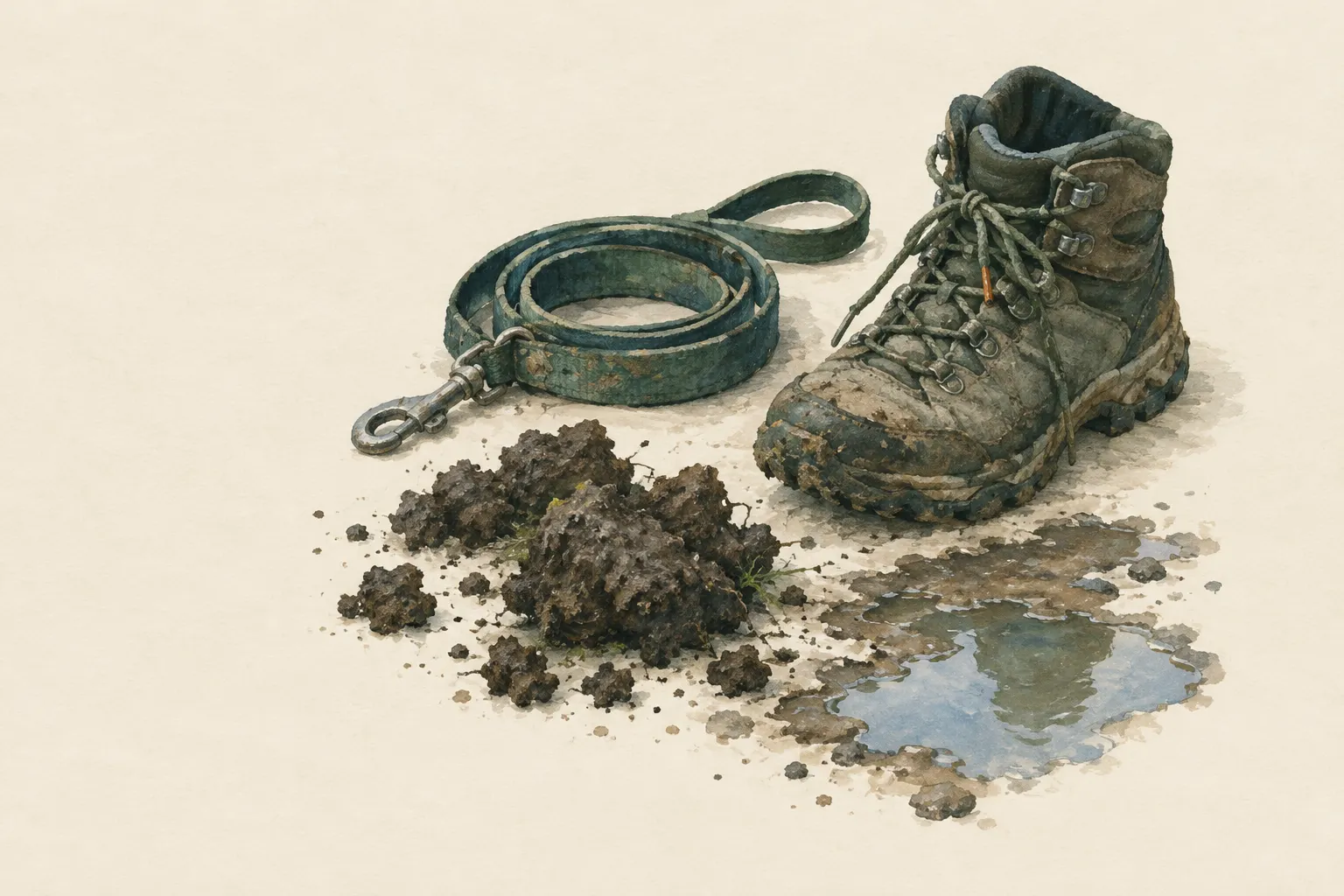
Explained simply
Wild boar are strong animals that are mostly out and about at night. During the day they sleep well hidden in dense bushes, in reeds or in maize fields. That is why you rarely see them – but you often find their signs: dug-up meadows, mud holes and trees with mud on their bark.
Their footprint looks similar to a roe deer's but is rounder. Behind it you almost always see two small dots, far out at the sides. If you find many small and large prints together, it was probably a mother with her striped young. The mother is called a sow, the little ones are piglets.
If the signs are very fresh, you do not go into the bushes. If you see a wild boar, stay calm, do not run away and walk slowly backwards along the way you came. Never get between a sow and her piglets – she protects her young very bravely.
How it works
Like deer, wild boar are even-toed ungulates: they walk on two cleaves. Their dewclaws, however, sit lower on the leg and further out. That is why they print on almost every surface, at the sides next to and behind the cleaves, wider than these. The cleaves themselves are rounder at the front than in roe deer. This creates an almost square print that is easy to tell from deer tracks.
With their powerful snouts wild boar break up the ground to find roots, grubs, worms and mouse nests. In doing so they turn over clods of soil as if someone had worked with a small hoe. In summer and in the heat they roll in mud puddles, the wallows. The mud cools them and protects against insects. Afterwards they rub themselves on nearby trees – on these rubbing trees a crust of mud remains at knee height, often with bristles.
Wild boar live in family groups, the sounders, led by experienced sows. Piglets are born mainly in spring but can appear all year round. They have light and dark lengthwise stripes. A sounder leaves many prints of different sizes on the same paths – an important sign that young are present.
What really matters
The age of the signs decides how you behave. Fresh rooting has dark, moist soil, sharp edges and roots that are not yet wilted. A fresh wallow is wet and murky, with wet mud splashes sticking to the edges. Old rooting is dried and crumbly, with grass growing over it again. Fresh signs mean: the animals could be lying in cover very close by.
Wild boar rely on smell and hearing; they do not see particularly well. If you move audibly and talk calmly, they notice you early and usually move away. It becomes dangerous if you surprise them, if they have no escape route or if a dog harasses them. That is why three rules are central: do not go into the thicket, dog on the lead, always leave a way out.
In an encounter, calm is what counts. Stop, do not scream, do not run away and do not walk towards the animal. Talk calmly so it recognises you as a human, and walk slowly backwards along the way you came. If a wild boar still comes towards you, step behind a thick tree or climb onto a raised spot such as a rock. Usually the animal then runs past.
Safety: what to watch out for
A sow with piglets is the most dangerous situation. She defends her young determinedly, even against people and dogs. Piglets look cute, but you never walk towards them, lure them or touch them. If you accidentally get between a sow and her piglets, withdraw calmly at once, if possible away from the piglets' side.
Wild boar are never fed, not even with bread scraps at a rest stop. Fed animals lose their shyness, come into gardens and settlements and can become dangerous there. Report a wild boar in a residential area or an injured, aggressive animal to the police – 110 in Germany, 133 in Austria. If anyone is injured call 112, in Austria also 144.
If you find a dead wild boar, do not touch it. Note the exact location, ideally with coordinates, and report the find to the veterinary office, the district authority or the police. The background is African swine fever: it is harmless to humans but usually fatal for wild and domestic pigs and can be carried on via shoes, vehicles and food scraps. So never leave food leftovers in nature.
When it makes sense – and when not
Knowing wild boar signs is useful in large parts of Central Europe, including at the edge of towns: when hiking, running, cycling and walking the dog, especially at dusk. Anyone who recognises rooting and wallows can avoid or bypass areas with fresh signs and be prepared for a possible encounter.
This knowledge is not meant for tracking down wild boar or stalking them for photos. Nor does it replace help with damage in the garden: there, sturdy fences, secured compost and bins, and advice from the municipality or local hunters help. You never drive animals off yourself.
Good to know
Wild boar are very adaptable. In some cities they live permanently in parks and gardens because they find food there. Their numbers have risen in many regions, partly because mild winters and maize fields provide food and cover. Accordingly you find their signs more often.
Hunting language has many words of its own: in German the rooted-up soil is called Gebräch, the snout Wurf, the trail Fährte. You do not need to know them to be safe outdoors – but they help when you read signs, books or notices from foresters.
Step by step
Recognise the print
Two cleaves with rounder tips than in roe deer, behind them two dewclaws that almost always print and stand further out than the width of the cleaves. The whole print is about as wide as long. In adults the cleaves are about 5 to 7 centimetres long (guide value); piglets leave tiny prints.
- 1
Recognise the print
Two cleaves with rounder tips than in roe deer, behind them two dewclaws that almost always print and stand further out than the width of the cleaves. The whole print is about as wide as long. In adults the cleaves are about 5 to 7 centimetres long (guide value); piglets leave tiny prints.
- 2
Read the trail of a group
Wild boar live in groups (sounders). Many prints of different sizes on a muddy path often mean: a sow with young. The trail runs wide, with a clear gap between left and right side.
- 3
Read rooting signs
Ploughed-up soil in meadows, along forest paths or in the forest floor, often turned over in clods. Fresh: dark, moist soil, sharp edges, roots not wilted. Old: dried, crumbly soil, grass growing over it again.
- 4
Wallows and rubbing trees
Muddy hollows with body impressions and bristles are wallows. Next to them there are often trees whose bark is caked with mud at about knee height, sometimes with bristles stuck in the resin. Wild boar stay here regularly.
- 5
Fresh signs: do not go in
Fresh rooting, wet wallows, a strong smell, or grunting and cracking in the thicket mean: the animals are close. Do not go into the thicket, reeds or maize field, put the dog on a short lead, talk audibly and turn back or give the area a wide berth.
Wild boar like to rest in dense cover during the day.
- 6
Encounter: withdraw calmly
Stop, do not scream, do not run away and do not walk towards the animal. Talk calmly so it recognises you as a human, and walk slowly backwards along the way you came. Leave the animal's escape route free. If it still comes towards you, step behind a thick tree or climb onto a raised spot such as a rock.
Never get between a sow and her piglets.
- 7
After the encounter and special cases
Leave the area, keep the dog on the lead. Report wild boar in residential areas or injured, aggressive animals to the police, dead wild boar to the veterinary office. If someone is injured, call 112. Leave no food scraps behind and secure compost and bins in the garden.
Common mistakes
- Finding piglets cute and approaching them
- Walking through wild boar areas with a dog running free
- Going into the maize field or thicket to look
- Running away or shouting at the animal and walking towards it
- Disposing of food scraps in the forest
Quick view
Materials
Dog lead (short or long line)
If a dog is with you
Use long lines only on a harness, not a collar.
Tape measure or folding rule
Mobile phone
For photos and in an emergency
The battery drains quickly in cold and with continuous screen and GPS use.
Do not plan on it as your only means of navigation or emergency calls.
Suitable for
- Hikes and walks in forest and farmland
- Running and cycling at dusk
- Urban fringes with wild boar
Not suitable for
- Deliberately seeking out wild boar or approaching for photos
- Crossing thickets, reed beds or maize fields with fresh signs
Prerequisites
- Knowing that wild boar live in the area (true for large parts of Central Europe)
- Being able to stay calm
Safety
- Never feed wild boar, not even with food scraps at a rest stop or in the garden. Fed animals lose their shyness and come into settlements.
- Do not touch a wild boar found dead. Note the exact location and report it to the veterinary office, the district authority or the police. African swine fever is harmless to humans but can be spread via shoes and food scraps – never leave food scraps in nature.
How it works
Wild boar are strong, intelligent omnivores that are mostly active at night and spend the day in dense cover. With their snouts they break up the ground to find roots, worms and larvae. For skin care they wallow in mud and then rub themselves on trees. Normally they avoid people. It becomes dangerous when they are surprised, have no escape route, are injured or defend their young – exactly the situations that reading signs helps you avoid.
Advantages
- Signs are conspicuous and easy to learn
- Lets you avoid dangerous situations early
Disadvantages
- Animals usually stay invisible in the thicket
- The age of rooting can only be roughly estimated
Deep knowledge
Background
Bang and Dahlström and Olsen describe the side-set dewclaws, rooting, wallows and rubbing trees as typical wild boar signs. The Friedrich-Loeffler-Institut informs about African swine fever, detected in wild boar in Germany since 2020, and its spread via people, vehicles and food.
The rules of behaviour follow the general principles for encounters with wildlife: distance, leave an escape route, withdraw calmly.
Variants
- Out at dusk
- Wild boar are active at dusk and at night. Be audible and clearly visible with a headlamp and avoid thickets. Drive more slowly on roads – more in the entry on wildlife collisions.
- In the garden
- Rooted-up lawns at the edge of settlements often come from wild boar. Sturdy fences and removing food sources help; never drive animals off yourself – ask the municipality or local hunters.
Common mistakes
- Finding piglets cute and approaching them
- Walking through wild boar areas with a dog running free
- Going into the maize field or thicket to look
- Running away or shouting at the animal and walking towards it
- Disposing of food scraps in the forest
Limits and risks
- No guarantee of a safe encounter
- Sizes are guide values
- No guidance on driving animals away
Material alternatives
Derived from material properties: a substitute must have all relevant properties. Observe the notes on the substitute.
- Mobile phone
- Headlamp / flashlight, Battery lantern / LED light
Results come exclusively from structured entries. No improvised instructions are generated.
Sources
Preben Bang, Preben Dahlström – Oxford University Press (2001): Animal Tracks and Signs
Wild boar print with side-set dewclaws, rooting, wallows and rubbing trees
Lars-Henrik Olsen – Princeton University Press (2013): Tracks and Signs of the Animals and Birds of Britain and Europe
Tracks and signs of wild boar in Europe
Friedrich-Loeffler-Institut (FLI), Bundesforschungsinstitut für Tiergesundheit: Afrikanische Schweinepest (ASP) – Tierseucheninformationen
African swine fever: harmless to humans, spread via people and food, reporting carcasses
Bundesministerium für Finanzen – Amtshelfer oesterreich.gv.at: Notrufnummern (oesterreich.gv.at)
Emergency numbers in Austria