Using birch bark: tinder, containers, weather protection
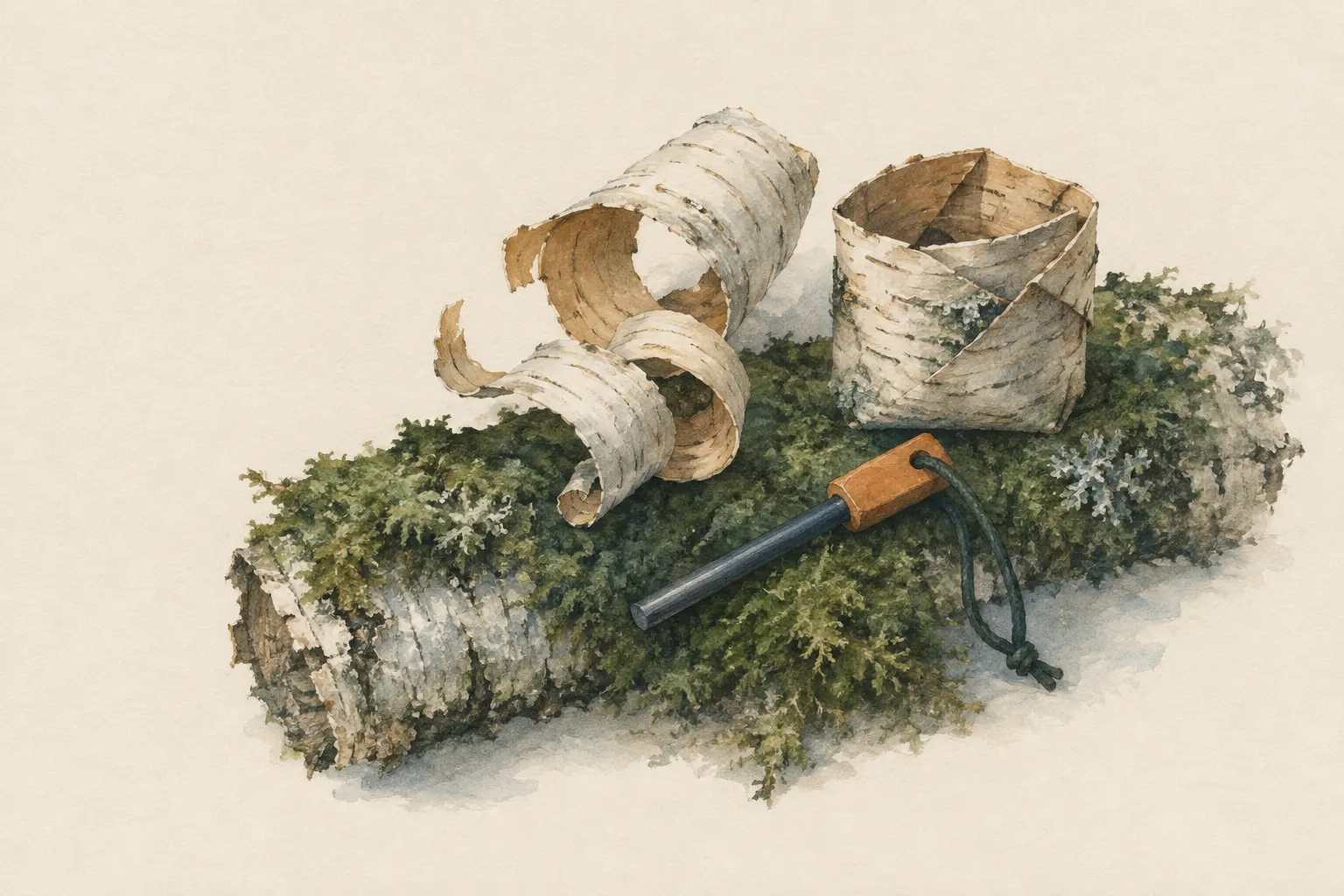
Birch bark is water-repellent, flexible and full of flammable oils. It burns even when slightly damp, can be folded into containers and sheds rain like roof shingles. It is collected only from dead, fallen birches or fallen branches – on lying trunks it often stays intact long after the wood inside has rotted. Living trees are never peeled.
- Collecting 10–30 minutes, more depending on use
Explained simply
You recognise a birch at once by its white bark with black stripes. This bark is a small wonder material: it is waterproof, flexible and even burns when it is a little damp. That is why many people call it the best tinder in the forest.
From large pieces you can fold containers or build a small roof that the rain runs off. From thin layers you make tinder: you tear them into strips or scrape off fine fibres, and a spark from the ferro rod catches straight away.
But you only take bark from dead birches lying on the ground or from fallen branches. You never tear bark off a living tree – not even a small piece. Otherwise the tree gets wounds that never heal properly.
How it works
White birch bark contains a waxy substance called betulin. It makes the bark white, water-repellent and very flammable. Water beads off it, and when it burns it gives a lot of heat and a sooty, bright flame.
The bark rots much more slowly than the wood beneath it. That is why on fallen birches you often find an intact tube of bark in which the wood is already soft and crumbly. That is exactly where you can collect good bark without harming a living tree.
Birch bark consists of many thin layers. The outer, paper-thin layers catch fire especially easily. The thicker pieces are tough and flexible – they are good for folding, sewing and covering.
What really matters
Sort the bark right after collecting it. Thin, papery layers go to tinder. Large, thick, flexible pieces without holes are kept for containers and weather protection. Brittle scraps are used as kindling material.
Thick bark is too stiff as tinder – it catches a spark poorly. Tear it into narrow strips or scrape off fine fibres with the back of the knife until you have a loose little heap. Thicker strips go on top, then thin twigs.
To make thick pieces flexible, warm them briefly in the sun or at a distance over gentle heat. Then press them flat with the white side outwards under a flat stone until they stay flat. Cold, dry bark breaks easily.
Safety: what to watch out for
Bark is never pulled off living birches. Even if only the white outer layer tears off, a permanent scar remains and fungi can get in. If a tree is peeled all the way round, it dies. In Austria and Germany wood and bark belong to the forest owner – peeling without permission is prohibited.
Dead, standing birches are dangerous. Their wood rots quickly, and often the crown suddenly breaks off. Collect only from lying trunks and branches, and never shake dead trees.
Birch bark burns hot and sometimes drips while burning. Light it only in a permitted, safe fireplace and keep water ready. Burning bark does not belong in your hand. With a burn, cool it at once with cool water, and for larger injuries call 112, in Austria also 144.
When it makes sense – and when not
Birch bark is ideal in damp weather when other tinder fails. A handful in a tin is a good reserve in your rucksack. In camp you can use large pieces to cover firewood, fold a container or make a dry base for your tinder.
In protected areas and where collecting is banned, the bark stays where it is. During fire bans or high wildfire danger you make no fire at all. And if there is no fallen birch nearby, you use other tinder – never the bark of a living tree.
Good to know
People have used birch bark since the Stone Age – for vessels, roofs, canoes and as tinder. Bark shingles are laid like roof tiles from the bottom upwards, so that each upper sheet overlaps the one below and the water runs off.
How to fold a container from bark is explained in the entry on the folded bark container. Birch pitch and birch tar are not covered in this entry.
Take only as much as you need. Part of the deadwood always stays behind – it is habitat for beetles, fungi and many other living things.
Step by step
Find dead, fallen birches
Look for fallen birches, broken branches or loose bark lying on the ground. A lying trunk whose wood is already soft often yields large, intact pieces of bark. Collect only where it is permitted.
- 1
Find dead, fallen birches
Look for fallen birches, broken branches or loose bark lying on the ground. A lying trunk whose wood is already soft often yields large, intact pieces of bark. Collect only where it is permitted.
- 2
Take the bark
On the lying trunk, score the bark lengthwise with the knife and lift it off with your fingers. Simply pick up loose curls. Never peel living or standing trees.
Only fallen deadwood.
- 3
Sort it
Thin, papery layers go to tinder. Thick, flexible pieces without holes are for containers and weather protection. Brittle, cracked pieces you use as kindling material.
- 4
Prepare tinder
Tear thin bark into narrow strips or scrape off fine fibres with the back of the knife until you have a loose little heap. It catches sparks from the ferro rod. Lay thicker strips over it, then thin wood.
- 5
Make it supple and flat
Thick pieces of bark become more flexible if you warm them briefly in the sun or at a distance over gentle heat. Press them flat under a flat stone with the white side outwards until they stay flat.
- 6
Fold containers
From a flat, flexible piece you can fold a simple container and secure it with wooden clips or cord – instructions are in the entry on the folded bark container.
- 7
Lay it as weather protection
Lay bark sheets overlapping like roof tiles from the bottom upwards so rain runs from one sheet onto the next. This lets you cover firewood or seal an improvised roof. Also good as a dry base for tinder.
- 8
Store dry and take only what you need
Carry tinder bark dry in a tin or bag. Collect only as much as you need and leave part of the deadwood lying as habitat.
Common mistakes
- Tearing bark off living birches
- Collecting beneath dead standing birches
- Using thick, stiff bark directly as tinder
- Laying shingles the wrong way round so water runs underneath
- Holding burning bark in your hand
Quick view
Materials
Birch bark (from dead, fallen wood)
Never peel from living trees.
Collect only with the forest owner's permission.
Knife (fixed or locking blade)
Cut away from your body.
Rules on carrying knives differ by region – check local rules.
Ferro rod
To light the tinder
Practise before you need it.
Sparks fly far – do not use near fuel containers.
Waterproof case or bag
For keeping it dry
Suitable for
- Tinder in damp weather
- Containers, scoops and ladles
- Groundsheets and weather protection in camp
Not suitable for
- Living birches – never peel, not even just the outer layer
- Protected areas and places where collecting is banned
- Fires during fire bans or high wildfire danger
Prerequisites
- Able to recognise birch reliably
- Knowing where collecting is permitted, or the owner's permission
Safety
- Birch bark burns hot, gives off lots of soot and sometimes drips while burning. Light it only in a permitted, safe fireplace, keep water ready and do not hold burning bark in your hand.
- Dead, standing birches break off easily – often the crown falls suddenly. Collect bark only from lying trunks and branches, and never shake dead standing trees.
How it works
White birch bark contains a waxy, oily substance (betulin) that makes it water-repellent and burn well. That is why it catches fire even when wet and keeps water out. Because the bark rots more slowly than the wood, fallen birches often still have intact tubes of bark around soft, rotten wood.
Advantages
- Burns even when slightly damp
- Water-repellent and light
- Versatile: fire, containers, weather protection
Disadvantages
- Good pieces from fallen birches are not found everywhere
- Gives off a lot of soot when burning
- Dry bark becomes brittle
Deep knowledge
Background
Birch bark has been used since the Stone Age – for vessels, canoes, roofs and as tinder. Bushcraft textbooks such as those by Mears and Kochanski and the US Army manual FM 3-05.70 name it as one of the best natural tinders.
In Austria and Germany wood and bark belong to the forest owner. The right of access allows walking, but not peeling or taking wood without permission.
Variants
- Bark torch
- A bundle of bark strips clamped into a split stick burns brightly for a short time. Only outdoors, away from dry material and with water at hand.
- Wrap for tools
- A strip of bark wrapped around a handle and secured with cord gives a better grip and protects against wet.
Common mistakes
- Tearing bark off living birches
- Collecting beneath dead standing birches
- Using thick, stiff bark directly as tinder
- Laying shingles the wrong way round so water runs underneath
- Holding burning bark in your hand
Limits and risks
- No making of birch pitch or birch tar
- Not legal advice – check local rules
Material alternatives
Derived from material properties: a substitute must have all relevant properties. Observe the notes on the substitute.
- Birch bark (from dead, fallen wood)
- Dry firewood (Collect only where permitted.), Tinder (Carry in waterproof packaging.), Char cloth (charred cotton) (Store dry in a tin.), Finest-grade steel wool (Store separately from batteries – fire risk.), Fatwood (resin-rich wood) (Collect only dead wood where permitted.), Stove fuel (canister, liquid fuel, alcohol) (Store fuels apart from food and in original containers or bottles intended for them.), Petroleum jelly cotton balls (Use only pure cotton.), Cooking oil or cooking fat (tallow, lard) (Never put out burning fat with water – cover it with a lid to smother it.), Tree resin (spruce, pine) (Resin is flammable and sticks to the skin when hot – melt it only slowly over low heat.)
- Ferro rod
- Lighter, matches or ferro rod (Observe local fire bans.), Fire striker and hard stone (Carbon steel, not stainless.), Bow drill set (bow, spindle, hearth board, bearing block) (Use only dry wood.), Burning lens / magnifier (Never leave lying in the sun – fire risk.), Fire piston (Maintain the seal.), Pump drill (spindle, flywheel, crossbar, cord) (Fix the flywheel firmly and centrally – a loose disc can fly off.)
- Waterproof case or bag
- Single-wall stainless steel bottle (Heat only single-wall bottles without paint/plastic; remove the lid before heating.), Double-wall insulated bottle (Never heat directly.), PET bottle (clear, max. 2 litres) (Do not heat or place in a fire.), Food-grade water container (Only use containers that never held chemicals or fuel.), Used chemical or fuel container (Never for drinking water or food – residues cannot be reliably removed.), Galvanised bucket (Do not heat: the zinc coating can release harmful fumes when heated.), Airtight food-grade storage container (Fill only when clean and completely dry; never use containers that previously held chemicals.), Wildlife-resistant food container (Where specific containers are required, use only approved models – check local rules.), Small metal tin with lid (Burn off coated or painted tins outdoors first.), Collapsible water container or bag (Protect from sharp objects.), Food-grade water bag (Use only for drinking water, never for chemicals or fuel.), Fermentation jar or crock (Use only food-grade containers of glass, food-safe glazed stoneware or food-grade plastic – no metal containers for acidic food.), Resealable food bags (Use only bags intended for food; do not use with boiling water unless the manufacturer explicitly allows it.)
Results come exclusively from structured entries. No improvised instructions are generated.
Sources
Ray Mears – Hodder & Stoughton (2002): Bushcraft
Birch bark as tinder and material for vessels
Mors L. Kochanski – Lone Pine Publishing: Bushcraft: Outdoor Skills and Wilderness Survival
Uses of birch bark in camp
Headquarters, Department of the Army (USA) (2002): FM 3-05.70 Survival
Birch bark as natural tinder
Republik Österreich – Rechtsinformationssystem des Bundes (RIS) (1975): Forstgesetz 1975 (BGBl. Nr. 440/1975), § 33 Benützung des Waldes zu Erholungszwecken
Forest access in Austria; wood and bark belong to the forest owner
Bundesrepublik Deutschland – Bundesministerium der Justiz (1975): Gesetz zur Erhaltung des Waldes und zur Förderung der Forstwirtschaft (Bundeswaldgesetz), § 14 Betreten des Waldes
Forest access in Germany – no right to take wood
Leave No Trace Center for Outdoor Ethics: The Seven Principles of Leave No Trace (Principle 5: Minimize Campfire Impacts)
Leave what you find