Pegs, toggles and notches for every ground
Building on the simple notched peg, here you learn the right shapes for different ground: forked pegs without a notch, long pegs for soft soil, cross pieces to bury in sand and snow. On top comes the toggle – a short piece of wood with a collar groove that lets you join and release lines in a flash.
- About 10 minutes per peg, about 5–10 minutes per toggle
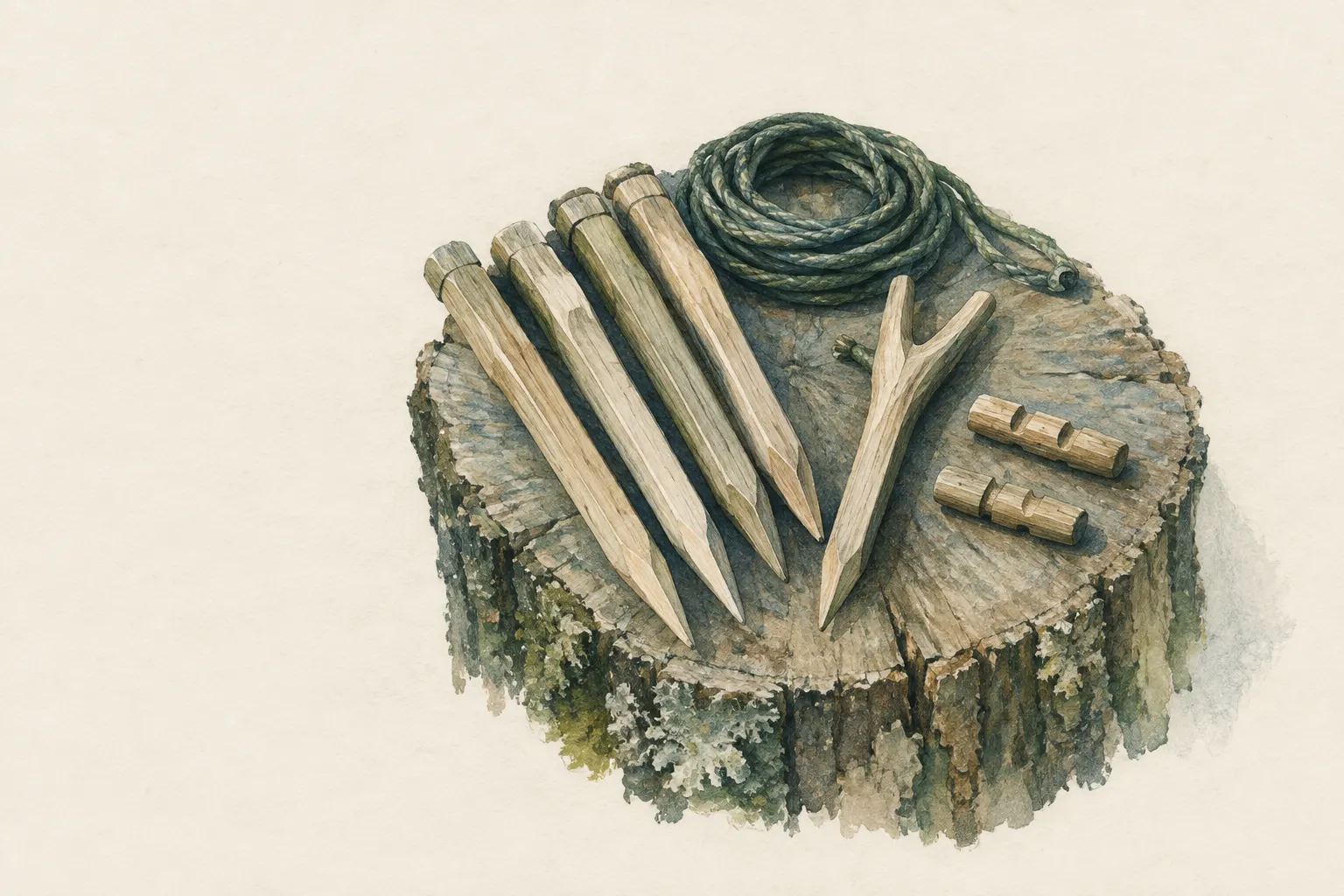
Explained simply
A peg is the little stake that holds your tent or tarp to the ground. If one is missing, you can carve it from a piece of wood. But not all ground is the same: in hard forest soil a short peg is enough, in soft soil you need a long one, and in sand or snow only a piece of wood buried crosswise will hold.
A forked branch is a gift: the short side branch simply becomes the hook, and you do not have to carve a notch. And then there is the toggle – a short piece of wood with a groove in the middle. You push it through a loop, and the line holds. To release it you simply pull it out again.
When carving the rule is always: away from your body, on a firm support, the holding hand behind the blade. And at the end you collect all the pegs again so nobody trips over them.
How it works
The line pulls at an angle on the peg. The peg presses against the soil in front of it, and this soil holds against it. The firmer the ground and the more surface the peg offers, the better it holds. That is why you set it angled slightly away from the line: then the pull tends to press it deeper rather than pull it out.
In soft ground the soil gives way more quickly. A longer, thicker peg reaches firmer layers and has more surface. In sand and snow a vertical peg hardly holds – there you bury a piece of wood crosswise to the pull. Then the line has to move a whole layer of sand or snow before it comes free.
The toggle works with a groove in which the cord sits and cannot slip. If you push it crosswise through a loop, it turns across under tension and cannot slip through. If you take off the tension, it slides out again – no knot at all.
What really matters
Use sound, dry deadwood without cracks – hardwood such as hazel, beech or ash holds best. For normal ground, pegs about 20–25 cm long are good, for soft ground 30 cm and more. Toggles are about finger thick and 8–10 cm long.
On a notched peg, the straight face of the notch points towards the head – that is, downwards when the peg is in the ground. So the line cannot slip off upwards. The stop cut goes only to about a third of the thickness, or the peg will break at that point.
The toggle's collar groove may be only a few millimetres deep. If it is too deep, the toggle breaks under tension. Lightly chamfer the head of a peg all round so it does not split when driven in. Drive it with a wooden mallet, not the hatchet.
Safety: what to watch out for
Notches and grooves are fine work in which it is easy to use too much force. Always work on a firm support, carve away from your body and never over the thigh or between the knees. The hand holding the wood always stays behind the edge. With heavy bleeding, press firmly on the wound and call 112, in Austria also 144.
When starting a saw cut, the saw easily jumps out, especially at the beginning. Rest the wood firmly, start the saw with short, light strokes and keep your free hand well away from the blade.
Pegs and tight lines are trip hazards, especially at night. Drive pegs in flush, mark lines with a bright strip of cloth and collect everything again when you break camp.
When it makes sense – and when not
Home-carved pegs and toggles make sense when pegs have been lost, when you need more hold in sand or snow, or when you want to release a line quickly again and again – for example on a tarp, a laundry bag or a ridgeline.
In frozen or very stony ground wooden pegs break. There, stones, logs or buried anchors help. Where wood may not be used, take the pegs you brought. And home-carved parts are not meant for anything that holds people or hangs above people.
Good to know
The simple notched peg and the pot hanger are explained step by step in the entry "Carving simple camp tools". This entry builds on it.
A toggle is also used in the marlinspike hitch: with a piece of wood in a loop you can pull a cord hard without it cutting into your hand. This helps, for example, when tightening lashings.
You may keep wooden pegs. If not, burn them where fire is permitted or scatter them in the forest – the main thing is that no scraps of line are left behind.
Step by step
Choose wood and sizes
Take sound, dry deadwood without cracks, preferably hardwood such as hazel, beech or ash. For normal forest soil pegs about 20–25 cm long, for soft ground 30 cm and longer. For toggles finger-thick pieces about 8–10 cm long.
- 1
Choose wood and sizes
Take sound, dry deadwood without cracks, preferably hardwood such as hazel, beech or ash. For normal forest soil pegs about 20–25 cm long, for soft ground 30 cm and longer. For toggles finger-thick pieces about 8–10 cm long.
- 2
Shape point and head
Point the tip with three or four flat cuts away from your body, not too fine. Lightly chamfer the edge of the head all round – then it splinters less when driven in.
Brace the workpiece on a firm support.
- 3
Notched peg: notch facing down
About 3–5 cm below the head, saw a straight stop cut to about a third of the thickness. Carve at an angle up towards it from below until a wedge drops out. The straight face points towards the head so the line cannot slip off.
- 4
Forked peg: no notch
A branch with a short side branch saves you the notch: leave the side branch about 3 cm long – it becomes the hook. Point the main branch below it.
- 5
Toggle: carve a collar groove
In the middle of the toggle make two stop cuts all round, about a finger's width apart and a few millimetres deep. Remove the wood between them with small cuts until a groove runs all the way round.
- 6
Use the toggle
Tie the cord into the groove with a clove hitch. Tie a loop on the other part. Push the toggle crosswise through the loop and apply tension – it holds. To release, take off the tension and pull the toggle out.
- 7
Set pegs correctly
Set the peg with the tip angled slightly away from the line and drive it in with a wooden mallet, not the hatchet. In soft ground use a long peg or two in line. In sand or snow tie a cross piece at its middle and bury it deep, crosswise to the pull.
- 8
Pull out and tidy up
Pull pegs out along their axis or lever them out with a second peg through the notch. Collect all pegs and toggles; you can keep wooden pegs or burn them where fire is permitted.
Common mistakes
- Carving the notch facing up so the line slips off
- Not chamfering the head – it splits when driven
- Short pegs in soft ground
- Collar groove too deep – the toggle breaks
- Driving pegs with the back of the hatchet
Quick view
Materials
Knife (fixed or locking blade)
Cut away from your body.
Rules on carrying knives differ by region – check local rules.
Folding saw
Fold or cover the blade after use; saw teeth are very sharp.
Sturdy sticks / poles
Sound, dry deadwood, one to two thumbs thick, including forked branches
Do not cut live wood where prohibited.
Paracord
Not a climbing or safety rope.
Cut-resistant glove
Reduces cuts but does not prevent stab injuries.
Suitable for
- Tarps and tents on varied ground
- Quick-release connections on lines and bags
- Practising stop cuts and notches
Not suitable for
- Frozen or very stony ground for driven wooden pegs
- Living trees or protected areas as a wood source
- Securing people or loads above people
Prerequisites
- Basic cuts and safe carving grips
- Able to carve simple pegs
- Able to tie a clove hitch
Safety
- When sawing stop cuts, rest the wood firmly and keep your free hand well away from the blade – the saw easily jumps when starting the cut.
- Pegs and lines are trip hazards. Drive pegs in flush, mark lines with bright cloth and collect all pegs again when breaking camp.
How it works
A peg holds because the line pulls it at an angle against the ground and the soil in front of it takes up the pull. The softer the ground, the longer and wider the peg must be – in sand and snow only a piece of wood buried crosswise will hold. A toggle uses a groove running all round it, in which the cord cannot slip; pushed through a loop, it holds under tension and can be released without untying a knot.
Advantages
- A suitable solution for almost any ground
- Toggles release quickly, even with cold hands
- Needs only knife, saw and deadwood
Disadvantages
- Wooden pegs break in hard ground
- Takes time compared to pegs brought along
- Only where wood may be used
Deep knowledge
Background
Notches, stop cuts and toggles are classic exercises in bushcraft teaching. Mears and Kochanski show how a few cuts solve many camp tasks; the marlinspike hitch is one of the old sailors' knots.
The simple notched peg and the pot hanger are explained in the entry "Carving simple camp tools". This entry is about shapes for difficult ground and about the toggle.
Variants
- Deadman in snow and sand
- A cross piece, a bag filled with snow or a stone is buried crosswise to the pull and stamped down. Details are in the entry on improvised pegs and deadman anchors.
- Tensioner instead of a knot
- A short piece of wood with two holes or two notches, through which the line runs in a zigzag, holds by friction and can be slid along – similar to a taut-line hitch.
Common mistakes
- Carving the notch facing up so the line slips off
- Not chamfering the head – it splits when driven
- Short pegs in soft ground
- Collar groove too deep – the toggle breaks
- Driving pegs with the back of the hatchet
Limits and risks
- No holding-force figures
- No wood identification – see separate entries
- Only with permission to use the wood
Material alternatives
Derived from material properties: a substitute must have all relevant properties. Observe the notes on the substitute.
- Paracord
- Rope (Never use unknown or damaged rope for life-safety purposes.), Thin, soft wire (brass or galvanised steel) (Wire ends are sharp – protect eyes and fingers when bending), Tow rope or tow strap (Attach only to the towing eyes provided by the manufacturer; never stand next to it under load.)
Results come exclusively from structured entries. No improvised instructions are generated.
Sources
Ray Mears – Hodder & Stoughton (2002): Bushcraft
Notches, stop cuts and wooden camp aids
Mors L. Kochanski – Lone Pine Publishing: Bushcraft: Outdoor Skills and Wilderness Survival
Pegs, toggles and notches
Clifford W. Ashley – Doubleday, Doran & Co. (1944): The Ashley Book of Knots
Toggle connections and marlinspike hitch
Leave No Trace Center for Outdoor Ethics: The Seven Principles of Leave No Trace (Principle 5: Minimize Campfire Impacts)
Pack out all equipment