Fire with a lens of ice, a water bottle or a plastic bag
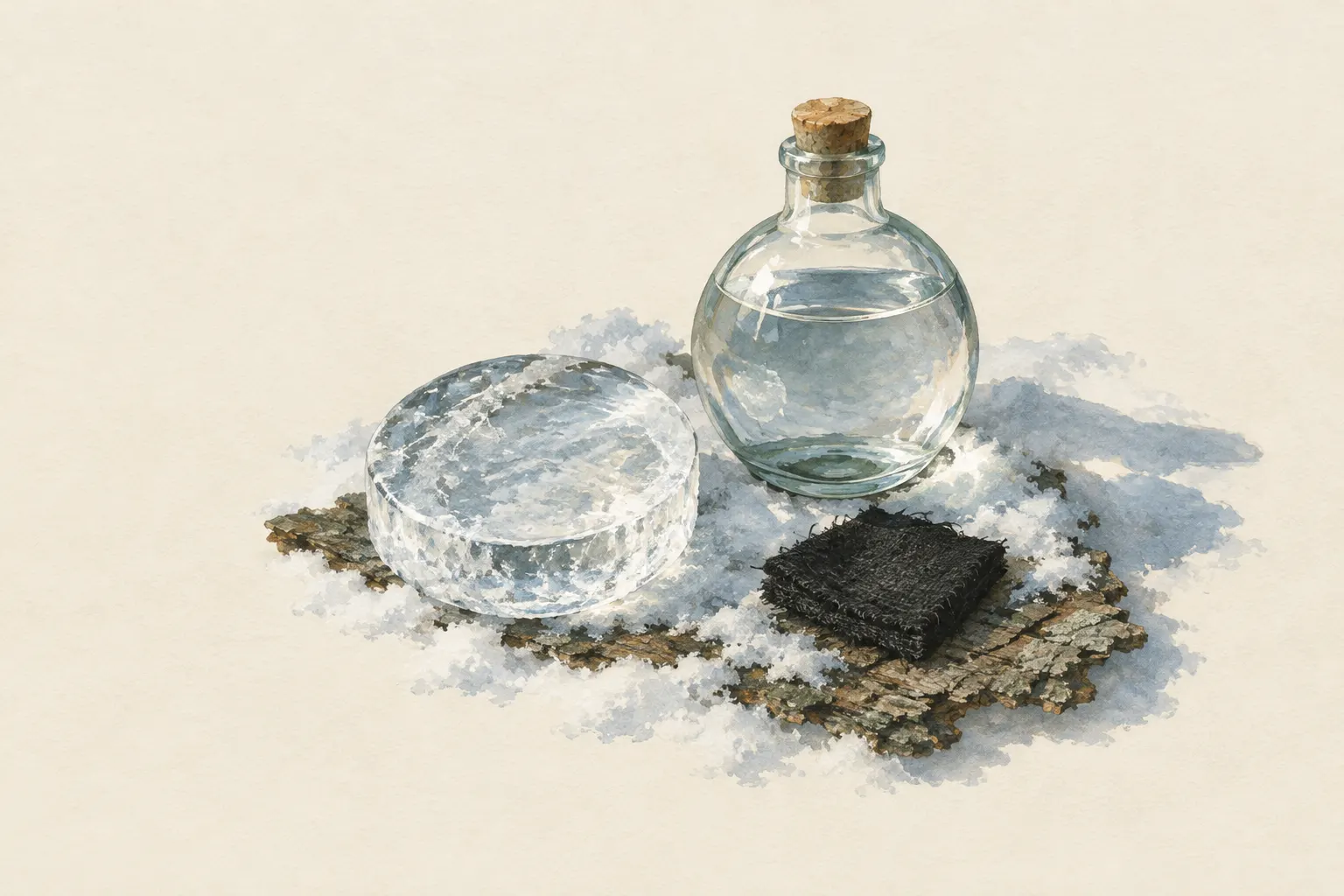
Clear ice, a round bottle filled with water or a tightly filled plastic bag can focus sunlight like a magnifier. But the focal spot is weaker and blurrier than with a real magnifier: it works only in strong, direct sun, with very dark tinder such as char cloth and with a lot of patience – often not at all. Protect your eyes: never look at the sun or stare at the bright spot.
- Shaping an ice lens 20–40 minutes; the lighting itself minutes – if it works at all
Explained simply
Have you ever made a bright spot of light with a magnifying glass? The magnifier collects the sunlight from a large area and sends it onto a tiny spot. It gets so hot there that dark paper can smoke. The amazing thing is: clear ice or a round bottle full of water can do it too, if they are curved the right way.
For an ice lens you scrape a clear piece of ice so that it is thick in the middle and thin at the edge, and polish it smooth with warm hands. With a bottle or bag you fill it to the brim with water, without an air bubble. Then you hold the lens in the sun and look for the smallest, brightest spot on very dark tinder.
Very important: never look at the sun through the lens and do not stare at the bright spot – it can harm your eyes. And be honest: it only works in really strong sun and often not at all. It is an exciting experiment, but no substitute for a lighter or matches.
How it works
Light is bent when it passes at an angle from air into water, ice or glass – this is called refraction. If a transparent body bulges outwards, the rays at the edge are bent more than those in the middle. They meet in a point behind the body, the focal point. There the light of a whole area is concentrated onto a small spot.
Ice and water bend light less strongly than glass. On top of that, bubbles, scratches and uneven surfaces scatter light. That is why the focal spot of an ice or water lens is larger and less hot than with a good magnifier. A round bottle or a tight bag focuses to a point, a cylindrical bottle rather to a narrow line – that spreads the heat and is weaker.
Whether tinder starts to glow depends on how much light it absorbs. Dark, charred material takes up almost everything and heats quickly. Light-coloured material reflects most of the light. That is why char cloth or charred wood is almost always needed for this method.
What really matters
The sun must shine strongly and directly. A good clue is your shadow: if it is short and sharply outlined, the sun is high and clear. In haze, thin cloud or with a low winter sun the energy is usually not enough. That is the catch with the ice lens: when there is ice in our latitudes, the sun is often low.
The lens must be clear and smooth. Ice with many bubbles or milky patches scatters the light. Polishing smooth only works with hand warmth, and it takes time. With a bottle or bag no air bubble may remain, and the surface must be smooth and clean – print, wrinkles and dirt weaken the spot.
Stillness is the third point. The focal spot has to stay on the same place, otherwise the tinder cools down again at once. Rest your hands on your knee or a stone. With ice, hold the lens so that meltwater does not drip onto the tinder.
Safety: what to watch out for
Your eyes come first. Never look at the sun through a lens, ice or a bottle. You should not stare at the bright focal spot either, because it is very glaring. Look only briefly and from the side, with sunglasses if you have them.
Lenses can also ignite things by accident. A water bottle or a glass lying in full sun on dry grass or on a windowsill can start a fire. In dry weather with wildfire danger you do not practise at all, and after the attempt you pack the bottle in the shade or in your rucksack.
Ice chills your hands badly. Warm them up again and again, hold the ice with a glove in turns and stop at once if your fingers go numb or white. Fetch ice only from the bank or from puddles, never by walking out onto ice. And never aim the focal spot at skin, clothing, people or animals.
When it makes sense – and when not
The method makes sense as an experiment and as a last stopgap when you have a clear bottle or clear ice, the sun is strong and you have char cloth or charred material with you. Children learn very vividly how a lens focuses light – with an adult present.
It does not make sense as a plan for a real emergency. In cloud, at dusk, at night and with a low winter sun it does not work. A small magnifier or plastic burning lens weighs almost nothing and is far more reliable – and a lighter, matches or a ferro rod are even more so.
Good to know
How far away the focal point is depends on the curvature. With a round bottle it lies only a few centimetres behind the bottle, with a flatter ice lens usually further away. The best way to find it is to change the distance slowly and watch the light spot on the ground until it is smallest.
Reading glasses for long-sightedness are also converging lenses and focus better than water. Glasses for short-sightedness, on the other hand, spread the light and do not work. A water drop on clear film shows the principle on a small scale, but is far too weak for fire.
Step by step
Check the sun, lay out tinder
Only try in cloudless, strong sun, best around midday – your shadow is then short and sharp. Put very dark tinder (char cloth, charred wood) on a dry base and keep a tinder bundle ready next to it.
- 1
Check the sun, lay out tinder
Only try in cloudless, strong sun, best around midday – your shadow is then short and sharp. Put very dark tinder (char cloth, charred wood) on a dry base and keep a tinder bundle ready next to it.
- 2
Get clear ice
Find a transparent piece of ice, as free of bubbles as possible, about the size of a hand and a few centimetres thick – from the bank, never on thin ice. Or let clear water freeze overnight in a round bowl. Milky ice with bubbles hardly focuses at all.
Never go out onto ice to fetch ice.
- 3
Shape the lens
Scrape carefully with the knife until both sides bulge outwards: thick in the middle, thin towards the edge. Scrape, do not pry, and work away from your body.
- 4
Polish with hand warmth
Rub the lens with bare, warm hands until the surface is smooth and clear as glass. Warm your hands again and again and hold the lens with a glove in turns. If fingers go numb or white, stop at once.
- 5
Or: fill a bottle or bag
Fill a clear, smooth, as round as possible bottle to the brim with clear water so that no air bubble remains, and close it. Fill a clear bag and twist the neck until it forms a tight, wrinkle-free ball. Wipe the outside dry.
- 6
Find the focal point
Hold the lens between the sun and the tinder and slowly change the distance until the light spot is as small and bright as possible. With a bottle or bag it lies only a few centimetres behind, with ice usually further. Look only briefly and from the side.
Never look at the sun or stare at the spot.
- 7
Hold steady
Rest your hands on your knee or a stone and keep the spot still on one point. With ice, make sure meltwater does not drip onto the tinder. When smoke rises and a red spot glows, keep holding until the ember grows.
- 8
Blow to flame and tidy up
Put the ember into the tinder bundle, close it loosely and blow gently until flames appear. Afterwards put the bottle or bag in the shade or your pack and break up the ice lens.
Common mistakes
- Trying with hazy or low sun
- Using milky ice with bubbles
- Leaving an air bubble in the bottle or bag
- Light-coloured or damp material as tinder
- Staring at the focal spot
- Leaving the bottle lying in the sun afterwards
Quick view
Materials
Clear, bubble-free ice
Never walk onto thin ice to fetch ice.
Hold with bare hands only briefly – risk of frostbite.
PET bottle (clear, max. 2 litres)
Clear, smooth, as rounded as possible
Do not heat or place in a fire.
Resealable food bags
Clear, smooth bag without print
Use only bags intended for food; do not use with boiling water unless the manufacturer explicitly allows it.
Char cloth (charred cotton)
Or other very dark, charred material
Store dry in a tin.
Make only outdoors.
Tinder
Carry in waterproof packaging.
Do not use liquid accelerants as tinder.
Knife (fixed or locking blade)
For shaping the ice lens
Cut away from your body.
Rules on carrying knives differ by region – check local rules.
Gloves and mittens
Suitable for
- Experiments and practice in sunshine
- A stopgap when a clear bottle or ice is at hand and the sun is strong
- Children who want to understand how a lens focuses light – with adults
Not suitable for
- Overcast, haze, dusk, night
- Winter with a low sun at northern latitudes – even though ice is available
- As the only ignition source
- Dry heat with wildfire danger
Prerequisites
- Cloudless, strong sun, best around midday
- Very dark, dry tinder
- A sheltered spot out of the wind
- Another ignition source as plan A
Safety
- Polishing ice with bare hands chills your fingers badly. Warm them up again and again, hold the ice with a glove in turns and stop at once if your fingers go numb or white. Never walk onto unsafe ice to get ice.
- The focal spot can burn skin. Never aim it at hands, clothing, people or animals.
How it works
A transparent body with a curved surface bends light rays and brings them together behind it – that is a converging lens. Ice and water bend light less strongly than glass, and their surface is rarely perfect. So the focal spot becomes larger and less hot than with a magnifier. A round bottle focuses well, whereas a cylindrical bottle tends to focus to a line instead of a point. Dark material absorbs the light and heats up; light-coloured material reflects it.
Advantages
- No fuel needed, only sun
- You often have a bottle with you
- Shows clearly how lenses work
Disadvantages
- Very unreliable, often unsuccessful with ice
- Only in strong sun
- Needs very dark tinder
- Shaping ice chills the hands
Deep knowledge
Background
That you can make fire with an ice lens has long been known and is often demonstrated in survival courses. In practice it often fails because of cloudy ice, an uneven surface or weak sun – especially in winter, when there is ice, the sun is low in our latitudes.
It is similar with water bottles: under ideal conditions and with char cloth it can work. Conversely, fire services warn against leaving glass and filled bottles in full sun.
Variants
- Glasses for long-sightedness
- Reading glasses for long-sightedness are converging lenses and focus better than water. Glasses for short-sightedness spread the light and do not work.
- A water drop on film
- A drop of water on clear film acts like a tiny lens – a nice experiment to see the principle, but far too weak to make fire.
Common mistakes
- Trying with hazy or low sun
- Using milky ice with bubbles
- Leaving an air bubble in the bottle or bag
- Light-coloured or damp material as tinder
- Staring at the focal spot
- Leaving the bottle lying in the sun afterwards
Limits and risks
- Not a substitute for a lighter, matches or ferro rod
- Success depends strongly on sun height and lens quality
Material alternatives
Derived from material properties: a substitute must have all relevant properties. Observe the notes on the substitute.
- Resealable food bags
- Single-wall stainless steel bottle (Heat only single-wall bottles without paint/plastic; remove the lid before heating.), Double-wall insulated bottle (Never heat directly.), PET bottle (clear, max. 2 litres) (Do not heat or place in a fire.), Food-grade water container (Only use containers that never held chemicals or fuel.), Airtight food-grade storage container (Fill only when clean and completely dry; never use containers that previously held chemicals.), Collapsible water container or bag (Protect from sharp objects.), Food-grade water bag (Use only for drinking water, never for chemicals or fuel.), Fermentation jar or crock (Use only food-grade containers of glass, food-safe glazed stoneware or food-grade plastic – no metal containers for acidic food.)
- Char cloth (charred cotton)
- Dry firewood (Collect only where permitted.), Tinder (Carry in waterproof packaging.), Finest-grade steel wool (Store separately from batteries – fire risk.), Fatwood (resin-rich wood) (Collect only dead wood where permitted.), Stove fuel (canister, liquid fuel, alcohol) (Store fuels apart from food and in original containers or bottles intended for them.), Petroleum jelly cotton balls (Use only pure cotton.), Cooking oil or cooking fat (tallow, lard) (Never put out burning fat with water – cover it with a lid to smother it.), Tree resin (spruce, pine) (Resin is flammable and sticks to the skin when hot – melt it only slowly over low heat.), Birch bark (from dead, fallen wood) (Never peel from living trees.)
- Tinder
- Dry firewood (Collect only where permitted.), Char cloth (charred cotton) (Store dry in a tin.), Finest-grade steel wool (Store separately from batteries – fire risk.), Fatwood (resin-rich wood) (Collect only dead wood where permitted.), Stove fuel (canister, liquid fuel, alcohol) (Store fuels apart from food and in original containers or bottles intended for them.), Petroleum jelly cotton balls (Use only pure cotton.), Cooking oil or cooking fat (tallow, lard) (Never put out burning fat with water – cover it with a lid to smother it.), Tree resin (spruce, pine) (Resin is flammable and sticks to the skin when hot – melt it only slowly over low heat.), Birch bark (from dead, fallen wood) (Never peel from living trees.)
Results come exclusively from structured entries. No improvised instructions are generated.
Sources
Headquarters, Department of the Army (USA) (2002): FM 3-05.70 Survival
Fire with a convex lens: focusing sunlight onto tinder
David Halliday, Robert Resnick, Jearl Walker – John Wiley & Sons: Fundamentals of Physics
Refraction and focal point of converging lenses
Mors L. Kochanski – Lone Pine Publishing: Bushcraft: Outdoor Skills and Wilderness Survival
Dark, fine tinder and the tinder bundle