A winter emergency kit for the car: packing, checking, acting right in snow
Anyone driving in winter or remote areas can be stuck for hours in a jam, after a breakdown or in a snowdrift. A kit of mandatory equipment, blankets, water, food, shovel, light, power bank, tow rope and jumper cables makes this safer. It is checked in autumn and spring. And anyone snowed in keeps the exhaust pipe clear – otherwise there is a risk of carbon monoxide poisoning.
- 1 hour to pack, 20 minutes per seasonal check
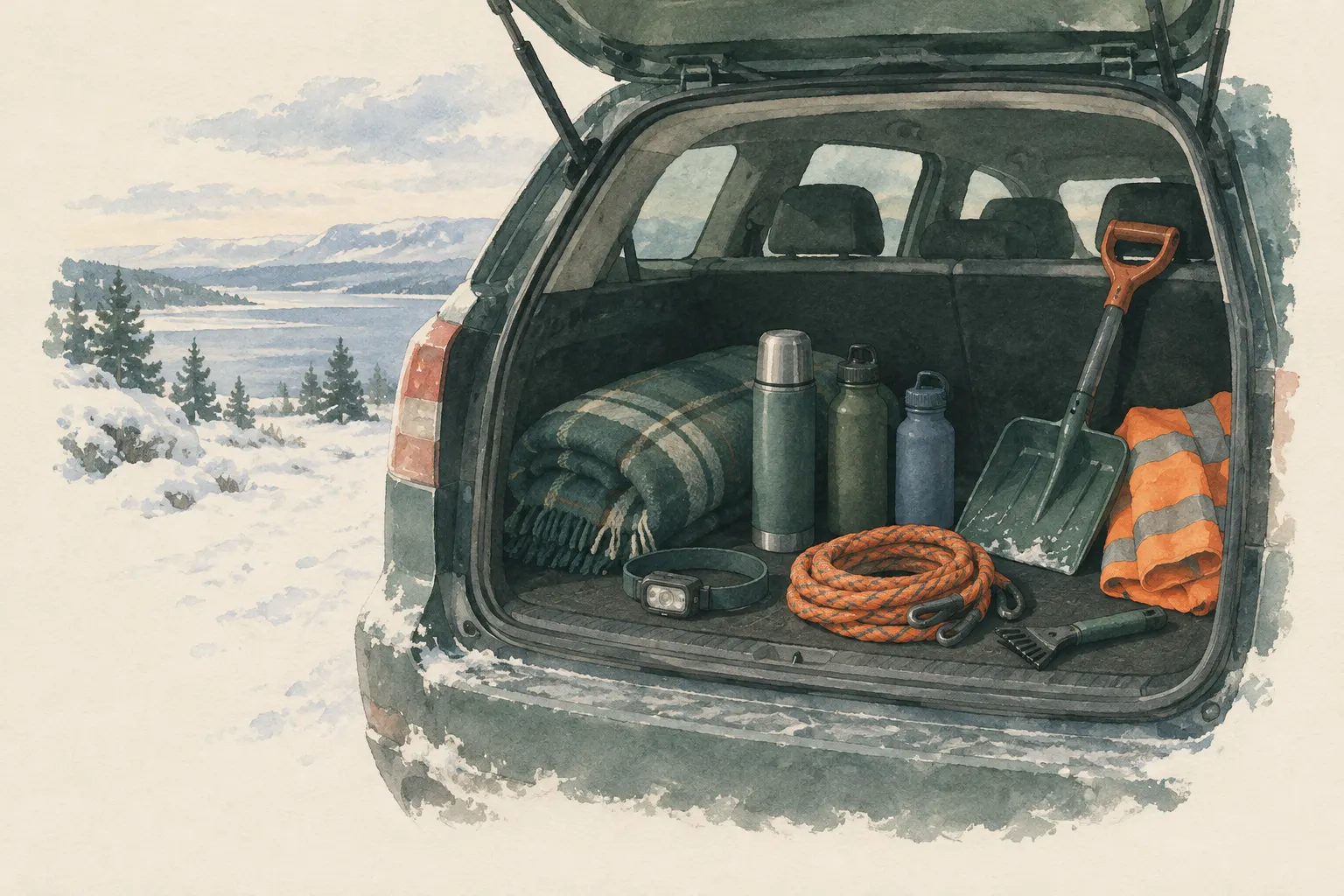
Explained simply
In winter a car can get stuck in snow or be in a jam on the motorway for hours. Then the car gets cold quickly, and people get hungry and thirsty. That is why smart drivers pack an emergency box in the boot: blankets, water, something to eat, a shovel, a torch and a charger for the phone.
The hi-vis vest does not go in the boot but up front, so you can put it on before you get out. Twice a year – in autumn and in spring – you check whether everything is still there and works.
And one rule is very important: if the car is snowed in, the exhaust pipe must be clear. Otherwise poisonous gas can get into the car, which you can neither see nor smell. That is why you dig it clear and run the engine only briefly now and then.
How it works
A car is good weather protection but not a heater you can rely on. With the engine off, the interior cools quickly in winter. With it running, it uses fuel and produces exhaust. The emergency kit makes sure warmth comes from the people themselves – through clothing, blankets, hot drinks and food – and the engine is needed only now and then.
Carbon monoxide is produced in every combustion in the engine. Normally it is blown away to the rear with the exhaust. But if the exhaust pipe is covered with snow, the exhaust builds up under and around the car and can get into the interior through gaps. Because the gas can neither be seen nor smelled, you notice nothing until you become tired, dizzy or unconscious.
The second part of the kit helps you get free again or get help: shovel and ice scraper, jumper cables and tow rope, light, power bank and charging cable. The mandatory equipment – warning triangle, first-aid kit, hi-vis vest – protects you when you stand by the road.
What really matters
Pack a blanket or sleeping bag for each person in the car, and add hat, gloves and warm footwear – especially if you drive in light shoes. Fill water into bottles that are not quite full so they do not burst when they freeze. On longer journeys a thermos flask with a hot drink is worth its weight in gold. Any food that needs no cooking and keeps well is suitable: nuts, bars, biscuits.
The hi-vis vest belongs in the driver's door or under the seat so you can put it on before getting out. Ideally there is one vest for every seat. Jumper cables, tow rope and snow chains are only useful if you know how to use them – read the vehicle manual and practise fitting the chains once in good weather.
Check the kit twice a year, ideally in autumn before the first frost and in spring: swap water and food, test and charge lamp and power bank, check the first-aid kit's expiry date. In winter try not to let the tank drop below half full – that gives you a reserve if you are stuck for a long time.
Safety: what to watch out for
If you are stuck in snow: dig the exhaust pipe clear and keep it clear, run the engine only about ten minutes per hour for heat, and open a window on the downwind side a crack while it runs. Civil protection agencies recommend this too. Never let an engine run in a closed garage. Anyone in the car who gets a headache, dizziness or nausea gets fresh air immediately and calls 112.
By the road, moving traffic is the greatest danger. Put on the hi-vis vest before getting out, switch on the hazard lights, set up the warning triangle at a sufficient distance and wait behind the crash barrier where there is one. Children stay holding hands or buckled up in the car if it is safely parked.
In a snowstorm stay in the car if it is safely parked. The car protects you from wind and cold and is much easier for rescuers to find than a person on foot. Setting off only makes sense if help is in sight. Call 112 and save your phone battery with the power bank.
When it makes sense – and when not
A winter kit is worthwhile for everyone who drives in winter – especially over passes, on country roads, in remote areas or with children and older people on board. For short city trips a small kit of mandatory equipment, blanket, water, bars, ice scraper and power bank is enough. The further you go from settlements, the more complete it should be.
The kit is no reason to set off despite a severe weather warning. The safest journey in a snowstorm is the one that never happens. No emergency kit can replace winter tyres and – where required – snow chains either.
Good to know
In Germany and Austria, warning triangle, first-aid kit and hi-vis vest are mandatory. Austria also has a situational winter equipment requirement, and snow chains are mandatory on some routes – road signs show this. Rules can change; before trips abroad it is worth checking the current requirements of the destination country.
An electric car has no exhaust and therefore no carbon monoxide risk from its own vehicle. Instead, heating costs range. Charge fully before winter journeys, take warm clothing and remember that other cars with running engines in a jam still produce exhaust.
Step by step
Mandatory kit within reach
Warning triangle, first-aid kit and hi-vis vest are mandatory in Germany and Austria. The vest belongs in the driver's door or under the seat – within reach without getting out. Ideally one vest for every seat.
- 1
Mandatory kit within reach
Warning triangle, first-aid kit and hi-vis vest are mandatory in Germany and Austria. The vest belongs in the driver's door or under the seat – within reach without getting out. Ideally one vest for every seat.
- 2
Warmth for everyone
A blanket or sleeping bag for each person, plus hat, gloves and warm footwear. Anyone driving in light shoes puts winter boots in the boot.
- 3
Water and food
Water in bottles that are not quite full so they do not burst when freezing. On longer journeys a thermos flask with a hot drink. Plus food that needs no cooking: nuts, bars, biscuits.
- 4
Snow tools
A small snow shovel, ice scraper and snow brush, gloves. For slippery spots some grit or traction aids, in the mountains snow chains where required – and practise fitting them once beforehand.
- 5
Light and power
A headlamp with spare batteries, a charged power bank and a car charging cable. That keeps the phone ready for an emergency call, even with the engine off.
- 6
Towing and jump-starting
A tow rope and jumper cables. Cold weakens car batteries. How to connect and where the towing eye is are in the vehicle manual – read it before you need it.
- 7
Check in autumn and spring
Twice a year: swap water and food, test and charge the lamp and power bank, check the first-aid kit's expiry date. In winter try not to let the tank drop below half full.
- 8
Snowed in: keep the exhaust clear
Stay in the car, hazard lights on, call 112. Dig the exhaust pipe clear and keep it clear. Run the engine only about ten minutes per hour for heat, with a window on the downwind side open a crack. Wrap up in blankets and huddle together.
Snow at the exhaust = carbon monoxide in the car.
Common mistakes
- Hi-vis vest in the boot instead of within reach
- Frozen, burst water bottles
- Running the engine for hours while the exhaust gets snowed in
- Setting off on foot in a snowstorm
- Packing the kit and never checking it again
Quick view
Materials
Warning triangle
Whether warning triangles are mandatory, or should be placed at all on certain roads (e.g. motorways), differs between countries – check local rules.
High-visibility vest
Keep within reach inside the cabin, not in the boot/trunk.
First-aid kit (household)
Vehicle first-aid kit
Does not replace a first-aid course; check contents and expiry dates regularly.
Wool blanket / duvet
One per person or a sleeping bag
Keep away from candles, stoves and heaters.
Double-wall insulated bottle
Never heat directly.
Non-perishable food
Prefer food that can be eaten without cooking; consider allergies and dietary needs; do not forget a can opener.
Snow shovel
Always take it inside when digging a snow shelter.
Ice scraper and snow brush
Headlamp / flashlight
Power bank
Do not use damaged or swollen batteries; do not charge while covered.
Tow rope or tow strap
Attach only to the towing eyes provided by the manufacturer; never stand next to it under load.
Jumper cables
Follow the order given in the vehicle manual; batteries can release explosive gas.
Gloves and mittens
Suitable for
- Winter driving, over passes and in remote areas
- Long journeys with children or older people
- Commuting on country roads
Not suitable for
- As a replacement for winter tyres, snow chains or waiting out a severe weather warning
- As a reason to drive despite a severe weather warning
Prerequisites
- A winter-ready vehicle (winter tyres, antifreeze)
- Know where the towing eye is and how jump-starting works (manual)
Safety
- In a snowstorm stay in the car if it is safely parked – the car is weather protection and easier to find. Do not set off on foot into the cold if help is not in sight. Emergency call 112.
How it works
A stationary car cools quickly in winter, and the engine is not a safe permanent heater. So warmth must come from the people themselves: clothing, blankets, a hot drink, food. Tools help you get free again; light, power bank and warning equipment make sure you are seen and can call for help. A seasonal check makes sure everything works when it matters.
Advantages
- Makes long waits safe and bearable
- Also helps other road users
- Pack once, check twice a year
Disadvantages
- Takes up boot space
- Contents must be swapped regularly
Deep knowledge
Background
Agencies such as FEMA and Ready.gov in the USA recommend a winter car emergency kit with blankets, water, food, shovel, light and charger. They expressly advise keeping the exhaust pipe clear when stuck in snow, running the engine only at intervals and opening a window a crack. The German BBK gives similar preparedness advice.
In Germany and Austria, warning triangle, first-aid kit and hi-vis vest are part of the mandatory equipment. Austria also has a situational winter equipment requirement; snow chains are mandatory on some routes – follow the signs.
Variants
- Small city kit
- For short city trips, the mandatory kit, a blanket, water, bars, an ice scraper and a power bank are enough. The kit grows with the distance from settlements.
- Electric car
- An electric car has no exhaust and therefore no carbon monoxide risk from its own vehicle, but heating costs range. Charge fully before winter journeys and take warm clothing.
Common mistakes
- Hi-vis vest in the boot instead of within reach
- Frozen, burst water bottles
- Running the engine for hours while the exhaust gets snowed in
- Setting off on foot in a snowstorm
- Packing the kit and never checking it again
Limits and risks
- Not a guide to driving on snow and ice
- Not a vehicle repair guide
- Legal requirements can change – check the current rules
Material alternatives
Derived from material properties: a substitute must have all relevant properties. Observe the notes on the substitute.
- Warning triangle
- Emergency blanket (Tears easily once punctured; short-term shelter only.), Signal mirror (Do not flash into the eyes of people nearby or of drivers.), High-visibility vest (Keep within reach inside the cabin, not in the boot/trunk.), Aluminium foil (heavy-duty) (Edges can be sharp; conducts heat and electricity.)
- High-visibility vest
- Emergency blanket (Tears easily once punctured; short-term shelter only.), Signal mirror (Do not flash into the eyes of people nearby or of drivers.), Warning triangle (Whether warning triangles are mandatory, or should be placed at all on certain roads (e.g. motorways), differs between countries – check local rules.), Aluminium foil (heavy-duty) (Edges can be sharp; conducts heat and electricity.)
- Wool blanket / duvet
- Sleeping pad, Dry leaves, grass or conifer boughs (Collect only where allowed; no protected plants. Check for ticks and insects.), Backpack, Dry spare clothing (Carry it in waterproof packaging – wet clothing barely insulates.), Insulated cool box (Keeps cold only for a limited time; without ice packs or ice it is not a fridge.), Sleeping bag (Do not store compressed long-term; do not pack away damp.), Newspaper and cardboard (Flammable – keep away from candles, stoves, heaters and embers.), Insulated cooking box (hay box, thermal cooker) (Never put open flame or embers inside – only the hot, closed pot.), Long-stemmed thatch (reed, grass, rushes) (Extremely flammable – no open fire and no sparks nearby.)
- Double-wall insulated bottle
- Single-wall stainless steel bottle (Heat only single-wall bottles without paint/plastic; remove the lid before heating.), PET bottle (clear, max. 2 litres) (Do not heat or place in a fire.), Food-grade water container (Only use containers that never held chemicals or fuel.), Airtight food-grade storage container (Fill only when clean and completely dry; never use containers that previously held chemicals.), Collapsible water container or bag (Protect from sharp objects.), Food-grade water bag (Use only for drinking water, never for chemicals or fuel.), Fermentation jar or crock (Use only food-grade containers of glass, food-safe glazed stoneware or food-grade plastic – no metal containers for acidic food.), Resealable food bags (Use only bags intended for food; do not use with boiling water unless the manufacturer explicitly allows it.)
- Headlamp / flashlight
- Mobile phone (The battery drains quickly in cold and with continuous screen and GPS use.), Battery lantern / LED light
- Tow rope or tow strap
- Rope (Never use unknown or damaged rope for life-safety purposes.), Paracord (Not a climbing or safety rope.), Thin, soft wire (brass or galvanised steel) (Wire ends are sharp – protect eyes and fingers when bending)
Results come exclusively from structured entries. No improvised instructions are generated.
Sources
U.S. Federal Emergency Management Agency (FEMA): Are You Ready? An In-Depth Guide to Citizen Preparedness
Winter car kit; when stranded keep the exhaust clear, run the engine at intervals, open a window slightly
Ready.gov – U.S. Federal Emergency Management Agency (FEMA): Winter Weather
Emergency kit in the vehicle for winter
Centers for Disease Control and Prevention: Carbon Monoxide Poisoning – Prevention guidance
Carbon monoxide from vehicle exhaust: never run an engine in an enclosed space
Bundesamt für Bevölkerungsschutz und Katastrophenhilfe (BBK), Deutschland: Ratgeber für Notfallvorsorge und richtiges Handeln in Notsituationen
Preparedness for emergencies on the road