Teaching children what to do if lost in the forest: “Hug a tree”
Children who get lost often keep walking, hide or do not answer because they are afraid of strangers or of getting into trouble. The “Hug a tree” rule gives them a simple task: stop, stay at a tree, whistle, make themselves visible and warm, and answer anyone who calls their name. Parents prepare this with a whistle, bright clothing and a few simple steps and practise it playfully.
- One practice session of 20–30 minutes, briefly repeated before each outing
Explained simply
If you suddenly cannot see or hear your family in the forest any more, that is pretty scary. Then you want to run off and look for them. But exactly that makes it harder to find you. That is why there is a simple rule: stop and hug a tree. The tree is your friend and helps you stay in one place.
In your jacket pocket you have a whistle. Blow into it three times really hard, then be quiet and listen. Then three times again. A whistle can be heard much further away than your voice. If it rains or gets cold, you put on the big bag from your pocket like a raincoat – with your face through the hole.
And very important: nobody is angry with you if you get lost! Everyone is just happy when they find you. If strangers call your name, they are helpers looking for you. Then you answer loudly and show yourself. Do not hide – not even from dogs or helicopters.
How it works
A child who stays in one place is found much more easily than one who wanders around. Every step enlarges the area searchers must comb through. But children need a concrete action for this instead of a prohibition: “Don't run away” is hard to follow when you are afraid. “Hug a tree”, on the other hand, is a clear task that gives a hold – literally and figuratively.
A second building block is the fear of trouble and of strangers. Search-service literature describes that some lost children hide or do not answer when called – for example because they fear punishment or because they have been taught not to talk to strangers. That is why the rule includes the explicit message: nobody is angry, and whoever calls your name wants to help you.
What really matters
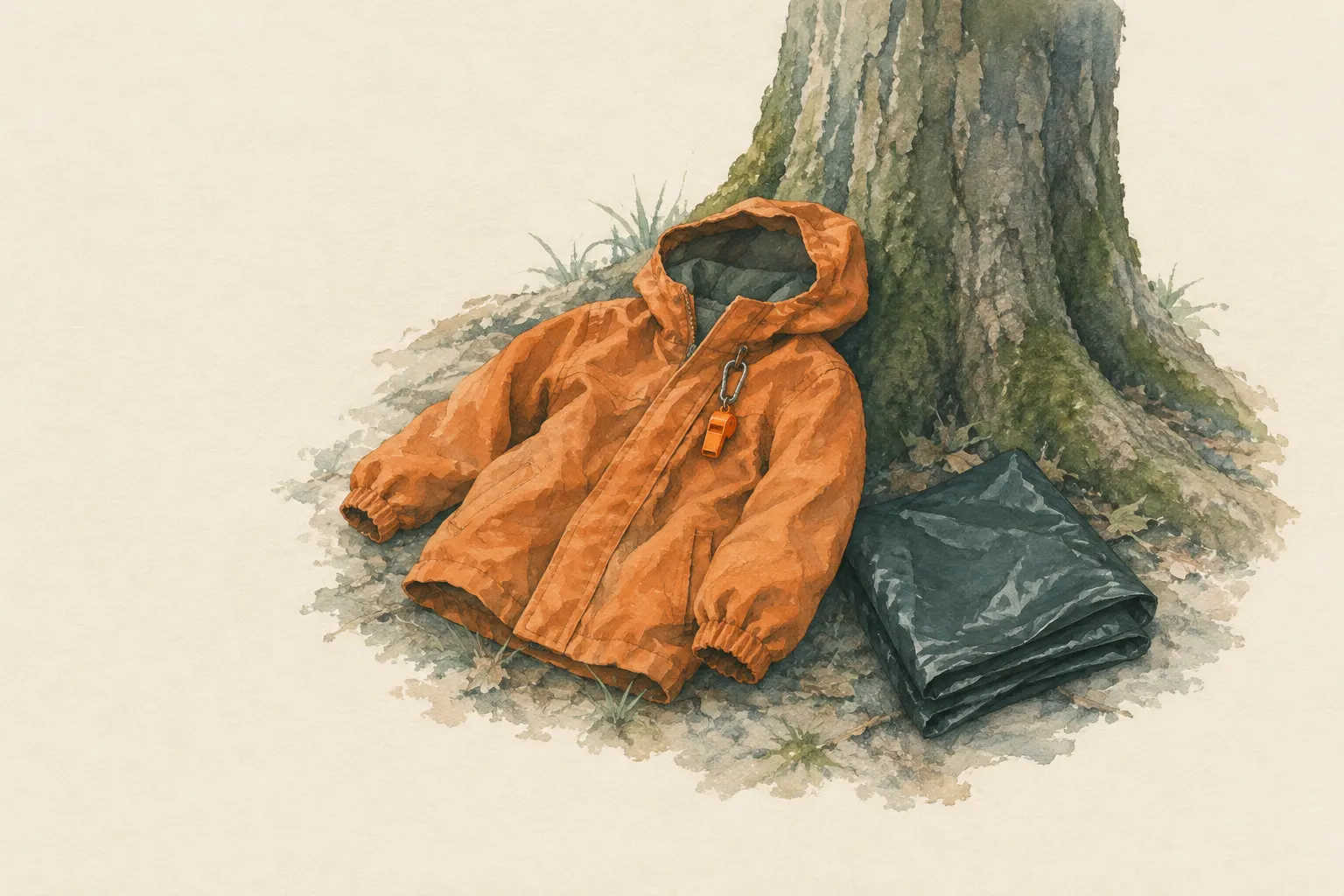
The kit is small: a whistle of their own, securely attached to the jacket, a large bin bag with a pre-cut face hole, folded in the jacket pocket, and bright, conspicuous clothing. The bag keeps off rain and wind when the child wears it like a poncho and also makes it more visible. If the child sits on leaves or the backpack instead of on wet ground, it stays warmer.
The messages must be simple and repeated often: stop, hug a tree, whistle three times and listen, nobody is angry, answer when someone calls your name. At animal noises: whistle or talk loudly – animals run away. It is best to say the rules together before every outing, like a little ritual.
Parents prepare: a current photo, noting the clothing colours on the day of the outing and a print of the shoe sole. For this the child steps with its hiking shoes onto a piece of aluminium foil lying on a soft surface such as a towel. The print helps search teams recognise the child's tracks.
Safety: what to watch out for
Plastic bags can suffocate small children. An adult cuts the face hole in advance, the bag is never pulled over the whole head, and bags are kept out of reach of babies and toddlers. Equally important: no fixed cord around small children's necks, because they can strangle themselves when climbing and playing. The whistle is attached to the jacket or worn on a breakaway lanyard that opens under pull.
For adults: if a child is missing, call and search briefly at the place where it was last seen – then call 112 immediately. Do not search alone for hours. The earlier search teams are alerted, the smaller the area the child can be in. If the child is at a dangerous spot, such as water, a steep slope or a road, it should walk a few steps to the nearest safe tree.
When it makes sense – and when not
The rule suits all families who hike, camp or go berry picking, and kindergartens, schools, scouts and youth groups. From about kindergarten age children can understand and practise it. Older children and teenagers also get a charged phone with 112 saved, a small headlamp and an emergency blanket – the rule “Stay where you are” applies to them just the same.
The rule never replaces adult supervision. Toddlers cannot yet apply it reliably and need constant company. In groups, fixed pairs, regular head counts and agreed meeting points help in addition.
Good to know
The “Hug-a-Tree and Survive” programme originated in the USA: Jacqueline Heet founded it together with the experienced U.S. Border Patrol tracker Ab Taylor after a boy who had become lost in the woods was not found in time. Since then it has been used by search services, schools and youth groups to teach children these simple rules.
Children learn best through play: in the park the child “gets lost” a few metres away, hugs a tree, whistles three times and answers when an adult calls its name. Praise it every time it stays put. That turns a frightening idea into a familiar exercise – and in an emergency the child knows what to do.
Step by step
Whistle, bag and bright clothing
Give each child their own signal whistle, securely attached to the jacket, and a large folded bin bag with a pre-cut face hole in the jacket pocket. Dress them in bright, conspicuous clothing. Show how loud the whistle is and explain: “This is only for emergencies.”
- 1
Whistle, bag and bright clothing
Give each child their own signal whistle, securely attached to the jacket, and a large folded bin bag with a pre-cut face hole in the jacket pocket. Dress them in bright, conspicuous clothing. Show how loud the whistle is and explain: “This is only for emergencies.”
- 2
Stop and hug a tree
Teach the child: “As soon as you can no longer see or hear us, you stop and find the nearest tree. You hug it, and you stay there until we find you.” The tree is a friend that helps you stay in one place. Do not walk on, do not try to find the way home.
- 3
Whistle three times, listen
“Blow three strong blasts on the whistle, then be quiet and listen. Then three times again.” A whistle can be heard much further than a child's voice and is less tiring than shouting. If the child hears calls, it whistles or calls back.
- 4
Nobody is angry – answer!
Tell your child explicitly: “If you get lost, nobody will be angry with you. We will just be happy when we find you.” Explain: strangers who call your name are helpers looking for you – then you may and should answer and show yourself. Do not hide, not even from dogs, lights or helicopters.
- 5
Stay visible and warm
“Put on the bag like a raincoat – with your face through the hole. Sit on leaves or your backpack, not on wet ground.” If there is an open space within sight, the child can sit at its edge so it is easier to see from above. At animal noises: whistle or talk loudly – animals run away.
- 6
What parents prepare
Before the outing take a current photo of the child and note the colours of its clothing. A print of the shoe sole helps search teams: the child steps with its hiking shoes onto a piece of aluminium foil on a soft surface. Agree on fixed rules, such as always staying within sight. If a child is missing: call and search briefly, then call 112 immediately.
- 7
Practise playfully
Practise it all in the park or forest like a game: the child “gets lost” a few metres away, hugs a tree, whistles three times and answers when an adult calls its name. Praise it every time it stays put. Before each outing briefly say the rules out loud together.
Common mistakes
- Threatening punishment if the child runs off – then it is more likely to hide
- Only saying “Don't run away!” instead of teaching an action
- Whistle on a fixed neck cord
- Giving the bin bag without a face hole
- Searching yourself for too long before calling 112
Quick view
Materials
Signal whistle
One for each child, attached to the jacket
Carry within easy reach, not deep in the pack.
Do not blow right next to other people's ears.
Heavy-duty bin bag (large)
Large bin bag as rain cover, face hole cut in advance by an adult
Suffocation risk: never pull plastic bags over the head or face and keep them away from small children.
Not breathable – sweating and condensation.
Signal panel (fluorescent)
Or bright, conspicuous clothing
Weigh down or hold firmly in wind, especially near landing helicopters.
Aluminium foil (heavy-duty)
For the shoe print
Edges can be sharp; conducts heat and electricity.
Suitable for
- Families who hike, camp or go foraging
- Kindergartens, schools, scouts and youth groups
- Children who are afraid of the forest
Not suitable for
- Danger at the spot, such as water, a steep slope or a road – then walk a few steps to the nearest safe tree
- As a substitute for adult supervision
Prerequisites
- The child is old enough to understand simple rules (roughly from kindergarten age)
- A calm practice time without time pressure
Safety
- No fixed cord around small children's necks – risk of strangulation when climbing and playing. Attach the whistle to the jacket or use a breakaway lanyard that opens under pull.
How it works
A child who stays in one place is found much faster than one who wanders around. For this children need a simple, concrete action instead of a prohibition – “Hug a tree” is easy to remember, gives them a hold and keeps them in one spot. It is also important to take away their fear of getting into trouble and of strange searchers, so that they answer instead of hiding.
Advantages
- Simple, child-friendly and quickly learned
- Greatly reduces the search area
- Takes away children's fear because they know what to do
Disadvantages
- Must be repeated regularly
- Only works if adults raise the alarm quickly
Deep knowledge
Background
The “Hug-a-Tree and Survive” programme was founded in the USA by Jacqueline Heet together with the experienced U.S. Border Patrol tracker Ab Taylor after a child who had become lost in the woods was not found in time. It teaches children to stay at a tree, carry a whistle and a bin bag, not to be afraid of getting into trouble and to answer searchers, and advises parents among other things to make a shoe print on aluminium foil.
The literature of search services, such as Robert Koester's “Lost Person Behavior”, describes that lost children behave differently depending on their age and that some hide from searchers or do not answer.
Variants
- For older children and teenagers
- In addition: a charged phone with 112 saved, knowing how to share their location, a small headlamp and an emergency blanket. The rule “Stay where you are” applies just the same.
- In children's groups
- On group outings put children into fixed pairs, count heads regularly and gather at meeting points. All children know the same tree rule.
Common mistakes
- Threatening punishment if the child runs off – then it is more likely to hide
- Only saying “Don't run away!” instead of teaching an action
- Whistle on a fixed neck cord
- Giving the bin bag without a face hole
- Searching yourself for too long before calling 112
Limits and risks
- Does not replace supervision
- Toddlers cannot yet apply the rule reliably – they need constant supervision
Material alternatives
Derived from material properties: a substitute must have all relevant properties. Observe the notes on the substitute.
- Heavy-duty bin bag (large)
- Tarp, Plastic sheet / large bin bag (Tears easily; never pull over the head (suffocation risk).), Emergency blanket (Tears easily once punctured; short-term shelter only.), Document folder (waterproof) (Store securely – contains sensitive personal data.), Rain poncho (When used as a shelter, it no longer protects your body from rain.), Bivy bag (Never fully close off the face.), Tent (Do not cook or heat inside the tent (fire and carbon monoxide danger).), Group shelter bag (Airtight – ventilate regularly.)
- Aluminium foil (heavy-duty)
- Emergency blanket (Tears easily once punctured; short-term shelter only.), Signal mirror (Do not flash into the eyes of people nearby or of drivers.), High-visibility vest (Keep within reach inside the cabin, not in the boot/trunk.), Warning triangle (Whether warning triangles are mandatory, or should be placed at all on certain roads (e.g. motorways), differs between countries – check local rules.)
Results come exclusively from structured entries. No improvised instructions are generated.
Sources
Hug-a-Tree and Survive (programme founded by Jacqueline Heet with U.S. Border Patrol tracker Ab Taylor): Hug-a-Tree and Survive – lost-child prevention programme for children and parents
Hug a tree, whistle and bin bag, no fear of trouble, answer searchers, shoe print on foil
Robert J. Koester – dbS Productions (2008): Lost Person Behavior: A Search and Rescue Guide on Where to Look – for Land, Air and Water
Age-dependent behaviour of lost children, hiding from searchers
Ready.gov – U.S. Federal Emergency Management Agency (FEMA): Ready Kids
Child-friendly emergency preparedness
European Commission: 112 – the European emergency number
European emergency number 112