Hot smoking and drying fish in the field
If you have more fish than you can eat at once, you can hot-smoke it over a smoking hardwood fire: first cook it right through, then keep drying it in the smoke. This makes fish keep a little longer – but not as safely as shop-bought smoked fish or fish made by tested instructions. Field-smoked fish is kept cool, eaten soon and never packed airtight, because with fish there is a risk of botulism.
- Preparation 1 hour; smoking and drying several hours, fire watched constantly
Explained simply
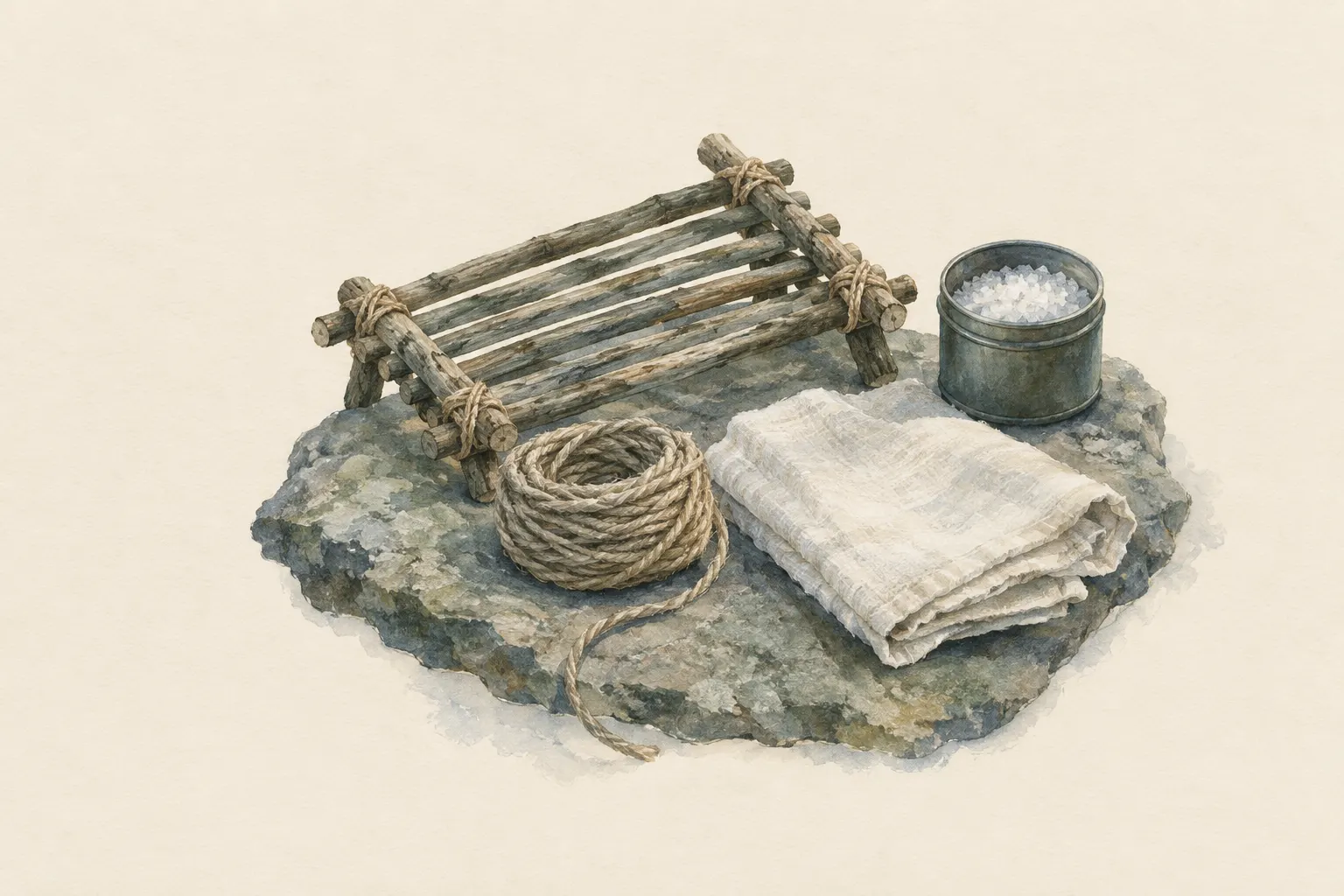
Fresh fish spoils quickly, especially when it is warm. That is why people used to smoke and dry it over a smoky fire. In hot smoking the fish lies on a rack of sticks above the embers. First it is cooked properly, then it slowly dries further in the warm smoke.
This makes the fish keep a little longer – but not for weeks. Outdoors you cannot measure exactly how hot, how salty and how dry it becomes. So you eat home-smoked fish within about one to two days and keep it cool and airy.
One rule is especially important: smoked fish from the woods never goes into a tightly sealed tin or bag. Where no air gets in, an invisible bacterium can make a very dangerous poison. You cannot smell or taste it.
How it works
In hot smoking three things work together. The heat cooks the fish and kills bacteria and parasites. The smoke dries the surface, adds flavour and keeps flies away. And salt, if available, draws water out of the flesh. Less water means germs grow more slowly.
How long smoked fish keeps depends on how much water is still in it and how much salt it contains. With smoked fish from a shop or made by tested instructions, salt content, temperature and time are precisely set. At a campfire this can neither be measured nor controlled.
That is why field-smoked fish is more like cooked fish with a dry, smoky skin than a real store. It keeps a little longer than freshly cooked fish, but only days, not weeks. Cold smoking, where the fish is not cooked, needs even more precise control and is not safe in the field.
What really matters
The fish must be as fresh as possible. Straight after catching it is killed and gutted, gills and kidney removed, and until smoking it lies cool in the shade. Fish that has already lain warm for a while is not smoked – it is cooked and eaten at once or thrown away. Smoke cannot rescue spoiled fish.
So that all pieces cook and dry at the same time, open the fish out flat or cut fillets, and cut thick fish into strips no more than about two centimetres thick. A strong brine for about half an hour or a thin rub of salt improves taste and keeping quality. Then let the surface dry off.
The rack stands over an even ember fire of hardwood. Some fresh hardwood or chips on top make smoke but no high flames. In the first phase it must be so hot at the rack that you can hold your hand there for only a few seconds – the fish is meant to cook: opaque throughout, coming away from the bone, with a thermometer at least 63 °C. Only then do you raise the rack and keep drying in mild heat.
Safety: what to watch out for
The greatest danger is botulism. Spores of the bacterium Clostridium botulinum occur in waters and also in fish. Where no oxygen gets in – in airtight bags, tins or under oil – and it is not cold enough, they can germinate and form a life-threatening toxin. You cannot see, smell or taste it. Field-smoked fish is therefore never packed airtight.
Signs of botulinum poisoning include double vision, drooping eyelids, difficulty swallowing or speaking and increasing muscle weakness. Anyone who notices such things after eating needs medical help at once: call 112, in Austria also 144. Waiting is dangerous, because the paralysis can progress.
The fire itself also has dangers. Only use dry, untreated hardwood – no softwood, which soots, no painted or preserved wood and never yew. Never smoke indoors or in closed tents, because carbon monoxide builds up there. A tarp used as a smoke roof needs plenty of distance from the heat, and the fire is never left unattended.
When it makes sense – and when it does not
Field smoking is worthwhile when, in a longer emergency without refrigeration, you have more fish than you can eat in one day and the weather is dry and breezy. The fish then keeps one to two days longer, is lighter to carry and better protected from flies.
For anything meant as a store for days or weeks, field smoking is the wrong method. For real preserving there are tested instructions for home use with exact salt amounts, temperatures and times – or simply a fridge and freezer.
In damp, muggy weather the fish hardly dries and is more likely to spoil than to keep. With a fire ban or wildfire danger, smoking is ruled out anyway. And fish may only be caught with a fishing licence and permission – without these rights only in genuine danger to life.
Good to know
Successful field-smoked fish is firm, dry and dark golden brown outside, cooked inside and without glassy or wet spots. If it smells sour or putrid, is slimy or shows mould, it is thrown away entirely – do not just cut off the bad part.
To keep it, wrap the fish loosely in a clean cloth or paper and put it in the coolest, airiest, shady place in camp. As soon as you reach a fridge, it goes straight in. Scraps and bones are disposed of far from camp so they do not attract animals.
For meat some different rules apply, for example because of Trichinella in wild boar. How to pre-heat and dry strips of meat is in the entry on smoking and drying meat and fish.
Step by step
Only use very fresh fish
Process the fish as soon as possible after catching it: kill, gut, remove the gills and the dark kidney along the backbone, rinse with clean water and keep cool in the shade until smoking. Fish that has already lain warm for a while is not smoked but cooked and eaten at once or discarded.
- 1
Only use very fresh fish
Process the fish as soon as possible after catching it: kill, gut, remove the gills and the dark kidney along the backbone, rinse with clean water and keep cool in the shade until smoking. Fish that has already lain warm for a while is not smoked but cooked and eaten at once or discarded.
- 2
Open out or fillet
Cut off the head and open the fish along the backbone so it lies flat, or cut fillets. Cut thick fish additionally into strips no more than about 2 cm thick. Pieces of equal thickness cook and dry at the same time.
- 3
Salt, if possible
If you have salt, put the pieces in a strong brine of clean water for about half an hour or rub them thinly with salt. Then rinse briefly and let them air-dry until the surface feels slightly tacky and dry. Salt improves taste and keeping quality but does not replace cooking through.
- 4
Build a smoking rack
Drive four forked posts into the ground around a small fire site and lay cross bars on top, roughly knee to hip height above the embers. On these goes a grid of thin, peeled hardwood rods. The fish pieces lie skin-side down and do not touch each other.
- 5
Hot-smoke and cook through
Keep an even ember fire of hardwood and put some fresh hardwood or chips on so it smokes but does not flame high. The heat at the rack should be so strong that you can hold your hand there for only a few seconds. After a while check the thickest part: the flesh must be opaque throughout and come away from the bone, with a thermometer at least 63 °C.
Not done? Lower the rack or finish cooking the fish right by the embers.
- 6
Keep drying in the smoke
Once the fish is cooked, raise the rack a little and let it dry further in mild heat and smoke for several hours. Turn the pieces now and then. The fire is never left unattended; at night cover the fish with a fine cloth against flies.
- 7
Check
Well-dried field-smoked fish is firm, dark golden brown and dry outside, cooked inside and without glassy or wet spots. If it smells sour or putrid, is slimy or grows mould, it is thrown away – do not cut it off and eat the rest.
- 8
Store cool, airy and briefly
Wrap the fish loosely in a clean cloth or paper and store it in the coolest, airy, shady place – never in a tightly sealed bag, a tin or in oil. Eat it within about one to two days. Once you reach refrigeration, put it straight into the fridge. Finally put the fire out completely and dispose of scraps far from camp.
Never pack airtight – risk of botulism.
Common mistakes
- Smoking fish that has lain warm for a long time
- Only cold-smoking and not cooking the fish through
- Pieces that are too thick
- Using softwood or treated wood
- Packing smoked fish airtight or putting it in oil
- Keeping field-smoked fish unrefrigerated for days
- Leaving the fire unattended
Quick view
Materials
Knife (fixed or locking blade)
Cut away from your body.
Rules on carrying knives differ by region – check local rules.
Table salt
For a brine before smoking
Salt improves keeping quality but does not replace heating through.
Metal pot (stainless steel, aluminium, titanium)
For the brine
Hot – scalding risk.
Sturdy sticks / poles
Forked posts, cross bars and thin rods for the rack
Do not cut live wood where prohibited.
Dry firewood
Dry, untreated hardwood, a little fresh hardwood for smoke
Collect only where permitted.
Probe thermometer (meat thermometer)
Measure at the thickest part, not against bone.
Clean after every use in raw meat.
Fine cloth or muslin net against flies
Keep clean and dry; do not hang it over the flames.
Water for extinguishing (bucket, canister or pot)
Have several litres ready before lighting.
Suitable for
- More fish than can be eaten in one day
- Longer emergencies without refrigeration
- Dry, breezy weather
Not suitable for
- Fish that has lain warm for a while or smells odd
- Cold smoking – it needs controlled conditions and is not safe in the field
- Storing for days without refrigeration or packed airtight
- Damp, muggy weather
- A fire ban or high wildfire danger
Prerequisites
- A lawfully caught, very fresh fish – or a genuine emergency
- The fish cleanly gutted and kept cool
- Able to keep a small fire safe for many hours
- Permission for the fire and the wood
Safety
- Field-smoked fish is not a store. Without refrigeration it is eaten within about one to two days; when in doubt – slimy, sour, putrid – it is thrown away. For real preserving at home there are tested instructions with exact salt amounts, temperatures and times.
- Only dry, untreated hardwood – no softwood, no painted or preserved wood, never yew. Never smoke indoors or in closed tents (carbon monoxide). Fire only where it is allowed and there is no wildfire danger – use existing fire sites, keep water ready to put it out and extinguish the fire completely at the end. Cut green wood from living shrubs only with the landowner's permission.
How it works
In hot smoking, fish cooks in hot smoke. The heat kills bacteria and parasites, the smoke dries the surface and keeps flies away, and salt draws water out of the flesh. Less water means slower spoilage. But in the field salt content, temperature and degree of drying cannot be set precisely. So field-smoked fish keeps only a little longer than freshly cooked fish – not for weeks.
Advantages
- Fish keeps a little longer than freshly cooked
- Smoke keeps flies away
- Lighter to carry than fresh fish
- Good flavour
Disadvantages
- Not a safe store – only short keeping time
- Risk of botulism with wrong storage
- Needs a lot of wood, time and supervision
- Fishing is only legal with a licence and permission
Deep knowledge
Background
Smoking and drying are among the oldest ways of preserving fish. The US Army survival manual (FM 3-05.70) describes smoking and drying fish and meat over a fire as a field expedient.
The FDA's Bad Bug Book names Clostridium botulinum type E as typical of fish and warns especially about smoked fish stored without oxygen and without adequate refrigeration. For home smoking, the National Center for Home Food Preservation refers to tested instructions with precisely set salt amounts, temperatures and times – conditions that cannot be recreated at a campfire.
Variants
- With a smoke roof
- A roof of green branches or a tarp well above the rack keeps the smoke on the fish longer. Leave an opening at the top and a gap at the bottom for air; the tarp must not come close to the heat. Never smoke in a closed tent.
- Air drying only
- In very dry, cold and windy climates thin strips of fish are traditionally dried in the air. In Central Europe it is usually too damp and too warm for this – there the method is not reliable in the field.
Common mistakes
- Smoking fish that has lain warm for a long time
- Only cold-smoking and not cooking the fish through
- Pieces that are too thick
- Using softwood or treated wood
- Packing smoked fish airtight or putting it in oil
- Keeping field-smoked fish unrefrigerated for days
- Leaving the fire unattended
Limits and risks
- No instructions for preserving as a store
- No cold smoking
- No storage times beyond one to two days without refrigeration
- For meat see the entry on smoking and drying meat
Material alternatives
Derived from material properties: a substitute must have all relevant properties. Observe the notes on the substitute.
- Metal pot (stainless steel, aluminium, titanium)
- Single-wall stainless steel bottle (Heat only single-wall bottles without paint/plastic; remove the lid before heating.)
- Dry firewood
- Tinder (Carry in waterproof packaging.), Char cloth (charred cotton) (Store dry in a tin.), Finest-grade steel wool (Store separately from batteries – fire risk.), Fatwood (resin-rich wood) (Collect only dead wood where permitted.), Stove fuel (canister, liquid fuel, alcohol) (Store fuels apart from food and in original containers or bottles intended for them.), Petroleum jelly cotton balls (Use only pure cotton.), Cooking oil or cooking fat (tallow, lard) (Never put out burning fat with water – cover it with a lid to smother it.), Tree resin (spruce, pine) (Resin is flammable and sticks to the skin when hot – melt it only slowly over low heat.), Birch bark (from dead, fallen wood) (Never peel from living trees.)
- Fine cloth or muslin net against flies
- Cotton cloth / T-shirt (Removes coarse particles only – no disinfection.)
Results come exclusively from structured entries. No improvised instructions are generated.
Sources
Headquarters, Department of the Army (USA) (2002): FM 3-05.70 Survival
Smoking and drying fish and meat over a fire as a field expedient
U.S. Food and Drug Administration (FDA) (2012): Bad Bug Book: Handbook of Foodborne Pathogenic Microorganisms and Natural Toxins, 2nd edition
Clostridium botulinum type E in fish; danger with smoked fish stored without oxygen and refrigeration
Centers for Disease Control and Prevention (CDC): Botulism – prevention information (including infant botulism)
Signs of botulism and immediate medical help
University of Georgia / National Center for Home Food Preservation (USA): National Center for Home Food Preservation – tested guidance on drying and preserving food
Smoking and drying at home only by tested instructions
United States Department of Agriculture – Food Safety and Inspection Service (USDA FSIS): Safe Minimum Internal Temperature Chart
Safe core temperature for fish 145 °F (63 °C)
Centers for Disease Control and Prevention: Carbon Monoxide Poisoning – Prevention guidance
No burning of fuel in enclosed spaces or tents