Cooking fish on a stick and on a plank by the fire
A gutted fish cooks at an angle beside the embers on a stick, or opened out on a wooden plank – not in the flames. This way it cooks slowly and evenly without burning on the outside. It is only ready when the flesh at the thickest part is opaque and comes away easily from the bone (at least 63 °C at the centre). Cooking it through protects against parasites; watch out for bones when eating.
- Preparation 10–15 minutes; cooking about 15–30 minutes depending on size
Explained simply
You can cook a fish by the fire without a pan: you push it onto a long, clean stick or fix it opened out on a wooden plank and stand it at an angle beside the embers. Not in the flames – otherwise the skin burns and the fish stays raw inside.
The fish needs about a quarter of an hour to half an hour, and you turn it now and then. It is ready when the flesh at the thickest part is white all through and comes away easily from the bones. Glassy, see-through flesh means: not ready yet.
Why so careful? Tiny worms can live in fish that you cannot always see. Good cooking kills them. And when eating you go slowly, because fish have fine bones that can get stuck in your throat.
How it works
Beside the embers the fish cooks by radiant heat, which acts evenly and without flicker. The thin skin protects the flesh and holds moisture in. Because the fish stands at an angle and at a distance, the heat has time to reach the thick part by the backbone before the surface chars.
An opened-out fish is roughly equally thin everywhere. It therefore cooks faster and more evenly than a whole one, whose back meat is much thicker than the belly. On the plank the fish lies still, and the soaked wood gives off some steam that keeps the flesh moist.
You can tell whether fish is cooked by its protein: raw it is glassy and translucent; cooked it turns white and opaque, and the muscle flakes separate easily from each other and from the bone. The US food safety agency gives 63 °C as the safe core temperature. If you have a probe thermometer, measure at the thickest part.
What really matters
Everything starts with a fresh, cleanly gutted fish: clear eyes, red gills, firm flesh, the dark kidney along the backbone scraped out. How to kill and gut the fish is in the separate entry. Hands and knife are washed afterwards, and raw fish does not touch ready-to-eat food.
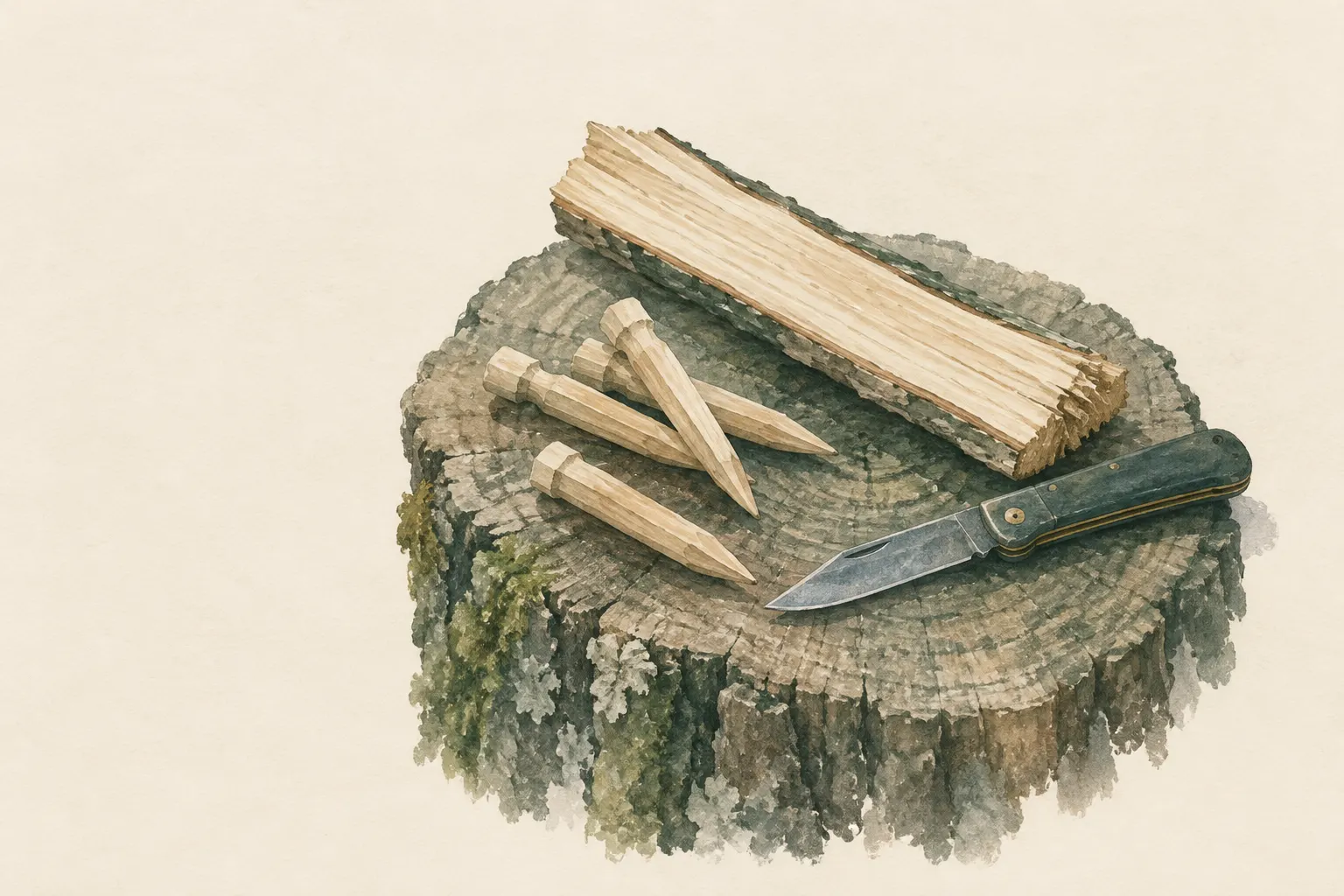
To put it on the stick, push the stick through the mouth along the backbone into the tail. If it is only in the mouth, the stick turns but the fish does not turn with it – or it slips off. For the plank use untreated hardwood, soak it for half an hour and fix the opened fish with thin wooden pegs.
The right distance is where you can hold your hand for only a few seconds. If the skin hisses at once and turns black, move it further away. A trout-sized fish needs about 15 to 30 minutes depending on the embers; the test at the thickest part behind the head decides. If it is still glassy there, keep cooking.
Safety: what to watch out for
Freshwater fish can carry fish tapeworms, sea fish roundworms such as Anisakis. Both are killed by thorough cooking. That is why fish from the wild is never eaten raw or glassy. If a fish smells unpleasant, has cloudy, sunken eyes or grey gills, or was floating dead in the water, it is not eaten.
Bones are dangerous above all for children. Eat slowly, check every bite with your tongue and flake the flesh for children beforehand. Lift the backbone off in one piece after cooking. If someone can no longer breathe, cough or speak after swallowing, it is an emergency: call 112 at once, in Austria also 144, and give first aid for choking.
Spit and plank must be of reliably known, untreated wood – never yew, laburnum, black locust, thuja, painted or preserved wood. Fire only where it is allowed, with water within reach and put out completely at the end. Fish scraps are buried far from camp where that is allowed, or packed out, so they do not attract animals.
When it makes sense – and when it does not
Fish on a stick or plank suits fish up to about forearm length – trout, char, mackerel or similar. You only need a knife, a stick and good embers, and several fish can cook at once by one bed of embers. For camps and trips with legally caught fish it is a simple, tasty method.
Very large fish cook too unevenly on a stick. They are better filleted and put in pieces on several thin skewers. Fish from waters with warnings about pollutants or algal blooms is not eaten either – cooking does not make toxins harmless.
In Germany and Austria fishing is only allowed with a fishing licence and the permission of the holder of the fishing rights. Without these rights, fishing is only justifiable in genuine danger to life. With a fire ban the fish stays in a pot on a stove.
Good to know
In the Alps, fish on a stick is a classic at festivals: the fish is salted inside and out, filled with herbs and cooked slowly by the embers on a long wooden rod. Salt improves the taste but does not replace cooking right through.
With its skin on, fish on a stick is better protected; with small-scaled fish such as trout you can cook it with the scales on and pull the skin off afterwards. On the plank the skin side lies down, and after cooking the flesh can be lifted off the plank in pieces.
A wooden plank can be used several times if it is only lightly charred. Afterwards let it dry well and do not soak it in soap. A badly charred plank goes into the fire – at the end of the evening, not while children are sitting next to it.
Step by step
Prepare a fresh fish
Only use a fresh, cleanly gutted fish with clear eyes, red gills and firm flesh, with the dark kidney along the backbone scraped out. Wash your hands first and keep raw fish separate from ready-to-eat food.
Caution: If the fish smells bad: do not eat it.
- 1
Prepare a fresh fish
Only use a fresh, cleanly gutted fish with clear eyes, red gills and firm flesh, with the dark kidney along the backbone scraped out. Wash your hands first and keep raw fish separate from ready-to-eat food.
If the fish smells bad: do not eat it.
- 2
Make an ember bed
Let hardwood burn down to embers or rake an ember bed to the edge of the fire. Fish cooks beside the embers, not over open flames. Keep the wind at your back so smoke and sparks move away from you.
- 3
Put the fish on a stick
Peel a straight, roughly thumb-thick stick of reliably known wood and sharpen it. Push it through the mouth along the backbone into the tail so the fish does not slip when turned. Alternatively, open the fish along the back and clamp it flat in a split stick, held with two small cross sticks.
- 4
Or: on a plank
Soak an untreated hardwood plank for about half an hour. Lay the opened fish skin-side down on the plank and fix it with thin, sharpened wooden pegs or natural-fibre string. Stand the plank at an angle facing the embers, propped with stones, flesh side towards the fire.
- 5
The right distance
Push the stick into the ground at an angle so the fish stands beside the embers, or lean the plank in front of them. The distance is right when you can hold your hand where the fish is for only a few seconds. If the skin hisses and chars at once, move it further away.
- 6
Turn and be patient
Turn the spit every few minutes so both sides get the same heat; turn the plank top to bottom once. A trout-sized fish needs about 15 to 30 minutes depending on the embers. Push in more embers when needed.
- 7
Test at the thickest part
Push a thin stick or the knife tip into the thickest part behind the head down to the bone. The fish is done when the flesh there is white and opaque throughout and comes away easily from the bone; with a thermometer at least 63 °C. If it is still glassy inside, keep cooking.
- 8
Remove the bones safely
Pull off the skin and lift the flesh off from the top in pieces. Then take hold of the backbone at the tail and lift it out with the bones in one piece. Eat slowly and check each bite with your tongue; flake the flesh for children beforehand. Bury scraps far from camp where allowed, or pack them out.
Common mistakes
- Holding the fish in the flames
- Eating too early while it is still glassy inside
- Pushing the stick only through the mouth – the fish slips when turned
- Using painted or unknown wood as a plank
- Eating hastily and missing bones
- Leaving scraps next to the tent
Quick view
Materials
Sturdy sticks / poles
A fresh, straight stick of safely non-toxic wood (e.g. hazel) or a split stick
Do not cut live wood where prohibited.
Untreated wooden plank (hardwood)
No painted, preserved, glued or unknown wood, no softwood and never yew.
Soak the plank first so it chars more slowly.
Knife (fixed or locking blade)
Cut away from your body.
Rules on carrying knives differ by region – check local rules.
Dry firewood
Hardwood for good embers
Collect only where permitted.
Probe thermometer (meat thermometer)
Measure at the thickest part, not against bone.
Clean after every use in raw meat.
Table salt
Salt improves keeping quality but does not replace heating through.
Water for extinguishing (bucket, canister or pot)
Have several litres ready before lighting.
Suitable for
- Trout, char, mackerel and other fish up to about forearm length
- Cooking without pan or pot
- Several fish at once by one bed of embers
Not suitable for
- Very large fish – better cut into pieces
- Fish that smells spoiled or was found floating dead
- Fish from waters with pollution or algae warnings
- A fire ban
Prerequisites
- A lawfully caught, fresh fish – or a genuine emergency
- The fish cleanly killed and gutted (see separate entry)
- A permitted fire site with embers
- Clean water for washing hands
Safety
- Bones can get stuck in the throat, especially in children. Eat slowly, lift the backbone off in one piece and flake the flesh for children beforehand. If someone can no longer breathe, cough or speak after swallowing: call 112 (in Austria also 144) at once and give first aid for choking.
- Spit and plank only of reliably known, untreated wood – never yew, laburnum, black locust, thuja or painted wood. Fire only where it is allowed and there is no wildfire danger – use existing fire sites, keep water ready to put it out and extinguish the fire completely at the end. Cut green wood from living shrubs only with the landowner's permission.
How it works
A fish beside the embers is cooked by radiant heat, which acts evenly. In the flames the thin skin would burn while the thick back meat stays raw. Set up at an angle and at a distance, the heat has time to reach the backbone. An opened-out fish is equally thin everywhere and therefore cooks faster and more evenly than a whole one.
Advantages
- No cookware needed
- Even cooking without burning
- Several fish by one bed of embers
- The plank can be used several times
Disadvantages
- Needs time and good embers
- Fish can slip off the stick
- Bones require attention
- Fishing is only legal with a licence and permission
Deep knowledge
Background
Fish on a stick is found all over the world and is known in the Alps as Steckerlfisch. The US Army survival manual (FM 3-05.70) describes cooking fish on a spit beside the fire; bushcraft books also show cooking on a wooden plank.
The US food safety agency USDA FSIS gives a safe core temperature of 145 °F, about 63 °C, for fish. The FDA's Bad Bug Book describes fish tapeworm and Anisakis as parasites that are killed by thorough cooking.
Variants
- Salted fish on a stick
- In Bavaria and Austria fish for the traditional fish on a stick is salted inside and out and filled with herbs beforehand. Salt improves the taste but does not make the fish safer – it still has to be cooked completely.
- Large fish in pieces
- Larger fish are filleted and the pieces put on several thin skewers. Pieces of equal thickness are done at the same time.
Common mistakes
- Holding the fish in the flames
- Eating too early while it is still glassy inside
- Pushing the stick only through the mouth – the fish slips when turned
- Using painted or unknown wood as a plank
- Eating hastily and missing bones
- Leaving scraps next to the tent
Limits and risks
- No substitute for the instructions on killing and gutting
- No fish identification and no information on poisonous sea fish
- Cooking times are guidelines – the doneness test decides
Material alternatives
Derived from material properties: a substitute must have all relevant properties. Observe the notes on the substitute.
- Dry firewood
- Tinder (Carry in waterproof packaging.), Char cloth (charred cotton) (Store dry in a tin.), Finest-grade steel wool (Store separately from batteries – fire risk.), Fatwood (resin-rich wood) (Collect only dead wood where permitted.), Stove fuel (canister, liquid fuel, alcohol) (Store fuels apart from food and in original containers or bottles intended for them.), Petroleum jelly cotton balls (Use only pure cotton.), Cooking oil or cooking fat (tallow, lard) (Never put out burning fat with water – cover it with a lid to smother it.), Tree resin (spruce, pine) (Resin is flammable and sticks to the skin when hot – melt it only slowly over low heat.), Birch bark (from dead, fallen wood) (Never peel from living trees.)
Results come exclusively from structured entries. No improvised instructions are generated.
Sources
Headquarters, Department of the Army (USA) (2002): FM 3-05.70 Survival
Cooking fish on a spit beside the fire; recognising spoiled fish
United States Department of Agriculture – Food Safety and Inspection Service (USDA FSIS): Safe Minimum Internal Temperature Chart
Safe core temperature for fish 145 °F (63 °C)
U.S. Food and Drug Administration (FDA) (2012): Bad Bug Book: Handbook of Foodborne Pathogenic Microorganisms and Natural Toxins, 2nd edition
Fish tapeworm (Diphyllobothrium) and Anisakis; killed by cooking
World Health Organization (WHO) (2006): Five Keys to Safer Food Manual
Separate raw and cooked, cook thoroughly, clean hands
European Resuscitation Council – Resuscitation (journal) (2021): European Resuscitation Council Guidelines 2021: First Aid
First aid for choking on a foreign body
Ray Mears – Hodder & Stoughton (2002): Bushcraft
Cooking fish at the campfire, including on a wooden plank