Cooking in the embers: potatoes, ash cake and vegetables
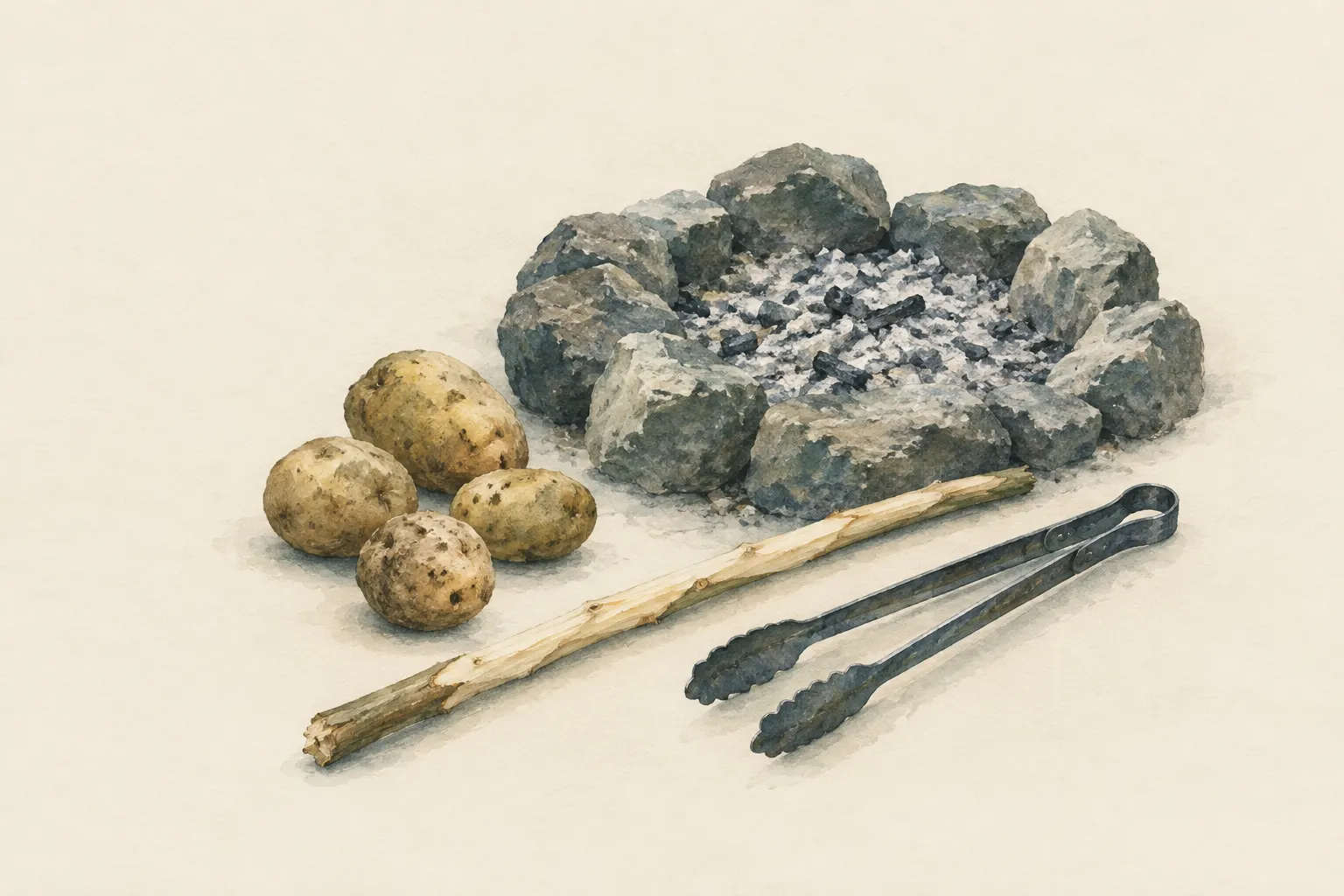
Flames burn food on the outside before the inside is cooked – embers, on the other hand, give even, steady heat. You let hardwood burn down to embers, rake a flat ember bed to one side and put potatoes, onions or a flat dough cake into it. Turn regularly, test with a little stick and only eat when everything is done.
- Preparing embers 30–60 minutes; cooking 10–60 minutes depending on size
Explained simply
A campfire has two faces: the dancing flames and the red-glowing embers underneath. For cooking, the embers are much better. Flames are like a hairdryer blowing hot air from one side only – the food turns black outside and stays hard inside. Embers, on the other hand, warm calmly and evenly, like an oven.
That is why you need patience. First the fire burns for half an hour to an hour until lots of embers have formed. Then you push some embers aside with a long stick, put a potato in and cover it with embers and ash. Every few minutes you turn it.
How do you know the potato is ready? You push a thin little stick into it. If it slides easily all the way to the middle, it is soft and cooked. And remember: embers sometimes look grey and harmless but are still glowing hot – so only work with a stick or tongs.
How it works
Embers give off their heat mainly as radiation – the same invisible warmth you feel on your face when you sit in front of a fire. If a piece of food lies in the middle of the embers, this radiation reaches it from all sides. On top of that comes the hot ash lying directly against the food and passing on heat. Together this makes a kind of small oven without walls.
The heat moves slowly from the outside in. For a small potato the way is short, for a large one long. That is why the cooking time depends mainly on thickness, not on weight. The skin – or a double layer of aluminium foil – keeps ash out and moisture in. The food therefore cooks in its own steam and does not dry out.
A good ember bed comes from hardwood such as beech, oak or ash. It burns more slowly than softwood and leaves dense pieces that glow for a long time. Softwood and thin brushwood flare up high, are gone quickly and give few embers. If you keep adding wood at the edge, you always have fresh embers to push over to the cooking spot.
What really matters
The most important thing is patience with the fire. If you start too early, you put the food into half flames and few embers – then it chars on the outside. Wait until the pieces of wood glow red and have a white-grey coat of ash. That usually takes half an hour to an hour. You can use the time to prepare the food.
Potatoes are pricked several times with the knife, otherwise the steam can make them burst. Cut green patches and sprouts away generously, because that is where the natural bitter compound solanine sits. Onions, beetroot and corn cobs go into the embers in their skins or husks. For an ash cake a firm dough of flour, water and salt, pressed flat, is enough.
Regular turning is the difference between evenly cooked and burnt on one side. Every 10 to 15 minutes turn each piece with a stick or tongs and push fresh embers in when the bed turns grey. In the end the stick test always decides – not the clock. If it slides to the centre without resistance, it is done.
Safety: what to watch out for
Embers are treacherous because under a layer of ash they can look grey and cold although they are still glowing. Never reach into ash with bare hands, not even after hours. Work with a long stick, tongs or leather gloves, tie long hair back and do not lean over the fire. Synthetic clothing can melt when hit by sparks.
With a burn every second counts: cool it at once with cool running water, not with ice. With large burns, burns to the face or in children call 112, in Austria also 144. Hot food can scald too – the inside of a potato stays very hot for a long time, so let it cool first.
Fire only where it is allowed, and never when there is wildfire danger. Embers from treated wood, chipboard or rubbish do not go near food, because they release harmful substances. At the end all embers are put out with plenty of water, stirred and soaked again until nothing hisses any more. Only when you can no longer feel warmth with the back of your hand is the fire site safe.
When it makes sense – and when it does not
Cooking in embers is ideal when you are out without pot or pan but are allowed to make a fire. It saves wood because embers, once formed, last a long time, and it is so simple that children can help under supervision. Potatoes, root vegetables, onions, apples and simple dough are particularly suitable.
Embers are less suitable for raw meat and poultry. The outside can be done while the inside is still raw, and without a thermometer that is hard to check reliably. For meat a pot, a spit with a thermometer or the earth oven are safer. Fish cooks best beside the embers on a stick or a plank.
With a fire ban, in drought or on peat and root-filled ground, you do not cook over an open fire at all. Embers can eat their way underground there and start a fire days later. Then a stove in a safe place is the better choice – or cold food.
Good to know
Ash cake is one of the oldest breads of all: a flat dough laid directly on hot ash and covered with ash. The ash that sticks to the outside is simply knocked off. If you prefer it cleaner, bake the same dough on a stick or a hot stone.
A foil parcel is practical but not necessary. Nature has already wrapped potatoes, onions and corn – their skin protects the inside. Always take used foil back with you, because it does not rot and otherwise stays in the fire site for years.
With some practice you learn to read the embers: bright red, almost orange embers are very hot, dark red ones with a thick layer of ash milder. For thick potatoes use milder embers and more time, for thin flat cakes briefly hotter embers. Cooks work in a similar way with the settings on a stove.
Step by step
Light the fire early
In a permitted fire site, make a fire of dry hardwood and add wood several times. After about 30 to 60 minutes there are enough embers: the pieces glow red and have a coat of white-grey ash. Softwood and brushwood burn away quickly and give few embers.
- 1
Light the fire early
In a permitted fire site, make a fire of dry hardwood and add wood several times. After about 30 to 60 minutes there are enough embers: the pieces glow red and have a coat of white-grey ash. Softwood and brushwood burn away quickly and give few embers.
- 2
Rake an ember bed to the side
With a long stick, push part of the embers next to the fire and spread them into a flat, even bed, about the size of a plate per potato. On the other side the fire keeps burning and supplies fresh embers.
Do not lean over the fire; tie long hair back.
- 3
Prepare the food
Wash potatoes, cut away green patches and prick them several times with a knife so they do not burst. If you have foil, wrap them twice. Onions and beetroot go into the embers in their skins, corn cobs in their husks. For ash cake, press a firm dough of flour, water and a pinch of salt into finger-thick flat cakes.
- 4
Bed it in the embers
Place the food on the ember bed with tongs or a stick and push embers and hot ash around and on top of it. The ash cake goes on a smoothed, hot layer of ash without large lumps of ember and is covered with a thin layer of ash.
- 5
Turn and add embers
Turn every 10 to 15 minutes and push fresh embers over from the fire side when the bed turns grey. Turn ash cake after about 5 to 10 minutes. Small potatoes need about half an hour, large ones up to an hour.
- 6
Test for doneness
Take a piece out and push a thin, clean stick into the centre. If it slides in without resistance, the potato is done. The ash cake sounds hollow when tapped and is dry inside, not sticky. If something is still hard, it goes back into the embers.
- 7
Knock off ash and let cool
Knock or brush off the ash, remove charred skin and eat the inside. Let everything cool for a few minutes – the inside stays very hot for a long time and steam can scald your lips. Take foil scraps back with you.
- 8
Put the embers out completely
At the end pour plenty of water over all the embers, stir and pour again until nothing hisses any more. Check with the back of your hand just above the ash whether warmth is still rising. Only leave the fire site once everything is cold.
Common mistakes
- Putting food in the flames instead of the embers
- Being impatient and starting with too few embers
- Not pricking potatoes – they can burst
- Not turning – one side chars, the other stays raw
- Reaching into the ash with bare hands
- Using embers from rubbish or treated wood
- Leaving the fire site warm
Quick view
Materials
Dry firewood
Dry hardwood gives the best embers
Collect only where permitted.
Lighter, matches or ferro rod
Observe local fire bans.
Sturdy sticks / poles
A long stick for raking embers
Do not cut live wood where prohibited.
Barbecue tongs or wooden tongs
Long tongs keep your hands away from the embers.
Leather or heat-resistant gloves
Synthetic gloves melt onto the skin – only leather or certified heat-resistant gloves.
Wet gloves conduct heat quickly.
Aluminium foil (heavy-duty)
Keeps ash off, not essential
Edges can be sharp; conducts heat and electricity.
Flour (wheat or spelt)
For ash cake
Raw flour and raw dough are not for nibbling – flour can carry germs and only becomes safe through baking.
Store dry and out of animals' reach.
Water for extinguishing (bucket, canister or pot)
Have several litres ready before lighting.
Suitable for
- Cooking without pot or pan
- Potatoes, onions, beetroot, corn cobs, apples
- Simple bread without an oven
- Group and family camps
Not suitable for
- Times with a fire ban or high wildfire danger
- Raw meat and raw poultry directly in the embers – the inside easily stays raw
- Embers from treated wood, chipboard or rubbish
- Peat or root-filled ground where embers can spread underground
Prerequisites
- A permitted, safe fire site
- Able to light and manage a fire
- Enough dry wood for lasting embers
- Water to put the fire out
Safety
- Black outside does not mean cooked inside. Only eat potatoes, vegetables and dough once a thin stick slides to the centre without resistance or the dough is dry inside. Cut green patches and sprouts off potatoes generously.
- Fire only where it is allowed and there is no wildfire danger – use existing fire sites, keep water ready to put it out and extinguish the fire completely at the end. Cut green wood from living shrubs only with the landowner's permission.
How it works
Embers radiate heat evenly without flickering. Bedded in embers and hot ash, food is warmed from all sides; the heat moves slowly from the outside in. The potato skin or a foil wrap keeps ash out and moisture in, so the food cooks in its own steam. The thicker the piece, the longer it takes.
Advantages
- Needs no cookware
- Even heat, little burning
- Saves wood because the embers last a long time
- Simple enough for children under supervision
Disadvantages
- Takes time until there are enough embers
- Ash on the food
- Cooking time hard to judge – a test is needed
- Not allowed everywhere
Deep knowledge
Background
Cooking in embers is one of the oldest cooking methods of all and is described in bushcraft textbooks as a basic technique. The US Army survival manual (FM 3-05.70) names baking and roasting by the embers as simple ways of cooking without equipment.
Potatoes contain the natural bitter compound solanine in green patches and sprouts, which is why you cut those parts away. Outdoors the same hygiene rules apply as in the kitchen: clean hands, keep raw and cooked apart, cook thoroughly.
Variants
- In a foil parcel
- Wrap vegetable pieces, a little fat and salt twice in heavy aluminium foil, fold the edges tightly and lay the parcel in the embers. This keeps the food clean; the cooking time is similar to cooking without foil.
- Baked apple
- Lay a whole apple in the embers at the edge and turn after 15 to 20 minutes until it is soft. Good for children – but let it cool first, the inside is as hot as porridge.
- Wrapped in clay
- Very small vegetables or fish can be packed in a shell of damp clay and laid in the embers. More on this in the entry on the earth oven and cooking in embers and clay.
Common mistakes
- Putting food in the flames instead of the embers
- Being impatient and starting with too few embers
- Not pricking potatoes – they can burst
- Not turning – one side chars, the other stays raw
- Reaching into the ash with bare hands
- Using embers from rubbish or treated wood
- Leaving the fire site warm
Limits and risks
- No cooking times for meat in embers – use a thermometer or a pot
- Times are guidelines; always do the doneness test
- Only applies where fire is allowed
Material alternatives
Derived from material properties: a substitute must have all relevant properties. Observe the notes on the substitute.
- Dry firewood
- Tinder (Carry in waterproof packaging.), Char cloth (charred cotton) (Store dry in a tin.), Finest-grade steel wool (Store separately from batteries – fire risk.), Fatwood (resin-rich wood) (Collect only dead wood where permitted.), Stove fuel (canister, liquid fuel, alcohol) (Store fuels apart from food and in original containers or bottles intended for them.), Petroleum jelly cotton balls (Use only pure cotton.), Cooking oil or cooking fat (tallow, lard) (Never put out burning fat with water – cover it with a lid to smother it.), Tree resin (spruce, pine) (Resin is flammable and sticks to the skin when hot – melt it only slowly over low heat.), Birch bark (from dead, fallen wood) (Never peel from living trees.)
- Lighter, matches or ferro rod
- Ferro rod (Practise before you need it.), Fire striker and hard stone (Carbon steel, not stainless.), Bow drill set (bow, spindle, hearth board, bearing block) (Use only dry wood.), Burning lens / magnifier (Never leave lying in the sun – fire risk.), Fire piston (Maintain the seal.), Pump drill (spindle, flywheel, crossbar, cord) (Fix the flywheel firmly and centrally – a loose disc can fly off.)
- Aluminium foil (heavy-duty)
- Emergency blanket (Tears easily once punctured; short-term shelter only.), Signal mirror (Do not flash into the eyes of people nearby or of drivers.), High-visibility vest (Keep within reach inside the cabin, not in the boot/trunk.), Warning triangle (Whether warning triangles are mandatory, or should be placed at all on certain roads (e.g. motorways), differs between countries – check local rules.)
Results come exclusively from structured entries. No improvised instructions are generated.
Sources
Headquarters, Department of the Army (USA) (2002): FM 3-05.70 Survival
Simple cooking methods without equipment: baking and roasting by the embers
Ray Mears – Hodder & Stoughton (2002): Bushcraft
Campfire cooking, using embers rather than flames
World Health Organization (WHO) (2006): Five Keys to Safer Food Manual
Keep clean, separate raw and cooked, cook thoroughly
Springer (H.-D. Belitz, W. Grosch, P. Schieberle) (2009): Food Chemistry, 4th edition
Solanine (glycoalkaloids) in green potato parts as a natural toxin
European Resuscitation Council – Resuscitation (journal) (2021): European Resuscitation Council Guidelines 2021: First Aid
Cool burns at once with cool running water; call emergency services for severe burns
Leave No Trace Center for Outdoor Ethics: The Seven Principles of Leave No Trace (Principle 5: Minimize Campfire Impacts)
Keep fires small, use existing fire sites, put fires out completely