Stick bread and bannock on a stick
A simple dough of flour, water, salt and baking powder or yeast is wound like a snake around the peeled end of a long stick and turned slowly over the embers until it is golden brown all round and dry inside. What matters is the right distance from the embers, patience and a stick of wood that is safely non-toxic. With clear fire rules, stick bread is ideal for children.
- Dough 10 minutes (with yeast plus 30–60 minutes rising); baking 10–15 minutes per stick
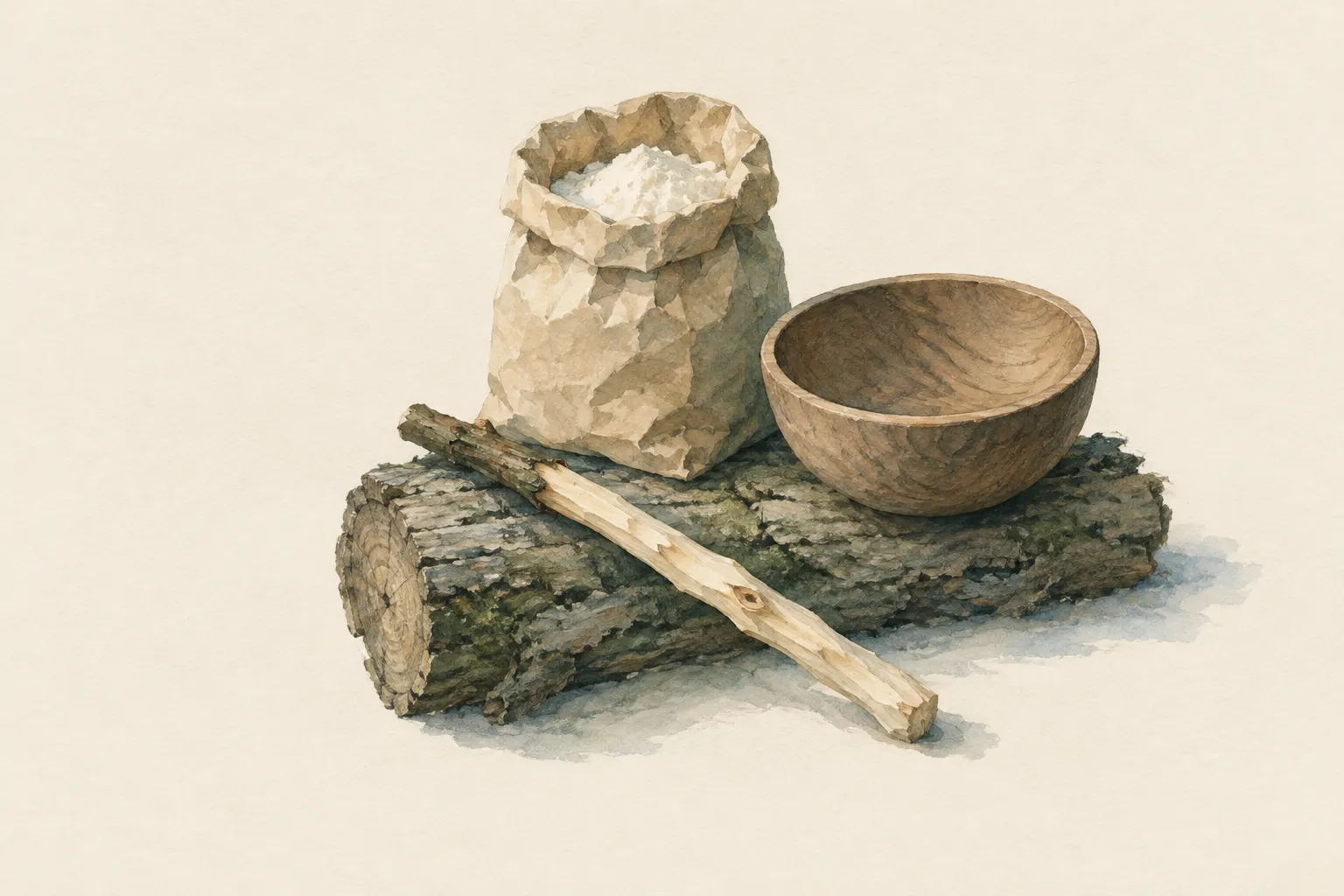
Explained simply
Stick bread is bread you bake yourself at the campfire. You knead a dough of flour, water, salt and baking powder, roll it into a long snake and wind it around the tip of a stick – like string around a pencil.
Then you hold the stick over the hot embers, but not in the flames, and turn it slowly, like a chicken on a spit. After about a quarter of an hour the bread is golden brown all round. When it is dry and light inside, it is ready.
There are clear rules at the fire: you stay in your seat, hold the stick with both hands and never run around with it. And you only use a stick that an adult knows for sure is not poisonous – for example from a hazel bush.
How it works
A thin strand of dough has a lot of surface compared with its thickness. The heat of the embers only has to travel just under a centimetre to the centre. So the bread bakes through before the outside burns. A thick lump of dough, by contrast, would be black outside long before the heat reached the inside.
Baking powder and yeast make the bread light. Baking powder forms gas bubbles when warmed; yeast produces them while the dough is rising. These bubbles expand in the heat and make the dough rise. Without a raising agent the bread becomes dense and chewy but edible – like a flatbread.
Embers bake evenly with radiant heat. Flames, in contrast, leap up restlessly, soot the dough and burn it in places. Because the embers radiate from one side only, the stick must be turned all the time. That way every part of the dough gets the same amount of heat in turn.
What really matters
A good basic recipe for six to eight sticks: about 500 grams of flour, one teaspoon of salt, one sachet of baking powder and gradually 250 to 300 millilitres of water. As a rule of thumb, roughly two parts flour to one part water. The dough is right when it no longer sticks to your hands. With yeast it also needs 30 to 60 minutes' rest in a warm place.
The distance from the embers decides between success and charcoal. Hold the bread where you can bear your hand for only a few seconds – usually one to two hand-widths above or beside the embers. If the dough darkens within a short time, it is too close. If nothing happens after minutes, it is too far away. Better to bake a little more slowly than to burn the outside.
The dough snake should be about finger-thick and wound on with small gaps so the heat also gets between the turns. The peeled, briefly warmed stick tip holds the dough better. The bread is done when it is golden brown, sounds hollow when tapped and turns easily off the stick. Break a piece open to check: dry and light inside, not sticky.
Safety: what to watch out for
The stick touches the food, so the wood must be safely non-toxic. Hazel is a good choice. Never use yew, laburnum, black locust, thuja, cherry laurel or elder – these shrubs and trees are poisonous. If you do not recognise a shrub for certain, take a different stick or bring some from home. Cut fresh sticks from living shrubs only with permission.
Children need clear, simple rules at the fire, discussed beforehand: a fixed seat at a distance, a circle around the fire that nobody steps over, the stick always pointing at the fire or down, and nobody running around with a stick. If the dough catches fire, it is not waved – otherwise burning pieces fly – but blown out or briefly pushed into sand. One adult looks after nothing but the fire.
Raw dough does not belong in your mouth. Flour is a raw product that can contain pathogens; only baking makes it safe. Take care with the first bite, because the inside is very hot. And with a burn: cool at once with cool running water, and with large burns, burns to the face or in children call 112, in Austria also 144.
When it makes sense – and when it does not
Stick bread is perfect for campfires with children and groups, because everyone bakes their own bread and learns to be patient with the fire. On longer trips a ready-made flour mix in a bag is light, energy-rich food that only needs water.
Outdoors there is no substitute for flour. Stick bread is therefore for people who carry supplies – not a way of finding new food in the wild. If you take flour, pack it dry and out of animals' reach, because damp flour clumps and attracts mice.
With a fire ban, strong wind or severe drought, the fire stays out – then there is no stick bread. A tall, flickering fire without embers is not suitable either. Then better wait, or bake the dough as a flatbread in a pan on a stove.
Good to know
Bannock is the name in Scotland and Canada for the simple bread of flour, baking powder, salt, water and sometimes some fat. Scouts and bushcrafters mix the dry ingredients at home in a bag. Outdoors only water is added, and the same dough can be baked on a stick, in a pan or as ash cake.
A little sugar, raisins, cheese or herbs in the dough add variety. Sugar browns and burns faster, though, so hold sweet dough a little further from the embers. The hole left by the stick can be filled once it has cooled.
If you are looking after many children, the sticks can be rested on a stone or a piece of wood so arms do not get tired, and children can bake in turns. That way there is room at the fire and nobody pushes.
Step by step
Mix the dough
For 6 to 8 sticks: mix about 500 g flour, 1 teaspoon salt and 1 sachet of baking powder, then gradually add about 250 to 300 ml clean water and knead until the dough no longer sticks to your hands. Rule of thumb: roughly 2 parts flour to 1 part water. With dried yeast, mix the dough with lukewarm water and let it rise covered in a warm place for 30 to 60 minutes.
- 1
Mix the dough
For 6 to 8 sticks: mix about 500 g flour, 1 teaspoon salt and 1 sachet of baking powder, then gradually add about 250 to 300 ml clean water and knead until the dough no longer sticks to your hands. Rule of thumb: roughly 2 parts flour to 1 part water. With dried yeast, mix the dough with lukewarm water and let it rise covered in a warm place for 30 to 60 minutes.
- 2
Choose and peel the stick
Take a straight, roughly thumb-thick stick 1 to 1.5 m long of reliably known wood such as hazel. Cut green wood only with permission, otherwise bring sticks along. Peel the front 20 to 30 cm with the knife – away from your body – and warm the tip briefly over the embers so the dough holds better.
Never yew, laburnum, black locust, thuja, cherry laurel, elder.
- 3
Wind on the dough snake
Roll a handful of dough into a finger-thick snake, about 1 cm thick. Press the end firmly onto the tip and wind the snake in a spiral with small gaps around the peeled part. Press the end on well. Thinner is better: a thick lump of dough stays raw inside.
- 4
Embers, not flames
Wait until the fire has burned down to embers, or rake an ember bed to the edge. Hold the bread beside or above the embers, never in the flames. The right distance is where you can hold your hand for only a few seconds – usually one to two hand-widths above the embers.
If the dough turns black quickly, it is too close.
- 5
Turn slowly
Keep turning the stick slowly, like a spit. If you are sitting, you can rest the stick on a stone or a piece of wood so your arms do not get tired. After about 10 to 15 minutes the bread is golden brown all round.
- 6
Check that it is done
The bread is done when it is golden brown all round, sounds hollow when tapped and turns easily off the stick. Break a piece open: inside it must be dry and light, not sticky and doughy. Otherwise keep baking.
- 7
Rules for children at the fire
Explain before baking: a seat at a distance from the fire, a circle that nobody steps over, stick always pointing at the fire or down, never running around or waving it. One adult looks after nothing but the fire. Put finished breads on a surface and let them cool.
- 8
Cool, enjoy, put out
Let the bread cool briefly, twist it off the stick and fill the hole as you like. Do not throw sticks into the fire while children are sitting next to it, and put the fire out completely with plenty of water at the end.
Common mistakes
- Holding the dough in the flames – black outside, raw inside
- Too thick a layer of dough
- A stick of unknown or poisonous wood
- An unpeeled, dirty stick tip
- Nibbling raw dough
- Running around or waving the stick
- Biting in straight away
Quick view
Materials
Flour (wheat or spelt)
About 500 g for 6–8 sticks
Raw flour and raw dough are not for nibbling – flour can carry germs and only becomes safe through baking.
Store dry and out of animals' reach.
Baking powder or dried yeast
Keep dry – damp baking powder stops working.
Table salt
A pinch to one teaspoon
Salt improves keeping quality but does not replace heating through.
Sturdy sticks / poles
About 1–1.5 m long, thumb-thick, of hazel or other safely non-toxic wood
Do not cut live wood where prohibited.
Knife (fixed or locking blade)
For peeling the stick tip
Cut away from your body.
Rules on carrying knives differ by region – check local rules.
Dry firewood
Collect only where permitted.
Water for extinguishing (bucket, canister or pot)
Have several litres ready before lighting.
Suitable for
- Campfires with children and groups
- Bread without oven, pot or pan
- Longer trips with flour in the pack
Not suitable for
- A fire ban or high wildfire danger
- A strong, flickering fire without embers
- Sticks from unknown or poisonous shrubs
- Very small children without constant company at the fire
Prerequisites
- A permitted fire site with good embers
- Clean water for the dough
- Sticks of reliably known wood – green wood only with permission
- With children: one adult whose only job is the fire
Safety
- Children sit or kneel at a distance from the fire, hold the stick with both hands and never run around with a hot or burning stick. If the dough catches fire, it is not waved about but blown out or briefly pushed into sand. Children's synthetic jackets melt when hit by sparks.
- Do not nibble raw dough: flour is a raw product and can contain pathogens that are only killed by baking. The bread is only ready when it is dry inside. Careful with the first bite – the inside is very hot.
- With burns, cool at once with cool running water. With large burns, burns to the face or in children call 112 (in Austria also 144). Fire only where it is allowed and there is no wildfire danger – use existing fire sites, keep water ready to put it out and extinguish the fire completely at the end. Cut green wood from living shrubs only with the landowner's permission.
How it works
A thin strand of dough has a lot of surface and little thickness, so the heat of the embers can bake it through before the outside burns. Baking powder or yeast forms gas bubbles that make the bread light. Radiant heat from embers bakes evenly; flames, by contrast, soot and burn the surface while the inside stays raw. Turning makes sure every side gets the same amount of heat.
Advantages
- Needs only flour, water, salt and a raising agent
- No cookware needed
- Fun for children and teaches patience at the fire
- Energy-rich and filling
Disadvantages
- Needs good embers and time
- Flour has to be carried – there is no substitute outdoors
- Risk of burns, especially for children
Deep knowledge
Background
Stick bread is a classic among scouts and families in Central Europe; in Canada and Scotland the simple bread of flour, fat, baking powder and water is called bannock. Bushcraft textbooks describe bannock as a versatile trail bread that is baked on a stick, in a pan or in the ashes.
The US Food and Drug Administration (FDA) points out that flour is a raw product that can contain pathogens, and that raw dough should therefore not be eaten.
Variants
- Bannock from a bag
- For trips, mix about one cup of flour with a teaspoon of baking powder and a pinch of salt per person in a bag at home. Outdoors just add water gradually to the bag and knead until a firm dough forms. Bannock can be baked on a stick, in a pan or as ash cake.
- Sweet or savoury
- A little sugar, raisins or herbs in the dough add variety. Sugar burns faster – then keep even more distance from the embers.
Common mistakes
- Holding the dough in the flames – black outside, raw inside
- Too thick a layer of dough
- A stick of unknown or poisonous wood
- An unpeeled, dirty stick tip
- Nibbling raw dough
- Running around or waving the stick
- Biting in straight away
Limits and risks
- Quantities are guidelines – types of flour absorb different amounts of water
- No instructions for bread from wild-plant flour
- Only applies where fire is allowed
Material alternatives
Derived from material properties: a substitute must have all relevant properties. Observe the notes on the substitute.
- Dry firewood
- Tinder (Carry in waterproof packaging.), Char cloth (charred cotton) (Store dry in a tin.), Finest-grade steel wool (Store separately from batteries – fire risk.), Fatwood (resin-rich wood) (Collect only dead wood where permitted.), Stove fuel (canister, liquid fuel, alcohol) (Store fuels apart from food and in original containers or bottles intended for them.), Petroleum jelly cotton balls (Use only pure cotton.), Cooking oil or cooking fat (tallow, lard) (Never put out burning fat with water – cover it with a lid to smother it.), Tree resin (spruce, pine) (Resin is flammable and sticks to the skin when hot – melt it only slowly over low heat.), Birch bark (from dead, fallen wood) (Never peel from living trees.)
Results come exclusively from structured entries. No improvised instructions are generated.
Sources
Ray Mears – Hodder & Stoughton (2002): Bushcraft
Bannock and simple bread at the campfire
Mors L. Kochanski – Lone Pine Publishing: Bushcraft: Outdoor Skills and Wilderness Survival
Simple trail bread from flour and baking powder
U.S. Food and Drug Administration (FDA): Handling Flour Safely: What You Need to Know
Flour is a raw product; do not eat raw dough, only eat it baked through
Bundesinstitut für Risikobewertung (BfR) (2017): Risiko Pflanze – Einschätzung und Hinweise
Yew, laburnum, black locust, thuja, cherry laurel as poisonous shrubs and trees
European Resuscitation Council – Resuscitation (journal) (2021): European Resuscitation Council Guidelines 2021: First Aid
Cool burns at once with cool running water; call emergency services for severe burns
Leave No Trace Center for Outdoor Ethics: The Seven Principles of Leave No Trace (Principle 5: Minimize Campfire Impacts)
Keep fires small, use existing fire sites, put fires out completely