























Protecting food from animals: hanging supplies high in a tree
Mice, foxes, raccoons, wild boar – and in some regions bears – smell food from far away. Losing your supplies at night means trouble the next day, and animals that get human food become bold. Here you learn to find a suitable branch, throw a cord with a weight over it, haul up the bag and secure it so it hangs far enough from the ground, the trunk and the branch – and where a canister is better.
- 10–20 minutes
Explained simply
Animals have fine noses. Mice, foxes, raccoons and wild boar smell your food from far away – and come for it at night.
That is why you hang the food in a bag high in a tree. You throw a cord with a stone over a branch, tie the bag on and pull it up – far from the trunk and well below the branch.
That way your food stays safe and the animals do not get used to human food. Nobody may stand under the branch while you throw.
How it works
Climbing animals come via the trunk and the branch, jumping ones from below. A bag that hangs high, far from the trunk and an arm's length below the branch is out of their reach.
A tight bag also holds back the smell. And because everything scented hangs away from the sleeping place, animals do not come near the tent in the first place.
What matters
The right branch: strong, alive, roughly horizontal and high enough.
Everything scented: not just food but also rubbish, toothpaste, sun cream and dirty cookware.
Distance from camp: cooking and hanging places are well away from where you sleep.
Safety: what to watch out for
Throwing weight: nobody stands under the branch or in the throwing line. Warn loudly before each throw.
Bear areas: special rules apply there; bear-resistant containers are often compulsory. Check with the area administration beforehand.
Thunderstorms: do not stay under single tall trees during a thunderstorm.
Step by step
Choose the place and branch
Find a tree well away from where you sleep, downwind and off to the side. The branch should be strong, alive and roughly horizontal, as high as possible, and the bag should later hang several paces from the trunk.
- 1
Choose the place and branch
Find a tree well away from where you sleep, downwind and off to the side. The branch should be strong, alive and roughly horizontal, as high as possible, and the bag should later hang several paces from the trunk.
- 2
Pack everything scented
Pack food, rubbish, toothpaste, sun cream and cookware with food remains into a tight bag. None of it stays in the tent.
- 3
Throw the cord over the branch
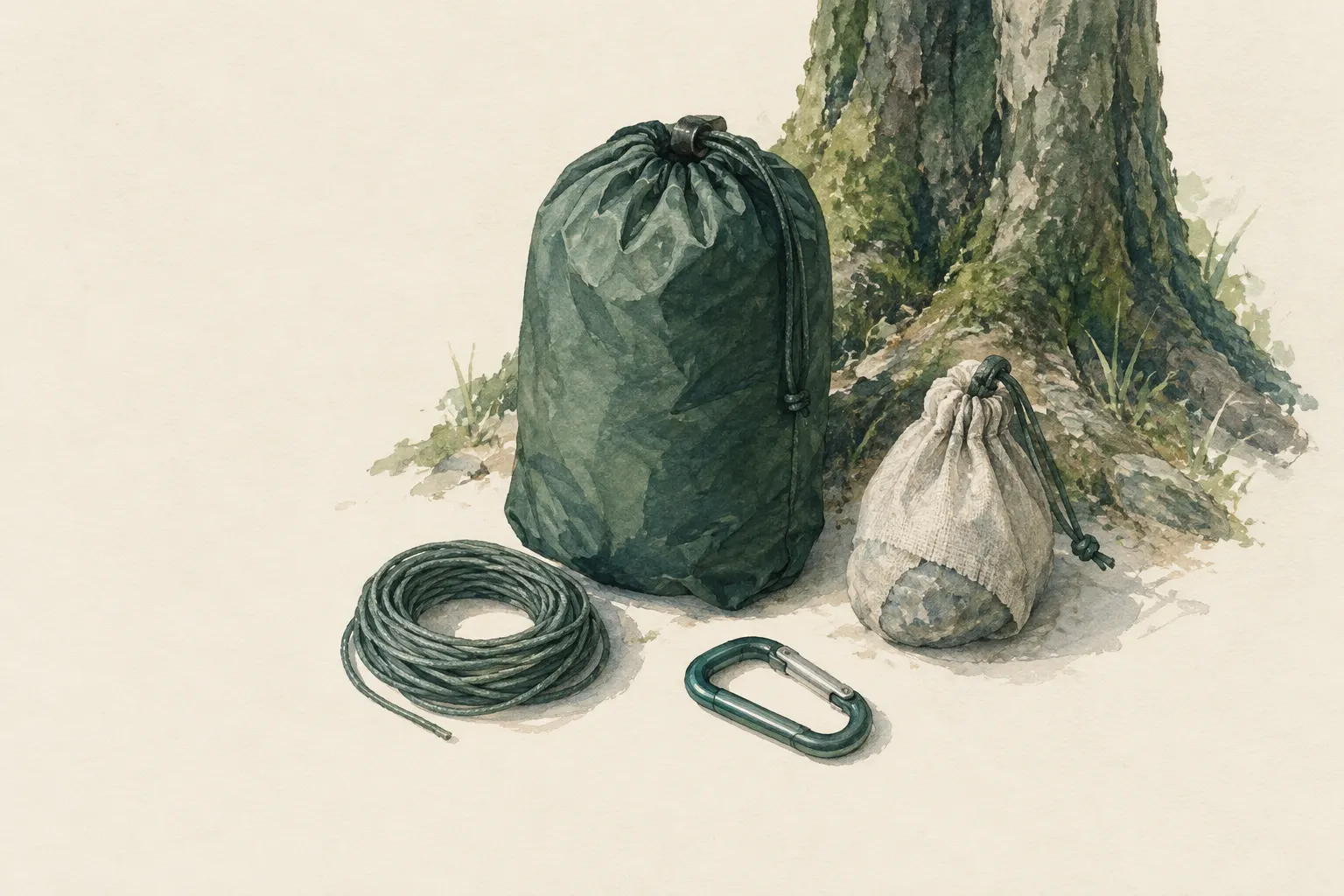
Tie a stone into a small bag or sock at the end of the cord. Hold the loose end, call "Watch out!" and throw the weight underarm with a swing over the branch. Nobody stands below.
Nobody under the branch or in the throwing line.
- 4
Haul up the bag
Remove the weight, tie the bag to this end of the cord and pull it up with the other end until it hangs well higher than a tall person can reach with a raised arm.
- 5
Secure the cord
Tie the free end with a secure knot to another tree or a low branch. The bag should hang at least an arm's length below the branch so no animal can reach it from the branch.
- 6
Lower it in the morning
In the morning undo the knot and lower the bag slowly. Coil the cord so it does not tangle next time.
Common mistakes
- Keeping food in the tent
- Bag too close to the trunk or too close below the branch
- Hanging it too low
- Throwing without a warning call
- A dead, rotten branch
Quick view
Materials
Paracord
About 15 metres of cord
Not a climbing or safety rope.
Dry bag
Tight bag for food, rubbish and everything scented
Accessory carabiner (not a safety device)
Accessory carabiners are not rated for personal protection.
Sturdy sticks / poles
A short stick for securing
Do not cut live wood where prohibited.
Suitable for
- Nights in the forest
- Areas with mice, foxes, raccoons and wild boar
- Multi-day trips
Not suitable for
- Areas where bear-resistant containers are required
- Treeless areas – then use a container or box
- Thunderstorms – do not stay under single tall trees
Prerequisites
- A tree with a strong, horizontal branch
- Enough cord
Safety
- When throwing the weight nobody may stand in the throwing line or under the branch. A falling stone can cause serious injury. Look around first and call out before each throw.
- Where bears live, special rules often apply, for example compulsory bear-resistant containers. Check beforehand with the national park or area administration. Cook and eat at least several dozen metres away from where you sleep.
How it works
Animals find food by smell. What hangs high, far from the trunk and well below the branch is out of reach of both climbing and jumping animals. A tight bag dampens the smell as well. Because animals learn where food is easy to get, this protects not only your food but also the animals: those that never get human food stay shy.
Advantages
- Protects food and animals
- Little equipment
Disadvantages
- Needs a suitable tree
- Throwing takes practice
Deep knowledge
Background
In North America hanging supplies has long been part of every wilderness trip. In Central Europe it is more often mice, foxes, martens, raccoons and wild boar that go for the food at night – in one night they can destroy supplies for several days.
The most important rule is not the knot but the habit: everything scented goes away from the sleeping place every evening.
Variants
- Between two trees
- Without a suitable branch you stretch a cord high between two trees and hang the bag in the middle. That needs two throws.
- Container instead of tree
- In treeless areas or where bears live, a solid, lockable container is often better or even required. Place it on the ground away from camp.
Common mistakes
- Keeping food in the tent
- Bag too close to the trunk or too close below the branch
- Hanging it too low
- Throwing without a warning call
- A dead, rotten branch
Limits and risks
- No guarantee against bears
- Protected area rules take precedence
Material alternatives
Derived from material properties: a substitute must have all relevant properties. Observe the notes on the substitute.
- Paracord
- Rope (Never use unknown or damaged rope for life-safety purposes.), Thin, soft wire (brass or galvanised steel) (Wire ends are sharp – protect eyes and fingers when bending), Tow rope or tow strap (Attach only to the towing eyes provided by the manufacturer; never stand next to it under load.)
Results come exclusively from structured entries. No improvised instructions are generated.
Sources (2)
- U.S. National Park Service: Bear Safety · Store food and scented items out of animals' reach; cook and sleep apart
- Leave No Trace Center for Outdoor Ethics: The Seven Principles of Leave No Trace (Principle 5: Minimize Campfire Impacts) · Keep fires small, use existing fire sites, do not feed wildlife, store food securely