























Washing without soap: ash, horse chestnut and soapwort
Long before shops sold soap, people washed with what lay around them. Wood ash scours greasy pots clean, horse chestnuts and soapwort lather in water like a mild detergent. Here you learn to clean cookware with ash, make a washing liquid from chestnuts for laundry and hands, recognise and use soapwort – and why the wash water never goes into the stream and none of these plants may be eaten.
- Ash immediately; chestnut liquid 30 minutes to overnight
Explained simply
In the past there was not always soap. People washed with ash from the fire and with certain plants.
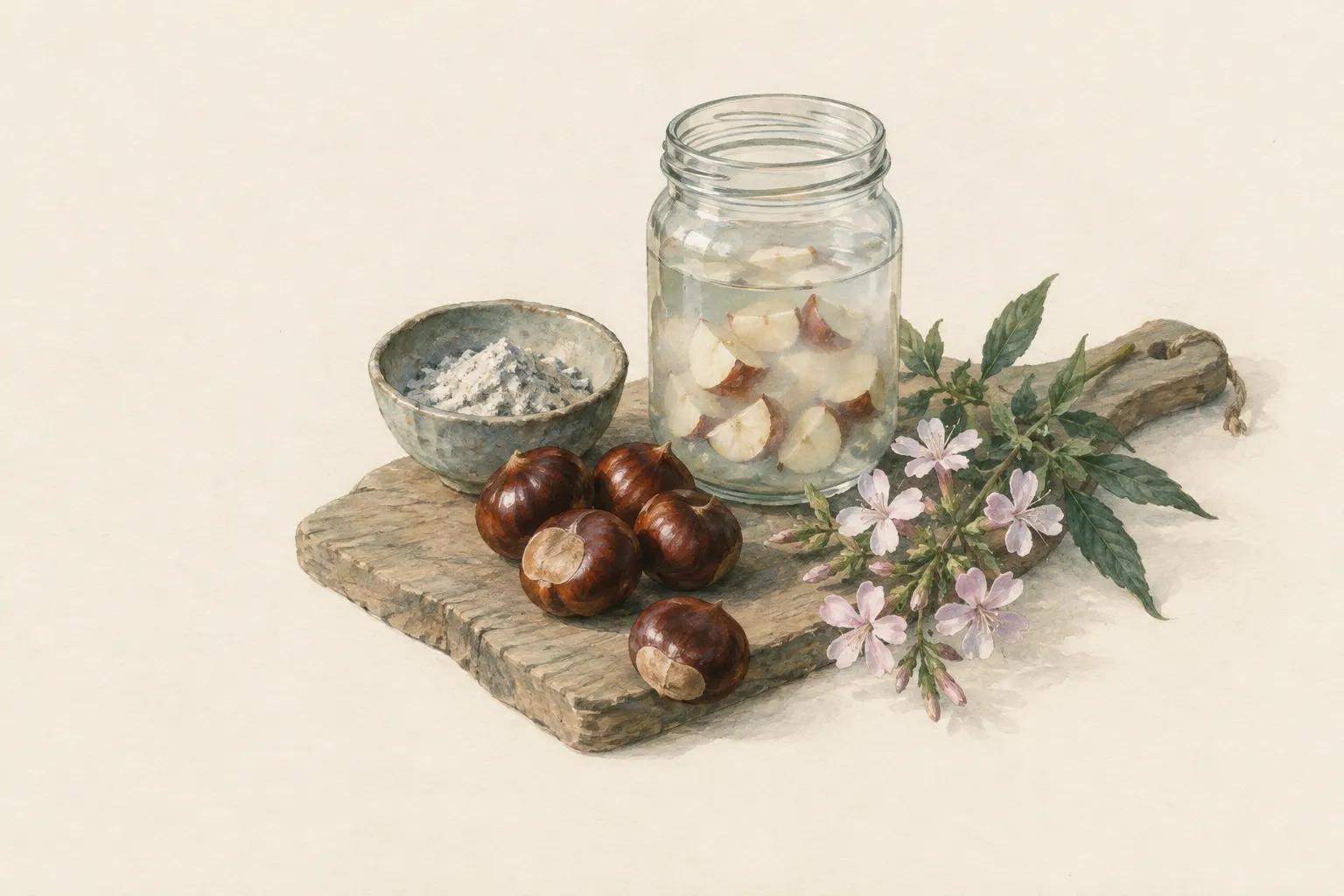
Cold ash rubs greasy pots clean. Chopped horse chestnuts – the shiny brown conkers you collect in autumn – make water foamy like soap. Soapwort also lathers a little.
Important: horse chestnuts and soapwort are poisonous, you must never eat them. And you always wash far away from the stream so the fish come to no harm.
How it works
Wood ash forms a mildly alkaline mixture with water that loosens grease. The fine grains also scour like a cleaning powder.
Horse chestnuts and soapwort contain saponins. These substances bind with grease and water and form foam – just like soap. That is why they loosen dirt from cloth and skin.
What matters
The right chestnut: horse chestnut has a thick, only slightly spiny husk and round, shiny nuts. The edible sweet chestnut has a densely spiny husk and pointed nuts. For washing you use the horse chestnut.
Clean ash: only cold, white ash from untreated wood.
Rinse well: rinse pots and hands with clean water afterwards.
Safety: what to watch out for
Poisonous when eaten: never eat or drink horse chestnuts, soapwort or the liquid. Keep out of children's reach. If poisoning is suspected, call the poison centre.
Ash: mildly caustic, keep it out of your eyes. Wear gloves if your skin is cracked.
Water: even natural wash water harms water creatures. Wash at least 60 metres from the water and scatter the water.
Step by step
Away from the water
Fetch water in a pot or bucket and carry it a good 60 metres away from the stream or lake. Wash there.
- 1
Away from the water
Fetch water in a pot or bucket and carry it a good 60 metres away from the stream or lake. Wash there.
- 2
Scour cookware with ash
Take a handful of cold, white ash from the fire pit, sprinkle it into the greasy pot, add a little water and rub with a tuft of grass or a cloth. Then rinse thoroughly with clean water.
Only cold ash, keep it out of your eyes.
- 3
Chop horse chestnuts
In autumn collect a few horse chestnuts – shiny brown, with a thick, only slightly spiny husk. Chop five to eight of them small or crush them between two stones.
- 4
Soak
Put the pieces into a pot with about half a litre of water. After 30 minutes the water is milky; overnight it gets stronger. With warm water it goes faster.
- 5
Strain and wash
Pour the liquid through a cloth. If you shake it, it foams. Wash hands, socks or light laundry with it – rub well, then rinse with clean water.
- 6
Use soapwort
Soapwort grows along paths and banks and flowers pale pink with five petals in summer. Rub a few leaves and stems between your hands with water – they lather slightly. Only take a few leaves, never dig it up.
- 7
Scatter the water
Pour the wash water widely over the ground, not in one spot and not near the water. Bury the chestnut remains or take them with you.
Common mistakes
- Washing directly in the stream
- Confusing horse chestnut with sweet chestnut
- Using hot ash
- Ash from treated wood
- Not rinsing pots after chestnut liquid
Quick view
Materials
Metal pot (stainless steel, aluminium, titanium)
Pot or vessel for soaking
Hot – scalding risk.
Knife (fixed or locking blade)
For chopping the chestnuts
Cut away from your body.
Rules on carrying knives differ by region – check local rules.
Cotton cloth / T-shirt
Cloth or sock for straining
Removes coarse particles only – no disinfection.
Galvanised bucket
Bucket to carry water away from the stream
Do not heat: the zinc coating can release harmful fumes when heated.
Suitable for
- Greasy cookware in camp
- Hands and light laundry on the way
- When you have run out of soap
Not suitable for
- Cleaning wounds – use clean water for that
- Sensitive or broken skin
- Washing directly in a stream or lake
Prerequisites
- Cold, white wood ash from untreated wood
- Reliable recognition of horse chestnut (do not confuse with sweet chestnut)
Safety
- Ash with water is mildly caustic. Only use cold ash, keep it out of your eyes, rinse your hands well afterwards and wear gloves if your skin is cracked. No ash from painted, coated or treated wood, coal or rubbish.
- Wash water, even natural, harms fish and small water creatures. Always wash well away from the water and scatter the water on the ground.
How it works
Wood ash contains potassium and calcium compounds. With water it forms a mildly alkaline mixture that loosens grease; the fine grains also scour. Horse chestnuts and soapwort contain saponins – substances that lather in water and loosen dirt and grease like soap. That is why they are called soap plants.
Advantages
- Costs nothing
- No plastic waste
Disadvantages
- Washes less strongly than soap
- Horse chestnuts only in autumn
Deep knowledge
Background
Soapwort used to be grown specially for washing fine wool and silk; some museums still clean old textiles with it today. In hard times during the World Wars many families washed with chestnut liquid.
For centuries ash was the most important cleaning agent in the kitchen and the basis of the first home-made soaps.
Variants
- Drying chestnuts
- Chopped, well-dried horse chestnuts keep for months. Just soak them to wash.
- Sand and grass
- Without ash, fine sand, a tuft of grass or fir cones also scour out the worst from the pot.
Common mistakes
- Washing directly in the stream
- Confusing horse chestnut with sweet chestnut
- Using hot ash
- Ash from treated wood
- Not rinsing pots after chestnut liquid
Limits and risks
- No disinfection
- No claims about germ reduction
Material alternatives
Derived from material properties: a substitute must have all relevant properties. Observe the notes on the substitute.
- Metal pot (stainless steel, aluminium, titanium)
- Single-wall stainless steel bottle (Heat only single-wall bottles without paint/plastic; remove the lid before heating.)
- Galvanised bucket
- Single-wall stainless steel bottle (Heat only single-wall bottles without paint/plastic; remove the lid before heating.), Double-wall insulated bottle (Never heat directly.), PET bottle (clear, max. 2 litres) (Do not heat or place in a fire.), Food-grade water container (Only use containers that never held chemicals or fuel.), Used chemical or fuel container (Never for drinking water or food – residues cannot be reliably removed.), Waterproof case or bag, Airtight food-grade storage container (Fill only when clean and completely dry; never use containers that previously held chemicals.), Wildlife-resistant food container (Where specific containers are required, use only approved models – check local rules.), Small metal tin with lid (Burn off coated or painted tins outdoors first.), Collapsible water container or bag (Protect from sharp objects.), Food-grade water bag (Use only for drinking water, never for chemicals or fuel.), Fermentation jar or crock (Use only food-grade containers of glass, food-safe glazed stoneware or food-grade plastic – no metal containers for acidic food.), Resealable food bags (Use only bags intended for food; do not use with boiling water unless the manufacturer explicitly allows it.), Bucket with a lid or a sealed bag (Never transport live invasive crayfish – only ones already killed)
Results come exclusively from structured entries. No improvised instructions are generated.
Sources (4)
- Leave No Trace Center for Outdoor Ethics: The Seven Principles of Leave No Trace (Principle 5: Minimize Campfire Impacts) · Wash about 60 metres from water; scatter the wash water, nothing into the water
- Bundesinstitut für Risikobewertung (BfR): Giftpflanzen: Wie kann man sich schützen und was ist bei einer Vergiftung zu tun? (Fragen und Antworten) · Saponin-containing plants such as horse chestnut and soapwort are poisonous when eaten
- Gesundheitsportal Österreich (gesundheit.gv.at), Bundesministerium für Soziales, Gesundheit, Pflege und Konsumentenschutz: Vergiftungsinformationszentrale (VIZ) · Call the poison information centre if poisoning is suspected
- Mors L. Kochanski – Lone Pine Publishing: Bushcraft: Outdoor Skills and Wilderness Survival · Ash and plants as cleaning agents in camp