



Crossing a stream together – only when there is no other way
The safest stream crossing is the one you do not make: find a bridge, wait, turn back. Sometimes, though, there is no way round it, such as a shallow mountain stream in the morning. Then three people together are much more stable than one alone. Here you learn to find a good spot, open your backpack, cross with a pole or as a group in a wedge or line – and the clear limits: never above knee height in fast water, never tied to a rope, never in a flood.
- 10–20 minutes with preparation
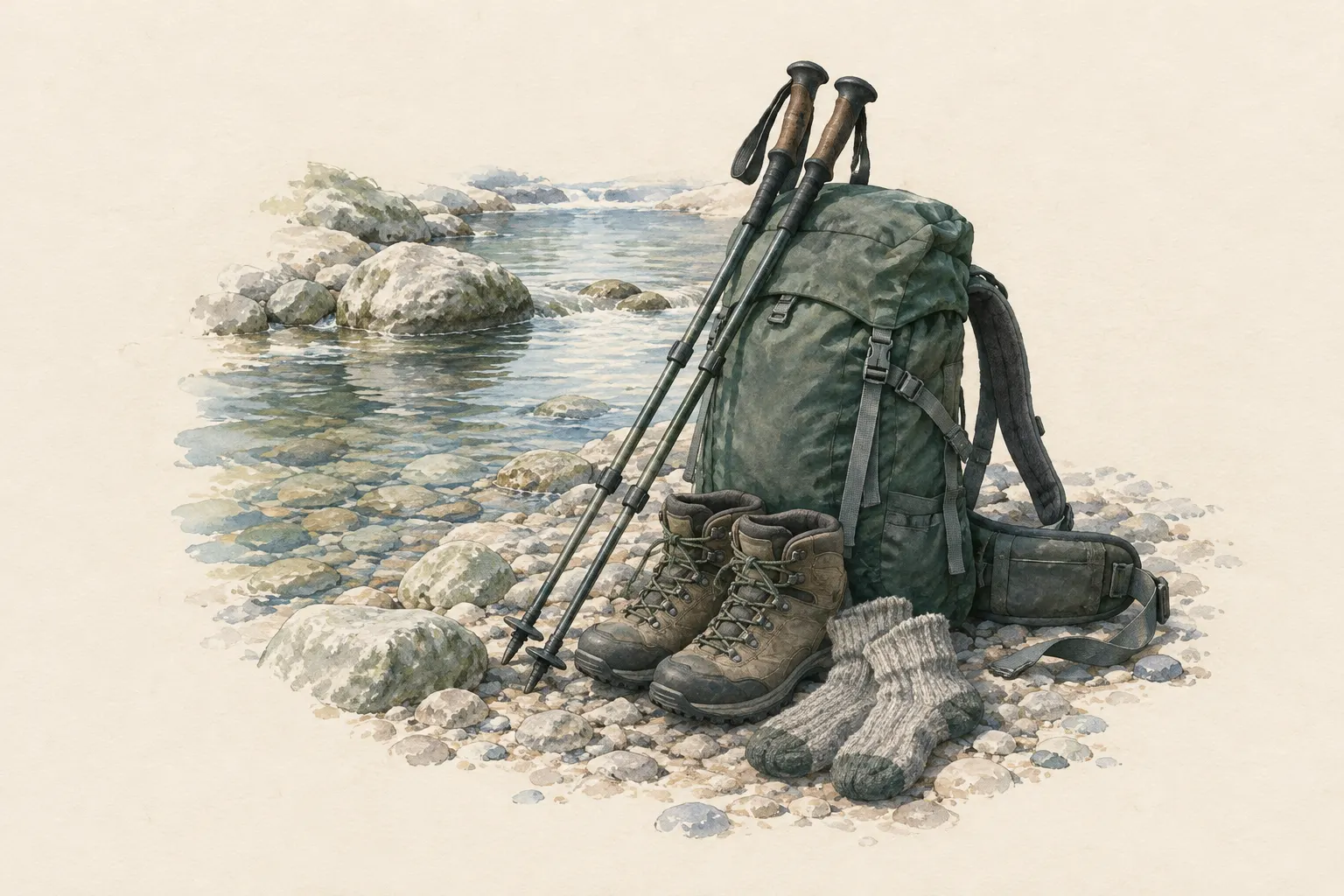
Explained simply
It is best to cross a stream on a bridge. If there is none and the water is shallow and calm, you can go across together.
Three people hold on to each other tightly. The strongest person stands in front against the current, and only one person takes a step at a time.
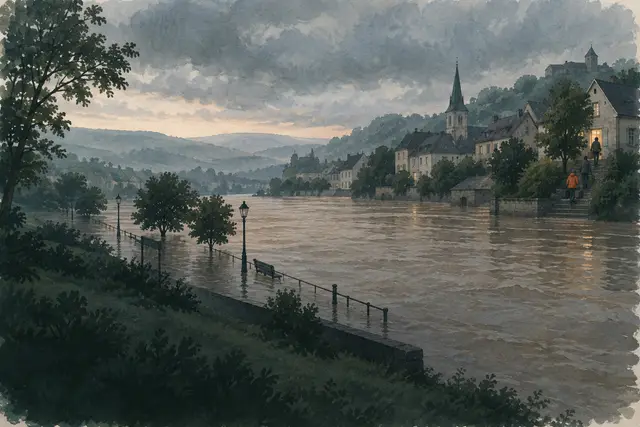
If the water is deeper than your knees, fast, murky or loud, you do not go in. Then it is better to wait until it drops.
How it works
Flowing water pushes against everything in its way. The deeper and faster it is, the stronger the push – even a little more depth makes a big difference.
Three people holding on to each other have six legs on the bed. When one person takes a step, four still stand firm. The front person breaks the current so the others stand in calmer water behind.
What matters
The spot: wide, shallow, even bed, nothing dangerous downstream.
The time: mountain streams are often shallower in the morning than in the afternoon.
The preparation: backpack straps open, shoes on, pole in hand.
Safety: what to watch out for
Never above knee height in fast water, never in a flood.
Never tie yourself to a rope – anyone who falls gets pushed under water.
If you fall: onto your back, feet first, drift diagonally to the bank.
Step by step
Look for alternatives first
Is there a bridge, a footbridge, a wider shallow spot further up? Can you wait until the water drops? Only if none of that works do you cross.
- 1
Look for alternatives first
Is there a bridge, a footbridge, a wider shallow spot further up? Can you wait until the water drops? Only if none of that works do you cross.
- 2
Choose the spot
Good is a wide, shallow spot with an even bed and calm water, where the stream splits into channels. Below it there must be no waterfall, no narrows and no log in the water.
- 3
Prepare
Pack important things waterproof, open hip and chest straps, keep shoes on, roll up or take off trousers. Pole in hand.
Backpack straps open.
- 4
Alone with a pole
Face upstream, set the pole upstream in front of you and shuffle your feet sideways after it. Always two points firmly on the bed, small steps.
- 5
Three in a wedge
The strongest person stands in front, upstream, breaking the current; the other two behind hold on to backpack or shoulders. Move together, only one person steps at a time.
- 6
One behind the other in a line
Alternatively stand one behind the other in the direction of flow, holding each other's hips; the first person breaks the water. Walk diagonally downstream.
- 7
Afterwards
On the other side dry off at once, put on dry socks and clothes, check feet for injuries. Count to make sure everyone is there.
Common mistakes
- Crossing in a flood
- Crossing tied to a rope
- Backpack straps closed
- Going barefoot
- Crossing directly above a waterfall or log
- Fighting against the current
Quick view
Materials
Trekking poles
Or a strong pole
Dry bag
Pack important things waterproof
Dry spare clothing
For afterwards
Carry it in waterproof packaging – wet clothing barely insulates.
Suitable for
- Shallow, wide streams
- Groups of three to five people
- Mountain streams early in the morning, when little meltwater flows
Not suitable for
- Floods, murky, roaring water
- Above knee height in a fast current
- Directly above waterfalls, narrows or logs in the water
- Children without adults
Prerequisites
- No alternative: no bridge, waiting not possible
- Water at most knee-deep and flowing calmly
- Clear view of the whole crossing
Safety
- Open the hip and chest straps of your backpack so you can throw it off immediately in a fall. Keep shoes on – barefoot you slip and get hurt.
How it works
Flowing water presses against legs and body with great force; the force grows sharply with depth and speed. Three people holding each other form a stable block: several legs always stand firm while one person takes a step. A pole acts like a third leg. Crossing diagonally downstream works with the current instead of against it.
Advantages
- Much more stable as three than alone
- No special equipment
Disadvantages
- Remains dangerous
- Wet feet and cold afterwards
Deep knowledge
Background
Stream crossings are among the most common causes of accidents on hikes in New Zealand, Scandinavia and North America; hiking groups there learn to cross together on courses.
In the Alps a simple rule of thumb applies: where you cannot see the bed and the water roars, you do not cross.
Variants
- With a cross-pole
- Three or four people hold a long, strong pole across the current in front of them and walk across side by side, step by step.
- Early in the morning
- Glacier and snowmelt streams carry the most water in the afternoon. In the morning they are often noticeably shallower – waiting pays off.
Common mistakes
- Crossing in a flood
- Crossing tied to a rope
- Backpack straps closed
- Going barefoot
- Crossing directly above a waterfall or log
- Fighting against the current
Limits and risks
- No rope technique
- No substitute for trained mountain guides
Material alternatives
Derived from material properties: a substitute must have all relevant properties. Observe the notes on the substitute.
- Trekking poles
- Sturdy sticks / poles (Do not cut live wood where prohibited.), Tent pole repair sleeve (Temporary only – have broken sections replaced at home.), Round logs (straight, sound) (Fell or take only with the forest owner's permission.), Straight, fresh hardwood stick (Only take dead wood or wood you are allowed to cut)
- Dry spare clothing
- Sleeping pad, Dry leaves, grass or conifer boughs (Collect only where allowed; no protected plants. Check for ticks and insects.), Backpack, Wool blanket / duvet (Keep away from candles, stoves and heaters.), Insulated cool box (Keeps cold only for a limited time; without ice packs or ice it is not a fridge.), Sleeping bag (Do not store compressed long-term; do not pack away damp.), Newspaper and cardboard (Flammable – keep away from candles, stoves, heaters and embers.), Insulated cooking box (hay box, thermal cooker) (Never put open flame or embers inside – only the hot, closed pot.), Long-stemmed thatch (reed, grass, rushes) (Extremely flammable – no open fire and no sparks nearby.), Pot insulation (pot cosy, beanie or fleece jacket) (Only around a pot that is no longer on the stove – fabric catches fire at the flame.)
Results come exclusively from structured entries. No improvised instructions are generated.
Sources (4)
- The Mountaineers Books (2017): Mountaineering: The Freedom of the Hills, 9th edition · Stream crossings: choose the spot, straps open, pole, group, no tied-on rope
- NOAA National Weather Service (USA): Turn Around Don't Drown · Moving water is underestimated; even shallow depth can knock you over
- European Commission: 112 – the European emergency number · Emergency number 112 throughout Europe
- Headquarters, Department of the Army (USA) (2002): FM 3-05.70 Survival · Crossing watercourses: spot, pole, group