






















Direction from the movement of the stars and Orion's belt
All stars move across the sky during the night – they rise in the east and sink in the west. With two sticks as a sighting aid you can see after just 15 to 20 minutes which way a star is moving and know roughly which direction you are facing. In winter the constellation Orion also helps: the first star of its belt rises almost exactly in the east and sets in the west – anywhere on Earth. Here you learn both methods and their limits.
- 20–30 minutes on a clear night
Explained simply
The stars move slowly across the sky at night, just like the sun during the day. They rise in the east and set in the west.
If you look at a star over two sticks and look again after a quarter of an hour, you see where it has moved. From that you can tell the direction.
In winter there is a shortcut: the first star in the belt of the constellation Orion rises almost exactly in the east.
How it works
It is not the stars that move but the Earth that turns – once a day from west to east. That is why the whole sky seems to move the other way, about 15 degrees per hour.
The two sticks are like the sights on a sighting device: they keep your eye fixed on the same point so you notice even a small movement.
What matters
Patience: wait 15 to 20 minutes, otherwise the movement is too small.
Exactly the same eye position: stay lying down or mark the spot.
Mind the hemisphere: in the southern hemisphere right and left are swapped.
Safety: what to watch out for
Do not set off at night: mark the direction and start in daylight.
Use red light or little light so your eyes adjust to the dark.
The method only shows a rough direction.
Step by step
Set up two sticks
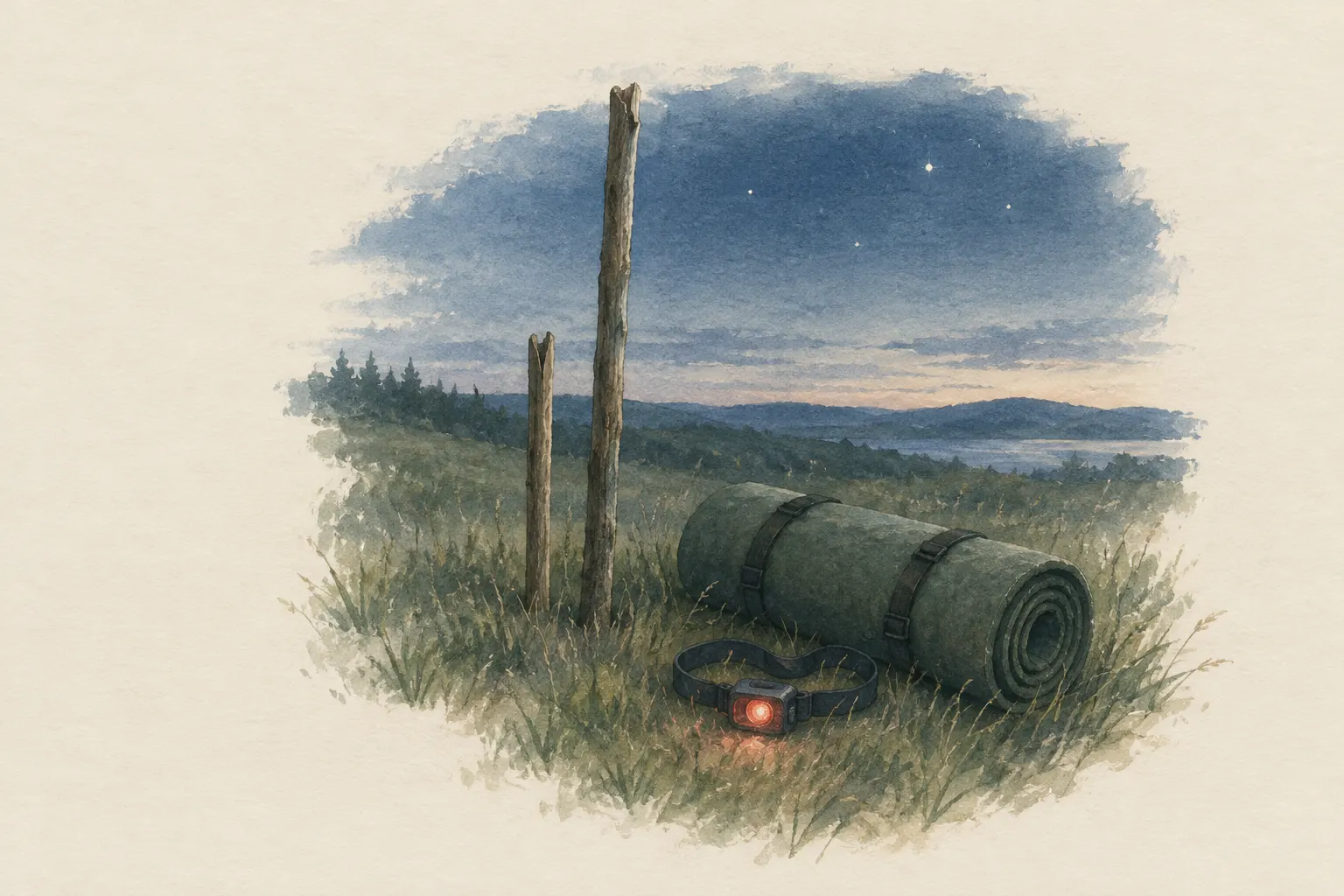
Push a long stick upright into the ground. About two paces in front of it push in a short stick so you can sight over both tips to the sky.
- 1
Set up two sticks
Push a long stick upright into the ground. About two paces in front of it push in a short stick so you can sight over both tips to the sky.
- 2
Sight a bright star
Lie down behind the short stick and find a bright star exactly above the tip of the long stick. Do not use a star straight overhead or one by the North Star.
- 3
Wait 15 to 20 minutes
Stay lying down or come back to exactly the same spot after 15 to 20 minutes and sight over the two tips again.
- 4
Read the movement
If the star has risen, you are facing east. If it has sunk, west. If it has moved to the right, south; to the left, north. In the southern hemisphere right and left are swapped.
- 5
In winter: Orion's belt
Orion is easy to see on winter evenings: three bright stars in a row form the belt. Where the first star of the belt (Mintaka) rises is almost exactly east; where it sets, west.
- 6
Mark the direction
Lay sticks or stones on the ground as an arrow. In the morning check the direction against the sun and only then set off.
Common mistakes
- Waiting too short a time
- Not returning to the same spot
- Choosing a star near the North Star
- Ignoring the hemisphere
- Setting off at night
Quick view
Materials
Sturdy sticks / poles
Two sticks: a short one and a long one
Do not cut live wood where prohibited.
Headlamp / flashlight
Red light protects night vision
Suitable for
- Fixing a direction at night when the North Star or Southern Cross cannot be seen
- Confirming other methods
- Marking a direction for the morning
Not suitable for
- Cloudy nights
- Stars near the celestial pole
- Setting off in the dark
Prerequisites
- A clear night with stars
- A safe place for the night
- Knowing which hemisphere you are in
Safety
- Do not walk through unknown terrain at night: drop-offs, streams and holes are hard to see in the dark. Mark the direction you found on the ground and only set off in daylight.
How it works
The Earth turns from west to east. That is why all stars seem to move across the sky from east to west – about 15 degrees per hour. A star in the east rises, one in the west sinks. In the northern hemisphere a star in the south moves to the right, one in the north to the left; in the southern hemisphere it is the other way round. The star Mintaka in Orion's belt lies almost exactly on the celestial equator and so rises almost exactly in the east and sets in the west.
Advantages
- Works with any bright star
- No equipment needed
- In both hemispheres
Disadvantages
- Needs a clear night and patience
- Only a rough direction
Deep knowledge
Background
For centuries seafarers in the Pacific navigated by the rising and setting of stars. For every island they knew a sequence of stars that rise at particular points on the horizon.
The two-stick method is in many survival handbooks because it works with any star – not just the North Star.
Variants
- With a fixed point
- Instead of two sticks you can sight over a fork in a branch or a rock edge – as long as your eye stays in the same place.
- The belt as a pointer
- If you extend the line of Orion's belt down to the left, you reach Sirius, the brightest star in the night sky. That helps you recognise Orion for sure.
Common mistakes
- Waiting too short a time
- Not returning to the same spot
- Choosing a star near the North Star
- Ignoring the hemisphere
- Setting off at night
Limits and risks
- Rough direction, no degrees
- Orion only well visible on winter nights
Material alternatives
Derived from material properties: a substitute must have all relevant properties. Observe the notes on the substitute.
- Headlamp / flashlight
- Mobile phone (The battery drains quickly in cold and with continuous screen and GPS use.), Battery lantern / LED light
Results come exclusively from structured entries. No improvised instructions are generated.
Sources (3)
- Headquarters, Department of the Army (USA) (2002): FM 3-05.70 Survival · Direction from star movement with two sticks
- U.S. Naval Observatory: Astronomical Applications Department – sun and moon data, phases of the moon · Rising and setting of stars, celestial equator
- Tristan Gooley – Virgin Books (2010): The Natural Navigator · Navigation by stars and Orion's belt