























Finding direction without a compass: which method when
Without a compass there are several ways to a direction: the sun's path, the shadow stick, the watch method, the North Star or the Southern Cross, the moon and – only for confirmation – signs in the landscape. None of them is precise, and each has its time. This decision guide shows what works in sunshine, on a clear night and under cloud, why moss is no compass, and why the first step is almost always: stop.
- Reading 15 minutes; practise the methods at home beforehand
Explained simply
If you are lost in the forest, the most important thing is not where north is. The most important thing is: stop, calm down and think. If someone knows where you are, people will look for you – and they will find you much more easily if you stay in one place.
Sometimes, though, you do need to find a direction. Then the sky helps you: by day the sun and its shadow, on a clear night the North Star. Every method has its time. The shadow of a stick needs a quarter of an hour of sunshine; the North Star needs a sky without clouds.
Maybe you have heard that moss always grows on the north side of trees. That is not true! Moss grows where it is damp and shady. When clouds hide the sun and the stars, there is no safe trick – then waiting is usually smarter than setting off.
Which method when
Sun and at least a quarter of an hour: the shadow stick. Mark two shadow tips; the line between them points roughly west–east. With more time around midday, the shortest shadow shows the north–south line. That is the best of the sun methods.
Sun but no time: the sun's path – roughly east in the morning, south at midday in the northern hemisphere, roughly west in the evening, shifted by the season. Or the watch method, which is quick but very imprecise, especially at midday and in the tropics.
Clear night: in the northern hemisphere the North Star via the Big Dipper, in the southern hemisphere the Southern Cross. The moon only helps for confirmation. At night you just lay the direction on the ground and set off only in daylight.
Cloud, fog, dense forest: there is no safe natural method. Wind-shaped trees, remaining snow on north slopes or old churches only help if several signs agree. Moss and anthills are myths.
How accurate is it?
There is no fixed accuracy for any of these methods – it depends on place, date, time and care. Roughly: a securely identified North Star is the most reliable natural clue; a shadow stick that you watch long enough is usable; the watch method and sunrise and sunset are very rough; landscape signs are only confirmation.
Even a small error takes you far from your goal over a few hours. That is why you never aim at a small point, but at a long handrail lying across your way – a road, a river, a coast. You will hit it even if the direction is not quite right.
Stop first, then decide
People who are lost often keep walking and move away from the area being searched. The STOP rule – stop, think, observe, plan – prevents this. If someone knows your route and return time, staying at a clearly visible place is usually the safest decision. With signal, call the emergency number 112 straight away.
Moving only makes sense if staying is more dangerous or nobody will look for you. Then check the direction with two methods, lay an arrow of sticks, walk from target to target and check again and again along the way. At night and in fog you do not walk through unknown terrain.
Practise beforehand
None of these methods works the first time under stress. Practise them on a sunny day in the garden or park and on a clear night on the balcony – ideally with a compass next to you so you can see how far off you are. With children it becomes a game, and along the way they learn the most important rule: if you are lost, stay put and call out.
And the best method without a compass is still to carry a compass, plus a map and a trip plan left with someone you trust.
Step by step
First: STOP – do you need to move at all?
Stop, take a breath, have a drink. Does someone know your route and return time? Then staying at a clearly visible place is usually the safest choice, and you do not need a direction at all. If you have signal, call the emergency number. Only if staying is not an option do you go on.
- 1
First: STOP – do you need to move at all?
Stop, take a breath, have a drink. Does someone know your route and return time? Then staying at a clearly visible place is usually the safest choice, and you do not need a direction at all. If you have signal, call the emergency number. Only if staying is not an option do you go on.
- 2
Where to? Choose a large target
An estimated direction never gets you exactly to a point. Using a map or your memory, think about where a long handrail lies across your direction: a road, a river, a coast, a large valley. You will hit it even if you are a bit off. Only then do you look for a method to find the direction.
- 3
Sun and time: the shadow stick
If the sun is shining and you have a quarter of an hour or more, use the shadow stick: mark two shadow tips, and the line between them points roughly west–east. That is the best of the sun methods. With more time around midday, the shortest shadow shows you the north–south line.
- 4
Sun but little time: sun path or watch
If you have to decide quickly, the sun's path helps: roughly east in the morning, roughly south at midday (northern hemisphere), roughly west in the evening – with the shift depending on the season. The watch method is quicker still, but very imprecise, especially around midday and in the tropics. Both are only good for a first rough direction.
Never look at the sun – point your arm towards it or read the shadow.
- 5
Clear night: North Star, Southern Cross, moon
In the northern hemisphere you find the North Star via the Big Dipper – north lies beneath it. Once securely identified, it is the most reliable natural clue. In the southern hemisphere the Southern Cross helps you find rough south. The moon only gives a rough confirmation. Lay the direction on the ground with sticks and set off only in daylight.
- 6
Cloud or fog: no safe method
Without sun and stars there is no safe natural method. Moss grows where it is damp and shady, on any side of the tree – it is no compass, and neither are anthills. Wind-shaped trees or remaining snow on north slopes only help if several signs agree. Waiting until the sun comes through is often the better decision.
- 7
Cross-check, mark, walk straight
Check the direction with a second method. If both roughly agree, lay an arrow of sticks on the ground. Pick a distinctive far-off target in that direction – a tree, a rock – and walk towards it, then to the next. Check the direction again and again along the way, because without a target people easily walk in circles.
Common mistakes
- Rushing off without STOP
- Aiming at a small target instead of a large handrail
- Walking by moss or anthills
- Trusting the watch method at midday or in the tropics
- Mistaking the brightest star for the North Star
- Setting off at night with a direction you found
- Using only one method and never cross-checking
Quick view
Materials
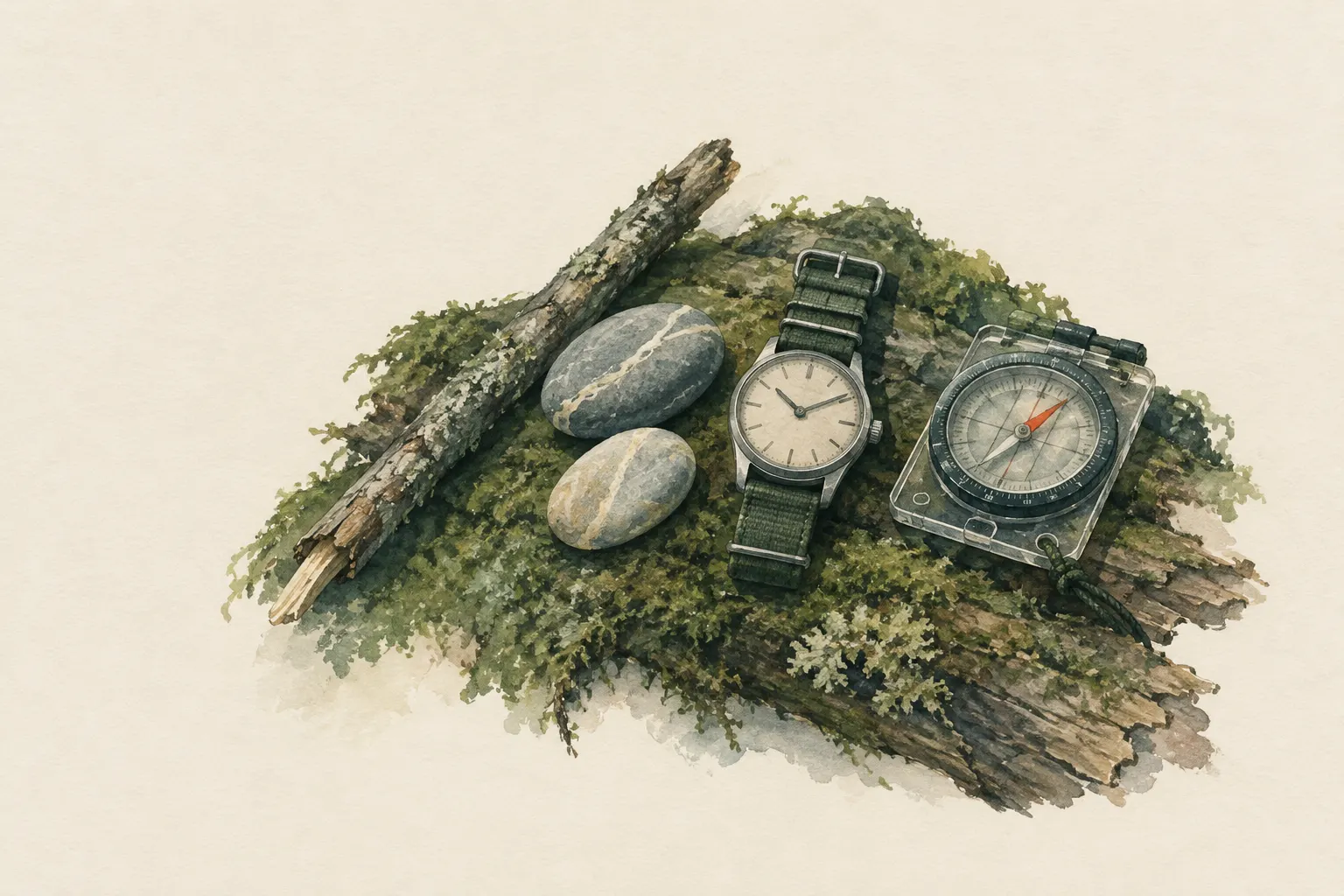
Baseplate compass
The best method without a compass is to carry one
Metal, magnets and electronics nearby deflect the needle.
Bubbles in the capsule or a sluggish needle indicate a defect.
Sturdy sticks / poles
For the shadow stick and to mark the direction on the ground
Do not cut live wood where prohibited.
Small pebbles or twigs as markers
Mark the shadow tips
Analogue wristwatch
For the watch method and to time the wait
Only a very rough direction aid – never a substitute for a compass in precise navigation.
Suitable for
- Deciding which method fits right now
- A rough direction towards a large handrail (road, river, coast)
- Trip preparation and practising with the family
Not suitable for
- Precise navigation to a small target
- Setting off into the unknown although someone knows your route
- Fog, whiteout or night in difficult terrain
Prerequisites
- Knowing the STOP rule
- Knowing which hemisphere you are in
- Having practised the methods once beforehand
Safety
- Direction by the sun is always rough. In cloud, haze, fog, dense forest or poor visibility, do not bet your life on it. A small error leads far away from your goal over a few hours.
- A direction found at night does not mean you should walk at night. Mark it on the ground and set off only in daylight.
- Before every trip, tell someone where you are going and when you will be back. Then people will start looking for you in time – and then staying put is often better than searching for the right direction.
How it works
All methods without a compass read something that moves by fixed rules: the sun (and with it the shadow), the stars, the moon. The longer and more carefully you observe, the better the result: a shadow stick over a quarter of an hour or more is better than a quick glance at a watch; a securely identified North Star is the most reliable natural clue on a clear night in the northern hemisphere. Signs in the landscape – wind, snow, churches – only help for confirmation, and moss is a myth. More important than any method is the question of whether you need to move at all – and where to: a rough direction is only enough if a large handrail such as a road, river or coast lies across it that you cannot miss.
Advantages
- Shows at a glance what works right now
- Links all methods into one sequence
- Puts safety before direction
Disadvantages
- Every method stays rough
- Needs knowledge practised beforehand
- In cloud and fog there is hardly any help
Deep knowledge
Background
Survival and navigation manuals such as FM 3-05.70 and FM 3-25.26 describe the shadow stick, watch method, North Star, Southern Cross and moon as makeshifts when there is no compass – each with the note that they are imprecise. Research on the behaviour of lost persons shows that many people who are lost keep walking and move away from the search area; that is why every decision starts with stopping.
The most reliable 'method without a compass' is a compass in your pocket and a trip plan left with someone you trust. The natural methods are the safety net underneath – they are most valuable if you have practised them calmly beforehand.
Variants
- Practising with children
- Turn it into a game in a meadow or the garden: set up a shadow stick, lay stones, look for the Big Dipper in the evening. Along the way children also learn the most important rule for a real emergency: if you are lost, stay put, hug a tree and call out – instead of looking for a direction.
- Southern hemisphere
- At midday the sun stands in the north, the shortest shadow points south, and you cannot see the North Star. At night the direction comes from the Southern Cross. The shadow-stick west–east line applies there just the same.
Common mistakes
- Rushing off without STOP
- Aiming at a small target instead of a large handrail
- Walking by moss or anthills
- Trusting the watch method at midday or in the tropics
- Mistaking the brightest star for the North Star
- Setting off at night with a direction you found
- Using only one method and never cross-checking
Limits and risks
- No accuracy figures – all methods are rough
- Hardly any help in cloud, fog and dense forest
- Does not replace a map, a compass or an emergency call
Sources (5)
- Headquarters, Department of the Army (USA) (2002): FM 3-05.70 Survival · Makeshift methods without a compass: shadow stick, watch, stars, moon and their limits
- Headquarters, Department of the Army (USA) (2001): FM 3-25.26 Map Reading and Land Navigation · Determining direction without a compass
- Robert J. Koester – dbS Productions (2008): Lost Person Behavior: A Search and Rescue Guide on Where to Look – for Land, Air and Water · Behaviour of lost persons; walking on moves away from the search area
- Tristan Gooley – Virgin Books (2010): The Natural Navigator · Moss as an unreliable clue; combining several natural signs
- NASA Science: Eclipse Safety – never look directly at the sun without proper eye protection · Never look directly at the sun