























The sun's path: where it rises and sets and when it stands in the south
The sun does not rise exactly in the east and set exactly in the west every day – that is only true around 20 March and 22/23 September. In the northern summer half of the year it rises north of east, in the winter half south of it. At solar noon, when the shadow is shortest, it stands due south in the mid-northern latitudes and due north in the southern hemisphere. If you know this path you can keep a rough direction – and you know why 12 o'clock on the watch is not solar noon.
- Reading 15 minutes; finding the shortest shadow about 1 hour around midday
Explained simply
Every morning the sun rises, travels across the sky and sets again in the evening. Where we live, it rises roughly in the east, stands in the south at midday and sets roughly in the west. You can picture it as a big arc across the sky.
But the arc is not always the same. In summer it is big and high: the sun already rises in the north-east and only sets in the north-west, which is why the days are so long. In winter the arc is small and flat; the sun comes up in the south-east and disappears early in the south-west. Only in spring and autumn does it rise almost exactly in the east.
You can tell when the sun is highest from the shadow of a stick: when it is shortest, it is solar noon. That is almost never at 12 o'clock on the watch – in summer it is more like 1 o'clock or later. And very important: you only ever look at the shadow, never into the sun – that can harm your eyes for good.
How it works
The Earth turns once in 24 hours. That is why the sun seems to move across the sky – on average about 15 degrees per hour, faster in direction around midday and slower in the morning and evening. The Earth's axis is tilted, and as the Earth circles the sun through the year, sometimes the northern and sometimes the southern hemisphere leans more towards the sun. That shifts the sun's arc.
This gives a rule that applies everywhere on Earth: from late March to late September the sun rises north of east and sets north of west; from late September to late March it rises and sets south of them. It is exactly east and west only around the equinoxes, around 20 March and 22/23 September. How large the shift is depends on latitude: in Central Europe it reaches roughly north-east and south-east around the solstices, further north even more, near the equator less.
At solar noon the sun is at its highest. In the mid-northern latitudes, which includes all of Europe, it is then due south, and in the mid-southern latitudes due north. In the tropics between the tropic lines it can stand in the north, in the south or almost overhead at midday, depending on the date.
Solar noon and clock time
You can find solar noon without a watch: set a straight stick upright, keep marking the shadow tip from late morning on and look for the shortest mark. The line from the stick to it is the noon line and points north in the northern hemisphere. The equal-shadow method is more accurate: there are two shadows of equal length in the morning and the afternoon, and the noon line lies exactly between them.
On the clock, solar noon is almost never 12 o'clock. A time zone is wide, but every place in it has the same clock time – in the west of the zone the sun arrives later than in the east. Daylight saving time pushes everything about an hour later again, and over the year the sun also runs a few minutes early or late. In Germany solar noon in summer is roughly between 1 and 2 p.m., and in Spain, which lies far to the west, only at about 2 p.m. in summer.
That is why the watch method is often off: it assumes the sun is due south at 12 o'clock (1 o'clock in daylight saving time). Before a trip you can use a solar calculator, such as NOAA's, to look up for your place when solar noon is and in which direction the sun rises and sets.
Using it on the move
The sun is a signpost that moves. In the morning it is roughly in the east, at midday in the south in the northern hemisphere, in the evening roughly in the west. If, for example, you keep it ahead and to your left, that is only right for a while; after that you have to remember a new position. The safest way is to check the direction regularly with the shadow and, in between, walk towards a fixed far-off target.
The sun's path is also useful for planning. If you know that the sun sets in the north-west in summer, you pick a campsite with evening sun or with shade in the afternoon. And if you know that a high ridge lies to the west, you expect darkness earlier.
Safety and limits
Never look directly at the sun, not even briefly and not with sunglasses, and never through binoculars, a camera or a phone. The eyes can be damaged for good without it hurting. Watching shadows for a long time often means standing in the midday sun: a hat, sunscreen and water are part of it.
The sun rules are rough. In cloud, haze, dense forest, in the tropics around midday and in the far north with a low sun they help little. Do not bet your life on an estimated direction in poor visibility: tell someone your route before the trip, carry a compass, and if you are lost, stop first.
Step by step
Work out hemisphere and season
Before you read the sun, you need two things: which hemisphere are you in, and which month is it? All of Europe lies in the northern hemisphere, outside the tropics. In the southern hemisphere (for example Australia, South Africa, Argentina) much is reversed, and in the tropics near the equator the simple rules often do not apply.
- 1
Work out hemisphere and season
Before you read the sun, you need two things: which hemisphere are you in, and which month is it? All of Europe lies in the northern hemisphere, outside the tropics. In the southern hemisphere (for example Australia, South Africa, Argentina) much is reversed, and in the tropics near the equator the simple rules often do not apply.
- 2
Sunrise and sunset: only roughly east and west
The sun rises in the east and sets in the west – but exactly east and exactly west only applies around the equinoxes, that is around 20 March and 22/23 September. On every other day sunrise is more or less off. Treat the spot on the horizon where the sun rises or sets only as 'roughly east' or 'roughly west'.
- 3
The season shifts sunrise and sunset
Between late March and late September the sun rises north of east and sets north of west everywhere on Earth; for the rest of the year it rises and sets south of them. The shift is largest around 21 June and 21 December. In Central Europe the sun rises roughly in the north-east and sets in the north-west in late June, and in late December roughly in the south-east and south-west. The further you are from the equator, the larger the shift.
- 4
Find solar noon: the shortest shadow
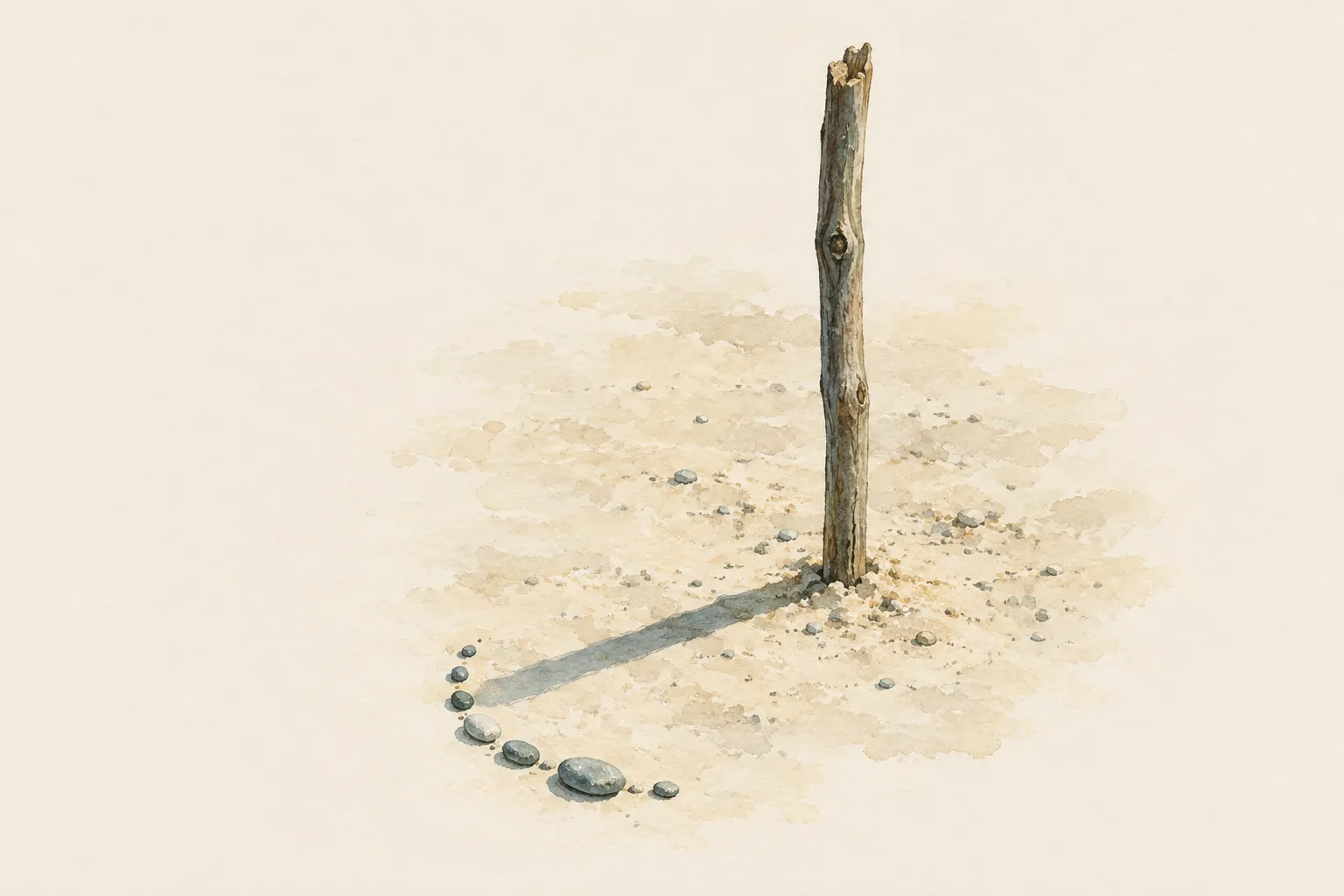
Put a straight stick upright on level ground. From late morning on, mark the tip of its shadow with a pebble at regular intervals. The shadow first gets shorter and then longer again. The shortest mark shows solar noon: the line from the stick to it points due north in the mid-northern latitudes and due south in the southern hemisphere. The sun is then exactly on the opposite side.
Only watch the shadow – never look up at the sun.
- 5
Clock time is not solar time
Solar noon is almost never at 12 o'clock. Daylight saving time pushes it about an hour later, and depending on where you are in your time zone, more is added. In Germany it is roughly between 1 p.m. and just before 2 p.m. in summer, and roughly between 12 and 1 p.m. in winter. You can look up the exact value for your place and date with a solar calculator before the trip.
- 6
Keep a direction during the day
In the morning the sun is roughly in the east, at midday (in our latitudes) in the south, in the evening roughly in the west. So it keeps moving while you walk. If, for example, you keep it ahead and to your left, that is only right for a short time. Check your direction again regularly, ideally with the shadow, and pick a fixed far-off target in the direction you want and walk towards it.
- 7
Judge the limits honestly
In the tropics the sun is almost overhead at midday; the shadow is tiny and shows hardly any direction. In the far north it stays low for a long time and travels almost all the way round the horizon. In cloud, haze or dense forest it is missing altogether. Then you trust no sun rule, but combine several methods – or stay where you are.
Common mistakes
- Always taking sunrise as due east
- Confusing 12 o'clock on the watch with solar noon
- Forgetting daylight saving time
- Forgetting the southern hemisphere rule
- 'Keeping' the sun in the same place for hours although it moves on
- Glancing at the sun to check where it is
Quick view
Materials
Sturdy sticks / poles
A straight stick, about arm's length, for the shortest shadow
Do not cut live wood where prohibited.
Small pebbles or twigs as markers
Mark the shadow tips
Analogue wristwatch
Note the time of the shortest shadow
Only a very rough direction aid – never a substitute for a compass in precise navigation.
Wide-brimmed sun hat
Protection while waiting in the midday sun
Suitable for
- Keeping a rough direction while the sun shines
- Checking other methods such as shadow stick and watch
- Planning a trip: where will the sun set today?
- Understanding why the watch method is often off
Not suitable for
- Precise navigation to a destination
- Overcast sky, fog, dense forest
- The tropics around midday
- Very high latitudes with a low sun
Prerequisites
- Knowing which hemisphere you are in
- Approximate date (month)
- Sun with a clear shadow
- Never looking at the sun
Safety
- Direction by the sun is always rough. In cloud, haze, fog, dense forest or poor visibility, do not bet your life on it. A small error leads far away from your goal over a few hours.
- Standing in the sun for a long time while watching shadows easily leads to sunburn or heat illness. UV radiation is strongest around midday, and even stronger on snow, on water and in the mountains. A hat, sunscreen, water and breaks in the shade are part of it – especially for children.
- Before every trip, tell someone where you are going and when you will be back. Then people will start looking for you in time – and then staying put is often better than searching for the right direction.
How it works
The Earth turns once a day, so the sun seems to travel across the sky – on average about 15 degrees per hour. Because the Earth's axis is tilted, the sun's path changes through the year: between late March and late September it rises north of east and sets north of west everywhere on Earth, between late September and late March south of them. How far it shifts depends on latitude – little near the equator, in Central Europe as far as roughly north-east and south-east, and very strongly near the polar circles. The sun reaches its highest point at solar noon. Then it stands due south in the mid-northern latitudes and due north in the mid-southern latitudes, and the shadow of an upright stick is at its shortest. In the tropics it can stand in the north, in the south or almost overhead at midday.
Advantages
- Explains why other sun methods are off
- Needs only a stick and pebbles
- Helps already when planning a trip
- Works anywhere on Earth with the right rules
Disadvantages
- Only in sunshine
- The shortest shadow takes time around midday
- Sunrise and sunset only rough
- Hardly usable at midday in the tropics
Deep knowledge
Background
Survival manuals such as FM 3-05.70 describe the shadow-tip method and, as a more accurate form, the equal-shadow method: two shadows of equal length in the morning and afternoon lie symmetrically around solar noon. When solar noon falls at your place and in which direction the sun rises and sets on any date are calculated, for example, by NOAA's solar calculator and the tables of the U.S. Naval Observatory.
There are three reasons why the clock does not match the sun: time zones are wide and share one clock time, daylight saving time shifts everything by an hour, and the sun itself runs a few minutes early or late over the year. In Spain, for example, which lies far west but uses Central European Time, solar noon in summer is only at about 2 p.m.
Variants
- Southern hemisphere
- At midday the sun stands in the north, and the shortest shadow points south. The sun travels from east via north to west, so anticlockwise as you see it. The rule 'late March to late September north of east' applies there just the same – but that is winter there.
- Tropics
- Between the tropics the sun is exactly overhead at midday on one or two days a year. Depending on the date it stands in the north or the south at midday. Sunrise and sunset there give a usable rough east and west because the direction shifts less through the year than in our latitudes; at midday the sun is no use as a direction pointer there.
- More accurate: the equal-shadow method
- In the morning, mark the shadow tip and use a cord around the stick to draw a circle exactly through that mark. In the afternoon, wait until the shadow tip touches the circle again and mark that point too. The line between the two marks runs west–east; the line from the stick to the midpoint between them is the north–south noon line. It takes several hours.
Common mistakes
- Always taking sunrise as due east
- Confusing 12 o'clock on the watch with solar noon
- Forgetting daylight saving time
- Forgetting the southern hemisphere rule
- 'Keeping' the sun in the same place for hours although it moves on
- Glancing at the sun to check where it is
Limits and risks
- No accuracy figure – depends on date, place and patience
- Sunrise and sunset only as a rough direction
- Tropics and high latitudes have their own rules
- Does not replace a map or compass
Sources (6)
- Headquarters, Department of the Army (USA) (2002): FM 3-05.70 Survival · Shadow-tip method and equal-shadow method
- Headquarters, Department of the Army (USA) (2001): FM 3-25.26 Map Reading and Land Navigation · Field-expedient direction finding with the sun
- NOAA Global Monitoring Laboratory (Global Radiation and Aerosols): NOAA Solar Calculator – sunrise, sunset, solar noon, azimuth and elevation for any place and date · Solar noon, sunrise and sunset direction (azimuth) for place and date; effect of time zone and daylight saving
- U.S. Naval Observatory: Astronomical Applications Department – sun and moon data, phases of the moon · Sunrise and sunset times and the sun's altitude and direction
- NASA Science: Eclipse Safety – never look directly at the sun without proper eye protection · Never look directly at the sun
- World Health Organization (with WMO, UNEP and ICNIRP) (2002): Global Solar UV Index: A Practical Guide · UV radiation strongest around midday, on snow, on water and at altitude