























Building a sundial from a stick and reading the time
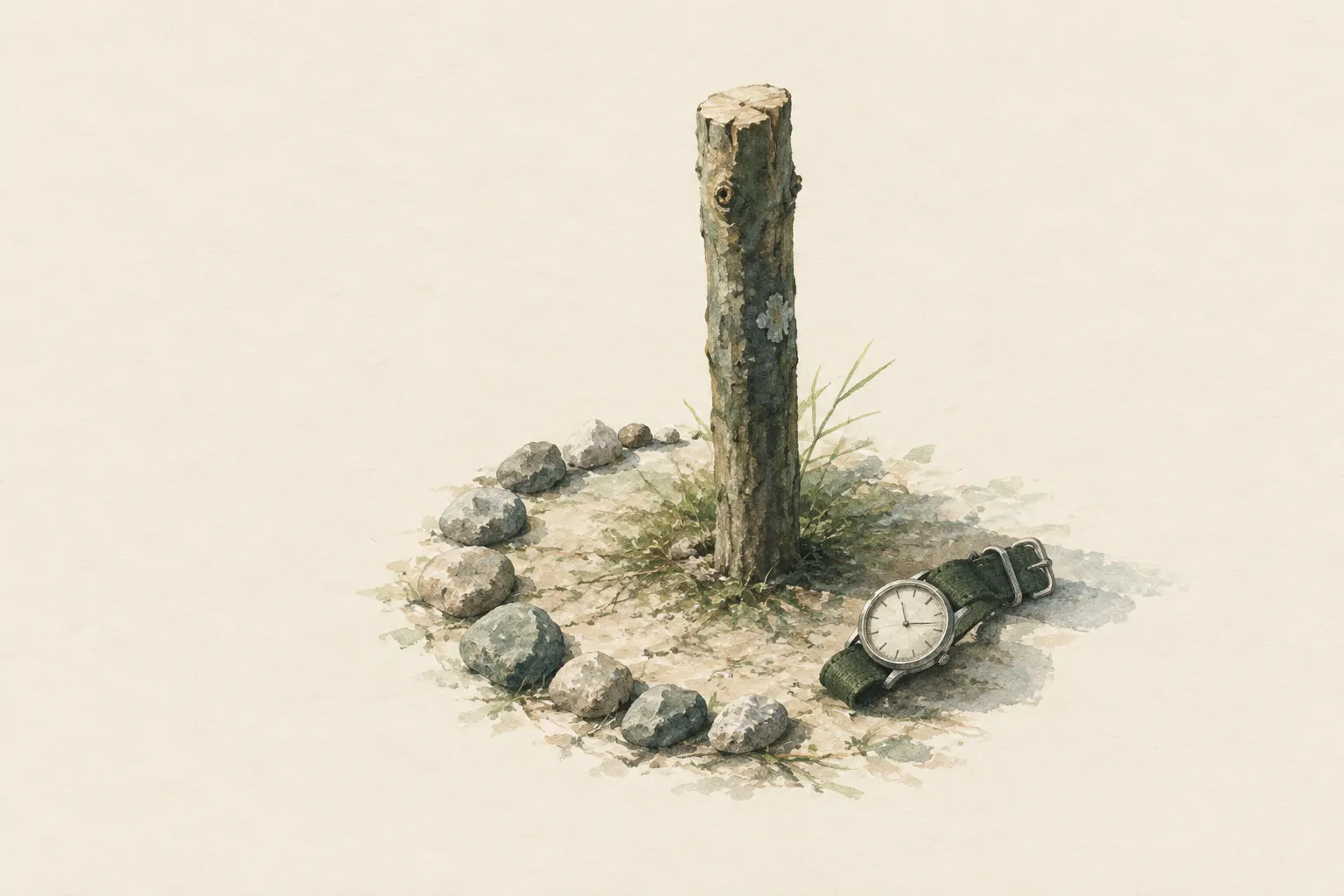
An upright stick and a few stones become a sundial: on the first sunny day you use a watch to mark the tip of the shadow at every full hour. On the following days you read the time from the shadow. It is a great project with children and useful in camp when the battery is flat. The marks only stay right for a few days to weeks, though, because the sun's path shifts – and of course only while the sun shines.
- Setting up 10 minutes, then one minute of marking every hour on a sunny day
Explained simply
With a stick and a few stones you can build your own clock – a sundial. You push the stick straight into the ground. The sun casts a shadow, and during the day this shadow moves around the stick like the hand of a clock.
On the first day you still need a real watch. Every time it is a full hour, you put a stone exactly at the tip of the shadow and write the number next to it in the sand. By evening you have an arc of stones. The next day you only look at where the shadow is – and you know roughly what time it is.
But the sundial is not right forever. The sun runs across the sky a tiny bit differently every day, so after a while you have to lay the stones again. In cloud it shows nothing at all. And remember: you only ever look at the shadow, never into the sun.
How it works
The sun moves steadily across the sky during the day, and the shadow of an upright stick turns with it. In the northern hemisphere it points roughly west in the morning, north at midday and roughly east in the evening – it moves clockwise. In the morning and evening it is long, at midday at its shortest. In the southern hemisphere it moves anticlockwise, and the shortest shadow points south.
If you use a watch on one day to mark where the shadow tip lies at every full hour, you have an hour scale for that day. Because the sun runs almost the same path on the following days, the scale still fits for a while. Your sundial shows the time of your watch, not solar time – because you calibrated it with the watch.
What really matters
The spot must be level and get sun all day. A tree that casts shade in the afternoon makes the afternoon hours useless. The stick must stand firm and upright – a cord with a stone on it hangs exactly vertical and helps you line it up. If the stick wobbles, all the marks move with it.
Put the stones exactly at the tip of the shadow, not beside it, and label them: with a number in the sand, a scratch on the stone or a set number of small twigs. Between two marks you estimate the minutes. Do not expect more than a rough time.
The marks shift because the sun runs higher and further north in summer than in winter. Around March and September this happens faster, around June and December more slowly. If you still have a watch, compare every few days and reposition the stones. When the clocks change, all marks are suddenly an hour out.
With children
A sundial is a wonderful project for a day in camp or in the garden. Children lay their stone every hour, paint numbers on pebbles and see how the shadow is long in the morning, gets short at midday and grows again in the evening. Along the way they learn that the shortest mark points north (south in the southern hemisphere).
Make sure the stick is blunt at the top or wears a cap, that nobody looks up at the sun, and that everyone goes into the shade now and then, drinks and wears a hat. Around midday the sun is at its strongest.
Limits
A stick sundial only shows an approximate time and only while the sun shines. For anything where the time really matters – medication, a meeting point, the return time of a trip – you need a real watch. The sundial without any watch that survival manuals describe counts sunrise as 6 a.m. and sunset as 6 p.m. and is even rougher.
Step by step
Choose a sunny, level spot
Find a spot that gets sun for as much of the day as possible and is level – a meadow, a patch of sand or a free area in camp. Trees, rocks or tents must not shade it during the day. It should be away from paths so that nobody kicks the stones away.
- 1
Choose a sunny, level spot
Find a spot that gets sun for as much of the day as possible and is level – a meadow, a patch of sand or a free area in camp. Trees, rocks or tents must not shade it during the day. It should be away from paths so that nobody kicks the stones away.
- 2
Set the stick upright
Push the stick firmly into the ground so that it no longer moves. Hold a cord with a small stone tied to it next to the stick: the hanging cord is exactly vertical, so you line the stick up with it. If the stick leans or wobbles, the marks will be wrong later.
- 3
Mark the first hour
Wait until a full hour on your watch, for example 9 o'clock. Put a stone exactly at the tip of the shadow and write or scratch the number next to it in the ground. Only look at the shadow while you do it, never at the sun.
- 4
One mark every full hour
Now put another stone at the shadow tip every full hour, until late afternoon. The stones form an arc around the stick. In the northern hemisphere the shadow moves clockwise; in the southern hemisphere anticlockwise. In between, find some shade, have a drink and wear a hat.
- 5
The shortest mark is solar noon
Look at the arc: the shadow is shortest around solar noon. That is usually not 12 o'clock – with daylight saving time the shortest shadow in our latitudes often comes at 1 p.m. or later. Your sundial still shows the time of your watch, because you calibrated it with it. As a bonus, the line from the stick to the shortest mark points roughly north (southern hemisphere: south).
- 6
Read the time the next day
On the next sunny day, look at where the shadow tip is right now. If it lies exactly on a stone, it is that hour. If it lies between two stones, for example roughly halfway between 10 and 11, it is about half past ten. You estimate the minutes – it does not get more precise than that.
- 7
Recalibrate regularly
The marks only hold for a few days to a few weeks, because the sun's path shifts with the season. If you still have a watch, compare again and again and reposition the stones. In cloud the sundial shows nothing at all. And when the clocks change (summer time/winter time), all marks are an hour out.
Common mistakes
- The stick leans or wobbles
- The spot gets shaded during the day
- Looking up at the sun instead of at the shadow
- Using the marks for months
- Forgetting the clock change
- Stones not labelled and mixed up later
Quick view
Materials
Sturdy sticks / poles
A straight stick, about arm's length, or a tent pole
Do not cut live wood where prohibited.
Small pebbles or twigs as markers
About a dozen stones or twigs for the hour marks
Analogue wristwatch
On the first day for calibrating; a phone works too
Only a very rough direction aid – never a substitute for a compass in precise navigation.
Thin twine
With a stone tied on as a plumb line to set the stick upright
Low breaking strength – light loads only.
Field notebook and pencil
Note the date and hours
Sunscreen and sunglasses
Sunscreen while marking in the sun
Sunscreen has an expiry date; replace old tubes.
Suitable for
- A camp of several days without power
- A learning project with children
- Understanding how sun and time are linked
- Roughly knowing how much of the day is left
Not suitable for
- Precise timekeeping
- Cloudy days
- On the move during a hike (the stick has to stay put)
- Several months without recalibrating
Prerequisites
- A sunny day for calibrating
- A level spot that gets sun all day
- A watch on the first day
- Never looking at the sun
Safety
- Standing in the sun for a long time while watching shadows easily leads to sunburn or heat illness. UV radiation is strongest around midday, and even stronger on snow, on water and in the mountains. A hat, sunscreen, water and breaks in the shade are part of it – especially for children.
- A sharp stick at eye level is dangerous for children. Use a stick with a blunt top, or put a cap, a pine cone or a cloth on the tip, and set the sundial up away from paths and play areas.
- The sundial only shows the approximate time. For things where the time matters – medication, an agreed meeting point, your return time – you need a real watch.
How it works
The sun moves steadily across the sky during the day, and the shadow of a stick turns with it. In the mid-latitudes of the northern hemisphere the shadow moves clockwise, in the southern hemisphere anticlockwise. If you use a watch on one day to mark where the shadow tip lies at every full hour, you can read the time there on the following days. But because the sun runs a slightly different path every day – higher or lower, further north or south – the length and direction of the shadow slowly shift. Around March and September this happens faster, around June and December more slowly. That is why you have to recalibrate the marks again and again.
Advantages
- Needs only a stick, stones and a watch once
- An exciting project for children
- Works without power
- Shows north as a bonus
Disadvantages
- Only in sunshine
- Marks only hold for a few days to weeks
- Imprecise
- Has to stay in the same place
Deep knowledge
Background
The simplest sundial is an upright rod; the Greeks called it a gnomon. Survival manuals such as FM 3-05.70 describe a shadow clock built on the shadow stick that counts sunrise as 6 a.m. and sunset as 6 p.m.; they point out that it is not a timepiece in the ordinary sense.
The marks shift because of the tilted Earth axis: in summer the sun runs higher and further north, in winter lower and further south. Where the shadow lies on a given day at a given time can be worked out from the sun's altitude and direction in NOAA's solar calculator.
Variants
- With children
- Children can lay 'their' stone every hour and write the number in the sand with a twig, or use a painted stone. An alarm or phone reminds you of the next hour. In the evening you look together at how the shadow was long in the morning, short at midday and long again in the evening. Watch out for hats, sunscreen and breaks in the shade – and make sure nobody looks at the sun.
- Without any watch: the shadow clock
- Survival manuals describe a shadow clock without any watch: you use the shadow stick to find the west–east line and the north–south line and set the stick on the point where they cross. The north–south line is then the noon line, and the west–east line counts roughly as 6 a.m. and 6 p.m. You estimate the hours in between. That is solar time, not clock time, and very rough – the 'hours' are not equally long.
- For advanced makers: a tilted stick
- Real sundials have a slanted pointer aimed at the celestial pole: in the northern hemisphere tilted towards the north, as steep as your latitude (in Germany about 50 degrees above the ground). Then it is not the tip but the direction of the whole shadow that counts, and the hour lines stay roughly the same all year – only the clock change and small deviations over the year remain.
- Southern hemisphere
- The shadow moves anticlockwise, and the shortest shadow points south. The arc of stones therefore lies on the south side of the stick. Everything else works the same way.
Common mistakes
- The stick leans or wobbles
- The spot gets shaded during the day
- Looking up at the sun instead of at the shadow
- Using the marks for months
- Forgetting the clock change
- Stones not labelled and mixed up later
Limits and risks
- Only an approximate time, no accuracy figure
- Marks only hold for a few days to weeks
- Shows nothing in cloud
- The clock change shifts all marks by an hour
Material alternatives
Derived from material properties: a substitute must have all relevant properties. Observe the notes on the substitute.
- Thin twine
- Rope (Never use unknown or damaged rope for life-safety purposes.), Paracord (Not a climbing or safety rope.), Accessory cord (Use only certified cord after training for life-safety purposes.), Webbing (tubular webbing) (Inspect knotted webbing before every use.), Jute or sisal twine (bought) (Low strength, absorbs water and rots – light loads and practice only.), Tree straps (Load only within the manufacturer's limits.), Monofilament fishing line (Never leave scraps of line behind: birds and other animals get tangled in them and die slowly. Wind up scraps and take them with you.), Thin, soft wire (brass or galvanised steel) (Wire ends are sharp – protect eyes and fingers when bending), Tow rope or tow strap (Attach only to the towing eyes provided by the manufacturer; never stand next to it under load.)
Results come exclusively from structured entries. No improvised instructions are generated.
Sources (5)
- Headquarters, Department of the Army (USA) (2002): FM 3-05.70 Survival · Shadow clock based on the shadow stick; not a timepiece in the ordinary sense
- NOAA Global Monitoring Laboratory (Global Radiation and Aerosols): NOAA Solar Calculator – sunrise, sunset, solar noon, azimuth and elevation for any place and date · Solar noon, sun altitude and direction for place and date
- U.S. Naval Observatory: Astronomical Applications Department – sun and moon data, phases of the moon · Sunrise and sunset times by place and date
- NASA Science: Eclipse Safety – never look directly at the sun without proper eye protection · Never look directly at the sun
- World Health Organization (with WMO, UNEP and ICNIRP) (2002): Global Solar UV Index: A Practical Guide · Sun protection during long periods in the sun