























Slit goggles against snow blindness: eye protection from bark or cardboard
On snow, glaciers and ice the sun comes twice: from above and bounced back from the ground. Without sunglasses the eyes can get sunburnt after just a few hours – snow blindness. It hurts terribly and only appears hours later. If your sunglasses are lost or broken, slit goggles help, as people in the far north have worn them for thousands of years. Here you learn to make them from bark, cardboard or cloth, fit them properly and wear them – and why they are only a stopgap.
- 15–20 minutes
Explained simply
On snow the sun shines twice: from above and back from the white ground. It is so bright that the eyes can get sunburnt. That is called snow blindness, and it hurts a lot.
If you have no sunglasses, you make slit goggles: a strip of bark or cardboard with two very narrow slits in front of the eyes. Only a little light comes through the slits.
You put them on as soon as you walk on snow, even when there are clouds. Because you see less through the slits, you walk more slowly.
How it works
UV radiation passes through clouds too, and fresh snow reflects most of it. The cornea of the eye then burns like skin – only you notice it hours later.
A slit of 2 to 3 millimetres lets through only a small part of the light and blocks above all the light coming at an angle from below and the side. The black inside stops light reflecting inside.
What matters
Narrow slits: better to start too narrow and widen carefully.
Snug fit: the goggles rest on the nose and cheeks so no light comes from below and the side.
Put them on early: protection before the pain, not afterwards.
Safety: what to watch out for
Recognise snow blindness: burning, watering, light-sensitive eyes, a feeling like sand. Then get into darkness, close the eyes, cover them with something cool, do not rub. If it does not improve or someone sees poorly, see a doctor.
Field of view: through the slits you see little downwards and to the side. Take special care in steep terrain, near crevasses and drops.
Bark: only from dead or fallen trees.
Step by step
Cut a strip
Cut a piece of bark or cardboard about two fingers wide and long enough to reach from temple to temple. Slightly curved, it fits the face better.
- 1
Cut a strip
Cut a piece of bark or cardboard about two fingers wide and long enough to reach from temple to temple. Slightly curved, it fits the face better.
- 2
Cut a nose notch
Hold the strip in front of your eyes and mark your nose. Cut a notch at the bottom in the middle so the strip rests comfortably and no light comes in from below.
- 3
Cut the slits
Mark where your pupils are. Cut a horizontal slit in front of each eye, only 2 to 3 millimetres high and about as wide as the eye. Better to start too narrow and widen it.
Cut away from your body, do not hold the goggles in front of your face while cutting.
- 4
Blacken the inside
Rub the inside black with charcoal or soot. That swallows light that would otherwise reflect inside and dazzle.
- 5
Attach a band
Make a small hole at each end and thread a cord or elastic through it to go round the back of your head. The goggles should fit snugly but not press.
- 6
Wear and adjust
Put the goggles on before your eyes hurt – ideally as soon as you reach snow, even when it is cloudy. If you see too little, widen the slits a little; if it still dazzles, make them narrower.
Common mistakes
- Thinking of eye protection only when it hurts
- Going without protection when it is cloudy
- Cutting the slits too wide
- Leaving the inside light
- Moving fast through steep terrain with the goggles
Quick view
Materials
Birch bark (from dead, fallen wood)
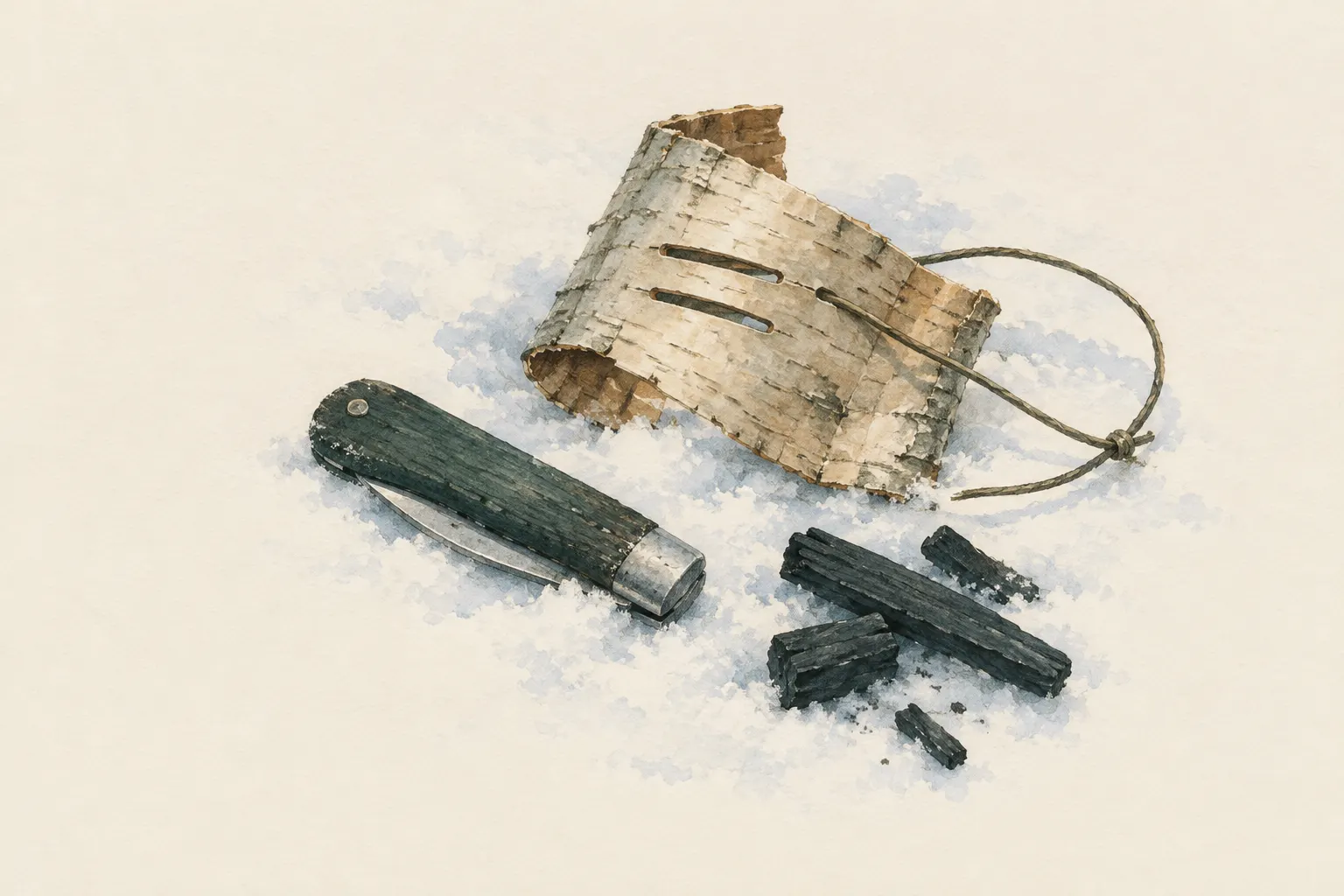
A hand-wide piece of bark from dead wood – or cardboard
Never peel from living trees.
Collect only with the forest owner's permission.
Newspaper and cardboard
Stiff cardboard instead of bark
Flammable – keep away from candles, stoves, heaters and embers.
Loses almost all insulation when wet.
Knife (fixed or locking blade)
Cut away from your body.
Rules on carrying knives differ by region – check local rules.
Accessory cord
Cord or elastic for the back of the head
Use only certified cord after training for life-safety purposes.
The diameter must suit the main rope or friction hitches will not grip.
Charcoal from a campfire
To blacken the inside
Not activated carbon: adsorption capacity is low and unknown.
Barbecue briquettes may contain additives – do not use for water.
Suitable for
- Lost or broken sunglasses on snow
- Glaciers, ice, snowfields
- Bright sand and water
Not suitable for
- Replacing good glacier glasses if you have them
- Difficult terrain – the field of view is restricted
- Driving
Prerequisites
- A piece of bark, cardboard, leather or dense cloth
- A knife
Safety
- Through the slits you see less, especially downwards and to the sides. Walk more slowly, look at the path more often and in steep terrain, near crevasses or drops only take the goggles off when standing still.
- Only take bark from dead or fallen trees. Bark peeled from living trees harms the tree and is forbidden without permission.
How it works
A narrow slit lets only a small part of the light into the eye – and hardly any of the light that comes back at an angle from below and the sides off the snow. The eye still sees almost sharply through the slit, a bit like squinting. A black inside swallows stray light and does not dazzle. This greatly reduces the UV load, even without glass.
Advantages
- Can be made from almost anything
- Light, does not fog up
Disadvantages
- Restricted field of view
- Only a stopgap
Deep knowledge
Background
Inuit, Yupik and other northern peoples have carved snow goggles from wood, bone or ivory for thousands of years. Some were blackened inside and fitted exactly to the wearer's face.
One advantage over glass: slit goggles do not fog up. That is why they still have fans today.
Variants
- From cloth or tape
- A strip of dense cloth, a scarf or two layers of tape with narrow slits also work. Tape can be stuck directly onto broken sunglasses.
- Soot under the eyes
- A little soot under the eyes reduces glare slightly but does not replace eye protection.
Common mistakes
- Thinking of eye protection only when it hurts
- Going without protection when it is cloudy
- Cutting the slits too wide
- Leaving the inside light
- Moving fast through steep terrain with the goggles
Limits and risks
- No tested UV protection
- Good glacier glasses are always better
Material alternatives
Derived from material properties: a substitute must have all relevant properties. Observe the notes on the substitute.
- Birch bark (from dead, fallen wood)
- Dry firewood (Collect only where permitted.), Tinder (Carry in waterproof packaging.), Char cloth (charred cotton) (Store dry in a tin.), Finest-grade steel wool (Store separately from batteries – fire risk.), Fatwood (resin-rich wood) (Collect only dead wood where permitted.), Stove fuel (canister, liquid fuel, alcohol) (Store fuels apart from food and in original containers or bottles intended for them.), Petroleum jelly cotton balls (Use only pure cotton.), Cooking oil or cooking fat (tallow, lard) (Never put out burning fat with water – cover it with a lid to smother it.), Tree resin (spruce, pine) (Resin is flammable and sticks to the skin when hot – melt it only slowly over low heat.)
- Newspaper and cardboard
- Sleeping pad, Dry leaves, grass or conifer boughs (Collect only where allowed; no protected plants. Check for ticks and insects.), Backpack, Dry spare clothing (Carry it in waterproof packaging – wet clothing barely insulates.), Wool blanket / duvet (Keep away from candles, stoves and heaters.), Insulated cool box (Keeps cold only for a limited time; without ice packs or ice it is not a fridge.), Sleeping bag (Do not store compressed long-term; do not pack away damp.), Insulated cooking box (hay box, thermal cooker) (Never put open flame or embers inside – only the hot, closed pot.), Long-stemmed thatch (reed, grass, rushes) (Extremely flammable – no open fire and no sparks nearby.), Pot insulation (pot cosy, beanie or fleece jacket) (Only around a pot that is no longer on the stove – fabric catches fire at the flame.)
- Accessory cord
- Rope (Never use unknown or damaged rope for life-safety purposes.), Paracord (Not a climbing or safety rope.), Thin twine (Low breaking strength – light loads only.), Webbing (tubular webbing) (Inspect knotted webbing before every use.), Jute or sisal twine (bought) (Low strength, absorbs water and rots – light loads and practice only.), Tree straps (Load only within the manufacturer's limits.), Monofilament fishing line (Never leave scraps of line behind: birds and other animals get tangled in them and die slowly. Wind up scraps and take them with you.), Thin, soft wire (brass or galvanised steel) (Wire ends are sharp – protect eyes and fingers when bending), Tow rope or tow strap (Attach only to the towing eyes provided by the manufacturer; never stand next to it under load.)
- Charcoal from a campfire
- Cotton cloth / T-shirt (Removes coarse particles only – no disinfection.), Coffee filter (Does not disinfect.), Gravel
Results come exclusively from structured entries. No improvised instructions are generated.
Sources (2)
- World Health Organization (with WMO, UNEP and ICNIRP) (2002): Global Solar UV Index: A Practical Guide · Snow reflects up to 80 percent of UV radiation; eye protection with side shields on snow
- Headquarters, Department of the Army (USA) (2002): FM 3-05.70 Survival · Improvised eye protection against snow blindness