























Making salt from seawater
Seawater contains salt – and with patience and fuel it becomes table salt for seasoning and preserving. Here you learn to find a clean place to collect water, to let the water settle and filter it, to boil it down in a shallow pan, to dry the damp crystals and to store the salt dry. And one rule always applies: seawater itself is never drunk.
- Several hours boiling down, drying up to a day
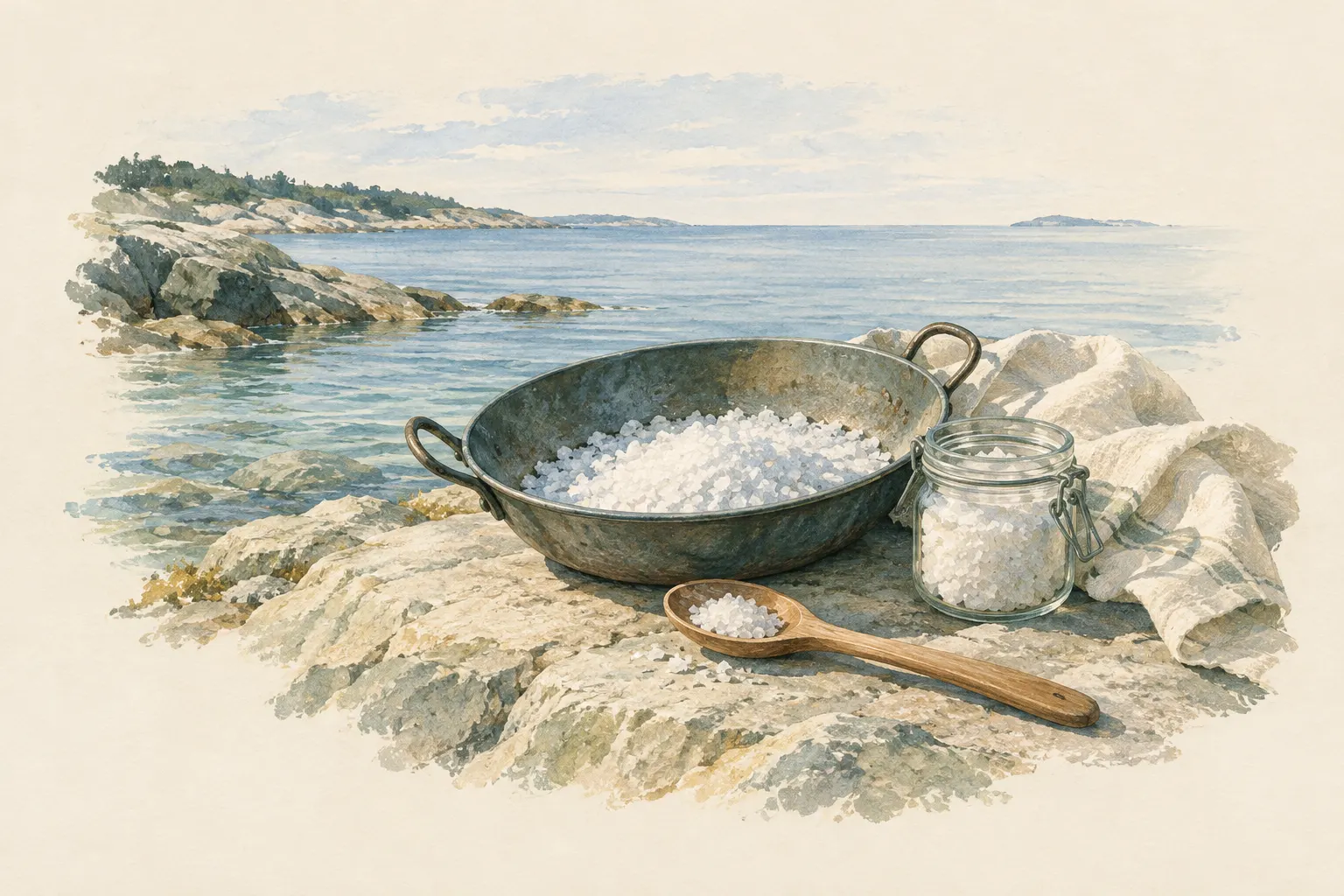
Explained simply
Salt is hidden in seawater. You cannot see it because it is dissolved – like sugar in tea. If you boil seawater for a long time, the water disappears as steam and the salt stays behind in the pan.
In the end you have white crystals, which you dry. You can use them to season food or salt fish.
But: you must never drink seawater. It makes you even thirstier and harms the body.
How it works
Seawater contains about 35 grams of dissolved salts per litre, mostly table salt. When heated, only the water evaporates. The less water remains, the saltier the solution gets, until it cannot hold any more salt – then crystals grow.
Evaporation happens at the surface. A wide, shallow pan has a lot of surface and therefore evaporates much faster than a tall pot. In hot, dry regions even the sun is enough.
What matters
Clean water: everything dissolved in the water stays behind when boiling down – dirt and pollutants too. So only take water from open, clean coasts, far from harbours, river mouths and sewage.
Settle and filter: sand and suspended particles sink to the bottom when left still. A dense cloth catches bits of seaweed.
Gentle at the end: once the solution turns slushy, salt spatters at high heat and burns. Then only warm it gently and let the rest dry in the air.
Safety: what to watch out for
Never drink seawater. The body has to excrete all that salt using its own water and loses more water in the process than it took in.
No algal blooms, no oil film, no foam: some algae produce toxins that do not break down when boiled but become concentrated in the salt.
Salt sparingly: the WHO recommends adults eat less than 5 g of salt a day. Home-made sea salt contains no added iodine.
Step by step
Choose a clean spot
Collect the water on an open, clean coast with clear water, ideally from rocks or a little way out from the shore where no sand gets stirred up. Avoid harbours, river mouths, sewage pipes and places with an oil film, foam or discoloured water.
- 1
Choose a clean spot
Collect the water on an open, clean coast with clear water, ideally from rocks or a little way out from the shore where no sand gets stirred up. Avoid harbours, river mouths, sewage pipes and places with an oil film, foam or discoloured water.
- 2
Let it settle
Let the water stand quietly in a pot or bucket for a few hours. Sand and suspended particles sink to the bottom. Then carefully scoop the clear water off the top.
- 3
Filter through a cloth
Pour the water through a clean, tightly woven cotton cloth so bits of seaweed and fine particles are caught. Folded double it filters better.
- 4
Boil down in a shallow pan
Pour the water into the widest, shallowest pan you have and heat it. Keep it simmering and top up when the level drops. This needs a lot of fuel and time – expect several hours for a few litres.
- 5
When it turns slushy: lower the heat
Towards the end the water turns cloudy and white crystals form at the edge and on the bottom. Now turn the heat right down and only stir gently until a damp salt slush is left. Too much heat makes the salt spatter and burn.
Hot salt spatters – keep your distance.
- 6
Dry
Spread the salt slush on a clean cloth or plate and let it dry completely in the sun or in a warm, dry place. Crush lumps with a spoon. It is done when it pours freely.
- 7
Store dry
Fill the salt into a tight, dry container. Salt attracts moisture and otherwise clumps. A few grains of rice in the jar keep it free-flowing longer.
Common mistakes
- Drinking seawater or "stretching" food with it
- Taking water from a harbour or river mouth
- Using a tall, narrow pot
- Boiling too hot at the end
- Filling damp salt into jars
Quick view
Materials
Wide, shallow pan or metal tray
The wider it is, the faster it evaporates
No aluminium for brine over long periods – it corrodes
Handles get hot
Metal pot (stainless steel, aluminium, titanium)
For collecting and settling
Hot – scalding risk.
Cotton cloth / T-shirt
For filtering
Removes coarse particles only – no disinfection.
Dry firewood
Lots – or a stove with enough fuel
Collect only where permitted.
Airtight food-grade storage container
Fill only when clean and completely dry; never use containers that previously held chemicals.
Suitable for
- Longer stays on the coast
- Salt for seasoning and preserving fish
- Sunny, dry days
Not suitable for
- Getting drinking water – that would need a still that collects condensation
- Harbours, river mouths, sewage outlets, algal blooms
- Fuel shortage – then secure warmth and water first
Prerequisites
- Access to clean seawater
- Enough fuel or a lot of sun
- A safe fire site or a stove
Safety
- Only take water from clean, open coasts – far from harbours, industry, river mouths, sewage plants and boats. After storms, or with an oil film, foam, discolouration or an algal bloom, do not take any water. Toxins and pollutants are not removed by boiling down but concentrated.
- Use salt sparingly. The WHO recommends adults eat less than 5 g of salt a day. Home-made sea salt contains no added iodine.
How it works
One litre of seawater holds about 35 grams of dissolved salts – roughly three teaspoons. When the water is heated, only the water evaporates; the salt stays in the pan. Once so much water has evaporated that the solution is saturated, crystals form. A wide, shallow pan evaporates much faster than a tall pot because more water surface meets the air.
Advantages
- Salt from an almost inexhaustible source
- Simple equipment
- Makes salting fish possible
Disadvantages
- Needs a lot of fuel or time
- Only on clean coasts
- Does not provide drinking water
Deep knowledge
Background
For thousands of years salt was so valuable that trade routes were named after it. In Austria and Bavaria it came from mining and brine springs – places like Hallstatt, Hallein or Bad Reichenhall carry the old word "Hall" for salt in their names. On the coasts it was won from seawater in shallow pans.
The principle is the same today: water evaporates, salt stays. Modern salt works use huge shallow ponds and the sun for this.
Variants
- With the sun only
- On hot, dry days seawater also evaporates in shallow dishes in the sun. It takes days but saves all the fuel. Cover against sand, insects and rain, for example with a fine cloth.
- Salt from rock pools
- In hot regions you sometimes find salt crusts in rock hollows above the tide line. Only take clean, white crusts, dissolve them in a little seawater, filter and boil down as above.
Common mistakes
- Drinking seawater or "stretching" food with it
- Taking water from a harbour or river mouth
- Using a tall, narrow pot
- Boiling too hot at the end
- Filling damp salt into jars
Limits and risks
- No laboratory analysis – pollutants are not tested
- No added iodine
- No instructions for making drinking water from seawater
Material alternatives
Derived from material properties: a substitute must have all relevant properties. Observe the notes on the substitute.
- Metal pot (stainless steel, aluminium, titanium)
- Single-wall stainless steel bottle (Heat only single-wall bottles without paint/plastic; remove the lid before heating.)
- Dry firewood
- Tinder (Carry in waterproof packaging.), Char cloth (charred cotton) (Store dry in a tin.), Finest-grade steel wool (Store separately from batteries – fire risk.), Fatwood (resin-rich wood) (Collect only dead wood where permitted.), Stove fuel (canister, liquid fuel, alcohol) (Store fuels apart from food and in original containers or bottles intended for them.), Petroleum jelly cotton balls (Use only pure cotton.), Cooking oil or cooking fat (tallow, lard) (Never put out burning fat with water – cover it with a lid to smother it.), Tree resin (spruce, pine) (Resin is flammable and sticks to the skin when hot – melt it only slowly over low heat.), Birch bark (from dead, fallen wood) (Never peel from living trees.)
- Airtight food-grade storage container
- Single-wall stainless steel bottle (Heat only single-wall bottles without paint/plastic; remove the lid before heating.), Double-wall insulated bottle (Never heat directly.), PET bottle (clear, max. 2 litres) (Do not heat or place in a fire.), Food-grade water container (Only use containers that never held chemicals or fuel.), Collapsible water container or bag (Protect from sharp objects.), Food-grade water bag (Use only for drinking water, never for chemicals or fuel.), Fermentation jar or crock (Use only food-grade containers of glass, food-safe glazed stoneware or food-grade plastic – no metal containers for acidic food.), Resealable food bags (Use only bags intended for food; do not use with boiling water unless the manufacturer explicitly allows it.)
Results come exclusively from structured entries. No improvised instructions are generated.
Sources (3)
- Headquarters, Department of the Army (USA) (2002): FM 3-05.70 Survival · Never drink seawater
- World Health Organization (WHO): Salt reduction (fact sheet) · Too much salt strains the heart and circulation; adults should eat less than 5 g a day
- U.S. Food and Drug Administration (FDA): Selecting and Serving Fresh and Frozen Seafood Safely · Algal blooms and polluted coastal waters as a health risk