




















Salting and drying fish
With plenty of salt, cold and wind, fresh fish can be kept for days to weeks – as fishermen have done with klipfish for centuries. Here you learn to use only truly fresh fish, to open it cleanly, split it flat, layer it generously with dry salt, let it drain, dry it in a cool, airy place, and soak and cook it thoroughly before eating. It does not work warm, damp or with too little salt – then you eat instead of storing.
- Preparation 30–60 minutes, salting 1–3 days, drying several days
Explained simply
Fresh fish spoils quickly. That is why fishermen on cold coasts used a trick hundreds of years ago: they covered the fish thickly with salt and then dried it in the cold wind.
The salt draws the water out of the fish. Without water, bacteria can hardly grow. So the fish keeps much longer.
Before eating salt fish, you soak it in water for a long time so it is not too salty, and cook it right through. And it only works if it is cool and you use a lot of salt.
How it works
Salt attracts water. If fish lies in plenty of dry salt, water moves out of the cells and runs off as brine. At the same time salt penetrates the flesh and binds the remaining water. Most bacteria cannot grow in such a salty environment.
Then the wind dries the surface. Cool temperatures slow any remaining germs. Only the combination of salt, cold and air makes salt fish keep.
What matters
Freshness: only salt on the day of the catch and only perfect fish. What already smells does not get better with salt.
Plenty of salt and even thickness: score thick parts, open out flat, cover every spot with salt. Too little salt is the most common mistake.
Cool and airy: salting and drying happen in a cool, shady, windy place, protected from rain and flies. In warm, muggy weather it does not work – then rather cook and eat the fish at once.
Safety: what to watch out for
Botulism: the toxin of the bacterium Clostridium botulinum forms without air, in warmth and with too little salt. So never pack half-dry fish airtight in foil or jars. Warning signs such as double vision, drooping eyelids, speech or swallowing problems are an emergency: call 112 at once.
Cooking: salt does not kill all germs and parasites. Salt fish is soaked and cooked through completely until it is opaque and flakes easily.
Fishing law: without a fishing licence and permission, fishing in Germany and Austria is fish poaching.
Step by step
Only take very fresh fish
Salt the fish on the day it is caught. Check eyes, gills, smell and firmness. Keep it cool in the shade, in wet moss or in cold water in a net until you process it.
- 1
Only take very fresh fish
Salt the fish on the day it is caught. Check eyes, gills, smell and firmness. Keep it cool in the shade, in wet moss or in cold water in a net until you process it.
- 2
Gut and clean
Gut the fish, remove the gills and the dark kidney along the spine and rinse it with clean, cold water. Work on a clean surface and wash your hands afterwards.
- 3
Split it flat
Cut larger fish open along the back or belly so they open out flat, or cut fillets. Score thick parts so the salt penetrates equally deep everywhere. Small fish stay whole.
- 4
Layer in plenty of salt
Scatter a layer of coarse salt into a box, a bucket or onto a rimmed board. Lay the fish skin side down on it and cover it completely with salt, then the next layer. Do not skimp: every spot must be covered with salt.
Too little salt is the most common mistake.
- 5
Leave cool and drain
Put the fish in a cool, shady place. A lot of brine comes out – pour it away or let it run off. After one to three days, depending on thickness, the flesh is firm and salted through.
- 6
Dry airily and coolly
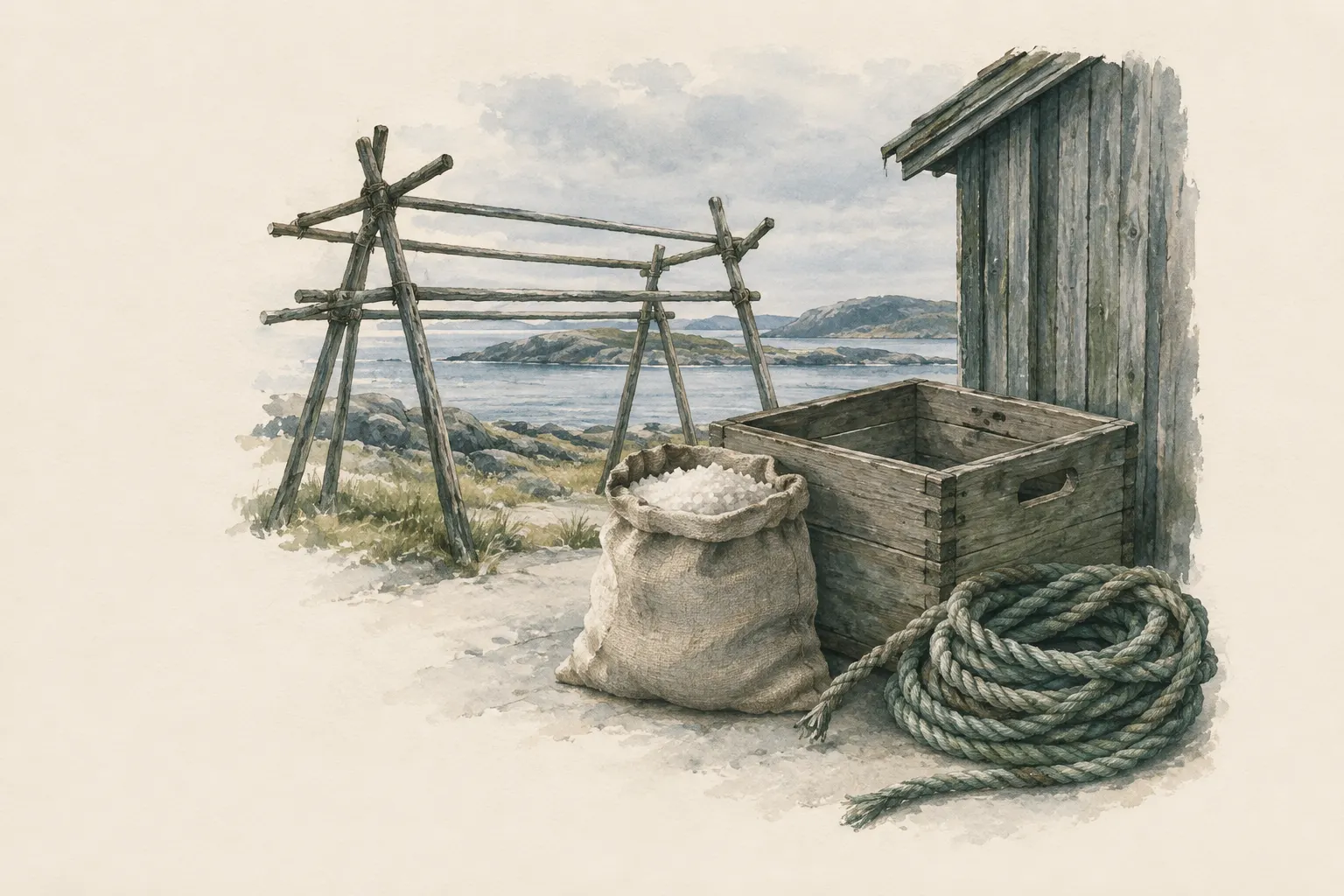
Brush off the coarse salt and hang the fish on a rack in a shady, airy place, protected from rain. Cover it with a fine cloth against flies. It is done when it feels dry and stiff; in cool, windy weather that takes several days.
- 7
Soak and cook before eating
Soak the salt fish in cold water before cooking and change the water several times until it only tastes pleasantly salty. Then cook it through completely in soup, stew or in the pan. If it smells rotten or shows mould, throw it away.
Common mistakes
- Too little salt
- Salting in warm weather
- Using fish that is not completely fresh
- Packing half-dry fish airtight
- Eating salt fish unsoaked and uncooked
- Fishing without a licence
Quick view
Materials
Knife (fixed or locking blade)
Cut away from your body.
Rules on carrying knives differ by region – check local rules.
Table salt
Plenty, coarse and dry
Salt improves keeping quality but does not replace heating through.
Galvanised bucket
Or a box, a rimmed board or a pot for layering
Do not heat: the zinc coating can release harmful fumes when heated.
Fine cloth or muslin net against flies
Against flies while drying
Keep clean and dry; do not hang it over the flames.
Sturdy sticks / poles
For a drying rack
Do not cut live wood where prohibited.
Metal pot (stainless steel, aluminium, titanium)
For soaking and cooking
Hot – scalding risk.
Suitable for
- More fish than can be eaten at once
- A cool, windy, dry season
- A coast with salt or salt you brought
Not suitable for
- Warm, muggy weather
- Fish that is no longer completely fresh
- Packing half-dry fish airtight – risk of botulism
- Oily fish such as mackerel without experience – they go rancid quickly
Prerequisites
- Legally caught or bought, very fresh fish
- Able to gut fish
- Cool weather or a cool room
Safety
- Salting does not kill all germs and parasites. Soak salt fish before eating and cook it through completely until the flesh is opaque and flakes easily.
- Fishing in Germany and Austria needs a fishing licence and the permission of the holder of the fishing rights. Without both it is fish poaching.
How it works
Salt draws water out of the fish flesh and binds the remaining water so tightly that most bacteria can no longer grow. Cool temperatures slow them further, and wind dries the surface before mould forms. All three together – plenty of salt, cold, air – make salt fish keep. If one is missing, it spoils.
Advantages
- Makes a large catch keep
- Needs no refrigeration when completely dry
- Proven, ancient method
Disadvantages
- Needs a lot of salt
- Only works cool and airy
- Must be soaked for a long time before eating
- Mistakes can be dangerous
Deep knowledge
Background
Klipfish – cod salted and dried on rocks – was one of the most important trade goods of northern Europe for centuries. As "bacalhau" or "baccalà" it is still a festive dish in Portugal, Spain and Italy today.
Botulism is rare but life-threatening. The toxin forms without air, in warmth and with too little salt or acid. Home-preserved fish and meat are among the known sources.
Variants
- Briefly in brine before smoking
- For fish that will soon be smoked and eaten, a short brine is enough. It makes it tastier and firmer, but does not make it keep for long.
- Stockfish without salt
- In very cold, dry and windy climates lean fish is also dried on racks without salt. This only works at temperatures just above freezing and constant wind.
Common mistakes
- Too little salt
- Salting in warm weather
- Using fish that is not completely fresh
- Packing half-dry fish airtight
- Eating salt fish unsoaked and uncooked
- Fishing without a licence
Limits and risks
- No exact salt quantities and times – they depend on fish, thickness and weather
- For real home storage use tested instructions
- No instructions for fermented fish
Material alternatives
Derived from material properties: a substitute must have all relevant properties. Observe the notes on the substitute.
- Galvanised bucket
- Single-wall stainless steel bottle (Heat only single-wall bottles without paint/plastic; remove the lid before heating.), Double-wall insulated bottle (Never heat directly.), PET bottle (clear, max. 2 litres) (Do not heat or place in a fire.), Food-grade water container (Only use containers that never held chemicals or fuel.), Used chemical or fuel container (Never for drinking water or food – residues cannot be reliably removed.), Waterproof case or bag, Airtight food-grade storage container (Fill only when clean and completely dry; never use containers that previously held chemicals.), Wildlife-resistant food container (Where specific containers are required, use only approved models – check local rules.), Small metal tin with lid (Burn off coated or painted tins outdoors first.), Collapsible water container or bag (Protect from sharp objects.), Food-grade water bag (Use only for drinking water, never for chemicals or fuel.), Fermentation jar or crock (Use only food-grade containers of glass, food-safe glazed stoneware or food-grade plastic – no metal containers for acidic food.), Resealable food bags (Use only bags intended for food; do not use with boiling water unless the manufacturer explicitly allows it.), Bucket with a lid or a sealed bag (Never transport live invasive crayfish – only ones already killed)
- Fine cloth or muslin net against flies
- Cotton cloth / T-shirt (Removes coarse particles only – no disinfection.)
- Metal pot (stainless steel, aluminium, titanium)
- Single-wall stainless steel bottle (Heat only single-wall bottles without paint/plastic; remove the lid before heating.)
Results come exclusively from structured entries. No improvised instructions are generated.
Sources (5)
- Bundesinstitut für Risikobewertung (BfR) (2023): Selten, aber vermeidbar: Fragen und Antworten zum Botulismus · Botulism from inadequately preserved food; toxin forms without air; warning signs
- U.S. Food and Drug Administration (FDA): Selecting and Serving Fresh and Frozen Seafood Safely · Recognising fresh fish: smell, eyes, gills, firmness
- United States Department of Agriculture – Food Safety and Inspection Service (USDA FSIS): Safe Minimum Internal Temperature Chart · Cook fish completely
- University of Georgia / National Center for Home Food Preservation (USA): National Center for Home Food Preservation – tested guidance on drying and preserving food · Tested guidance on preserving fish
- Headquarters, Department of the Army (USA) (2002): FM 3-05.70 Survival · Preserving fish by salting, drying and smoking