























Shelter in the tropics: a leaf roof over a raised bed
In the rainforest it rains almost every day, and the ground is wet and full of ants, scorpions and leeches. Anyone who has to spend the night there sleeps not on the ground but above it – under a steep roof the water runs off quickly. Here you learn to find a safe spot with no dead branches above you, build a ridge roof of poles, thatch it with large leaves like tiles, lay a bed knee-high above the ground and protect yourself from mosquitoes with a net.
- 2–3 hours
Explained simply
In the rainforest it often rains, and ants and other animals crawl about on the ground. That is why you do not sleep on the ground there, but on a bed of poles as high as your knee.
Above it goes a steep roof of large leaves. You lay them from bottom to top like roof tiles, then the rain runs off.
Before building you look up to check whether dead branches could fall. And you always sleep under a mosquito net.
How it works
Water runs off a steep surface faster than it can seep through. Because each row of leaves overlaps the one below, the rain trickles down from leaf to leaf and drips off outside.
The raised bed keeps you off the wet ground and lets air flow underneath. Ants, leeches and other crawling animals reach you less easily.
What matters
Steep roof: the steeper, the tighter.
Overlap: each row of leaves covers half of the one below.
Site: slightly raised, away from streams, with no dead branches above.
Safety: what to watch out for
Falling branches: the most common accident in a rainforest camp. Always look up first.
Floods: streams rise very quickly after rain.
Mosquitoes and animals: mosquito net, shake out shoes, check wood before touching. Clean cuts at once.
Step by step
Check the site
Look for slightly raised, level ground away from streams. Look up: no dead branches, no dead trees. On the ground: no ant trails, no animal paths.
Caution: Look up before you build.
- 1
Check the site
Look for slightly raised, level ground away from streams. Look up: no dead branches, no dead trees. On the ground: no ant trails, no animal paths.
Look up before you build.
- 2
Set up the frame
Ram four forked posts into the ground or use two trees. Lay a ridge pole across at about head height and tie it firmly.
- 3
Lean the rafters
Lean poles steeply against the ridge pole on both sides and tie cross-poles onto them a hand-span apart. The steeper, the better the rain runs off.
- 4
Thatch with leaves
Lay large leaves starting at the bottom like roof tiles on the cross-poles, each row overlapping the one below by half. Palm fronds can be split lengthwise and hung over the cross-poles.
- 5
Build the raised bed
Under the roof tie two long poles knee-high to the posts and lay cross-poles or bamboo close together on top. On top, a layer of leaves as padding.
- 6
Hang the mosquito net
Hang the mosquito net from the ridge pole and tuck the edges under the sleeping platform so no mosquitoes get in.
- 7
Drain the water
Scrape a shallow channel round the camp so rainwater flows past. Hang your luggage high on the poles, not on the ground.
Common mistakes
- Building under dead branches
- Camping right by the stream
- Roof too flat – it drips through
- Sleeping on the ground
- Sleeping without a mosquito net
Quick view
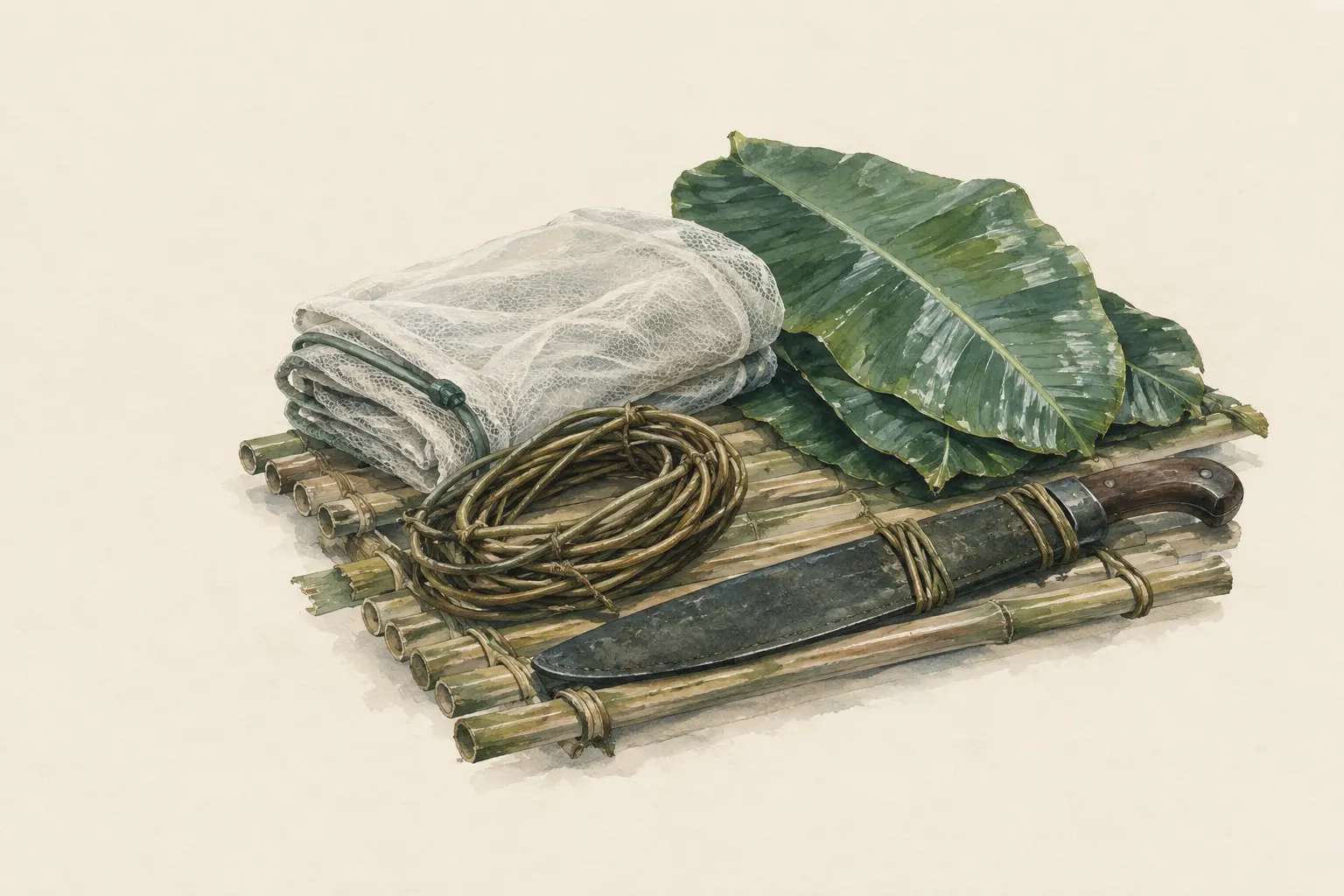
Materials
Sturdy sticks / poles
Strong poles for posts, ridge and bed frame; bamboo is ideal
Do not cut live wood where prohibited.
Large leaves (palm fronds, banana leaves)
Many large leaves for the roof
Check for thorns, ants, spiders and snakes before touching.
Only use fallen fronds or cut them with permission.
Jute or sisal twine (bought)
Or paracord, vines, bark for the lashings
Low strength, absorbs water and rots – light loads and practice only.
Mosquito net
Essential against mosquitoes
Flammable – keep away from flames.
Use treated nets as directed by the manufacturer.
Tarp
Replaces the leaf roof
Sturdy work gloves
When handling flood mud or chemicals, also wear waterproof gloves.
Suitable for
- Rainforest and humid tropics
- A longer stay in one place
- Waiting for rescue in the jungle
Not suitable for
- Riverbanks and hollows – floods
- Beneath dead trees or branches
- Animal trails and ant trails
Prerequisites
- Knife or machete and practice with it
- Permission to cut material where required
Safety
- Check wood and leaves for ants, spiders, scorpions and snakes before touching them. Shake out shoes in the morning. Always sleep under a mosquito net – mosquitoes transmit malaria and dengue.
- Swing a machete or knife away from your body with nobody in range. Cuts get infected quickly in the tropics: clean and cover them at once.
How it works
A steep roof lets water run off quickly before it gets through the leaves. The leaves are laid like roof tiles from bottom to top, each row overlapping the one below. A bed knee-high above the ground keeps you dry and away from ants and crawling animals, and lets air flow underneath, which cools in the humid heat.
Advantages
- Dry above the wet ground
- Protection from crawling animals
Disadvantages
- A lot of work
- Needs many leaves and poles
Deep knowledge
Background
In many tropical countries houses on stilts with steep roofs of palm leaves have been common for centuries – they stay dry and cool and protect against floods and animals.
Military jungle training teaches as its first rule: never sleep on the ground.
Variants
- Hammock with tarp
- A hammock with a built-in net and a tarp above it is the quickest solution if you have them with you.
- Lean-to
- With little time, a one-sided, steep lean-to of leaves over the raised bed is enough.
Common mistakes
- Building under dead branches
- Camping right by the stream
- Roof too flat – it drips through
- Sleeping on the ground
- Sleeping without a mosquito net
Limits and risks
- No identification of poisonous plants and animals
- No medical advice on tropical diseases
Material alternatives
Derived from material properties: a substitute must have all relevant properties. Observe the notes on the substitute.
- Jute or sisal twine (bought)
- Rope (Never use unknown or damaged rope for life-safety purposes.), Paracord (Not a climbing or safety rope.), Thin twine (Low breaking strength – light loads only.), Accessory cord (Use only certified cord after training for life-safety purposes.), Webbing (tubular webbing) (Inspect knotted webbing before every use.), Tree straps (Load only within the manufacturer's limits.), Monofilament fishing line (Never leave scraps of line behind: birds and other animals get tangled in them and die slowly. Wind up scraps and take them with you.), Thin, soft wire (brass or galvanised steel) (Wire ends are sharp – protect eyes and fingers when bending), Tow rope or tow strap (Attach only to the towing eyes provided by the manufacturer; never stand next to it under load.)
- Mosquito net
- Cotton cloth / T-shirt (Removes coarse particles only – no disinfection.), Sterile dressings and bandages (Open sterile packaging only immediately before use; observe the expiry date.), Fine cloth or muslin net against flies (Keep clean and dry; do not hang it over the flames.)
- Tarp
- Plastic sheet / large bin bag (Tears easily; never pull over the head (suffocation risk).), Emergency blanket (Tears easily once punctured; short-term shelter only.), Document folder (waterproof) (Store securely – contains sensitive personal data.), Rain poncho (When used as a shelter, it no longer protects your body from rain.), Bivy bag (Never fully close off the face.), Tent (Do not cook or heat inside the tent (fire and carbon monoxide danger).), Heavy-duty bin bag (large) (Suffocation risk: never pull plastic bags over the head or face and keep them away from small children.), Group shelter bag (Airtight – ventilate regularly.)
Results come exclusively from structured entries. No improvised instructions are generated.
Sources (2)
- Centers for Disease Control and Prevention: CDC Yellow Book: Health Information for International Travel · In the tropics protect against mosquitoes: net, clothing, repellent
- Headquarters, Department of the Army (USA) (2002): FM 3-05.70 Survival · Jungle shelters: sleep raised, steep roof, site away from water