











Rendering fat: making tallow and lard yourself
Slow heating turns raw animal fat into clean fat that keeps for months: beef tallow sets hard, pork lard stays spreadable. It is used for cooking and frying, for pemmican, as lamp fat and for caring for leather. Here you learn to choose the right fat, cut it small, render it over low heat, strain it, fill it into jars and store it – and how to prevent a fat fire and put one out correctly.
- 2–4 hours over low heat, plus cooling
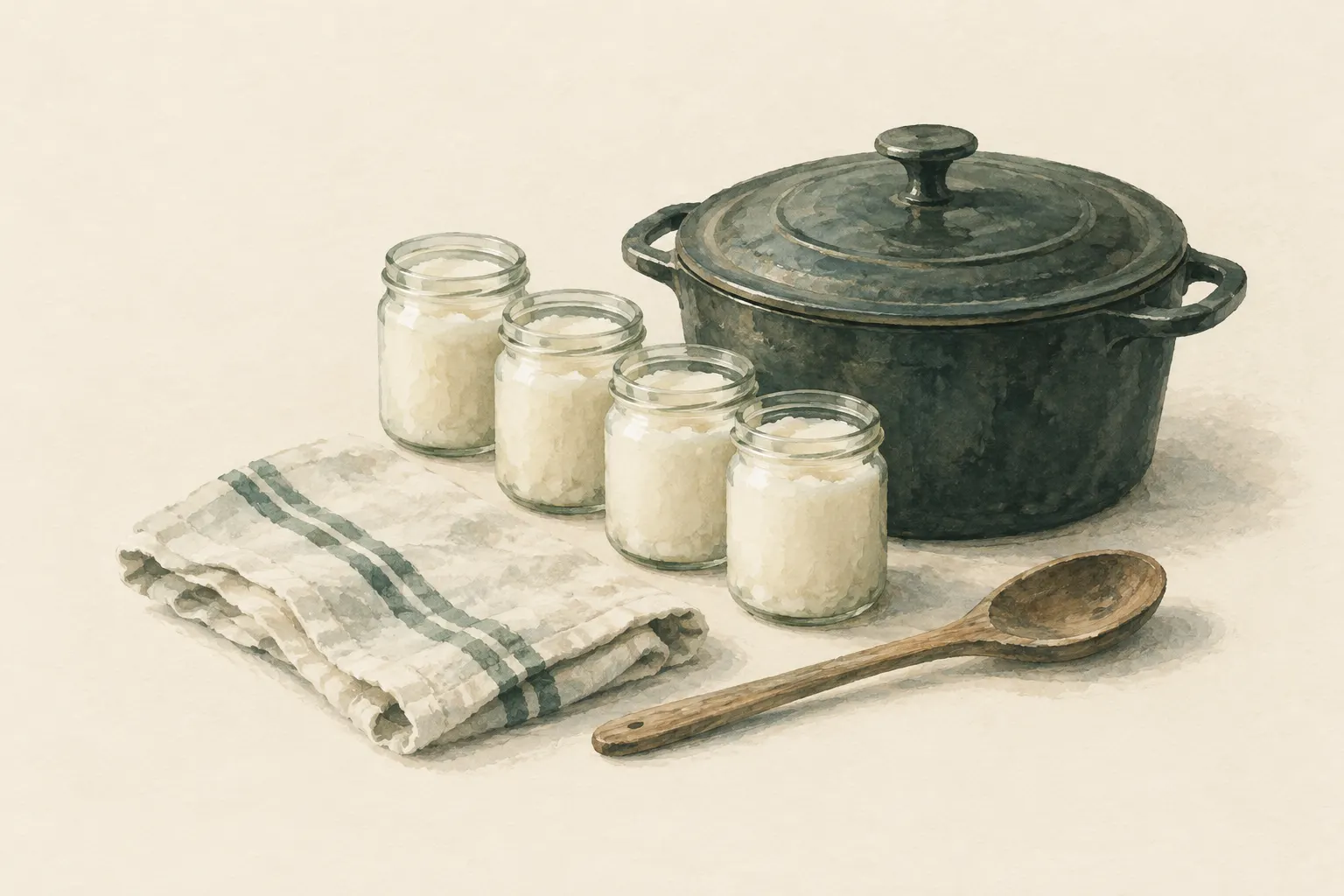
Explained simply
Raw animal fat from the butcher looks like white, soft lumps. When you heat it very slowly, the fat melts out, and small crispy bits remain, the cracklings.
You pour the liquid fat through a cloth into jars. As it cools it sets: beef tallow very hard, pork lard creamy. That way it keeps for many months and you can cook with it, fill lamps or care for leather.
Hot fat is dangerous. If it catches fire, never put water on it – put a lid on instead.
How it works
Raw fat consists of tiny fat cells in a net of connective tissue, plus some water. Over gentle heat the cells burst, the fat runs out and collects in the pot. The water gradually evaporates, the tissue shrinks into cracklings.
Finished, strained fat contains practically no water and no protein remains. So bacteria find hardly any food in it. Over time, however, fat reacts with oxygen and goes rancid – cold and darkness slow that down.
What matters
Cut small and heat slowly: small cubes melt evenly. Too much heat burns the tissue, makes the fat dark and bitter and raises the fire risk. Quiet bubbling is right, smoke is too much.
Work dry: jars, spoons and cloths must be dry. Water in hot fat spatters, water in the finished fat makes it go mouldy.
Cool first, then close: a lid on hot fat collects condensation.
Safety: what to watch out for
Fat fire: water sinks to the bottom in hot fat, turns to steam in a fraction of a second and throws burning fat out as a jet of flame. So always have a suitable lid ready. If it burns, lid on, heat off, and wait until everything has cooled.
Burns: liquid fat is much hotter than boiling water. Cool burnt skin at once with cool running water; for large areas, the face or children, call emergency services.
Only use fresh fat from a legal source, never from animals found dead.
Step by step
Choose the right fat
For hard tallow, kidney fat from beef, sheep or deer is best; for soft lard, back fat or belly fat from pork. The fat should be fresh, white to cream-coloured and without an off smell. Ask a butcher – raw fat is often cheap or even free.
- 1
Choose the right fat
For hard tallow, kidney fat from beef, sheep or deer is best; for soft lard, back fat or belly fat from pork. The fat should be fresh, white to cream-coloured and without an off smell. Ask a butcher – raw fat is often cheap or even free.
- 2
Cut it small
Remove bits of meat and blood and cut the fat into small cubes, about the size of a sugar cube. Well-chilled fat is easier to cut. The smaller the pieces, the faster and more evenly it melts.
- 3
Start with a little water
Put the cubes into a heavy pot and add a small splash of water, just enough to cover the base. The water stops the first pieces from burning before fat comes out. It evaporates completely later.
- 4
Render slowly over low heat
Heat the pot gently, without a lid, and stir now and then. The fat should bubble quietly, never smoke. Bit by bit the pieces shrink and turn golden brown, and clear fat collects. Depending on the amount this takes two to four hours.
Never leave it unattended. Keep a lid within reach.
- 5
Strain
Take the pot off the heat when the cracklings are golden brown and hardly any bubbles rise. Let it cool a little for a moment. Then pour the fat slowly through a clean cotton cloth or a fine sieve into a heat-proof container.
- 6
Fill into clean, dry jars
Fill the still liquid fat into clean, completely dry jars and let it cool uncovered before closing the lid. Tallow sets hard and white, lard creamy. Label the jars with the type of fat and the date.
- 7
Store and use the cracklings
Store the fat cool and dark; in a fridge or cellar it keeps for many months. If it smells sharp, soapy or stale, it is rancid and is thrown away. You can salt the cracklings and eat them straight away or use them in bread and fried potatoes – they only keep a few days.
Common mistakes
- Too much heat – the fat smokes and turns bitter
- Leaving the pot unattended
- Putting out burning fat with water
- Using damp jars
- Large pieces that burn outside and stay raw inside
- Closing the lid while the fat is hot
Quick view
Materials
Raw animal fat (beef suet, kidney fat, pork back fat)
Only fresh and from a butcher, hunter or own livestock
Keep cool and process soon
Knife (fixed or locking blade)
Cut away from your body.
Rules on carrying knives differ by region – check local rules.
Metal pot (stainless steel, aluminium, titanium)
Heavy pot with a thick base
Hot – scalding risk.
Cotton cloth / T-shirt
For straining
Removes coarse particles only – no disinfection.
Airtight food-grade storage container
Clean, heat-proof jars with lids
Fill only when clean and completely dry; never use containers that previously held chemicals.
Fitting lid for pan or pot
Within reach – in case of a fat fire
If fat catches fire, put the lid on at once and turn off the heat – never water.
Tilt the lid away from you when lifting it so the steam does not rise into your face.
Suitable for
- A store of cooking and frying fat
- Basis for pemmican, fat lamps and leather care
- Using leftovers from a butcher or your own slaughter
Not suitable for
- Cooking inside a tent or closed room without ventilation
- Cooking unattended
- Fat from animals found dead
Prerequisites
- Fresh raw fat from a legal source
- A calm, stable cooking place
- Time to watch the pot the whole time
Safety
- Fat and jars must be dry. Water in hot fat spatters, and leftover water in the finished fat makes it go mouldy.
- Only use meat, fat, hides, sinew and bone from a legal source: from a hunter, a butcher, your own livestock or a shop. Killing or trapping game yourself is only allowed with hunting rights in Germany and Austria. Never use animals found dead – the cause of death is unknown.
How it works
Raw fat consists of fat cells, connective tissue and some water. Over gentle heat the cells burst, the fat runs out, the water evaporates and the tissue remains as crisp cracklings. Strained, water-free fat offers germs hardly any food and therefore keeps a long time. Too much heat burns the tissue, darkens the fat and makes it taste bitter.
Advantages
- Turns leftovers into a long-keeping store
- Versatile: cooking, pemmican, light, leather care
- Simple equipment
Disadvantages
- Takes hours
- Smell while rendering
- Risk of fire and burns
Deep knowledge
Background
Tallow and lard used to be a store, cooking fat, light source and care product all at once in every household. Tallow candles lit farmhouse rooms before paraffin came along. Cracklings, called "Grammeln" in Austria, are still a speciality in Austria and Bavaria today.
Burning fat is one of the most common causes of kitchen fires. The reason is physics: water sinks to the bottom in hot fat, turns to steam instantly and carries burning fat upwards as a fireball.
Variants
- In the oven
- At home it is easier in the oven at a low temperature in an open roasting tin. The heat is more even and there is less spattering.
- As lamp fat
- Hard tallow is suitable for a simple fat lamp or tallow light. It smokes more than wax but burns steadily.
Common mistakes
- Too much heat – the fat smokes and turns bitter
- Leaving the pot unattended
- Putting out burning fat with water
- Using damp jars
- Large pieces that burn outside and stay raw inside
- Closing the lid while the fat is hot
Limits and risks
- No exact shelf life
- No temperature figures for every fat
- Soap making not described – lye is caustic
Material alternatives
Derived from material properties: a substitute must have all relevant properties. Observe the notes on the substitute.
- Metal pot (stainless steel, aluminium, titanium)
- Single-wall stainless steel bottle (Heat only single-wall bottles without paint/plastic; remove the lid before heating.)
- Airtight food-grade storage container
- Single-wall stainless steel bottle (Heat only single-wall bottles without paint/plastic; remove the lid before heating.), Double-wall insulated bottle (Never heat directly.), PET bottle (clear, max. 2 litres) (Do not heat or place in a fire.), Food-grade water container (Only use containers that never held chemicals or fuel.), Collapsible water container or bag (Protect from sharp objects.), Food-grade water bag (Use only for drinking water, never for chemicals or fuel.), Fermentation jar or crock (Use only food-grade containers of glass, food-safe glazed stoneware or food-grade plastic – no metal containers for acidic food.), Resealable food bags (Use only bags intended for food; do not use with boiling water unless the manufacturer explicitly allows it.)
Results come exclusively from structured entries. No improvised instructions are generated.
Sources (4)
- World Health Organization (WHO) (2006): Five Keys to Safer Food Manual · Work cleanly, store food safely
- U.S. Department of Agriculture, Food Safety and Inspection Service (USDA FSIS): Molds on Food: Are They Dangerous? · Throw away mouldy food
- European Resuscitation Council – Resuscitation (journal) (2021): European Resuscitation Council Guidelines 2021: First Aid · Cool burns at once with cool running water; call emergency services for severe burns
- Ray Mears – Hodder & Stoughton (2002): Bushcraft · Animal fat as a valuable raw material for food and light