























Preserving a hide or pelt and smoke-tanning it
A fresh hide spoils within hours; a tanned one lasts a lifetime. Without chemicals this works with a method thousands of years old: flesh the hide, preserve it with salt or by drying, soak it in a fat emulsion of egg yolk or soap and oil, pull it soft while it dries, and finally smoke it so it stays soft after getting wet. Here you learn every step – and why hygiene and a legal source come first.
- Several days with breaks; softening alone takes a few hours at a stretch
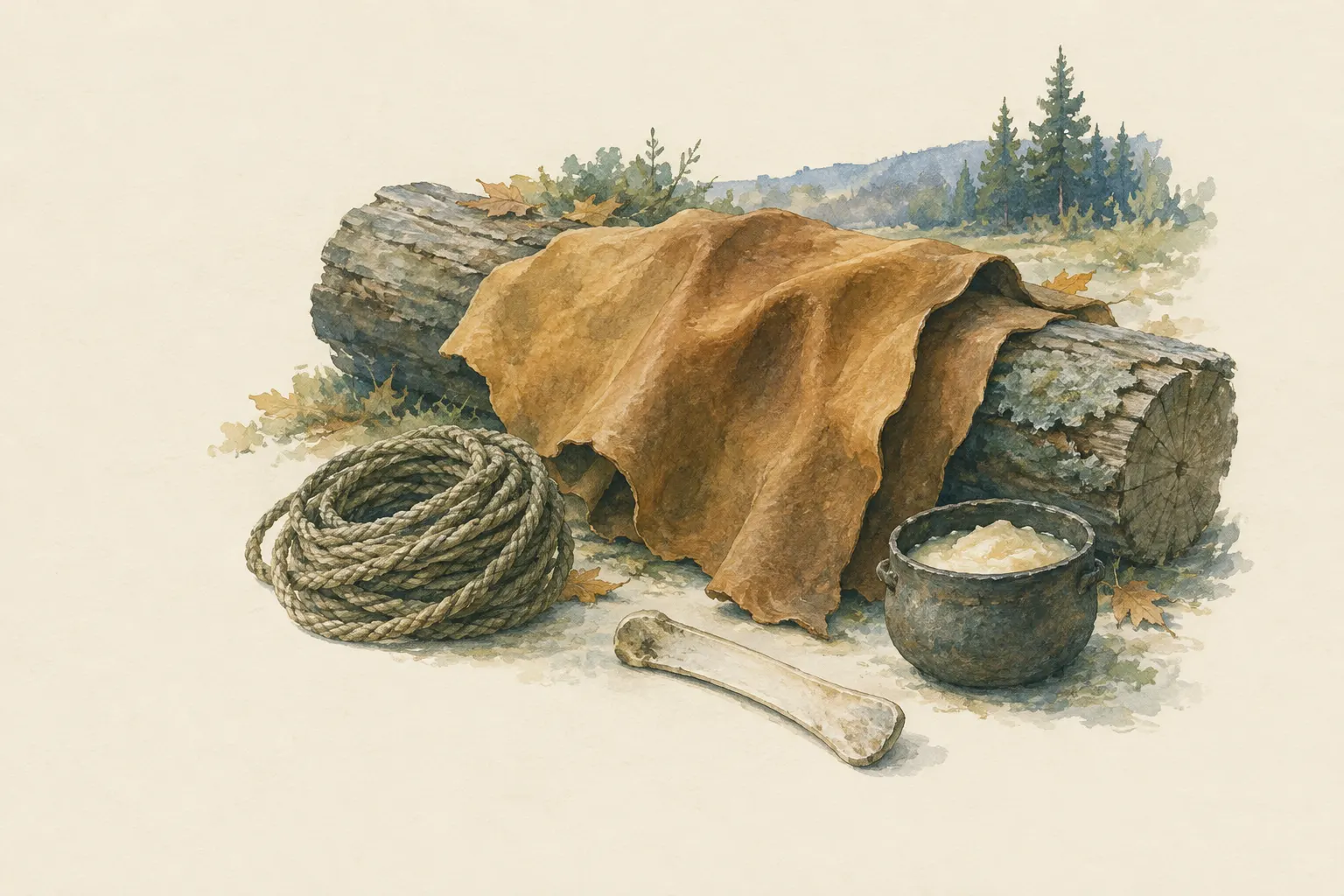
Explained simply
An animal's skin starts to rot after a few hours. If you simply dry it, it turns rock hard. To turn it into soft leather, you have to tan it.
First you scrape off all the meat and fat. Then you soak the hide in a mixture of egg yolk or soap with oil. After that you pull and stretch it for hours until it is dry – that way it stays soft. Finally you hang it in smoke so it stays soft even after rain.
Because fresh hides can transmit diseases, you always work with gloves and only take hides from a hunter or butcher.
How it works
Hide is made of a dense mesh of protein fibres. If it dries untreated, the fibres glue together and hard rawhide results. The fat emulsion of egg yolk or soap with oil penetrates between the fibres and lubricates them. If the hide is constantly stretched while drying, the fibres cannot stick together.
Smoke contains substances that cross-link the fibres further. Without smoke the leather would dry stiff again after the first rain; with smoke it stays soft and gets its golden brown colour.
What matters
Flesh thoroughly: every bit of fat or meat rots later and stops the tanning emulsion from penetrating. Scrape with the blunt back, do not cut.
Keep going while softening: this is the hardest part. The hide must be worked until it is really completely dry. If you stop too early you get hard spots – these can be dampened again and reworked.
Cool smoke: the hide should get smoke but no heat. A small, smouldering fire of punky wood in a pit is ideal.
Safety: what to watch out for
Pathogens: fresh hides of hares and rabbits can transmit tularaemia. Wear gloves, cover wounds, do not touch your face and wash thoroughly afterwards.
No fox pelts: eggs of the fox tapeworm can cling to fox fur. They cause a severe liver disease that is often only noticed years later.
Fire: never walk away while smoking and never smoke inside tents or rooms – carbon monoxide is invisible and odourless.
Step by step
Hide from a safe source, gloves on
Ask a hunter or butcher for a fresh hide from roe deer, red deer, sheep or goat. Process it the same day or keep it cool. Wear gloves for every step on the fresh hide and work outdoors.
- 1
Hide from a safe source, gloves on
Ask a hunter or butcher for a fresh hide from roe deer, red deer, sheep or goat. Process it the same day or keep it cool. Wear gloves for every step on the fresh hide and work outdoors.
- 2
Flesh it
Lay the hide fur side down over a smooth, sloping log or board. Use the blunt back of a knife or a scraper to scrape off all bits of meat and fat and the thin membrane beneath – always away from your body. Fat and meat that remain will rot later.
Do not cut through the hide – holes tear further.
- 3
Salt it or dry it stretched
Scatter fine salt thickly over the flesh side, roll the hide up and let it drain in a cool place for one to two days. Or lace it into a wooden frame and let it dry in the shade into hard rawhide. That way you can tan it later at your leisure.
- 4
Soak in the tanning emulsion
First soak dried or salted hide in clean water until it is soft again, and wring it out. Then whisk egg yolk with lukewarm water, or dissolve plain soap in warm water and add some cooking oil. Work the emulsion into the hide and let it steep in it for a few hours.
- 5
Pull it soft as it dries
Wring out the hide and stretch it in every direction, over a taut rope, the back of a chair or a post. Keep going until it is completely dry – often several hours. If you stop too early, it goes hard in those places. Dampen hard spots again and keep working.
Do not stop before it is completely dry.
- 6
Smoke it
Sew or clip the hide into a bag and hang it with the opening over a small, smouldering fire of dry, punky wood, for example in a pit. The smoke should pass through the hide without heat or flames reaching it. After half an hour to an hour per side it is evenly light to golden brown.
No flames, no heat on the hide.
- 7
Air it, care for it, use it
Let the leather air for a few days so the smoky smell fades. If it gets wet, let it dry slowly and knead it a little as it does. A little tallow keeps it supple. Finally, wash your hands, tools and work place thoroughly.
Common mistakes
- Working without gloves
- Leaving bits of meat and fat on the hide
- Cutting through the hide
- Stopping softening too early
- Letting the hide get too hot while smoking
- Processing fox pelts yourself
Quick view
Materials
Fresh hide or fresh pelt
Only from a hunter, butcher or own livestock – never from animals found dead or from foxes
Always work with gloves
Disposable gloves
For all work on the fresh hide
Consider latex allergies – prefer latex-free gloves (e.g. nitrile).
Knife (fixed or locking blade)
Blunt back or a scraper for fleshing
Cut away from your body.
Rules on carrying knives differ by region – check local rules.
Table salt
Plenty of fine salt
Salt improves keeping quality but does not replace heating through.
Galvanised bucket
For soaking
Do not heat: the zinc coating can release harmful fumes when heated.
Fresh eggs (short trips only)
Egg yolk for the tanning emulsion
Raw eggs can carry salmonella – only use clean eggs without cracks and always cook them right through.
Carry them cool (cool bag, shade) and use them on the first day; for longer trips take whole-egg powder.
Allergen: egg. Wash your hands after cracking eggs.
Soap / detergent
Plain soap with cooking oil as an alternative to egg yolk
Rinse drinking-water containers thoroughly after cleaning.
Rope
For stretching and softening
Never use unknown or damaged rope for life-safety purposes.
Sturdy sticks / poles
Frame and smoking poles
Do not cut live wood where prohibited.
Suitable for
- Hides of roe deer, red deer, sheep, goat or rabbit
- Soft leather for pouches, straps and clothing
- Warm pelts as a seat mat
Not suitable for
- Foxes and other predators – danger from the fox tapeworm
- Animals found dead
- Protected species
- Working with chrome salts, lye or lime – caustic and toxic
Prerequisites
- A hide from a legal source (hunter, butcher, own livestock)
- An outdoor place where smell does not bother anyone
- Several days' time
Safety
- When smoking, keep the fire small and smouldering and never leave it unattended. The hide must not get hot – it shrinks and turns hard. Do not smoke inside tents or closed rooms: carbon monoxide.
- Only use meat, fat, hides, sinew and bone from a legal source: from a hunter, a butcher, your own livestock or a shop. Killing or trapping game yourself is only allowed with hunting rights in Germany and Austria. Never use animals found dead – the cause of death is unknown.
How it works
Hide is made mainly of protein fibres (collagen). Fresh, it is wet and is broken down by bacteria; simply dried, it becomes stiff rawhide. Tanning means treating the fibres so they do not glue together while drying. Fat from egg yolk or soap and oil coats the fibres, and constant movement while drying keeps them apart – that is how soft leather is made. The smoke binds the fibres further, so the leather dries soft again after rain, and gives the typical brown colour.
Advantages
- Completely without chemicals
- Uses the whole animal
- Soft, breathable leather
Disadvantages
- Very labour-intensive
- Smell
- Hygiene risks with fresh hides
Deep knowledge
Background
Smoke-tanned leather is one of humanity's oldest techniques. Many peoples in North America, Siberia and northern Europe used the animal's brain as a fat emulsion – egg yolk and soap with oil work the same way and are easier to get today.
Industrial leather is mostly tanned with chrome salts. That is faster but needs chemicals that do not belong in nature.
Variants
- With fur
- If the fur is to stay, you only work on the flesh side and keep the fur side dry. Rabbit pelts are thin and tear easily – pull gently.
- Rawhide instead of leather
- Hide simply dried stretched without tanning is hard and very strong. Cut wet and wrapped around a handle, it shrinks tight as it dries – good for lashings.
Common mistakes
- Working without gloves
- Leaving bits of meat and fat on the hide
- Cutting through the hide
- Stopping softening too early
- Letting the hide get too hot while smoking
- Processing fox pelts yourself
Limits and risks
- No instructions for dehairing with lye or lime
- No times for every hide thickness
- No taxidermy or trophy treatment
Material alternatives
Derived from material properties: a substitute must have all relevant properties. Observe the notes on the substitute.
- Galvanised bucket
- Single-wall stainless steel bottle (Heat only single-wall bottles without paint/plastic; remove the lid before heating.), Double-wall insulated bottle (Never heat directly.), PET bottle (clear, max. 2 litres) (Do not heat or place in a fire.), Food-grade water container (Only use containers that never held chemicals or fuel.), Used chemical or fuel container (Never for drinking water or food – residues cannot be reliably removed.), Waterproof case or bag, Airtight food-grade storage container (Fill only when clean and completely dry; never use containers that previously held chemicals.), Wildlife-resistant food container (Where specific containers are required, use only approved models – check local rules.), Small metal tin with lid (Burn off coated or painted tins outdoors first.), Collapsible water container or bag (Protect from sharp objects.), Food-grade water bag (Use only for drinking water, never for chemicals or fuel.), Fermentation jar or crock (Use only food-grade containers of glass, food-safe glazed stoneware or food-grade plastic – no metal containers for acidic food.), Resealable food bags (Use only bags intended for food; do not use with boiling water unless the manufacturer explicitly allows it.), Bucket with a lid or a sealed bag (Never transport live invasive crayfish – only ones already killed)
- Rope
- Paracord (Not a climbing or safety rope.), Thin, soft wire (brass or galvanised steel) (Wire ends are sharp – protect eyes and fingers when bending), Tow rope or tow strap (Attach only to the towing eyes provided by the manufacturer; never stand next to it under load.)
Results come exclusively from structured entries. No improvised instructions are generated.
Sources (5)
- Centers for Disease Control and Prevention (CDC): Tularemia – Prevention · Gloves when handling hares and rabbits; tularaemia through the skin
- Robert Koch-Institut: RKI-Ratgeber Echinokokkose · Fox tapeworm: transmission via eggs from the fur and faeces of foxes and dogs
- Amt der Tiroler Landesregierung – Landesveterinärdirektion (tirol.gv.at) (2023): Wildfleischuntersuchung und praktische Wildbrethygiene (Jagdaufseher-Lehrgang 2023) · Hygiene when handling game and game hides
- Ray Mears – Hodder & Stoughton (2002): Bushcraft · Fleshing hides, rawhide and smoke tanning
- Mors L. Kochanski – Lone Pine Publishing: Bushcraft: Outdoor Skills and Wilderness Survival · Leather and rawhide as camp materials