
















Using sinew and bone: thread, awl, needle and broth
When you use an animal completely, you throw almost nothing away. Dried sinew can be split into fine fibres and twisted into a very strong thread. Boiling bones yields nourishing broth and marrow, and bones can be ground on a stone into an awl or needle. Here you learn to obtain and dry sinew, split it into fibres and twist it into thread, boil and clean bones, and grind them safely into tools.
- Drying sinew 1–3 days; twisting thread and grinding a tool 1–2 hours each; broth several hours
Explained simply
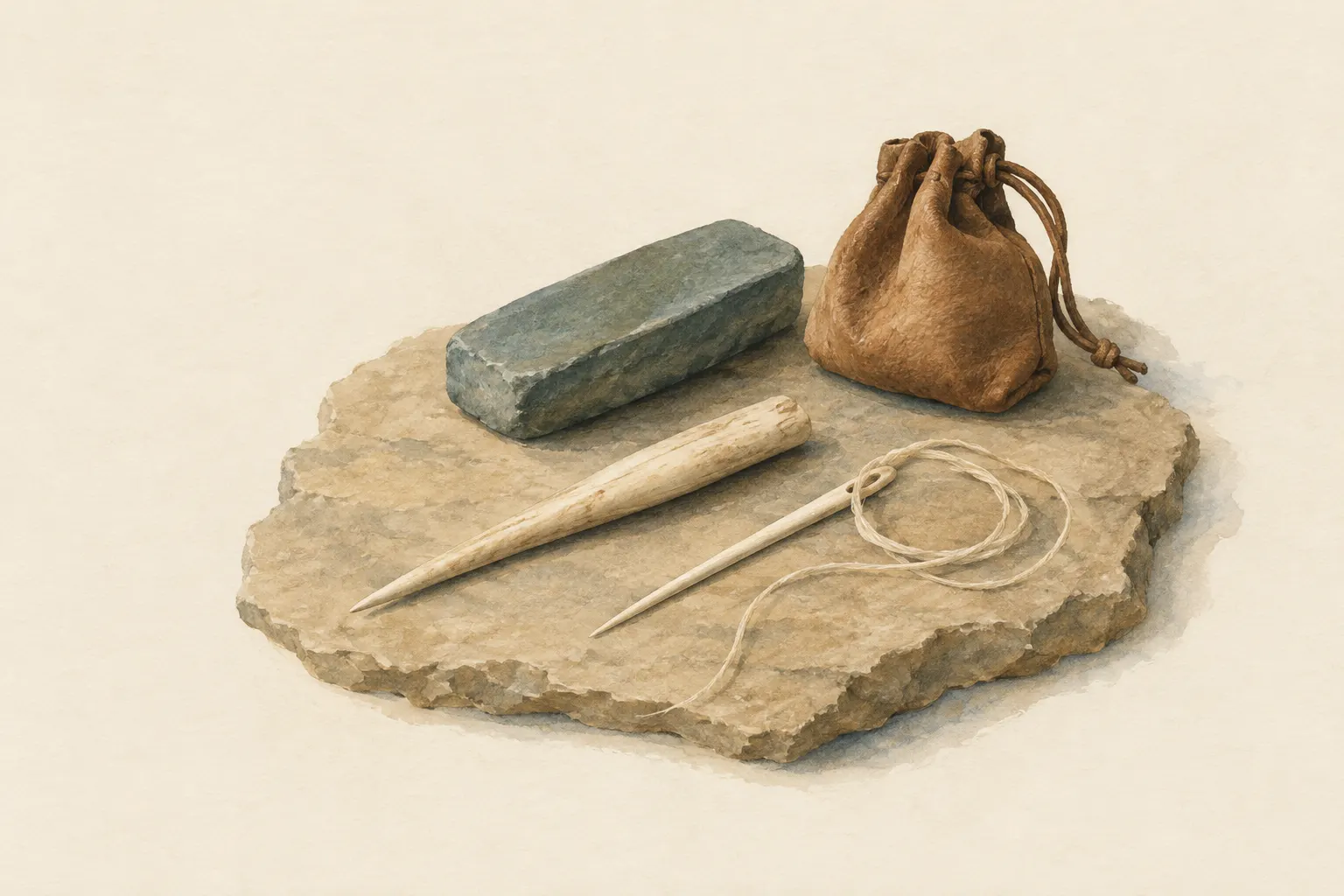
In the past people used almost everything from an animal. From the sinew – the strong bands that hold muscles to bones – they made thread. From bones they ground needles and awls.
You pound dried sinew until it falls apart into fine fibres. You wet these and twist them into a thread. When it dries, it becomes hard and very strong.
You boil bones first – that makes a good soup. Afterwards you can grind them into a point on a wet stone. Careful: bone splinters are as sharp as glass.
How it works
Sinew consists of millions of parallel protein fibres. It has to transfer the full force of a muscle to the bone and is therefore extremely strong in tension. Dried and pounded, the fibres separate from each other.
Wet, the fibres become soft and a little sticky. As they dry, they shrink and stick together. That is why a sinew binding tightens by itself as it dries.
Bone is hard but brittle. Slow grinding on a wet stone removes material without splintering the bone. When boiled, bones release fat, marrow and gelatine into the water.
What matters
Clean sinew: bits of meat rot. So loosen the sinew cleanly, scrape it and dry it in the air.
Always twist damp: dry fibres break. Only moistened fibres can be twisted into a firm thread.
Grind slowly and wet: water cools, washes away the grinding dust and stops you breathing in bone dust.
Safety: what to watch out for
Sharp splinters: when breaking bones, lay a cloth over them and wear safety glasses and gloves.
Trichinella: only eat bones and marrow from wild boar, bear and other omnivores when boiled through completely.
Hygiene and origin: only use material from healthy, legally obtained animals, wear gloves and wash thoroughly afterwards.
Step by step
Obtain the sinew
The best sinew lies along the back of a roe or red deer as a flat, shiny band over the backstraps, and as round cords at the back of the lower legs. Ask a hunter or butcher for it. Loosen it cleanly from the meat with a knife and scrape off any bits of meat.
- 1
Obtain the sinew
The best sinew lies along the back of a roe or red deer as a flat, shiny band over the backstraps, and as round cords at the back of the lower legs. Ask a hunter or butcher for it. Loosen it cleanly from the meat with a knife and scrape off any bits of meat.
- 2
Dry the sinew
Lay the sinew flat on a board or hang it in a shady, airy place, protected from flies and animals. After one to three days it is hard, yellowish and translucent. Dry, it keeps almost indefinitely.
- 3
Pound and split into fibres
Pound the dry sinew with a smooth stone on a smooth surface until it fans out white and fibrous. Then pull off single bundles of fibres with your fingers – as thin as you want the thread to be.
- 4
Twist into thread
Moisten two fibre bundles with water or in your mouth until they are soft. Twist each bundle in the same direction and then lay them around each other in the opposite direction – as for two-ply cord. Add new fibres with an overlap. As it dries, the thread shrinks and becomes hard and firm.
- 5
Boil the bones
Put the bones in a pot of cold water and let them simmer gently for several hours. Skim off the foam. The broth is nourishing and warming. Afterwards you can crack long bones and eat the cooked marrow.
Wild boar and bear: only cooked right through.
- 6
Clean and split the bone
Scrape boiled bones clean and let them dry. To split a long bone, score it lengthwise with a knife or a sharp-edged stone, lay a cloth over it and break it along the groove with light blows. Choose a long, straight piece.
Safety glasses, gloves, cloth over it.
- 7
Grind an awl or needle
Grind the piece of bone slowly into a point on a wet sandstone or whetstone – short and strong for an awl, long and slender for a needle. For the eye, drill a small hole from both sides with a stone point or the tip of a knife. With the awl you punch holes in leather and pull the sinew thread through them.
Common mistakes
- Leaving bits of meat on the sinew – it rots
- Twisting the fibre dry – it breaks
- Smashing bones without protection
- Grinding dry
- Eating marrow from wild boar bones that are not cooked through
Quick view
Materials
Sinew and bones
Only from healthy, legally obtained animals
Bone splinters are sharp
Knife (fixed or locking blade)
Cut away from your body.
Rules on carrying knives differ by region – check local rules.
Metal pot (stainless steel, aluminium, titanium)
For boiling the bones
Hot – scalding risk.
Sharpening stone (combination coarse/fine)
Or a flat sandstone for grinding
Follow the manufacturer's instructions on water or oil.
Disposable gloves
Consider latex allergies – prefer latex-free gloves (e.g. nitrile).
Close-fitting safety goggles
When breaking and grinding bone
Suitable for
- Sewing leather and repairing gear
- Binding handles and tools
- Nourishing broth from leftovers
Not suitable for
- Bones from animals found dead
- Using wild boar or bear bones without cooking through – Trichinella
- Loads where a failure would endanger people
Prerequisites
- Sinew and bones from a legally obtained, healthy animal
- Able to cut cleanly and away from your body
Safety
- Broken bones have razor-sharp edges and splinters. When breaking them, lay a cloth over them, wear safety glasses and put on gloves. Always grind wet so that no bone dust is produced.
- Handle fresh sinew and bones with gloves, cover wounds and wash hands and tools thoroughly afterwards.
- Only use meat, fat, hides, sinew and bone from a legal source: from a hunter, a butcher, your own livestock or a shop. Killing or trapping game yourself is only allowed with hunting rights in Germany and Austria. Never use animals found dead – the cause of death is unknown.
How it works
Sinew consists of long, parallel protein fibres that connect muscles to bones – it withstands enormous pulling forces. Dried, it can be split into hair-fine fibres. Dampened, the fibres become soft and sticky and dry into a firm thread when twisted, which shrinks as it dries and tightens bindings. Bone is hard but brittle; slow grinding on stone lets you shape it without splintering. When boiled, bones release fat, marrow and gelatine.
Advantages
- Uses the whole animal
- Sinew thread is very strong and tightens as it dries
- Tools without metal
Disadvantages
- Sinew thread goes soft when wet
- Bone is brittle
- Time-consuming
Deep knowledge
Background
Bone needles with an eye are among humanity's oldest tools; the oldest are tens of thousands of years old. With them and sinew thread, close-fitting clothing could be sewn from fur – a prerequisite for surviving in cold regions.
Bow makers still work with sinew today because it withstands tension better than almost any natural fibre.
Variants
- Sinew as a binding
- Wrap damp sinew fibres directly around a joint, such as a knife handle or a point. As they dry they shrink and stick fast. Protect against moisture with some fat or resin.
- Bone scraper
- A shoulder blade or a long bone with a straight, blunt edge works well as a scraper for fleshing hides.
Common mistakes
- Leaving bits of meat on the sinew – it rots
- Twisting the fibre dry – it breaks
- Smashing bones without protection
- Grinding dry
- Eating marrow from wild boar bones that are not cooked through
Limits and risks
- No instructions for weapons
- No load ratings for sinew thread
- No substitute for certified rope
Material alternatives
Derived from material properties: a substitute must have all relevant properties. Observe the notes on the substitute.
- Metal pot (stainless steel, aluminium, titanium)
- Single-wall stainless steel bottle (Heat only single-wall bottles without paint/plastic; remove the lid before heating.)
Results come exclusively from structured entries. No improvised instructions are generated.
Sources (4)
- Centers for Disease Control and Prevention (CDC): Trichinellosis – Prevention · Trichinella in wild boar and bear; only eat cooked through
- Amt der Tiroler Landesregierung – Landesveterinärdirektion (tirol.gv.at) (2023): Wildfleischuntersuchung und praktische Wildbrethygiene (Jagdaufseher-Lehrgang 2023) · Hygiene when handling game
- Ray Mears – Hodder & Stoughton (2002): Bushcraft · Sinew as thread and binding; bone as a material
- Mors L. Kochanski – Lone Pine Publishing: Bushcraft: Outdoor Skills and Wilderness Survival · Natural materials as camp materials