























Beach shelter: driftwood, tide line and wind
By the sea there is often enough wood lying around to build a shelter quickly. The danger comes from the water: the tide rises twice a day, and in a storm or spring tide it reaches much further than you think. Here you learn to recognise the highest tide line, find a safe spot behind the beach, build a lean-to from driftwood, cover it with seaweed, grass or a tarp and protect it from the wind – and where dunes are off limits.
- 1–2 hours
Explained simply
On the beach there is often washed-up wood from which you can quickly build a shelter: one long log across, many poles leaned against it at an angle, and seaweed, grass or a tarp on top.
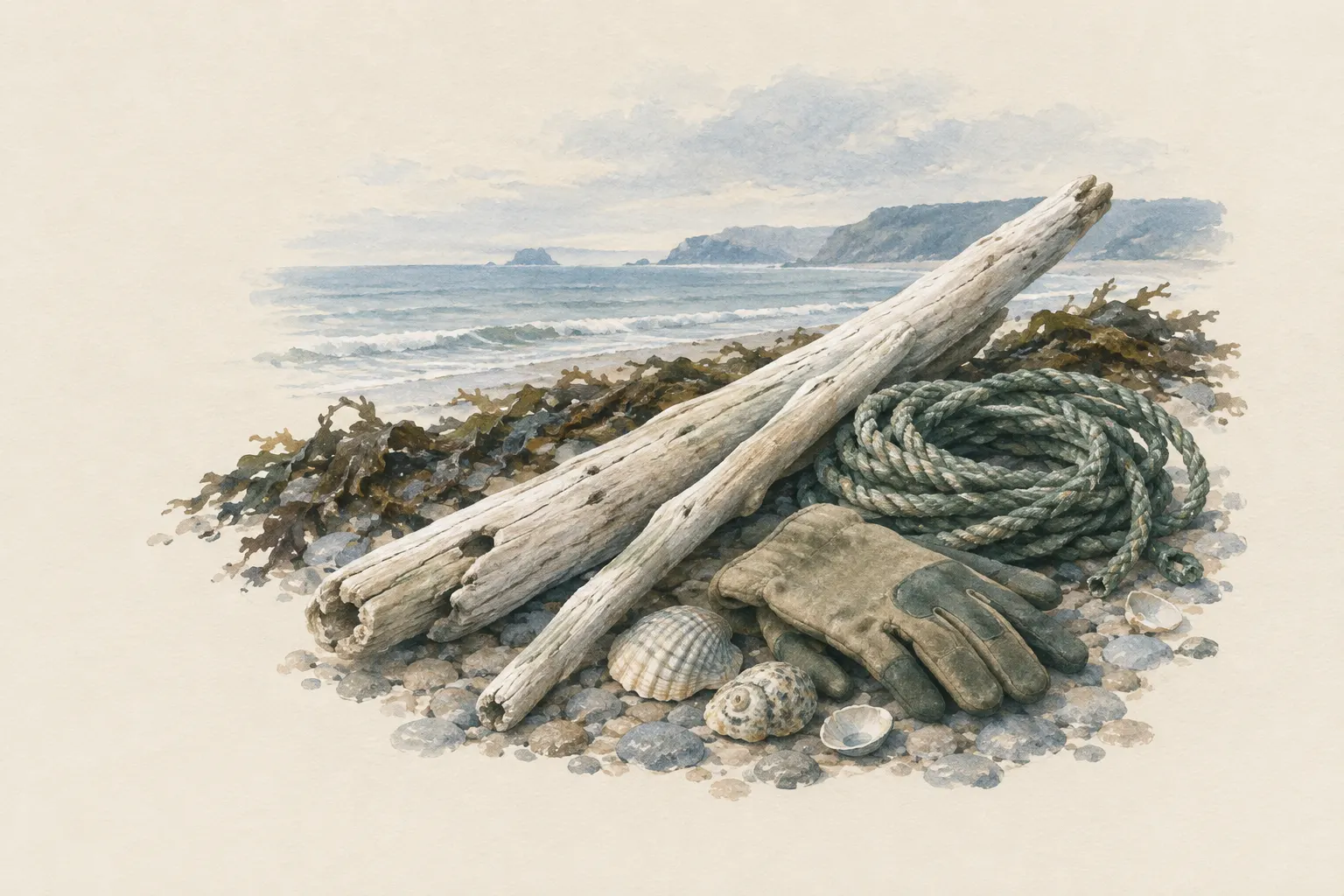
The most important thing is the spot. The sea comes far up twice a day. Where it last was, there is a line of seaweed and shells. The shelter belongs well above it.
The open side faces away from the wind. You do not build beneath cliffs or in dunes.
How it works
The moon and sun pull on the sea and make it rise and fall twice a day. At full and new moon it rises highest, with storms and onshore wind even higher. Every tide leaves a wrack line; the highest shows how far the water has already come.
The lean-to deflects wind and spray over itself. A sand wall along the bottom edge stops the wind getting underneath.
What matters
Height: well above the highest wrack line, ideally behind the beach.
Wind: back of the roof to the wind.
Ground: sand is cold and damp at night – pad it thickly.
Safety: what to watch out for
Tide and storm surge: never sleep below the tide line; with a storm surge warning move inland.
Cliffs and caves: rockfall and tide – do not camp beneath or inside them.
Driftwood: nails and splinters, wear gloves; do not touch logs in the surf.
Step by step
Find the tide line
Look for the wrack lines on the beach: lines of seaweed, shells and wood. The uppermost shows the highest tide. Your spot is well above it, ideally behind the beach where grass already grows.
Caution: Always well above the highest wrack line.
- 1
Find the tide line
Look for the wrack lines on the beach: lines of seaweed, shells and wood. The uppermost shows the highest tide. Your spot is well above it, ideally behind the beach where grass already grows.
Always well above the highest wrack line.
- 2
Check the site and wind
Check where the wind comes from. Avoid cliffs, caves and dunes. A large rock or a washed-up log can serve as a back wall.
- 3
Lay the ridge pole
Lay a long, strong log at hip height between two rocks, forks or a fork of two poles rammed into the sand at an angle.
- 4
Lean the poles
Lean poles close together from the windward side against the ridge pole at an angle, the ends pushed firmly into the sand. The open side faces away from the wind.
- 5
Cover the roof
Cover the frame from bottom to top like roof tiles: tarp, net remnants, dried seaweed or grass. Finally pile sand along the bottom edge so no wind gets underneath.
- 6
Insulate the floor
Sand is cold and damp at night. Lay a thick layer of dry grass, seaweed or your sleeping pad as a base.
- 7
Be seen
Lay out clearly visible signs of wood or stones on the beach and keep a light ready at night. Keep an eye on the tide.
Common mistakes
- Building below the wrack line
- Camping beneath a cliff
- Digging in dunes
- Open side facing the wind
- Sleeping directly on the sand
Quick view
Materials
Driftwood
One long, strong log and many poles
Watch out for nails, screws and splinters; wear gloves.
Do not take wood in protected areas and dunes.
Sturdy work gloves
Against nails, splinters and shells
When handling flood mud or chemicals, also wear waterproof gloves.
Tarp
Or a tarp, net remnants, seaweed and dry grass for covering
Paracord
Not a climbing or safety rope.
Sleeping pad
Sand draws a lot of heat at night
Suitable for
- Stranded or lost on the coast
- Windy beaches with a lot of driftwood
- Waiting for rescue on the coast
Not suitable for
- Below the tide line
- Beneath cliffs – rockfall
- Storm surge warning – then move inland
Prerequisites
- Reliable recognition of the tide line
- No protected area, no dunes
Safety
- Driftwood can have nails, screws and splinters. Work with gloves. Do not touch loose logs in the surf – waves can move them like battering rams.
- Dunes are often protected and hold the land together. Do not dig or build in dunes and do not pull up dune grass.
How it works
Driftwood is soaked by salt water and dried by the wind – often light and straight, ideal for poles. A lean-to with its back to the wind keeps off gusts and spray. You recognise the highest tide line by the wrack line: a line of seaweed, shells, wood and rubbish left by the water at high tide. The uppermost, oldest wrack line shows how far storm tides have already come.
Advantages
- Material is often at hand
- Quick to build
Disadvantages
- Danger from tide and storm
- Sand gets in everywhere
Deep knowledge
Background
Fishermen and beachcombers on many coasts built huts from driftwood that were put up again after every winter storm. On islands without forest, driftwood was often the only timber of all.
The wrack line is also a habitat: many shore birds search for food there. Camping there disturbs them – one more reason to stay a little higher up.
Variants
- Driftwood tipi
- Three long logs tied together at the top, more poles leaned around them: stands more freely in the wind and has room for two.
- Behind the boat
- A boat or kayak pulled ashore, turned on its side and secured, makes an instant windbreak.
Common mistakes
- Building below the wrack line
- Camping beneath a cliff
- Digging in dunes
- Open side facing the wind
- Sleeping directly on the sand
Limits and risks
- No tide times for specific places
- Protected area rules take precedence
Material alternatives
Derived from material properties: a substitute must have all relevant properties. Observe the notes on the substitute.
- Tarp
- Plastic sheet / large bin bag (Tears easily; never pull over the head (suffocation risk).), Emergency blanket (Tears easily once punctured; short-term shelter only.), Document folder (waterproof) (Store securely – contains sensitive personal data.), Rain poncho (When used as a shelter, it no longer protects your body from rain.), Bivy bag (Never fully close off the face.), Tent (Do not cook or heat inside the tent (fire and carbon monoxide danger).), Heavy-duty bin bag (large) (Suffocation risk: never pull plastic bags over the head or face and keep them away from small children.), Group shelter bag (Airtight – ventilate regularly.)
- Paracord
- Rope (Never use unknown or damaged rope for life-safety purposes.), Thin, soft wire (brass or galvanised steel) (Wire ends are sharp – protect eyes and fingers when bending), Tow rope or tow strap (Attach only to the towing eyes provided by the manufacturer; never stand next to it under load.)
- Sleeping pad
- Dry leaves, grass or conifer boughs (Collect only where allowed; no protected plants. Check for ticks and insects.), Backpack, Dry spare clothing (Carry it in waterproof packaging – wet clothing barely insulates.), Wool blanket / duvet (Keep away from candles, stoves and heaters.), Insulated cool box (Keeps cold only for a limited time; without ice packs or ice it is not a fridge.), Sleeping bag (Do not store compressed long-term; do not pack away damp.), Newspaper and cardboard (Flammable – keep away from candles, stoves, heaters and embers.), Insulated cooking box (hay box, thermal cooker) (Never put open flame or embers inside – only the hot, closed pot.), Long-stemmed thatch (reed, grass, rushes) (Extremely flammable – no open fire and no sparks nearby.), Pot insulation (pot cosy, beanie or fleece jacket) (Only around a pot that is no longer on the stove – fabric catches fire at the flame.)
Results come exclusively from structured entries. No improvised instructions are generated.
Sources (4)
- U.S. National Oceanic and Atmospheric Administration (NOAA) – National Ocean Service: Tides and Water Levels (NOAA Ocean Service Education tutorial) · Tides rise and fall twice a day; spring tides reach higher
- Royal National Lifeboat Institution (RNLI), UK: Respect the Water – Float to Live · On the coast watch the tides and waves; call the coastguard in an emergency
- Leave No Trace Center for Outdoor Ethics: The Seven Principles of Leave No Trace (Principle 5: Minimize Campfire Impacts) · Use existing sites, cut nothing living, remove all traces
- Headquarters, Department of the Army (USA) (2002): FM 3-05.70 Survival · Coastal shelters above the high-water mark