





















Water from plants in the tropics: bamboo, vines and green coconuts
In the humid tropics some plants store surprising amounts of clear water: green coconuts, the chambers of bamboo stems and certain thick vines. This water is usually cleaner than stream water. Here you learn which plants are suitable, how to open a green coconut and get water from bamboo and vines – and how to tell a sap is dangerous: milky, sticky, bitter or burning always means throw it away.
- 5–20 minutes per plant
Explained simply
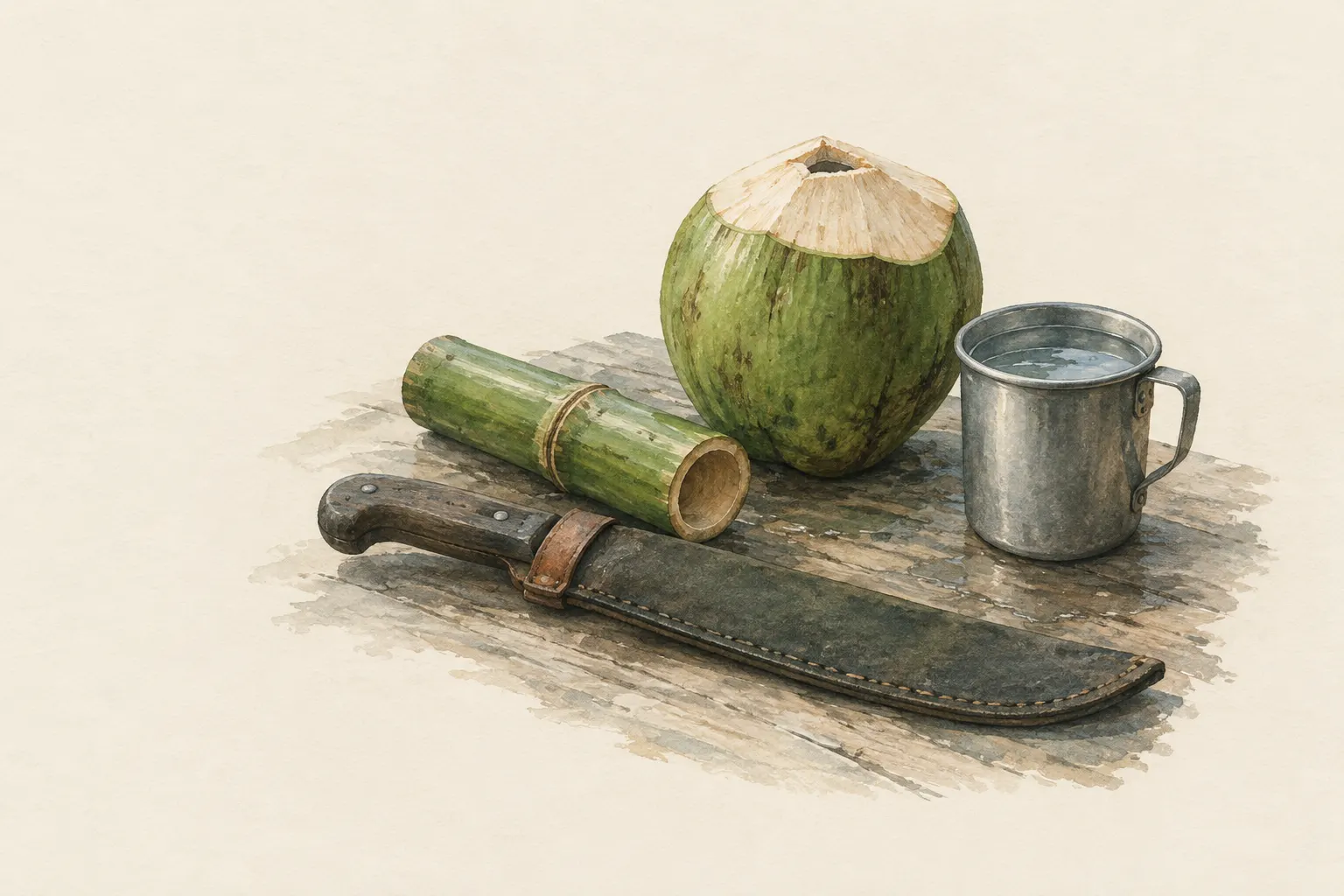
In warm rainforests some plants store water inside them. A green, young coconut is full of clear, sweet water inside.
Thick bamboo stems also often have water in their chambers, and some thick vines drip water when you cut them at the top and the bottom.
The most important rule: only drink clear, watery liquid. If the sap is white like milk, sticky, bitter or burns in your mouth, it is poisonous – spit it out at once.
How it works
Plants draw water from the ground with their roots and carry it upwards through fine tubes. As a coconut grows it fills with water that is well protected by the thick shell – which is why it is almost germ-free.
In a vine, suction holds the water in the tubes. If you cut at the top first, air can flow in, and the water runs out at the bottom as soon as you cut there. If you cut at the bottom first, the plant draws the water away upwards.
What matters
The coconut: green and heavy, it sloshes when shaken. Brown, ripe nuts have less water and fatty milk.
The bamboo: green, thick stems; the water sits in the chambers between the nodes. If it smells foul, leave it.
The vine: only if you know the species for certain and the sap is clear, odourless and tasteless or slightly sweet.
Safety: what to watch out for
Poisonous sap: milky, coloured, sticky, bitter or burning always means poisonous. Spit out, rinse your mouth.
Coconut palms: never rest or sleep underneath – falling nuts are as heavy as stones.
Machete: always swing away from your body, the nut lies on the ground, not in your hand.
Step by step
Recognise suitable plants
Good choices are green, young coconuts that slosh when shaken, thick green bamboo stems and vines as thick as a thumb to an arm. Leave anything you do not know for certain.
- 1
Recognise suitable plants
Good choices are green, young coconuts that slosh when shaken, thick green bamboo stems and vines as thick as a thumb to an arm. Leave anything you do not know for certain.
- 2
Prepare the coconut
Lay the green coconut on the ground. Slice the fibrous husk off the pointed end in flat cuts until the soft, pale shell underneath shows.
Hold the nut on the ground, not in your hand.
- 3
Open the coconut and drink
Pierce a hole in the soft shell with the knife tip or knock off a small lid. Drink the clear coconut water directly. Afterwards you can split the nut and scoop out the soft flesh.
- 4
Tap bamboo
Shake green bamboo stems: if it sloshes, there is water in the chamber. Drill or cut a small hole just above a node and let the water run into a container. If it smells or tastes foul, do not drink it.
- 5
Cut the vine at the top
Cut through a thick vine as high up as possible. Cut at the top first – otherwise the water draws back upwards.
- 6
Cut the vine at the bottom
Then cut off a piece about an arm's length below and hold it upright over your mouth or a container, without putting your lips on the bark.
- 7
Check the sap
Look at the sap first: clear and watery is good. Taste one drop. If it is milky, coloured, sticky, bitter or burns, spit it out at once and rinse your mouth.
Milky, bitter, burning: never drink.
Common mistakes
- Drinking unknown vines with milky sap
- Cutting the vine at the bottom first
- Resting under coconut palms
- Drinking a lot of milk from ripe nuts
- Splitting a coconut held in your hand
Quick view
Materials
Machete or large knife
Or a strong knife
Always swing away from your body, nobody within reach.
Carry it in its sheath.
Metal pot (stainless steel, aluminium, titanium)
For collecting – or a bottle, a leaf
Hot – scalding risk.
Sturdy work gloves
Against thorns, ants and sharp leaves
When handling flood mud or chemicals, also wear waterproof gloves.
Suitable for
- Humid tropics without a safe water source
- Supplement to treated water
- Islands with coconut palms
Not suitable for
- Unknown plants with milky sap
- Ripe brown coconuts as the main water source
- Areas without permission to cut
Prerequisites
- Reliable recognition of coconut palm and bamboo
- Knife or machete and practice with it
Safety
- Falling coconuts can cause serious injury: do not rest or sleep under palms. Do not climb palms unsecured. Ripe brown coconuts contain less water; their fatty milk can cause diarrhoea in larger amounts.
- Always swing the machete away from your body and never towards the holding hand. Hold the coconut on the ground or on a log, not in your hand. Clean cuts in the tropics at once.
How it works
Plants move water upwards from the roots and store it in hollow spaces. A green coconut is a natural, sterile water container. Bamboo stems collect rain and plant water in their closed chambers. Thick water vines carry water upwards in long tubes; if you cut first at the top and then at the bottom, it runs out like from a straw.
Advantages
- Usually clean and low in germs
- No boiling needed for green coconuts
Disadvantages
- Small amounts per plant
- Needs reliable plant knowledge
- Machete needed
Deep knowledge
Background
On many Pacific islands the green coconut was the most important water source for centuries. Seafarers took them on board as a long-lasting, clean drink supply.
People in Southeast Asia and South America have known their water vines precisely for generations. For strangers the rule is: if you do not know the plant for certain, rely on rain and treated water instead.
Variants
- Banana plant
- If a banana plant is cut off just above the ground and the stump hollowed out, the hollow fills with water over hours. The first fillings are bitter and are poured away. Only where you are allowed to use the plant.
- Rain from leaves
- Large, smooth leaves channel rain like gutters into a container. This is often the simplest water source in the tropics.
Common mistakes
- Drinking unknown vines with milky sap
- Cutting the vine at the bottom first
- Resting under coconut palms
- Drinking a lot of milk from ripe nuts
- Splitting a coconut held in your hand
Limits and risks
- No identification of individual vine species
- No amounts per plant
Material alternatives
Derived from material properties: a substitute must have all relevant properties. Observe the notes on the substitute.
- Metal pot (stainless steel, aluminium, titanium)
- Single-wall stainless steel bottle (Heat only single-wall bottles without paint/plastic; remove the lid before heating.)
Results come exclusively from structured entries. No improvised instructions are generated.
Sources (3)
- Headquarters, Department of the Army (USA) (2002): FM 3-05.70 Survival · Water from plants in the tropics: coconut, bamboo, vines; avoid milky sap
- Centers for Disease Control and Prevention: CDC Yellow Book: Health Information for International Travel · Safe drinking water in the tropics; avoid unknown plants and fruit
- World Health Organization (2022): Guidelines for drinking-water quality, fourth edition incorporating the first and second addenda · Treat water of unknown origin before drinking