























Making charcoal yourself: in a tin and in a pit
Charcoal burns hot, almost smokelessly, and is light. It is used for smithing, cooking, drawing, making pitch or filtering. It forms when wood is heated without air. Here you learn the small method in a tin with a lid and the larger one in a covered pit: choose the wood, pack it tightly, heat until no more smoke escapes, let it cool airtight and check the finished charcoal.
- Tin: 1–2 hours including cooling; pit: half a day to a whole day
Explained simply
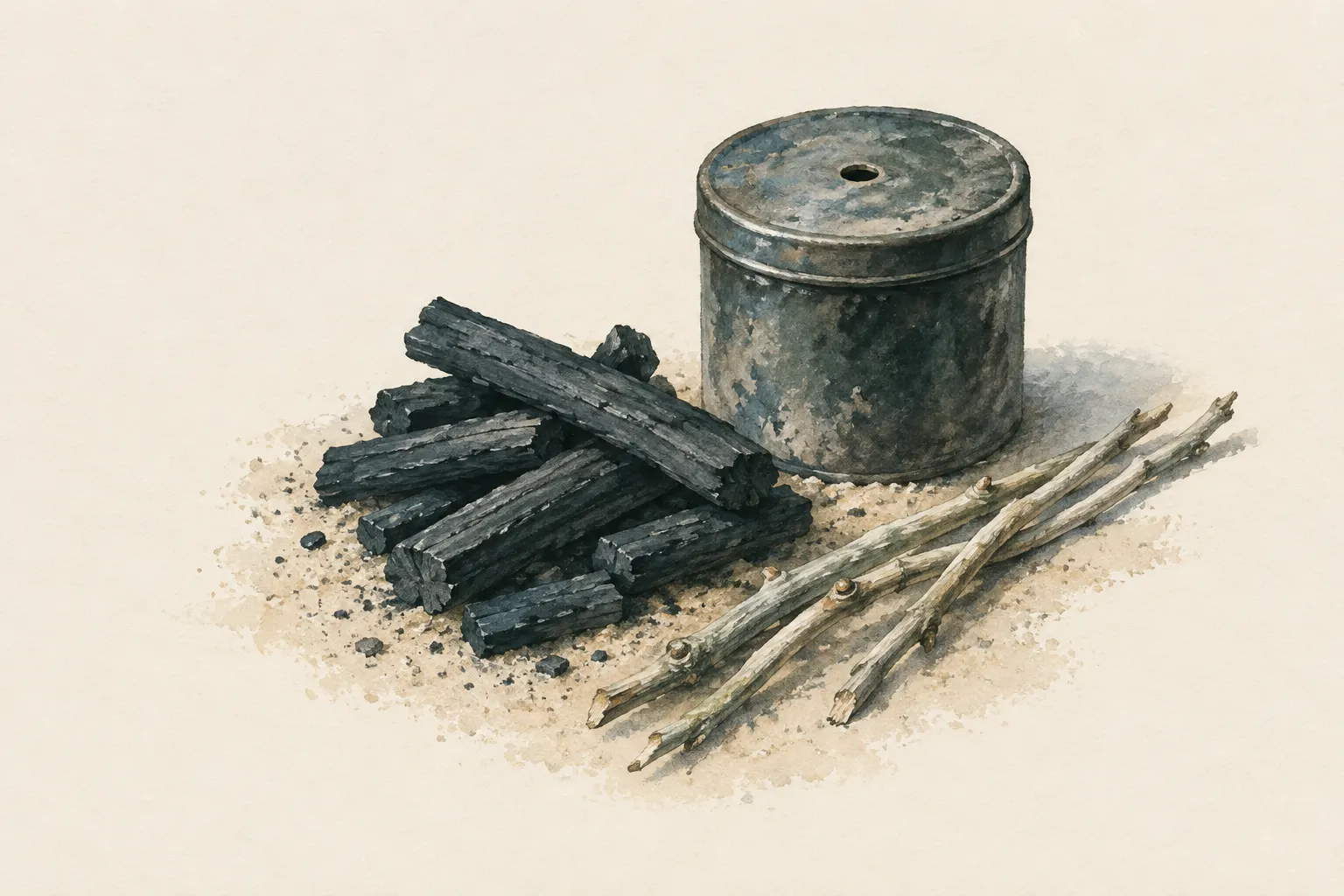
Charcoal is wood that has been "baked" without air. The water and smoke disappear, leaving light, black charcoal that glows very hot and almost without smoke.
Small amounts are made in a tin with a lid and a small hole. You put it in the fire until no more smoke comes out and then let it cool airtight.
Very important: glowing charcoal makes an invisible poison, carbon monoxide. That is why it is only used outdoors, never in a tent, a car or the house.
How it works
Wood consists of cellulose, lignin and water. Under strong heat without air it breaks down: first the water evaporates, then flammable gases and tar escape. What remains is a framework of almost pure carbon.
In the fire the gases often ignite at the hole of the tin as a small flame. When this flame goes out, there is nothing left to give off gas – the charcoal is done.
What matters
Dry, untreated wood: varnish, glue and paint give off toxic fumes. Damp wood takes much longer.
Pieces of equal thickness: they finish at the same time. Otherwise thick pieces stay brown inside.
Cool airtight: if hot charcoal gets air, it keeps glowing and turns to ash.
Safety: what to watch out for
Carbon monoxide: charcoal makes hardly any visible smoke but a lot of carbon monoxide. Every year people die because they heat with charcoal in tents, garages or flats.
Reignition: fresh charcoal can reignite by itself in air. Only open when completely cold and do not store in flammable sacks.
Pit method: not on peat or heavily rooted soils – embers can keep burning underground.
Step by step
Choose the wood
Use dry, untreated wood. Hardwood such as beech gives firm charcoal for heating; soft wood such as willow or lime gives soft charcoal for drawing and pitch. Cut it into pieces of equal thickness that fit the tin.
- 1
Choose the wood
Use dry, untreated wood. Hardwood such as beech gives firm charcoal for heating; soft wood such as willow or lime gives soft charcoal for drawing and pitch. Cut it into pieces of equal thickness that fit the tin.
- 2
Pack the tin tightly
Pack the pieces tightly into the tin so little air remains. Punch a small hole in the lid and press it firmly on.
- 3
Put it in the embers
Place the tin in a strong bed of embers and put wood around it. Soon smoke hisses out of the hole and often catches fire as a small flame. That is intended: the gases are burning.
- 4
Wait until no more smoke comes
When no more smoke or flame comes from the hole, the wood is fully charred. Depending on size this takes half an hour to an hour.
- 5
Cool airtight
Take the tin out of the fire with gloves and tongs and plug the hole with earth, or stand the tin upside down in the sand. Let it cool completely before opening it.
Only open when completely cold.
- 6
Larger amounts: in a pit
Dig a pit, light a strong fire in it and add wood until it is full of embers. Then add dense wood, cover everything with green branches and a layer of earth and leave only small smoke holes. When hardly any smoke comes, close all holes and leave it to cool until the next day.
- 7
Check the charcoal
Good charcoal is black right to the core, light, rings when two pieces are knocked together and blackens your fingers. Brown spots are not finished and will smoke later.
Common mistakes
- Letting charcoal glow indoors or in a tent
- Opening the tin hot – the charcoal catches fire
- Damp or treated wood
- Not covering the pit tightly
- Stopping too early – brown pieces
Quick view
Materials
Small metal tin with lid
Tin with a lid and a small hole
Burn off coated or painted tins outdoors first.
Gets very hot in a fire.
Dry firewood
Collect only where permitted.
Small shovel / folding spade
For the pit method
Leather or heat-resistant gloves
Synthetic gloves melt onto the skin – only leather or certified heat-resistant gloves.
Wet gloves conduct heat quickly.
Water for extinguishing (bucket, canister or pot)
Have several litres ready before lighting.
Suitable for
- Small amounts for pitch, drawing, filters or smithing experiments
- Grilling and cooking without smoke
- Learning how charcoal burners work
Not suitable for
- Burning charcoal in rooms, tents or vehicles – life-threatening
- Treated, painted or coated wood
- Peat and root-filled soils – embers can keep burning underground
Prerequisites
- A permitted fire site
- Dry wood you are allowed to take
- Time to supervise
Safety
- Fresh charcoal can reignite in air. Let it cool completely, then open it and store it in a non-flammable container.
How it works
If wood is heated without enough air, it does not burn but gives off water, gases and tar as smoke. What remains is almost pure carbon in the shape of the wood: charcoal. The small hole in the tin lets the gases escape but hardly lets air in. When the smoking stops, the wood is fully charred. It must cool airtight, otherwise the charcoal burns to ash.
Advantages
- Hot, almost smokeless embers
- Easy to store
- Versatile
Disadvantages
- A lot of wood for little charcoal
- Carbon monoxide danger
- Takes a long time
Deep knowledge
Background
For centuries charcoal burners built large kilns in the forest from stacked wood covered with earth and grass. They watched them day and night, often for weeks. Without charcoal there would have been no iron, no glass and no smithies.
In Austria and Germany a few charcoal makers still demonstrate the old craft today.
Variants
- Drawing charcoal
- Char thin willow twigs without bark in a small tin. The sticks are soft and draw like bought drawing charcoal.
- For water filters
- Crushed charcoal improves smell and taste in an improvised filter but does not make water germ-free. Always boil or disinfect afterwards.
Common mistakes
- Letting charcoal glow indoors or in a tent
- Opening the tin hot – the charcoal catches fire
- Damp or treated wood
- Not covering the pit tightly
- Stopping too early – brown pieces
Limits and risks
- No instructions for large kilns
- Charcoal filters do not replace disinfection
Material alternatives
Derived from material properties: a substitute must have all relevant properties. Observe the notes on the substitute.
- Small metal tin with lid
- Single-wall stainless steel bottle (Heat only single-wall bottles without paint/plastic; remove the lid before heating.)
- Dry firewood
- Tinder (Carry in waterproof packaging.), Char cloth (charred cotton) (Store dry in a tin.), Finest-grade steel wool (Store separately from batteries – fire risk.), Fatwood (resin-rich wood) (Collect only dead wood where permitted.), Stove fuel (canister, liquid fuel, alcohol) (Store fuels apart from food and in original containers or bottles intended for them.), Petroleum jelly cotton balls (Use only pure cotton.), Cooking oil or cooking fat (tallow, lard) (Never put out burning fat with water – cover it with a lid to smother it.), Tree resin (spruce, pine) (Resin is flammable and sticks to the skin when hot – melt it only slowly over low heat.), Birch bark (from dead, fallen wood) (Never peel from living trees.)
Results come exclusively from structured entries. No improvised instructions are generated.
Sources (4)
- Centers for Disease Control and Prevention: Carbon Monoxide Poisoning – Prevention guidance · Never use embers, charcoal or fire in closed rooms, tents or vehicles – carbon monoxide
- USDA Forest Service / Ad Council / National Association of State Foresters: Campfire Safety (Smokey Bear wildfire prevention campaign) · Never leave a fire unattended, keep water ready, put it out completely
- Deutscher Wetterdienst (DWD): Waldbrandgefahrenindex (WBI) · Check wildfire danger; no open fire when the danger is high
- Mors L. Kochanski – Lone Pine Publishing: Bushcraft: Outdoor Skills and Wilderness Survival · Making and using charcoal