























Carrying embers: taking fire from camp to camp
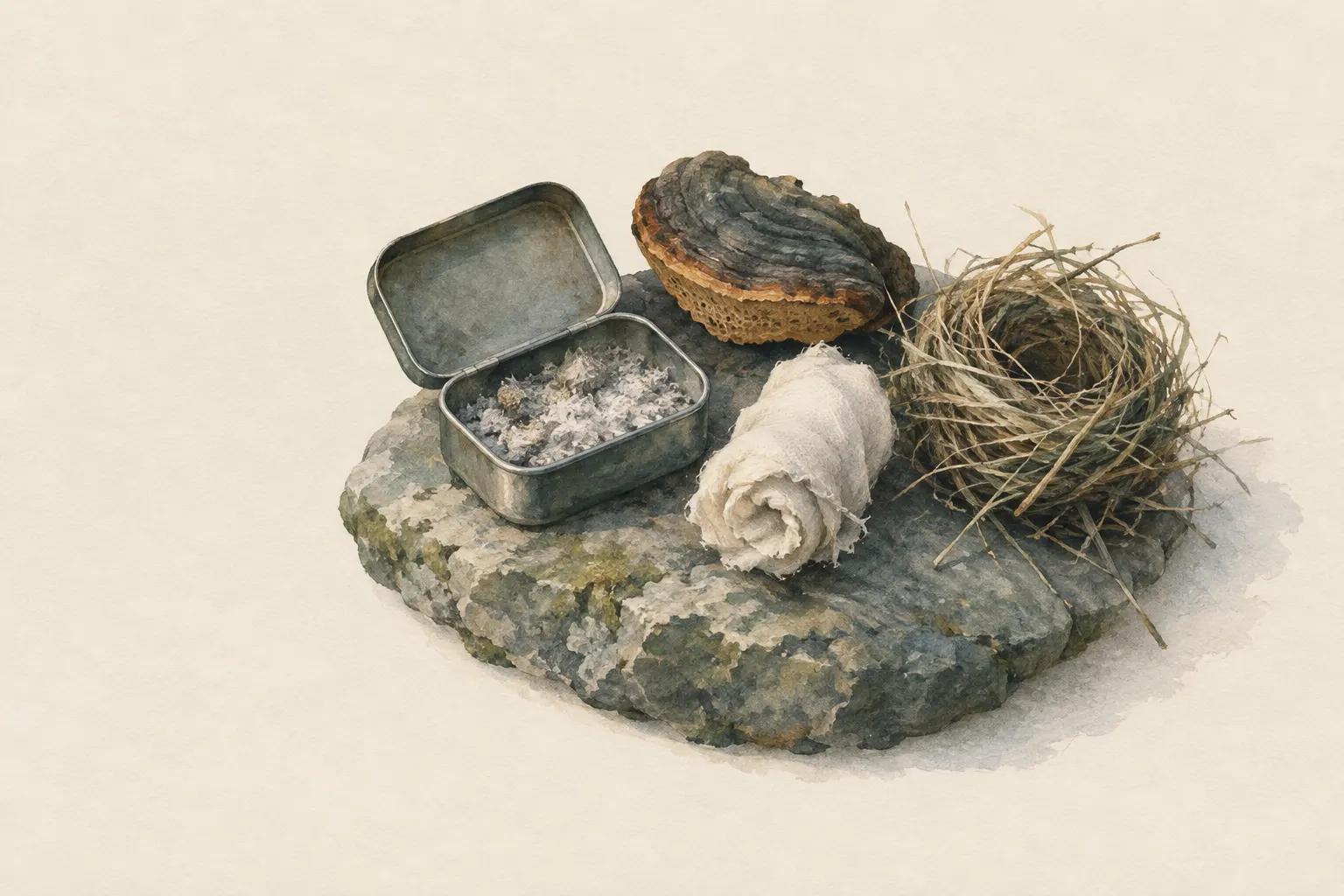
Lighting a fire from scratch costs tinder, effort and, in the wet, sometimes all your luck. That is why people used to carry embers – in a tinder fungus, a roll of bark or a tin. Here you learn to choose a slowly smouldering material, take it from the fire, pack it in a container with little air, check it on the way and blow it back into a fire at the new camp – and why this only works when wildfire danger is low and with great care.
- Preparation 15 minutes; lasts one to several hours depending on material
Explained simply
Making fire is sometimes hard, especially when everything is wet. That is why people used to take a piece of ember from the old fire with them.
For this you take something that smoulders slowly, for example a tinder fungus. You put the ember in a tin with a small hole. That way it gets just enough air to keep glowing.
At the new camp you put the ember in dry grass and blow gently until flames come. But careful: embers can set anything alight. So only in a tin, and never when it is very dry.
How it works
An ember is combustion without flame. It needs little oxygen and eats slowly through dense material. In a tin with a small hole oxygen is scarce: the ember smoulders but cannot flare up.
To revive it, you give it more oxygen again by blowing into the tinder nest. The temperature rises and the tinder catches fire.
What matters
Dense smouldering material: tinder fungus, dry punky wood, charcoal or tightly rolled cotton smoulder for a long time.
The right amount of air: too little – the ember suffocates; too much – it burns out quickly. The air hole can be adjusted with a little soil.
Check regularly: feel and smell every half hour on the way.
Safety: what to watch out for
Fire risk: only carry in fireproof, closed containers, outside your pack. Do without when it is dry and wildfire danger is high.
Put out the old fire: before you leave a camp, douse the fire with water, stir and douse again until everything is cold.
Carbon monoxide: never put the tin in a tent or vehicle.
Step by step
Choose a smouldering material
Good choices are a piece of tinder fungus, dry punky wood, a bundle of charcoal and dry moss, or a tightly rolled piece of cotton. They smoulder for a long time and hardly flare up.
- 1
Choose a smouldering material
Good choices are a piece of tinder fungus, dry punky wood, a bundle of charcoal and dry moss, or a tightly rolled piece of cotton. They smoulder for a long time and hardly flare up.
- 2
Light it from the fire
Hold the material to the embers until it glows evenly red in one spot. It should smoulder, not burn.
- 3
Pack it in the tin
Put some ash or dry soil into the tin, the ember on top, and surround it with more smouldering material. Lid on – a small hole lets in just enough air.
- 4
Put the old fire out completely
Before you leave, douse the old fire with water, stir and douse again until nothing hisses and everything is cold.
- 5
Check on the way
Carry the tin outside your pack or in your hand, never inside the pack among clothes. Check every half hour: is it warm? Does it smell of smoke? If it glows too strongly, make the air hole smaller; if it threatens to go out, open it briefly.
Never inside the pack among clothes.
- 6
Revive it at the new camp
First prepare a tinder nest and kindling. Put the ember inside, close the nest loosely around it and blow gently until flames appear. Then build the fire as usual.
Common mistakes
- Carrying embers inside the pack among clothes
- Carrying embers when wildfire danger is high
- Not putting out the old fire
- Tin without an air hole – the ember suffocates
- Putting the tin in the tent
Quick view
Materials
Small metal tin with lid
Tin with a lid and a small air hole
Burn off coated or painted tins outdoors first.
Gets very hot in a fire.
Tinder
Dry tinder for reviving
Carry in waterproof packaging.
Do not use liquid accelerants as tinder.
Water for extinguishing (bucket, canister or pot)
Have several litres ready before lighting.
Suitable for
- Short moves between two camps
- Wet weather in which lighting a fire is hard
- Saving tinder
Not suitable for
- High wildfire danger or drought
- In a backpack, tent or vehicle without a fireproof container
- Long distances without checking
Prerequisites
- A burning fire with good embers
- Low wildfire danger
- Fire permitted at the destination camp
Safety
- Only take tinder fungus from dead trees or fallen wood and not at all in protected areas. Do not confuse it with other bracket fungi.
How it works
Embers glow as long as they get some oxygen, but not so much that they flare up. Dense, fibrous materials such as tinder fungus, dry punky wood or charcoal smoulder very slowly. In a tin with a small air hole the ember gets just enough air to keep glowing. At the new camp you put it into a tinder nest and blow gently – more oxygen makes it flare up again.
Advantages
- Saves tinder and effort
- Helps in wet weather
Disadvantages
- Fire risk while carrying
- Only for short distances
- Must be checked constantly
Deep knowledge
Background
Before matches existed, fire was precious. Many peoples carried embers in horns, shells or bark containers from camp to camp. With Ötzi, tinder fungus and remains of charcoal were found in a container of birch bark.
In some villages the hearth fire used to be never put out completely, but covered with ash in the evening and revived in the morning.
Variants
- Tinder fungus
- The brown middle layer of the tinder fungus smoulders for hours. Ötzi carried a piece of it. A whole piece with a glowing spot fits in a small tin.
- Fire roll of bark
- Ember and dry, punky wood are rolled into a piece of birch bark or thick bark and tied with cord. It lasts less long than a tin but needs no metal.
Common mistakes
- Carrying embers inside the pack among clothes
- Carrying embers when wildfire danger is high
- Not putting out the old fire
- Tin without an air hole – the ember suffocates
- Putting the tin in the tent
Limits and risks
- No exact smouldering times
- Do not use when there is wildfire danger
Material alternatives
Derived from material properties: a substitute must have all relevant properties. Observe the notes on the substitute.
- Small metal tin with lid
- Single-wall stainless steel bottle (Heat only single-wall bottles without paint/plastic; remove the lid before heating.)
- Tinder
- Dry firewood (Collect only where permitted.), Char cloth (charred cotton) (Store dry in a tin.), Finest-grade steel wool (Store separately from batteries – fire risk.), Fatwood (resin-rich wood) (Collect only dead wood where permitted.), Stove fuel (canister, liquid fuel, alcohol) (Store fuels apart from food and in original containers or bottles intended for them.), Petroleum jelly cotton balls (Use only pure cotton.), Cooking oil or cooking fat (tallow, lard) (Never put out burning fat with water – cover it with a lid to smother it.), Tree resin (spruce, pine) (Resin is flammable and sticks to the skin when hot – melt it only slowly over low heat.), Birch bark (from dead, fallen wood) (Never peel from living trees.)
Results come exclusively from structured entries. No improvised instructions are generated.
Sources (4)
- USDA Forest Service / Ad Council / National Association of State Foresters: Campfire Safety (Smokey Bear wildfire prevention campaign) · Never leave a fire unattended, keep water ready, put it out completely
- Centers for Disease Control and Prevention: Carbon Monoxide Poisoning – Prevention guidance · Never use embers, charcoal or fire in closed rooms, tents or vehicles – carbon monoxide
- Deutscher Wetterdienst (DWD): Waldbrandgefahrenindex (WBI) · Check wildfire danger; no open fire when the danger is high
- Ray Mears – Hodder & Stoughton (2002): Bushcraft · Keeping and carrying embers; tinder fungus