























Felling a small tree safely – only with permission
For poles, firewood or a shelter you sometimes need a thin tree. But felling is one of the most dangerous jobs in the forest. Here you learn the basic rules for thin pole timber with a saw or hatchet: get permission, check the tree and its surroundings, decide the felling direction and escape route, cut the notch and the back cut with a hinge, step back in time and never free a hung-up tree yourself. Thick trees and chainsaws belong in the hands of professionals.
- 10–30 minutes for a thin trunk
Explained simply
Felling a tree is dangerous – even a thin one. That is why there are fixed rules, and you only fell if the forest owner has allowed it.
First you cut a wedge out on the side where the tree should fall. Then you saw from the other side, but not all the way through. The little bit of wood left in the middle works like a hinge on a door and steers the tree.
When the tree tips, you move away diagonally backwards and shout "Watch out!". If it gets stuck in another tree, you get help and never go underneath it.
How it works
The notch removes the tree's support on the falling side. The back cut from behind severs the rest – except the hinge. As soon as the tree tips, the hinge bends like a door hinge and keeps the trunk on track until it lies on the ground.
Without a hinge the tree is free: it can twist, fall sideways or kick back off the stump. That is why sawing through the hinge is the most dangerous mistake.
What matters
Look first: lean, wind, tangled branches, dead wood in the crown and people nearby decide whether felling is allowed.
Escape route: it lies diagonally behind you, not directly behind the trunk. It must be clear of branches and trip hazards.
Thin trunks only: anything you cannot manage in a few minutes with a hand saw is a job for trained professionals with protective equipment.
Safety: what to watch out for
Danger zone: two tree lengths all round clear of people and animals.
Hung-up trees: do not go underneath, do not fell the supporting tree, do not pull or climb on it. Cordon off and call professionals.
Permission: the right of forest access in Austria and Germany allows recreation, not felling. Without permission it is prohibited.
Step by step
Get permission and choose the tree
Ask the forest owner or forester and have them show you which tree may go. Choose a thin, healthy, preferably straight tree with no dead wood in the crown, far from paths and lines.
- 1
Get permission and choose the tree
Ask the forest owner or forester and have them show you which tree may go. Choose a thin, healthy, preferably straight tree with no dead wood in the crown, far from paths and lines.
- 2
Check the tree and its surroundings
Look up: does the tree lean to one side, are branches tangled in other crowns, is there snow on it? Look around: is the danger zone of two tree lengths clear? Do not fell in wind.
- 3
Decide the felling direction and escape route
Decide where the tree should fall – ideally in the direction of its natural lean, into a clear gap. Clear an escape route for yourself diagonally backwards, at about 45 degrees to the felling direction. Never escape directly behind the tree.
- 4
Saw the notch
On the falling side, saw a wedge-shaped notch about a fifth to a quarter of the way into the trunk: first a sloping cut from above, then a horizontal one from below, until the wedge comes out. The mouth of the notch points exactly in the felling direction.
- 5
Back cut with a hinge
Saw horizontally from the opposite side, a little higher than the base of the notch. Stop before you reach the notch: a strip of about a tenth of the diameter stays as the hinge. It holds and steers the tree.
Never saw through the hinge.
- 6
Call out and step back
As soon as the tree starts to lean, pull out the saw, call "Watch out, tree falling!" and step back quickly along the escape route. Keep the crown in view: branches can whip back.
- 7
Secure and process the felled tree
Wait until everything is still. If the tree is hung up, do not free it yourself – cordon it off and get help. If it lies safely, limb it from the base towards the top, standing on the opposite side from the branch you are sawing.
Common mistakes
- Felling without permission
- Felling in wind
- Not clearing an escape route
- Sawing the back cut through to the notch
- Other people in the danger zone
- Freeing a hung-up tree yourself
Quick view
Materials
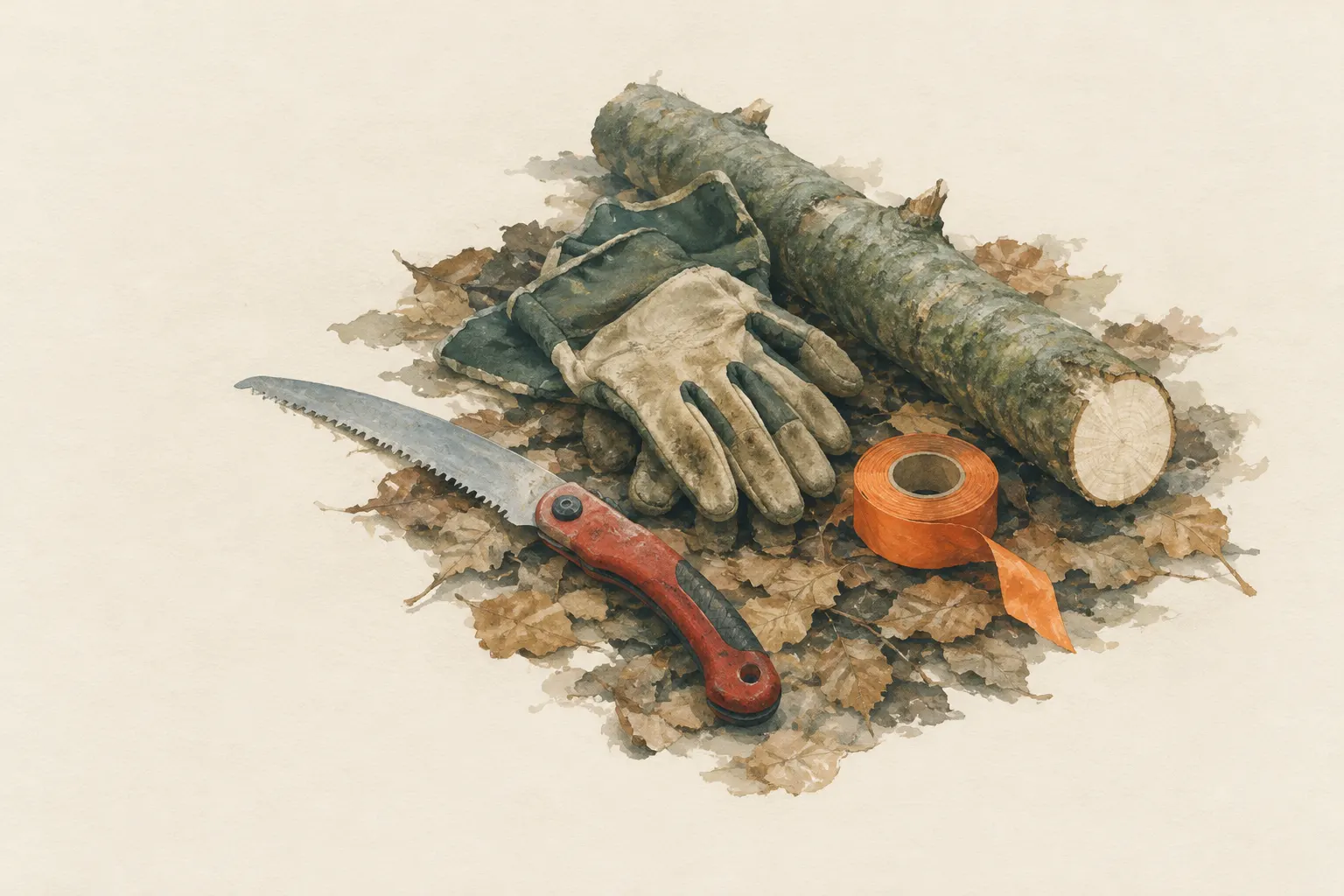
Folding saw
Or a bow saw
Fold or cover the blade after use; saw teeth are very sharp.
Hatchet or small axe
Only use with a firmly seated head and sound handle; fit the edge guard when not in use.
Rules on carrying and on cutting wood differ by region – check local rules.
Sturdy work gloves
When handling flood mud or chemicals, also wear waterproof gloves.
Close-fitting safety goggles
Suitable for
- Thin pole timber for shelters, frames and firewood
- Thinning with permission
- Practice under guidance
Not suitable for
- Thick, leaning or rotten trees
- Trees near paths, roads, power lines or houses
- Storm, wind, snow or ice in the crown
- Chainsaw work without training and protective equipment
- Freeing hung-up trees yourself
Prerequisites
- Explicit permission from the forest owner or your own land
- A thin, healthy tree you can safely handle with a saw
- A second person within calling distance
- Safe handling of saw and hatchet
Safety
- These instructions only apply to thin trunks you can saw through in a few minutes with a hand or folding saw. Anything larger needs training, a chainsaw and protective equipment.
- Wood, bark and trees belong to someone. Without the forest owner's permission you may not fell trees, peel bark or take wood in Austria and Germany. Only take what you are allowed to – best of all dead wood on the ground or wood from your own land.
How it works
A tree falls where the notch guides it. The notch is a wedge-shaped cut on the falling side. The back cut comes from the opposite side a little higher, but never all the way through: the strip of wood left standing, the hinge, works like a door hinge and steers the tree until it falls. Whoever saws through the hinge loses all control.
Advantages
- Controlled felling instead of gambling
- Straight poles for builds
Disadvantages
- High accident risk
- Only with permission
- Only for thin trunks
Deep knowledge
Background
Felling accidents are among the most serious workplace accidents of all – for professionals too. That is why foresters learn the notch, the hinge and the escape route first in every course, before they touch a tree.
In Austria and Germany you may enter the forest for recreation. The right to fell trees or take wood, however, belongs to the owner.
Variants
- With a hatchet
- Very thin saplings can also be felled with a hatchet: work out the notch with alternating angled blows from above and below, then from the opposite side. The saw is safer and more controlled.
- Prefer dead wood
- For firewood and many builds, dead wood lying on the ground is enough. It needs no felling, is already dry and spares the forest – if you are allowed to take it.
Common mistakes
- Felling without permission
- Felling in wind
- Not clearing an escape route
- Sawing the back cut through to the notch
- Other people in the danger zone
- Freeing a hung-up tree yourself
Limits and risks
- No chainsaw instructions
- No instructions for thick or difficult trees
- Does not replace a chainsaw or forestry course
Sources (4)
- Occupational Safety and Health Administration (OSHA), U.S. Department of Labor: Logging eTool – Felling · Notch, back cut with a hinge, escape route, danger zone of two tree lengths
- Republik Österreich – Rechtsinformationssystem des Bundes (RIS) (1975): Forstgesetz 1975 (BGBl. Nr. 440/1975), § 33 Benützung des Waldes zu Erholungszwecken · Felling without authorisation, taking wood and damaging trees in the forest is prohibited in Austria (§ 174)
- Bundesrepublik Deutschland – Bundesministerium der Justiz (1975): Gesetz zur Erhaltung des Waldes und zur Förderung der Forstwirtschaft (Bundeswaldgesetz), § 14 Betreten des Waldes · The right of access allows recreation, not taking wood
- Ray Mears – Hodder & Stoughton (2002): Bushcraft · Felling small trees safely with saw or axe