












Spruce-bough bed: soft and warm above the cold ground
The ground steals more of your warmth at night than the cold air. Without a sleeping pad, a thick bed of conifer boughs helps: the boughs spring, and lots of air stays between them, which insulates. Here you learn where you may take boughs, lay a frame of logs, stick the boughs in like roof shingles, make the bed thick enough and refresh it every evening – and why a thin layer does almost nothing.
- 45–90 minutes
Explained simply
When you lie on the cold ground you soon get cold, because the ground draws warmth from your body. A bed of many conifer boughs keeps you away from the ground.
There is a lot of air between the boughs, and air keeps you warm. For it to work the bed has to be very thick – as high as your knee, because when you lie on it, it gets pressed flat.
You may only cut boughs from living trees with permission. You may take fallen boughs. And the bed never goes right next to the fire.
How it works
Heat always flows from warm to cold. If your body lies directly on the ground, it flows away very quickly through contact. Air conducts heat poorly; a cushion with a lot of trapped air slows that flow.
The springy boughs keep the air layer open even under your weight. The shingle-like layering means no hard ends poke you and the boughs do not slip.
What matters
Thickness: at least knee-high, especially under hips and shoulders.
Direction: cut ends down and towards the foot end.
Care: fluff it up every evening and add fresh boughs.
Safety: what to watch out for
Permission: only cut living boughs with the forest owner's consent.
Fire: conifer boughs burn explosively – at least three paces away.
Cold: the bed does not replace a sleeping bag. Take hypothermia seriously.
Step by step
Collect boughs
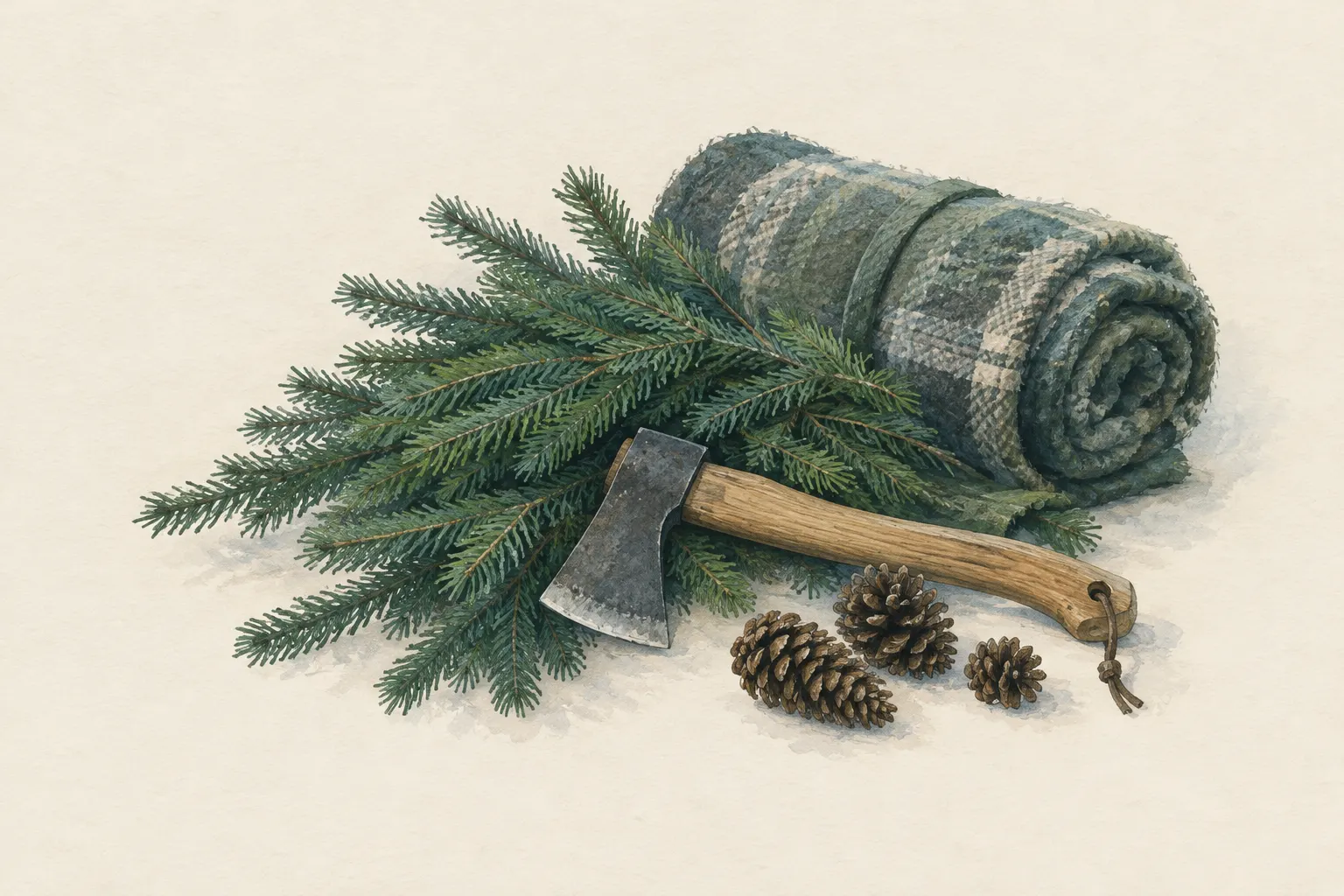
Collect fallen or permitted spruce or fir boughs, ideally the soft, flat tips, about forearm length. You need a great many – a large pile, higher than your knee.
Caution: Not from living trees without permission.
- 1
Collect boughs
Collect fallen or permitted spruce or fir boughs, ideally the soft, flat tips, about forearm length. You need a great many – a large pile, higher than your knee.
Not from living trees without permission.
- 2
Lay the frame
Lay four logs or thick branches as a rectangle a little larger than your body. They hold the boughs together.
- 3
Coarse layer below
First lay coarser boughs across the frame, curved underside up so they spring.
- 4
Stick them in like shingles
Starting at the head end, stick the fine boughs in at an angle, cut ends down and towards the foot end, each row overlapping the last like roof shingles. That way no hard ends poke you.
- 5
Make it thick enough
Make the bed at least knee-high. Lie on it as a test: if you feel the ground or the cold at your hips and shoulders, add more boughs.
- 6
Cover
Put a tarp, blanket or dry leaves on top. That keeps resin and moisture off clothing and sleeping bag.
- 7
Refresh every evening
Overnight the bed gets flat. Fluff it up in the evening and add new boughs on top. When you leave, scatter the boughs in the forest.
Common mistakes
- Far too thin a layer
- Boughs from living trees without permission
- Bed next to the fire
- Cut ends pointing up
- No frame – the boughs slide away
Quick view
Materials
Spruce or fir boughs as bedding
A great many boughs – more than you think
Only use fallen boughs or cut them with the forest owner's permission.
Dry conifer boughs burn very easily – keep them away from the fire.
Sturdy sticks / poles
Four logs or branches as a frame
Do not cut live wood where prohibited.
Dry leaves, grass or conifer boughs
Dry leaves or grass as an extra layer
Collect only where allowed; no protected plants. Check for ticks and insects.
Tarp
As a cover against resin and wet
Suitable for
- Emergency bivouac without a sleeping pad
- Under a tarp, lean-to or in a debris hut
- Several nights in a conifer forest
Not suitable for
- Forests where you may not take boughs
- Next to the fire – dry needles burn instantly
- Protected areas
Prerequisites
- Fallen boughs or the forest owner's permission
- A dry, level spot
Safety
- Cutting boughs from living trees is forbidden in Austria and Germany without the forest owner's permission. Take fallen boughs, windthrow and branches from felled trees – or ask first.
- A bough bed does not replace a sleeping bag. In the cold, add dry clothing, a hat and a warm drink; take signs of hypothermia seriously.
How it works
Heat flows from the warm body into the cold ground when they touch. Air conducts heat very poorly. A thick cushion of springy boughs keeps you at a distance from the ground and traps a lot of air. When you lie on it, it gets squashed a lot – that is why it has to be much thicker at the start than it ends up.
Advantages
- Soft and warm
- Smells pleasant
Disadvantages
- Needs a great many boughs
- Resin sticks
- Only where allowed
Deep knowledge
Background
Lumberjacks and trappers in North America and Scandinavia slept on bough beds for generations. Skilled ones laid them so densely that they sprang like a mattress.
Because many people use the forest today, cutting living boughs is only acceptable in exceptional cases. For an emergency night, though, a bed of windthrow and fallen boughs is often found quickly.
Variants
- Leaf bed
- In a deciduous forest fill the frame with dry leaves to above knee height. It insulates about as well but gets flat faster.
- On a raised bed
- On a raised bed a thinner layer is enough because the cold ground is further away.
Common mistakes
- Far too thin a layer
- Boughs from living trees without permission
- Bed next to the fire
- Cut ends pointing up
- No frame – the boughs slide away
Limits and risks
- No exact insulation values
- No substitute for a sleeping pad and sleeping bag
Material alternatives
Derived from material properties: a substitute must have all relevant properties. Observe the notes on the substitute.
- Dry leaves, grass or conifer boughs
- Sleeping pad, Backpack, Dry spare clothing (Carry it in waterproof packaging – wet clothing barely insulates.), Wool blanket / duvet (Keep away from candles, stoves and heaters.), Insulated cool box (Keeps cold only for a limited time; without ice packs or ice it is not a fridge.), Sleeping bag (Do not store compressed long-term; do not pack away damp.), Newspaper and cardboard (Flammable – keep away from candles, stoves, heaters and embers.), Insulated cooking box (hay box, thermal cooker) (Never put open flame or embers inside – only the hot, closed pot.), Long-stemmed thatch (reed, grass, rushes) (Extremely flammable – no open fire and no sparks nearby.), Pot insulation (pot cosy, beanie or fleece jacket) (Only around a pot that is no longer on the stove – fabric catches fire at the flame.)
- Tarp
- Plastic sheet / large bin bag (Tears easily; never pull over the head (suffocation risk).), Emergency blanket (Tears easily once punctured; short-term shelter only.), Document folder (waterproof) (Store securely – contains sensitive personal data.), Rain poncho (When used as a shelter, it no longer protects your body from rain.), Bivy bag (Never fully close off the face.), Tent (Do not cook or heat inside the tent (fire and carbon monoxide danger).), Heavy-duty bin bag (large) (Suffocation risk: never pull plastic bags over the head or face and keep them away from small children.), Group shelter bag (Airtight – ventilate regularly.)
Results come exclusively from structured entries. No improvised instructions are generated.
Sources (4)
- Wilderness & Environmental Medicine (Wilderness Medical Society) (2019): Wilderness Medical Society Clinical Practice Guidelines for the Out-of-Hospital Evaluation and Treatment of Accidental Hypothermia: 2019 Update · Avoid heat loss through conduction, wind and wet; insulation from the ground
- Republik Österreich – Rechtsinformationssystem des Bundes (RIS) (1975): Forstgesetz 1975 (BGBl. Nr. 440/1975), § 33 Benützung des Waldes zu Erholungszwecken · Taking branches and wood in the forest only with the forest owner's permission (§ 174)
- Mors L. Kochanski – Lone Pine Publishing: Bushcraft: Outdoor Skills and Wilderness Survival · Ground insulation with boughs; thick enough and layered
- Headquarters, Department of the Army (USA) (2002): FM 3-05.70 Survival · Emergency bed of boughs and leaves against ground cold